
If you find out a lease is up for renewal when the tenant asks for a new contract, this is for you. A Dubai rent increase has two tests: a date and a cap. The date decides first. This is not for an owner with one or two units and a good tenant. A calendar reminder is enough, and you can stop here.
Which comes first, the notice or the calculator?
The notice date. Most pages that rank for "RERA rent calculator" are written for a tenant checking one number: open the Dubai Land Department (DLD) calculator, read the average, see the cap. For a landlord that is the second step.
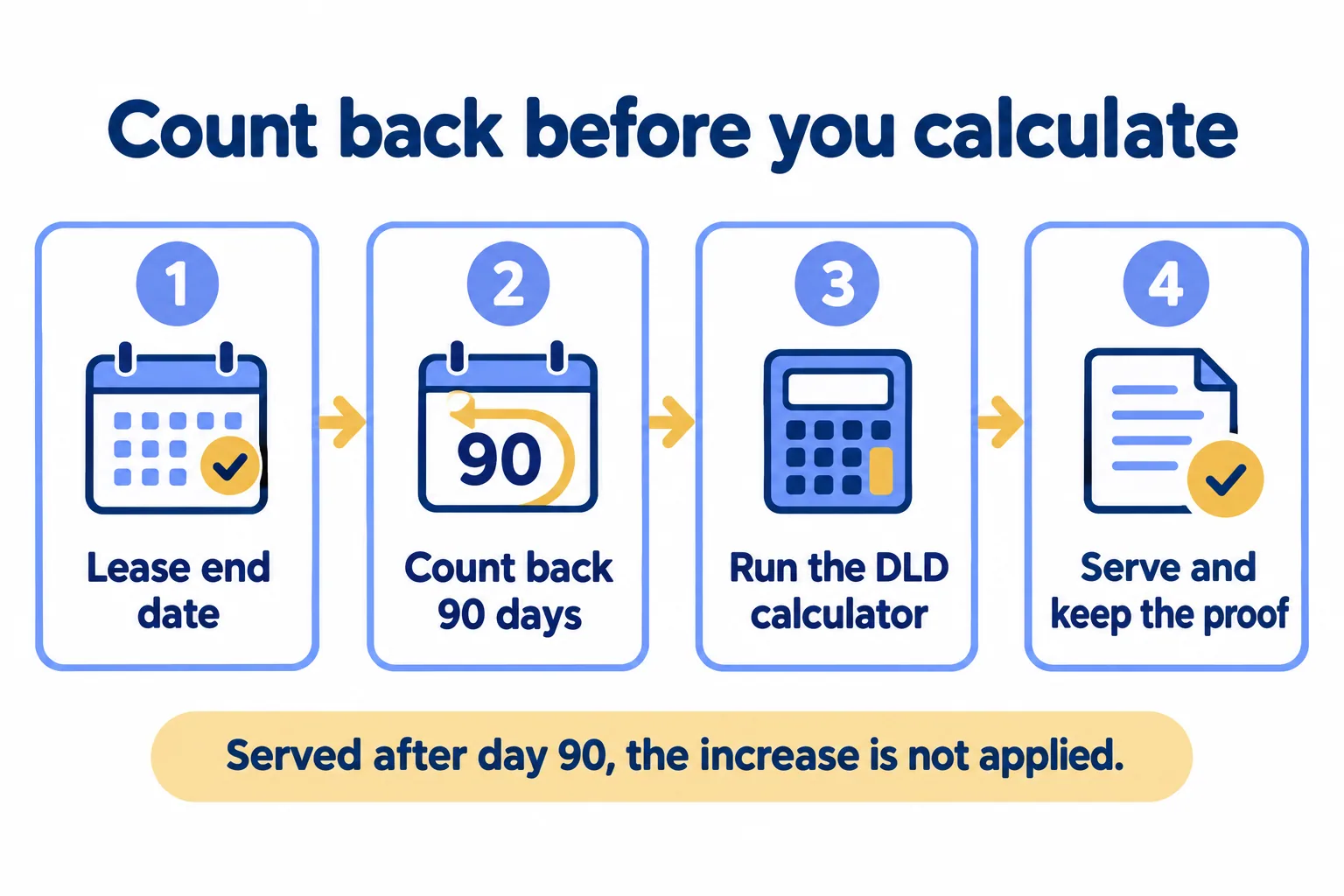
The first is a count. Article 14 of Law No. 26 of 2007, as printed in DLD's Tenancy Guide, says that a party who wants to amend the terms of a tenancy "must notify the other party of same no less than ninety (90) days prior to the date on which the Tenancy Contract expires", unless the parties agree otherwise. DLD's release of 16 February 2025 on the Smart Rental Index goes further. If the index shows the property is eligible but the landlord did not give the 90 days' notice, "the increase will not be applied".
So a lease ending on 31 December 2026 needs its notice served by 2 October 2026. After that date the increase is gone for that lease, whatever the calculator says. We count the days, then run the index. Not the other way round.
Tenants know this rule. Gulf News quoted one in June 2025: "My renewal was up in late April and I found out about a 5% hike only after I turned up at the landlord's office for renewal."
What counts as notice in Dubai?
A written notification that can be proved. DLD's Tenancy Guide defines Notice as "a written notification sent by either party to the Lease Contract to the other through the Notary Public, or delivered by registered post, by hand, or by any other technological means approved by law."
Four routes are named, and the fourth is the one people argue about. We do not call a chat message good enough. We serve by a route on that list and keep the proof next to the lease: the postal receipt, the signed hand delivery, the notary's stamp. This is not legal advice. Ask your lawyer which technological means count for your contract.
When is the allowed increase zero?
More often than owners expect. Decree No. 43 of 2013, printed in the same guide, sets the maximum increase at renewal by how far the current rent sits below the average rent of similar units:
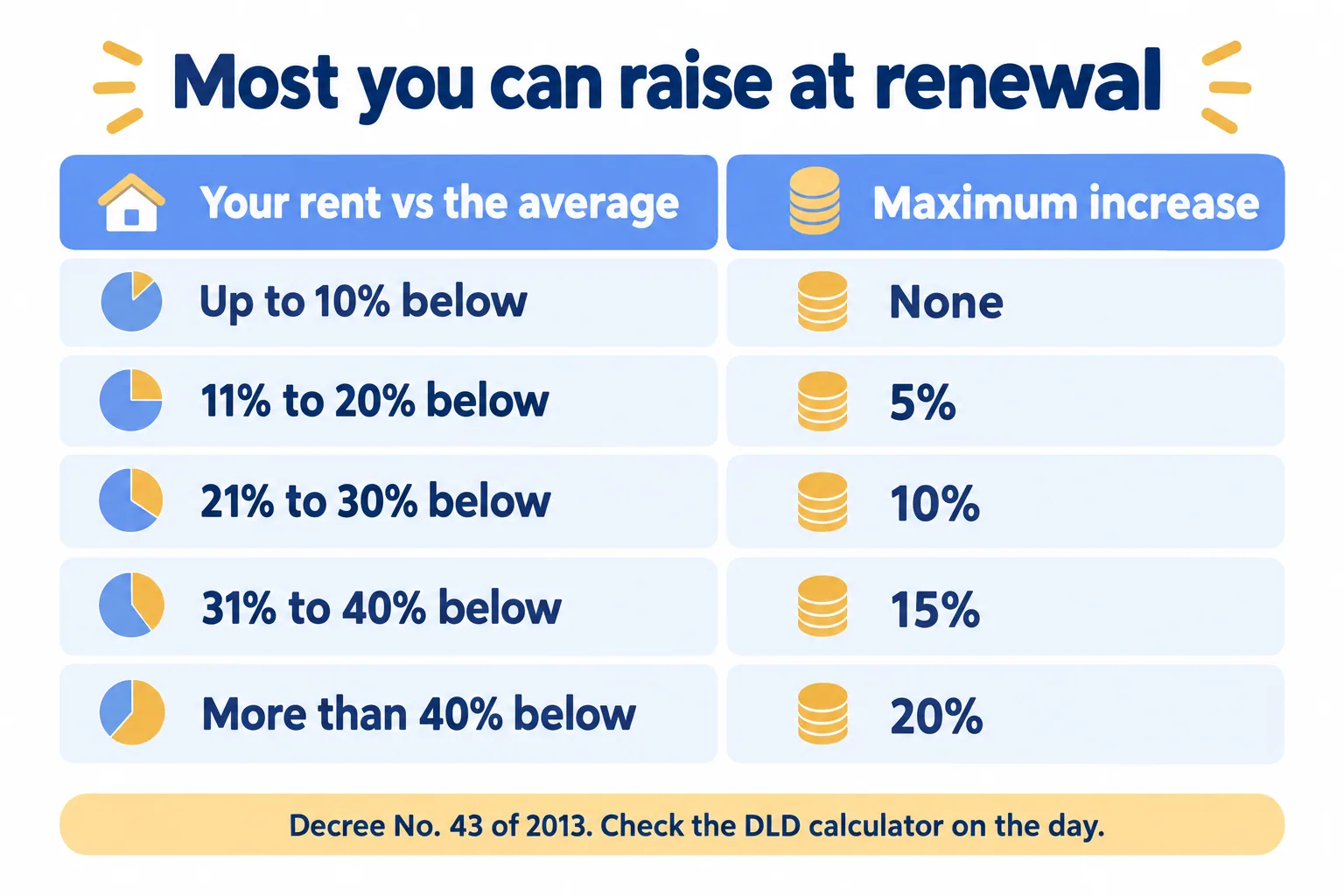
Take a sample unit, not a real lease. It rents at AED 100,000 and the average for similar units is AED 125,000. The rent is 20 percent below, so the band is 5 percent and the most you can ask is AED 5,000. If the average were AED 108,000, the rent would be about 7 percent below, the band zero, and the notice would be wasted effort. It would also cost goodwill with a tenant who pays on time.
DLD updates its calculator, and its February 2025 release says the Smart Rental Index draws on contract values in the building, average area rents and building classification. We read the bands from the decree and the average from DLD's calculator on the day. The legislation's Arabic text prevails over the English one.
What do we tell a landlord to do?
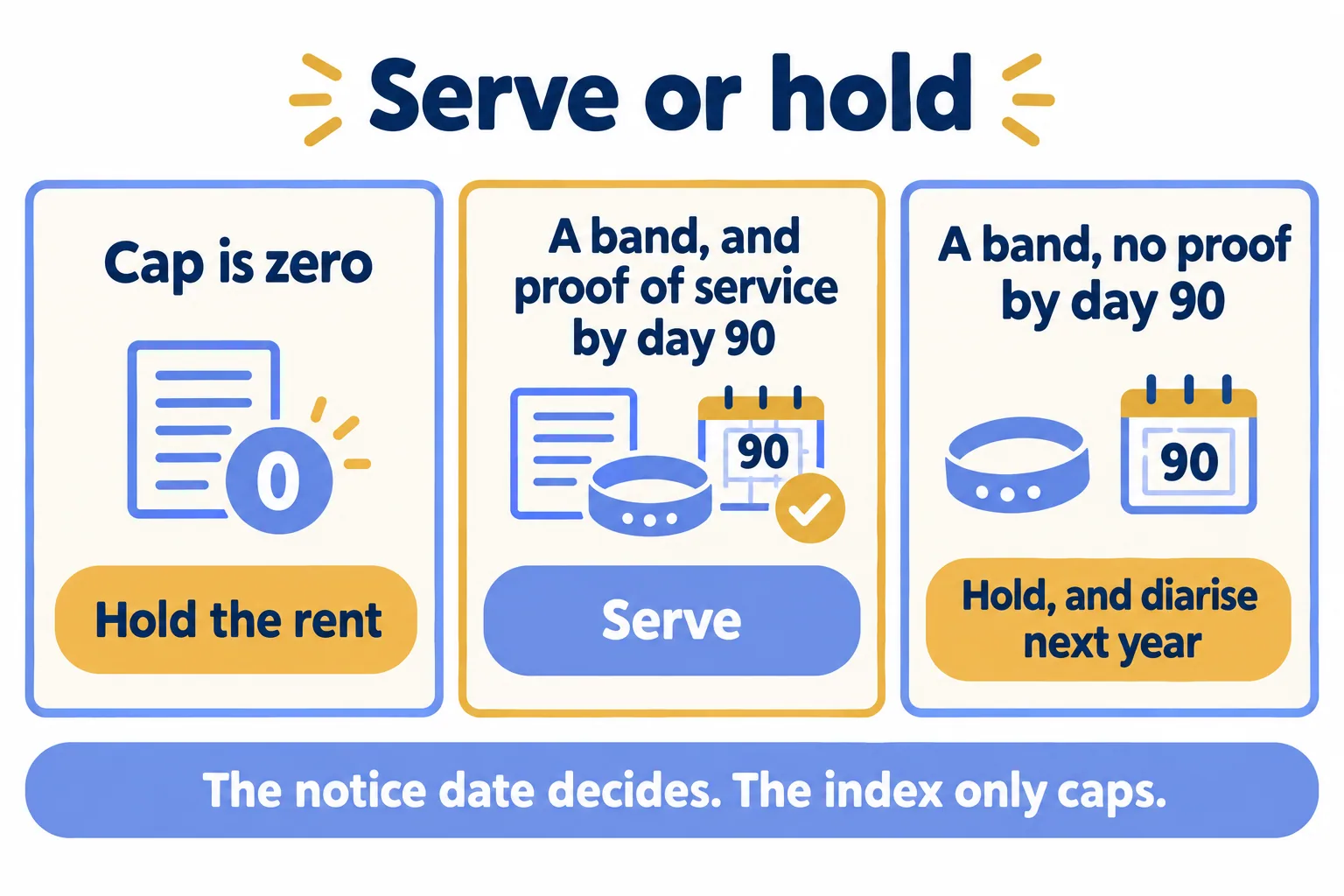
One rule: the notice date decides, the index only caps. In practice there are three outcomes.
- 01The cap is zero. Hold the rent and keep the tenant. Do not spend a notice on a figure you cannot raise.
- 02There is a band above zero and you can prove service by day 90. Serve, and keep the proof on the lease.
- 03There is a band but you cannot prove service by day 90. Hold the rent for the year and diarise next year's date the day you sign the renewal.
When do we say do not push? A good-paying tenant in a 5 percent band, on a rent you could not defend at the Rent Disputes Settlement Centre.
How do you check your own renewal dates?
With three questions, answered from last year's files. They are our rule of thumb, not a study.
- 01List the leases that ended in the last 12 months. For each, what was the notice date, and can you find the proof that it was served?
- 02For every lease ending in the next five months, which date is the 90-day mark, and has anyone run the calculator for it?
- 03Who owns the date: a named person, or whoever remembers? If you cannot name one, that is your first fix.
If the answer to the second question is a spreadsheet nobody has opened since the leases were signed, the date is already late for some of them. Sort by the notice-by date, not the lease end date, and work from the top. For a lease already past its date, the rule above still applies: hold the rent and diarise next year's date.
What does Mindcat Lease keep, and what stays with you?
The date and the place to keep the proof. Each lease in Mindcat Lease carries its notice days. We calculate the notice-by date when we import the lease, and Renewals Due sorts every lease by that date, with days left, current and proposed rent and the rule your team checked. If someone changes a lease end date later, they update the notice date on the same screen.
Three things stay with you. The allowed increase is a note your team fills in from the DLD calculator; the software does not work out the band. The renewal-notice email from the lease record is set up for your company during the managed setup, and proof of service by post, hand or notary stays with your team: you attach it to the lease. And Mindcat Lease does not register Ejari contracts or connect to Ejari. It is not a legal service. It keeps the dates and the proof next to the lease, which is where an owner's questions start.
What would this cost a management company?
These are the prices on our page today. Mindcat Lease is AED or SAR 15 per unit a month for 1 to 100 units, 8 for 101 to 500, 5 for 501 to 2,000 and 3 above that. Owner, tenant and staff logins cost nothing extra. The shared plan has a monthly minimum of AED or SAR 990, which covers up to 66 units, so the per-unit price never applies to a single unit on its own.
The page's own examples: 100 units come to AED 1,500 a month, 300 units to AED 3,100 and 1,000 units to AED 7,200. Up to 100 units, the quick start is a fixed AED or SAR 2,500, once, and we set it up for you from your CSV file. We check your CSV, and we agree the go-live date once it is complete. Above 100 units, setup is managed to a written plan and price, which we give you before you pay. Prices exclude 5 percent UAE VAT. Ejari and Tawtheeq fees are paid to the authorities, not to us. Compare the price with one renewal where the notice went out late, not with a spreadsheet.
If your answers above point to the dates, tell us how many units you manage and how your tenants pay, and we reply with the setup plan and the monthly price per unit. Our property management page shows the same renewal screens with sample data.
