

If your IT provider says it is fast and your staff say it is not, and nobody can show the ticket times, this is for you. It is not for a team with no one who owns the queue after the first reply: start by naming that person.
Why does the quote not settle in-house versus outsourced?
Because a quote compares a salary with a fee, and the problem sits in between. One UAE provider's page, dated 18 March 2026, puts the yearly cost for a 20 to 100 person firm at AED 350K to 700K+ for an in-house team against AED 60K to 180K for managed IT. A provider wrote it to sell the managed side, so read it as a range to test against your own payroll, not as a price you will be quoted.
The same page makes a point worth keeping: the comparison is often wrong because the fee is set against a base salary alone. Visa, benefits, recruitment and cover for leave all sit on the in-house side. Add the other side too. If your own people quietly fix what the provider should have fixed, that time belongs on the outsourced bill.
You cannot add it up without data. That is the whole decision.
Which three numbers decide it?
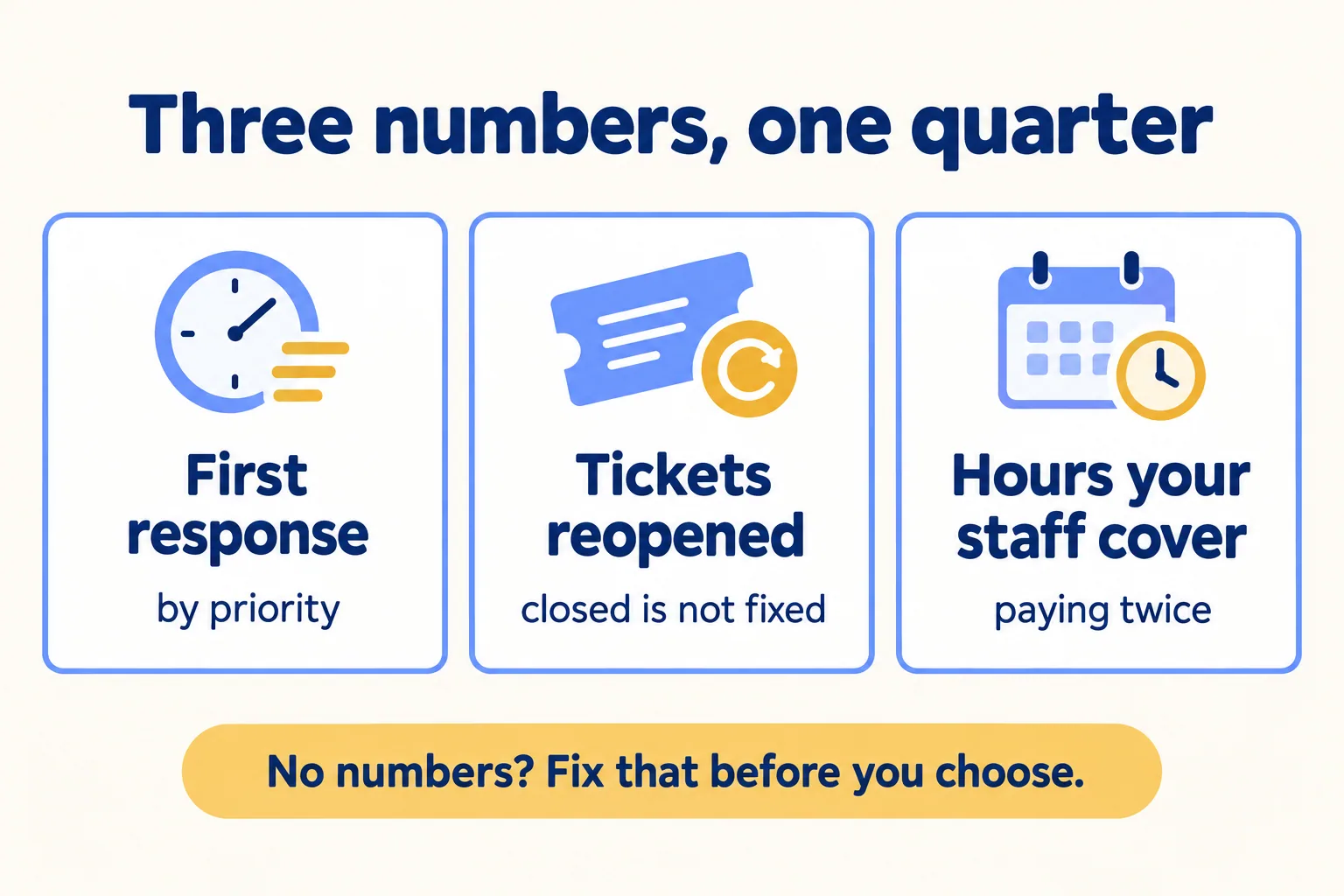
Take one quarter and put these on a single page:
A thread on Reddit about leaving a managed provider (archived 23 June 2026) puts the third number plainly. One reply: "if your internal team is already picking up slack because the MSP is slow, you're essentially paying twice for the same work. track response times and unplanned costs over a quarter." Another says: "if u cant track their ticket response times or uptime reliably anymore, its probably time to move in house."
These are voices from outside the Gulf. The test does not depend on the country: it asks for three counts you can get from any ticket log.
The same thread has an answer from a person who runs a managed provider, who warns that "a lot of 'they're too slow' really means 'we never agreed on what fast means.'" So the first number needs a written definition before it is a verdict.
If you cannot produce the three numbers, do not choose yet. Either choice fails without them: an outsourced desk you cannot measure drifts, and an in-house desk you cannot measure hides the same gaps behind a friendlier face.
What does fast mean in writing?
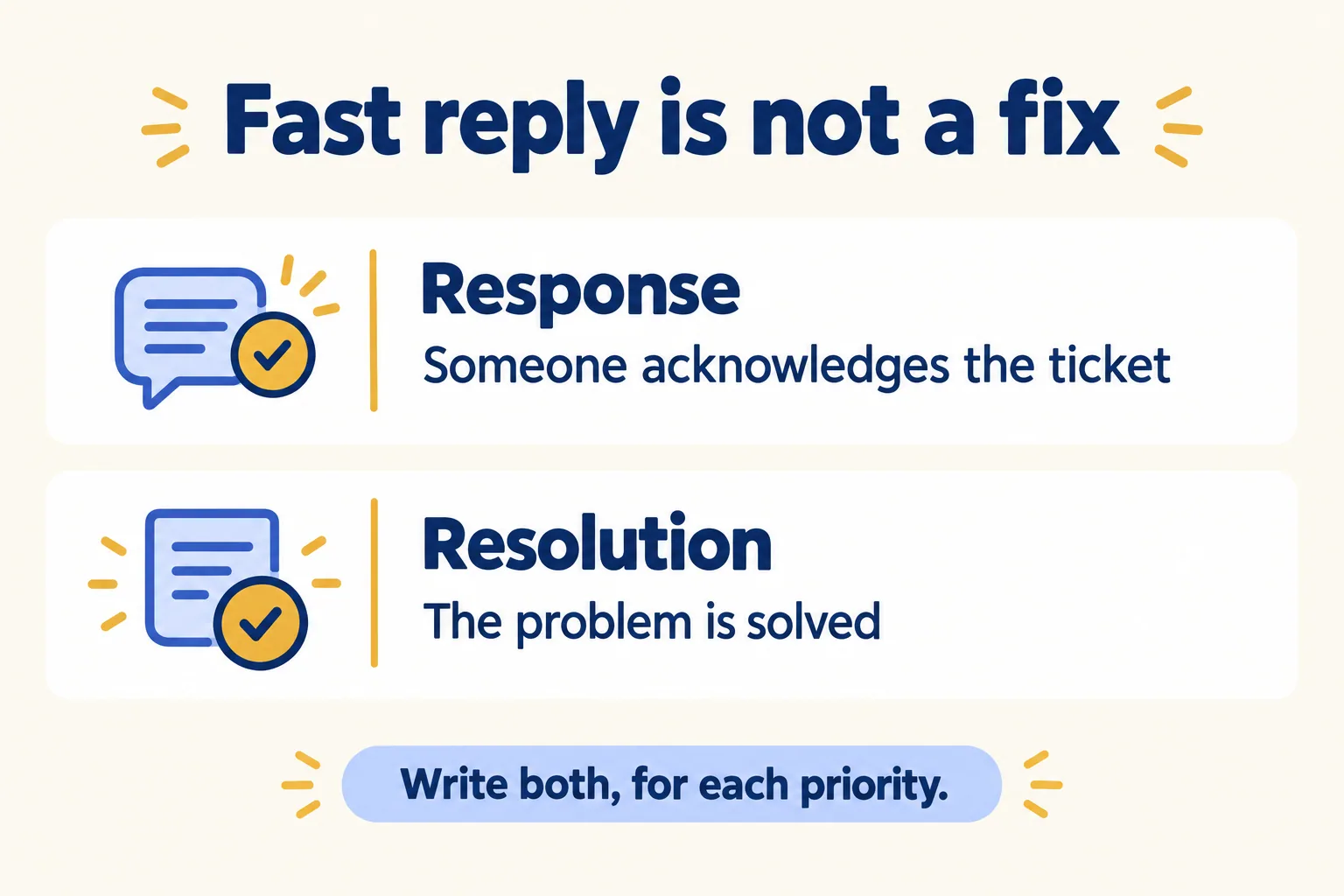
Two promises, not one. Al Aida IT, a UAE provider, writes that "response is only an acknowledgement, not a fix" and that a contract quoting only response times leaves resolution open. It gives 15 to 30 minutes for a critical issue and about an hour for a high-priority one as the usual response targets, with resolution tied to an escalation trigger rather than one fixed number.
So write each priority with a response time, a resolution target or an escalation trigger, and the hours each one counts. The hours matter more in the Gulf than most contracts admit. A promise counted in elapsed hours marks a request that arrives at the end of the working week as late before anyone is back at work. We cover how to set that clock in our post on SLA agreements for Gulf service desks.
Which model fits which size of company?
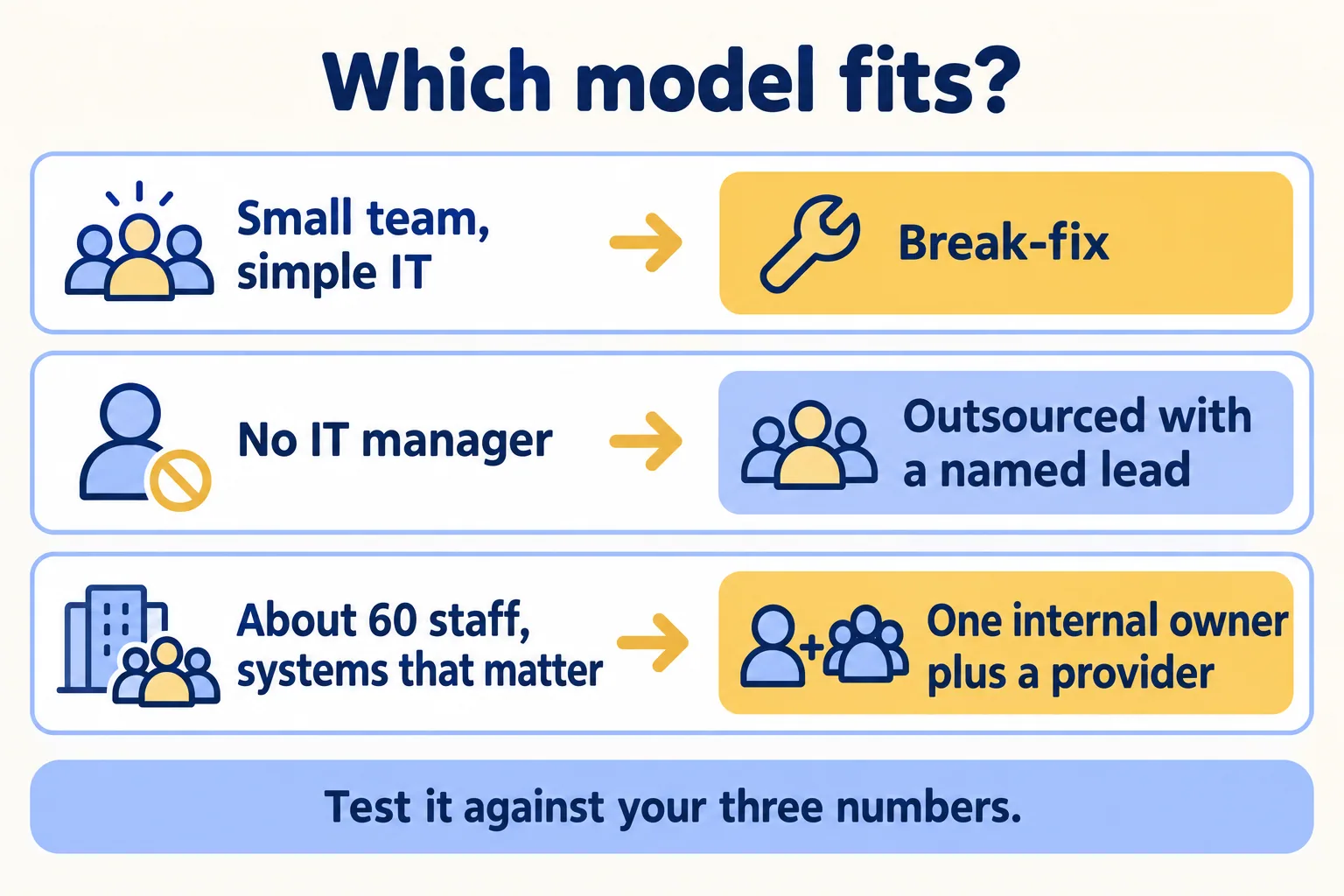
Our rule of thumb at Mindcat is below. Providers in Dubai draw similar lines: the iTAG page describes a split model as the usual fit for companies of about 50 to 300 staff, and the GR IT Services guide recommends it from 100 to 1,000.
The split works because it separates the two jobs. The internal owner keeps the queue, knows the people and holds the numbers. The provider covers the nights, the weekends and the depth one person cannot have. The person on that Reddit thread who runs a provider says the same: one strong internal hire for responsiveness and ownership, outside help for after-hours and security.
What should an outsourced contract say?
GR IT Services, a Dubai provider, publishes a checklist that any buyer can borrow:
- 01A written priority SLA with minutes per level, not 'we will respond quickly'.
- 02A service credit when the SLA is missed, so the promise has a cost.
- 03A named lead and a named backup, not 'our team'.
- 04A monthly report with tickets opened and solved, SLA compliance and top categories.
- 05Exit terms: what happens to your data, credentials and runbooks if you leave.
It lists three red flags: 'unlimited support' with no scope, an SLA with no service credit, and an auto-renewal with no opt-out window. It also suggests a 90-day pilot with a clean exit and two reference clients in your industry that you can call.
Add one line of your own: the monthly report comes from the ticket log, and you can see the log. A report you receive is the provider's view. The log is the same data you would have kept yourself.
Where does Mindcat Desk fit, and what does it cost?
Mindcat Desk does not provide IT support. It is the ticketing system that gives every request a number, an owner and an SLA clock on your working calendar, whichever side runs the desk. If you keep the desk in-house, it is your queue. If you outsource, the free read-only owner login lets you see the queue yourself. Customers and staff who raise requests are free, so only the people who answer count as agents.
Our page prices each agent a month in bands: AED 99 for agents 1 to 5, AED 69 for 6 to 20, AED 49 for 21 to 50 and AED 39 from 51. The shared plan has a monthly minimum of 5 agents, AED 495, so no one can buy a single agent at the per-agent rate. Twenty agents pay 5 × 99 + 15 × 69 = AED 1,530 a month. Up to 20 agents, the quick start is a fixed package we set up for AED 2,500, one time. Larger teams get a written plan. AI drafts on your own account, SMS and your phone system are billed at cost. Prices exclude VAT.
What it does not do today: Arabic screens are about 60 percent translated, and we finish the ones your team uses during setup. Ramadan hours and public holidays go into your calendars during setup each year. Local SMS gateways and WhatsApp as a ticket channel are options we connect in setup. Teams that sell and serve on WhatsApp should start with Mindcat Inbox. Work orders and equipment sit in Mindcat Maintain and Mindcat Assets.
We call the method Every request on the clock. Tell us how many agents answer requests, how they arrive and the response time you promise. We reply with the setup plan and the monthly price per agent, in AED. If you cannot yet say who owns the queue, we say start there before you buy anything.
