

If a rent cheque came back this month and you do not know whether to send a notice, this is for you. Not for a landlord whose tenant has already been served: take that file to a UAE lawyer, not to a blog post.
This is how we decide, not legal advice. Mindcat does not give legal advice, serve notices or file at the Rental Disputes Centre. We keep the record. The law and the sources below are quoted as they stand today; check them with a UAE lawyer for your own lease.
Is a returned cheque the same as an eviction case?
No. A returned cheque is a fact about one payment. An eviction case is a legal route with its own steps. Most of the pain comes from treating the first as the second.
One landlord described it on a Reddit thread (a mirror of the post, captured 4 June 2026): the third cheque "was returned by the bank with the reason 'alteration without proper endorsement'", the bank "refused to issue a memo since the cheque was not processed", and the tenant refused to replace it. The landlord wanted the tenant out "as soon as possible". Whatever the right answer was for that file, the first question was not "how do I evict". It was "what was due, what came back, and has the tenant answered".
What the law says is short. Dubai Law No. 26 of 2007, on the Dubai Legislation Portal, lets a landlord seek eviction before the term ends where the tenant "fails to pay the Rent or any part thereof within thirty (30) days from the date of service of Notice to pay on the Tenant by the Landlord" (Article 25). It defines a notice as "a written notification" sent "through the Notary Public, or delivered by registered post, by hand, or by any other technological means approved by law". The text we read is the 2007 version, and later amendments changed parts of it. Read the current consolidated text, or ask your lawyer, before you rely on any period other than the thirty days.
Two things follow. The thirty days count from service of the notice. And the notice is a formal step, not a reminder.
When do we say settle, wait or serve?
Three moves, and one test for each.
The order matters. If the tenant is reachable and the cause is the cheque, a written replacement date costs nothing and keeps the lease alive. If a date is in writing and inside the thirty days, waiting is a decision you can defend, because you can show the date. If neither is true, waiting only lets the arrears grow, and a notice is the step the law gives you.
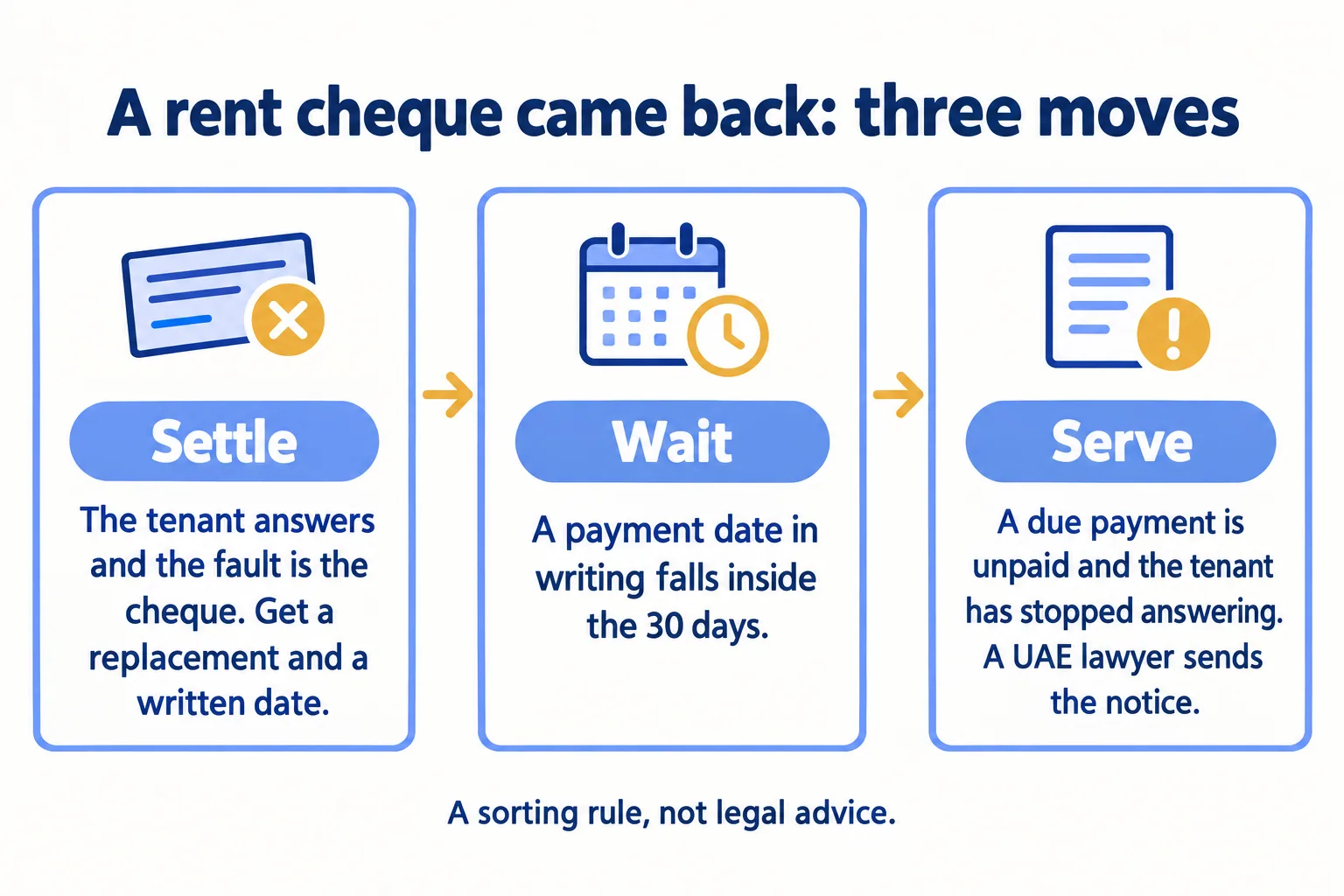
This is a sorting rule for a landlord, not a prediction. Which of the three fits your tenant depends on your lease and your lawyer's advice.
What does the notice step involve?
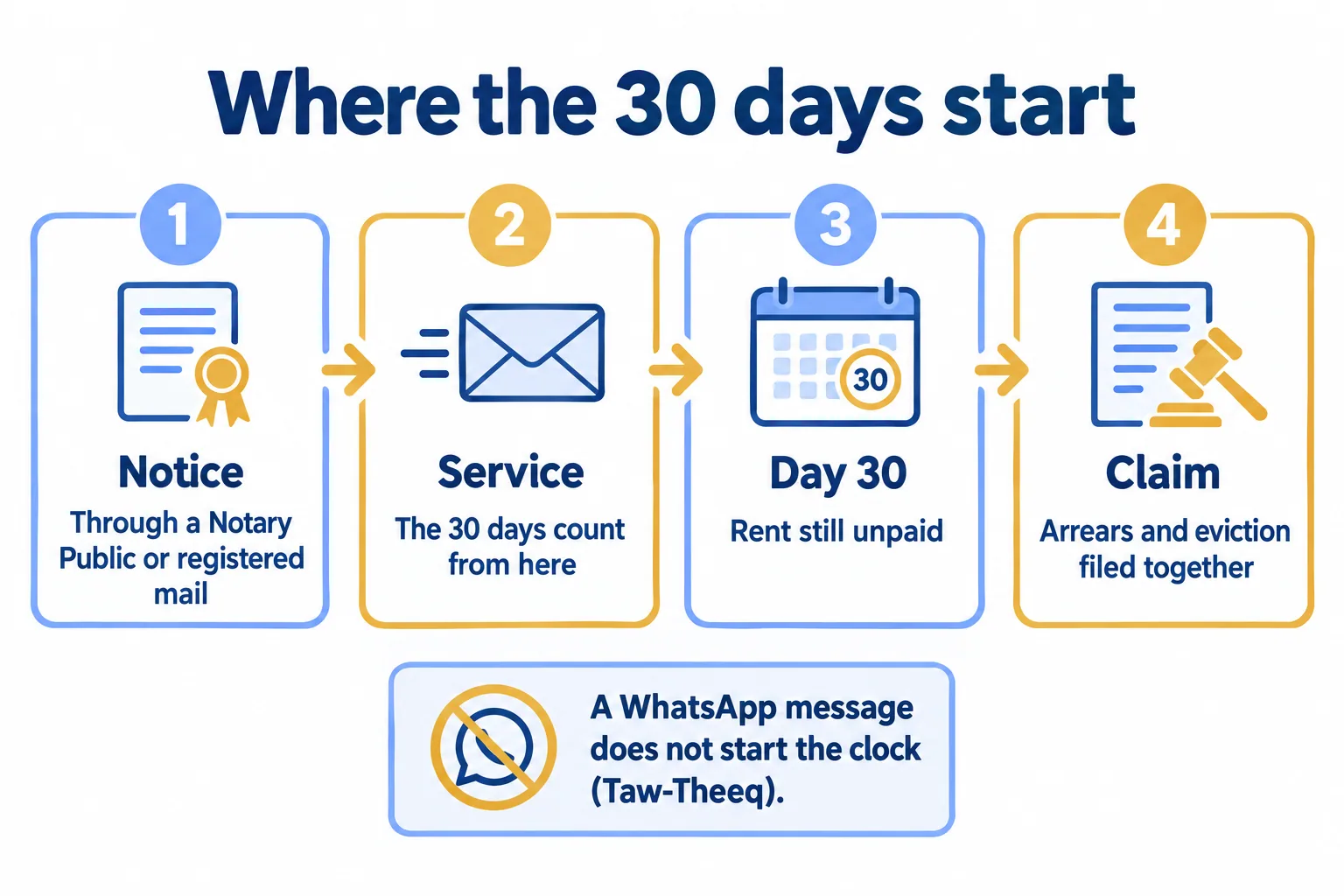
A notice, thirty days and then a claim. Taw-Theeq, a Dubai legal-services firm, sets the sequence out on its landlord guide (read 5 November 2026): a notice through a Notary Public or registered mail, thirty days from valid service, then a claim for the arrears and the eviction together at the Rental Disputes Centre.
Three details from that guide and from the Centre are worth knowing before you choose.
- A message is not service. The guide says a WhatsApp warning "never starts the thirty-day clock". The law's own wording allows "other technological means approved by law", so ask your lawyer which method fits your lease.
- A returned cheque does not replace the notice. The same guide says a bounced cheque does not remove the need for a legal notice if you are also seeking eviction. The cheque and the bank's return memo go into the file.
- The fee is public. The Centre's FAQ states 3.5 percent of the annual rent or lease value for an eviction claim, with a minimum of AED 500 and a maximum of AED 20,000, plus small fixed fees, and half the court fee comes back if the case settles through conciliation. On the sample of a flat at AED 80,000 a year, that is AED 2,800 before the fixed fees. The sample is an example, not a market figure.
The same guide lists what not to do. Cutting water or power, changing the locks or evicting the tenant yourself is prohibited, it says, and "turns you from claimant into defendant". Article 31 adds that a claim to evict does not stop the rent: the tenant still owes it for the whole period the claim is considered.
What must your record show before any notice?
Whichever move you pick, you will be asked for the same facts. Taw-Theeq's guide names the cheque and the bank's return memo as documents in the file, and your lawyer will want the rest. The landlord in the Reddit thread had no bank memo, and that gap is the sort of thing you want to learn before the day you need it.
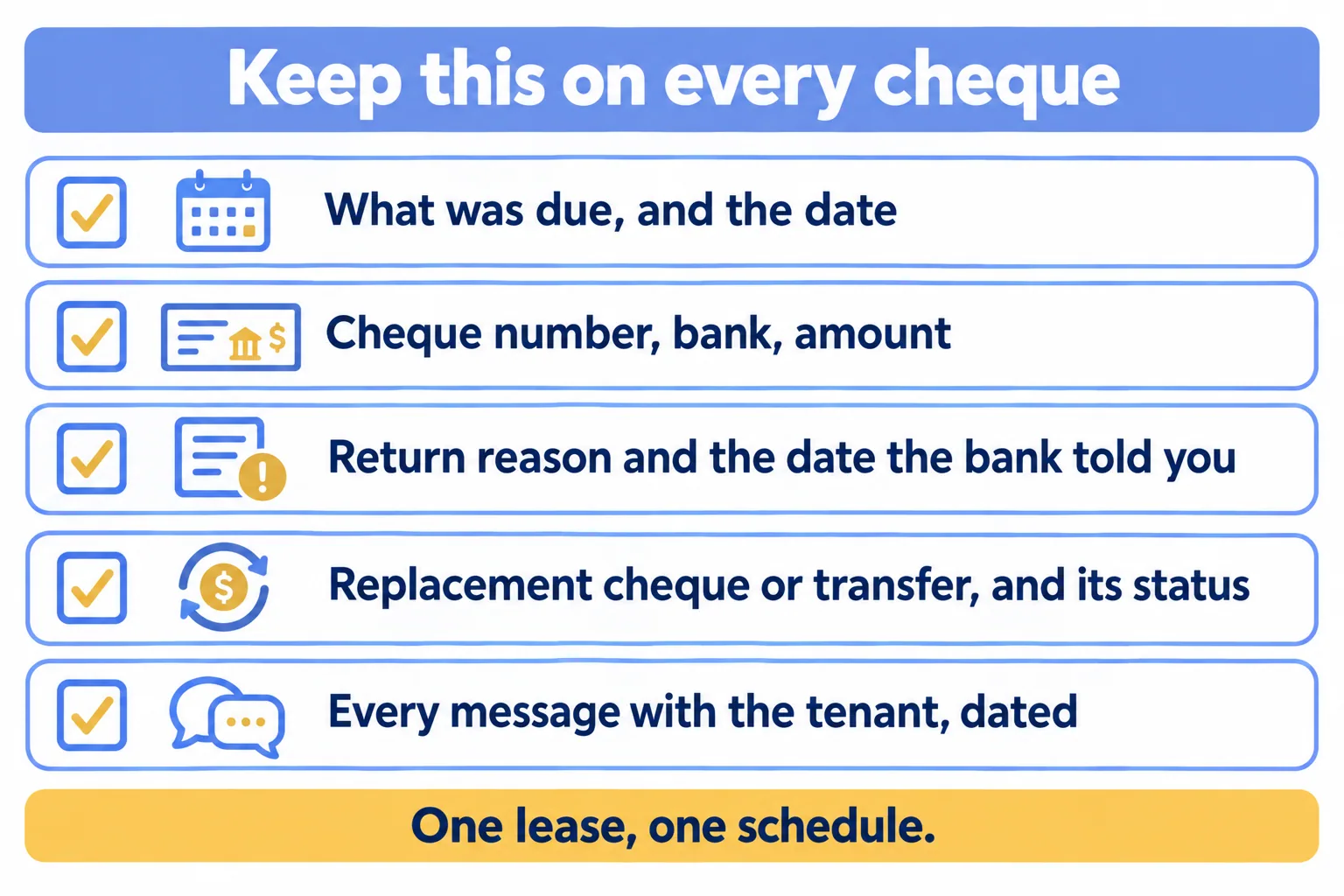
WhatsApp is where most tenants answer, so treat it as evidence, not as service. When a tenant promises "the 15th" in a chat, the same day someone on your team puts that date against the replacement cheque on the lease, and the chat export goes to your lawyer with the file. Name that person. The thirty days are for a notice; the promise is for your record.
If the rows live in four places (a drawer, a sheet, a chat and a bank app), you assemble the file on the worst day. If they sit on one lease, your lawyer gets one export.
What does Mindcat Lease keep, and what stays with your lawyer?
One lease, one schedule. Each lease carries its cheque schedule. Every cheque has a status: held, deposited, cleared, returned or replaced. A returned cheque stays at the top of Cheques to Deposit with its reason until you mark it replaced, and the Leasing home counts returned cheques on its first screen. That is the record in the table above, kept as you go.
What stays outside it is the legal work. Mindcat Lease does not give legal advice, serve a notice, file at the Rental Disputes Centre or guarantee that a tenant pays. Ejari, Tawtheeq and Ejar registration stay on DLD's, the Abu Dhabi registry's and REGA's channels. Bank charges for a returned cheque are your bank's. Renewal reminders go by email, not WhatsApp.
Under about ten units a spreadsheet and a calendar do the job, our page says, and our minimum would cost more than the problem. If you manage more, tell us how many units you manage and how your tenants pay, and we reply with the setup plan and the monthly price. If you are weighing a manager against a ledger first, our note on managers and ledgers prices both. Our property management page shows the same screens with sample data.
