

If you are on a help desk you set up years ago and someone asks where the tickets are stored, read this first. It is not for a team with no one who owns the queue after the first reply: name that person before you change any tool.
Why does one question reopen a tool that works?
Because a client, a landlord or a regulator can ask it in writing, and "I think so" is not an answer. Until then the desk did its job. Requests came in, people answered, nobody asked where the database lived.
The reflex is to start a migration. Slow down. The question has a short answer for most tools, and the answer is usually a letter from your vendor, not a new system. Moving costs you a month of rebuilt rules, and a new tool will not fix a queue nobody owns.
So treat the question as three smaller ones. Where are the tickets stored? Who reads the clock? What would you rebuild if you left? Get each answer in writing, then apply the rule at the end.
Where are tickets stored, and what is in writing?
Start with your vendor, not a competitor. Many cloud help desks now host in the Gulf. Zoho's data-centre page, read on 5 November 2026, lists Dubai and Abu Dhabi in the UAE and Riyadh and Jeddah in Saudi Arabia. If you are on Zoho Desk, that may already settle the question for your client.
"May" matters. Zoho lists where it operates. Which centre holds your account depends on the region you signed up in. So ask your account manager for one line in writing: the location that holds your tickets and attachments today.
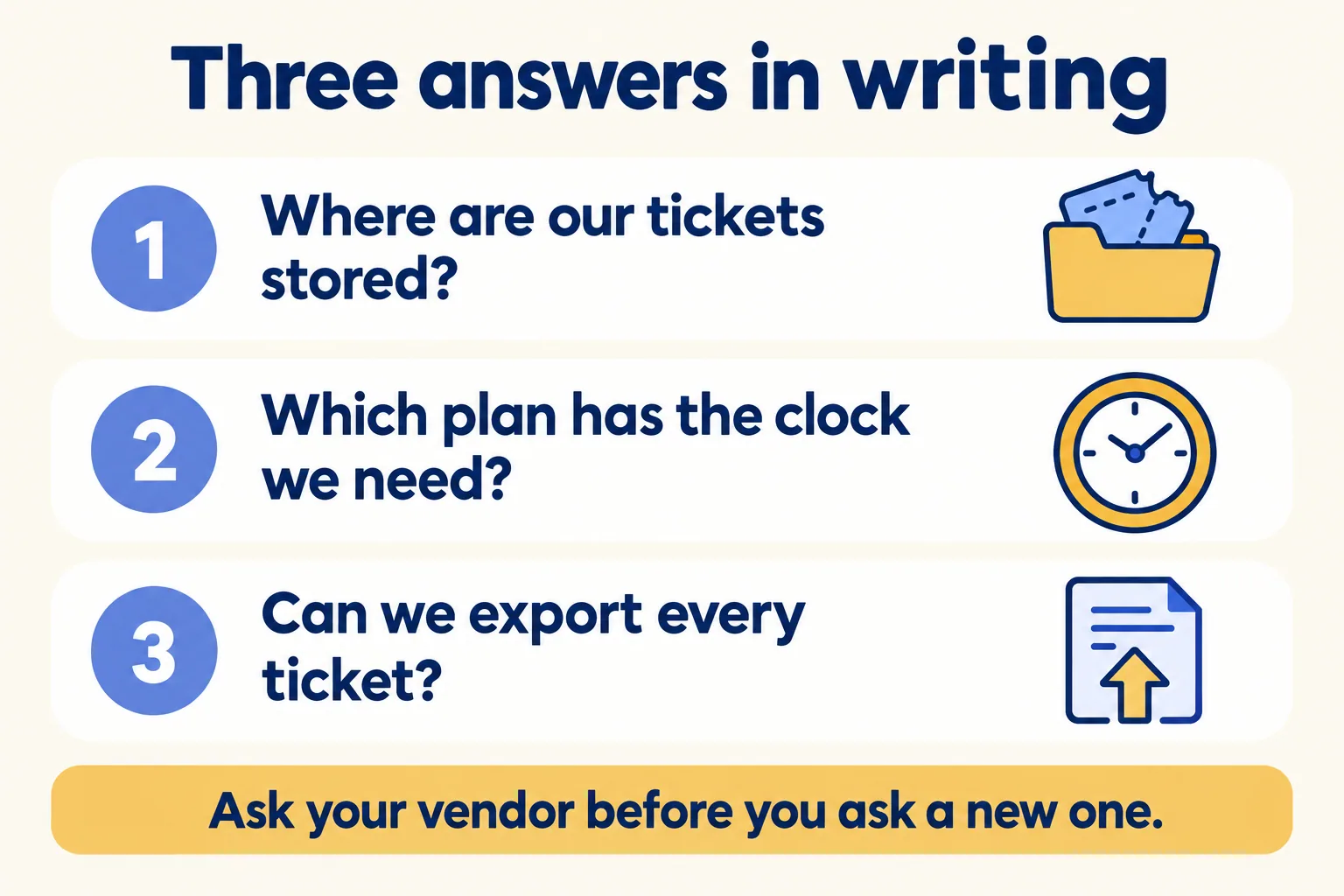
Put three questions to your vendor and keep the replies:
- Which country and city hold our tickets and attachments today?
- Which plan gives us the SLA clocks we need, and what does the next plan cost?
- Can we export every ticket, with attachments, at any time?
What would you rebuild if you moved?
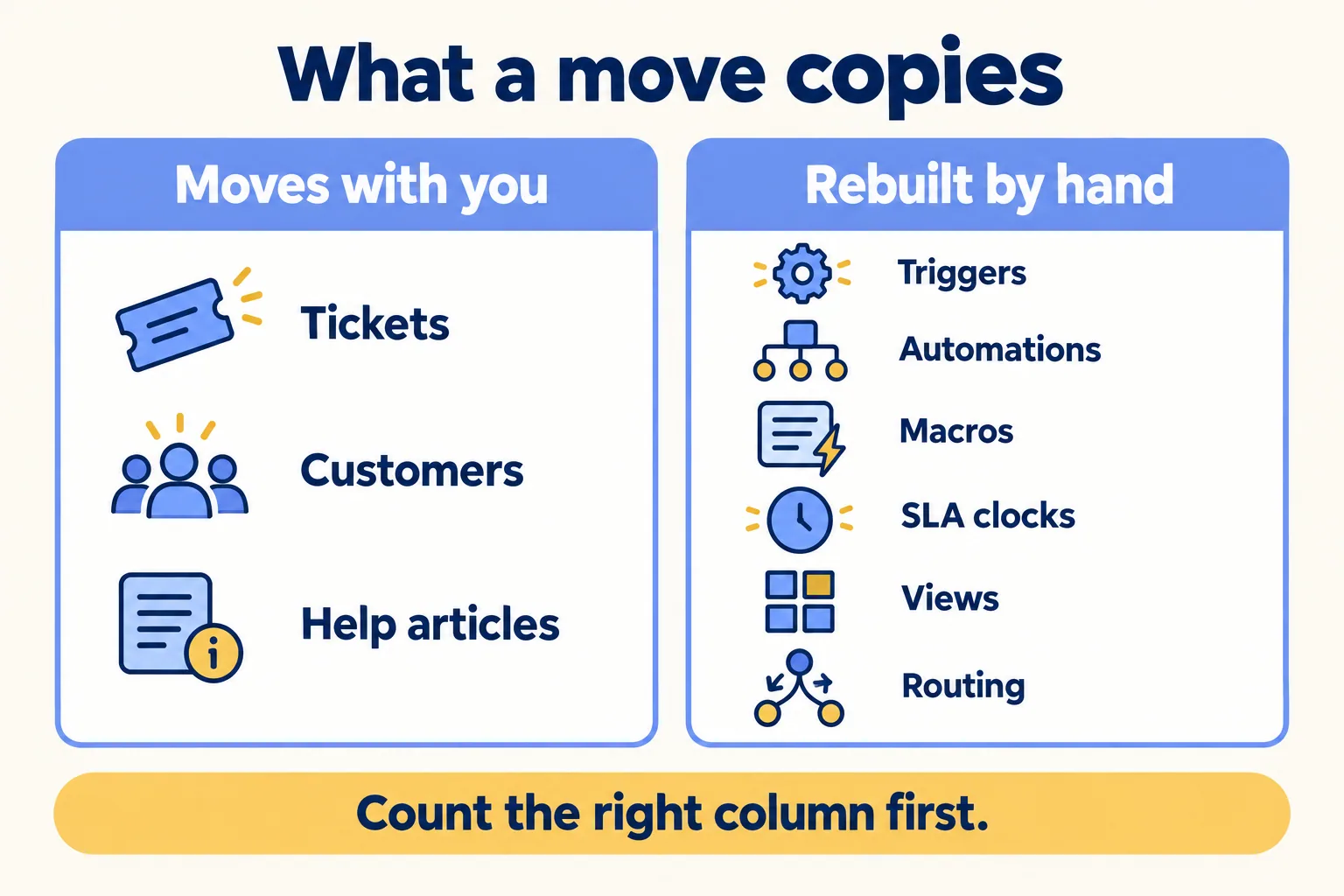
More than most buyers expect. Macha, which sells help-desk automation, wrote a migration guide for Zendesk on 30 June 2026 and updated it on 24 September. Its words: "triggers, automations, macros, SLAs, views, and routing are platform-specific and do not transfer." They are rebuilt by hand in the new tool. The guide is about Zendesk, but the same logic holds for any move between help desks, because each tool stores rules its own way.
Read that as a list for your own desk. Open the settings and count your triggers, macros, SLA policies, saved views and routing rules. Each one is an hour or more of rebuilding and testing. That count, not the price per agent, is the real cost of leaving.
The same guide makes a second point worth your time: "a surprising number of 'we need to leave Zendesk' projects are really 'we need to fix three things in Zendesk.'" Before you plan a move, write down what actually hurts. If it is three settings, fix three settings. Macha sells automation, so weigh that as one practitioner's view, but the test costs you an afternoon.
Who reads the clock?
This is the setting that most often turns into "the tool is slow". An SLA clock is a rule, not a feature. It runs against a priority, so a ticket left at the default priority may never get the policy you wrote for urgent ones. It also needs to know which statuses stop it, and which calendar it counts.
Check three things on your current desk before you blame it:
- What priority does a new ticket get when nobody sets one?
- Which statuses pause the clock, for example waiting for the customer?
- Does the clock count your working week, or every hour that passes? We cover the calendar in our post on SLA agreements for Gulf service desks.
If the answers show the clock is set wrongly, that is a settings fix. If the plan you are on does not offer the clock you need, such as a different policy per priority, that is the upgrade question from the vendor's reply to question 2. Only if the plan above it does not offer it either does the desk itself become the problem.
Stay, upgrade or move: the rule
Apply it in this order.
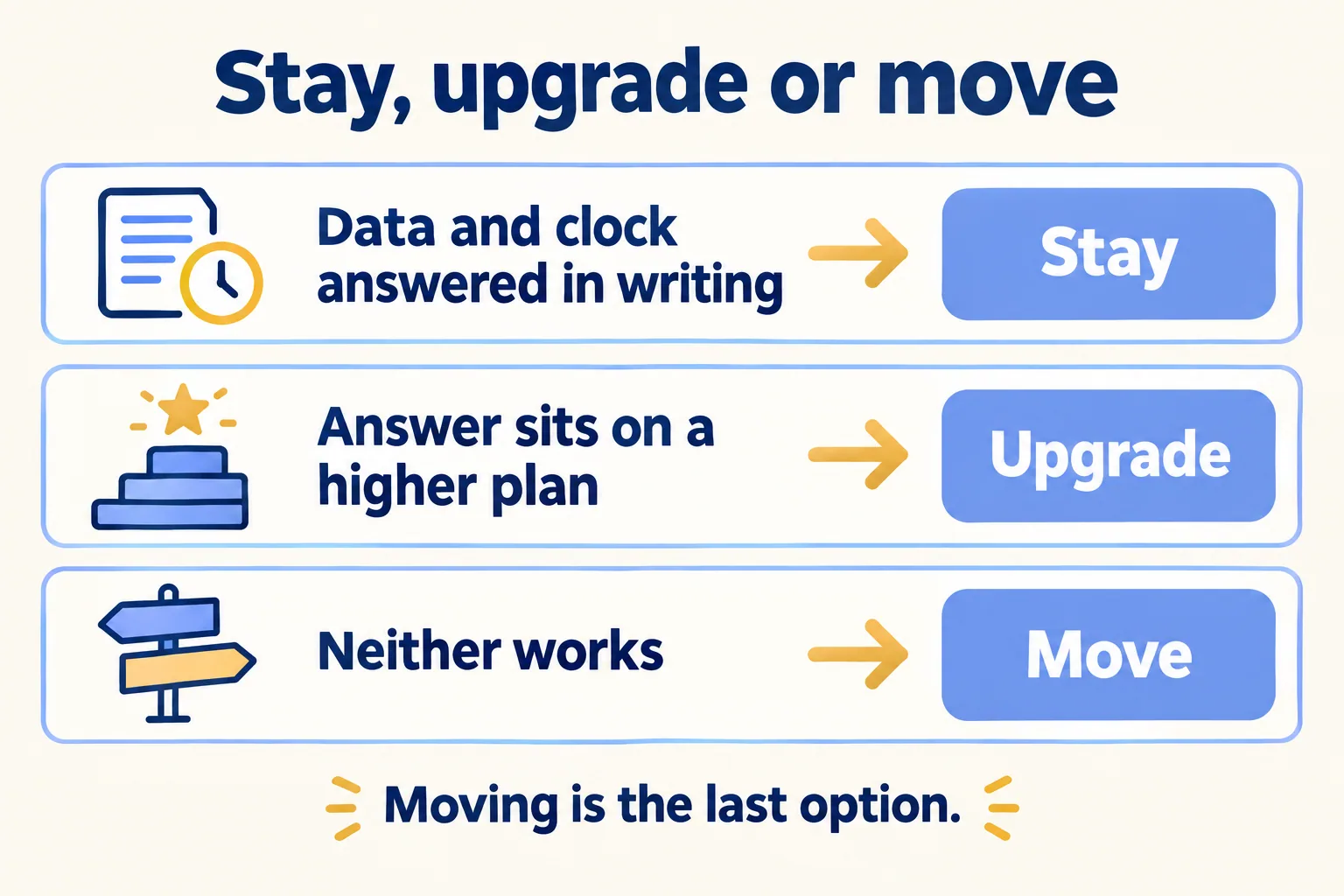
- Stay if your vendor confirms in writing where the tickets are stored, your client accepts that answer, and the clock is set to your working week. You are done. Send the letter to the client.
- Upgrade if the answer exists but sits on a higher plan: a clock per priority, an export, a stated region. Ask for the price in writing and compare it with the rebuild hours you counted above.
- Move if the vendor cannot name where the data sits, cannot give the clock you need on any plan, or will not let you export every ticket. Then the rebuild is worth it.
The rule is deliberately dull. Moving is the expensive option, so it comes last.
What does Mindcat Desk change, and cost?
If you land on "move", Mindcat Desk is one option. It is a separate copy of the help desk hosted in the UAE or Saudi Arabia, with SLA clocks on your own working week and an export of every ticket at any time. We move your open tickets, customers and help centre answers during setup, quoted with the setup fee. The rules are rebuilt with you, not copied, which is why the count above matters.
Our page compares the price with Zoho Desk Professional on annual billing: USD 23 per user, USD 460 for 20 agents, read from zoho.com. Our page prices each agent a month in bands: AED 99 for agents 1 to 5, AED 69 for 6 to 20, AED 49 for 21 to 50 and AED 39 from 51. The shared plan has a monthly minimum of 5 agents, AED 495, so no one can buy a single agent at the per-agent rate. Twenty agents pay 5 × 99 + 15 × 69 = AED 1,530 a month. Customers, staff who raise requests and one read-only owner login are free. Up to 20 agents, the quick start is a fixed package we set up for AED 2,500, one time. Larger teams get a written plan. AI drafts on your own account, SMS and your phone system are billed at cost. Prices exclude VAT.
What it does not do today: Arabic screens for agents are partly translated, and we finish the ones your team uses during setup. Ramadan hours and public holidays go into your calendars during setup each year. Phone-system call events and WhatsApp as a ticket channel are connected in setup too. Teams that sell and serve on WhatsApp should start with Mindcat Inbox.
We call the method Every request on the clock. Tell us how many agents answer requests, how they arrive and the response time you promise. We reply with the setup plan and the monthly price per agent, in AED. If your current vendor can answer the three questions in writing, we say stay.
