

If your provider says it is fast and your staff say it is not, this is for you. It is not for a team with no one who owns the queue after the first reply: name that person first, because no check below works without one.
Why do both sides sound right?
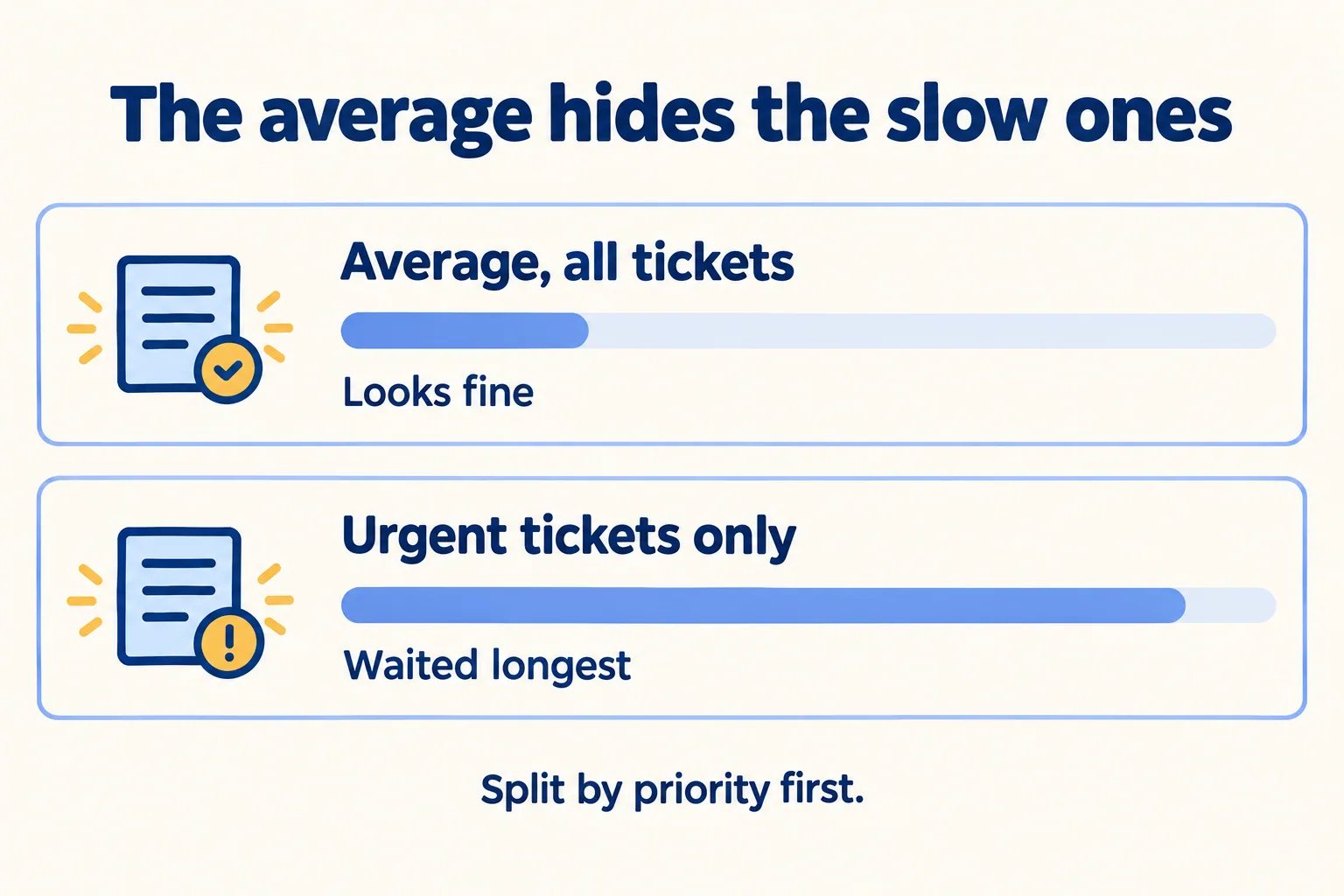
Because they are counting different things. Your provider reports an average across every ticket. Your staff remember the one ticket that mattered and how long it waited. A provider can report a respectable one-hour average and still miss every urgent ticket, because the easy tickets pull the average down. Rallied, a vendor of help-desk automation, makes that point in a guide updated on 19 August 2026, quoting LTVPlus.
So do not decide on a feeling, and do not change provider yet. A new provider inherits the same requests, and the same requests produce the same complaints. Pull one month of tickets from your provider's portal or ask for the export. For each ticket you want five columns: when it was raised, by whom, the priority, when a person first replied, and when it closed.
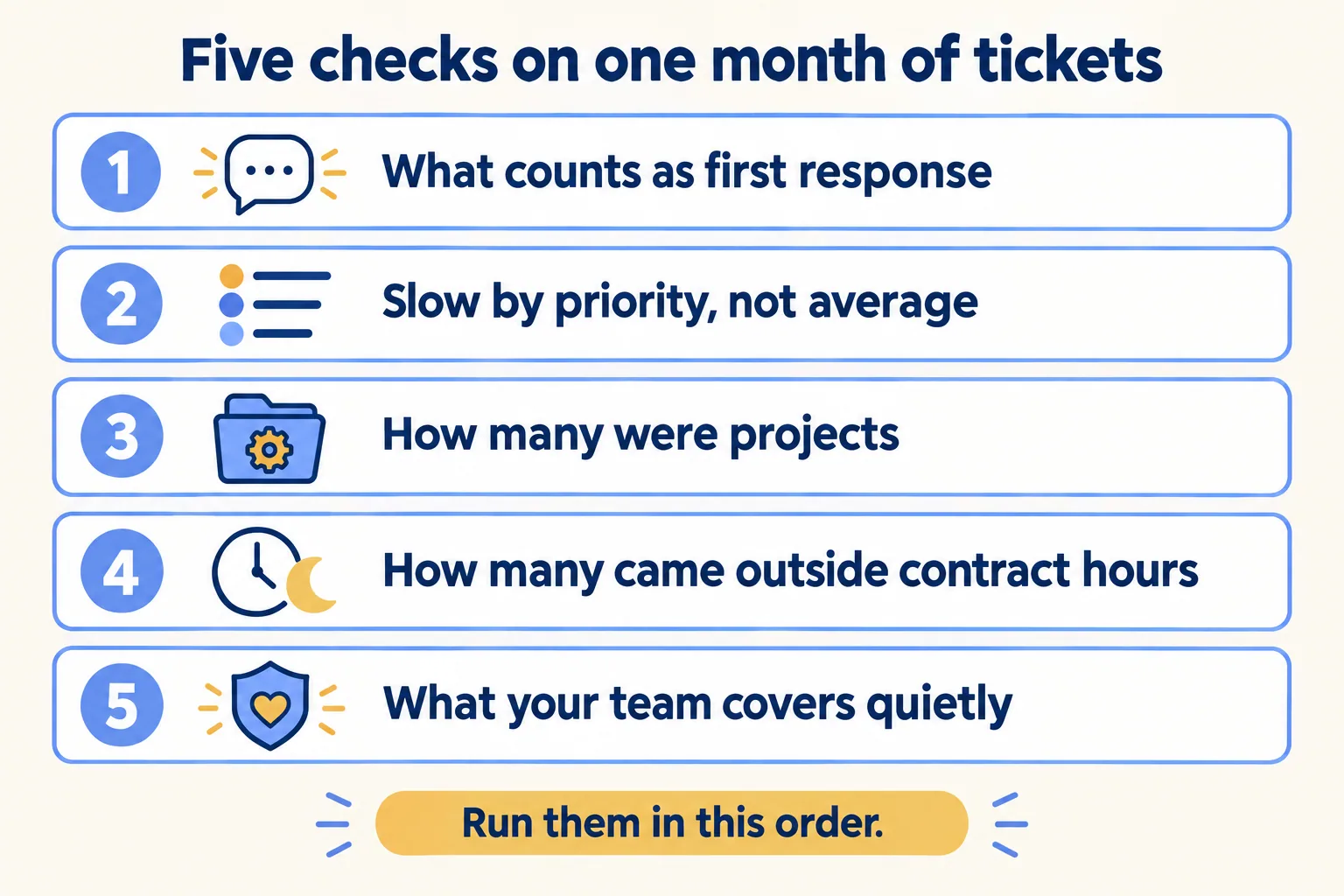
Then ask the five questions below, in order. Each one splits the slow tickets into the provider's share and yours.
What counts as a first response in your contract?
Start here, because the answer can end the argument. FixIT Dubai, a Dubai provider, tells buyers to ask whether a commitment is to acknowledge the ticket, begin troubleshooting or restore service. Those are three different clocks.
Rallied adds the trap. Its guide quotes a managed-service provider on a contract with two SLAs, "one of them is to acknowledge we receive the ticket, that's 2 hours for emergencies". An automatic "we received ticket #" email can stop the first-response clock while the person who wrote in still waits for a human. If your contract counts the automatic email, your provider can be fast on paper and slow in the office.
Read the clause and write down which of the three your clock stops on. If it stops on the automatic email, ask for a first human reply as a separate line. That is a wording fix, not a reason to leave.
How slow is it by priority, not on average?
Split the month into urgent, high, medium and low, and take the first human reply for each. This is the check that tells you whether the provider is slow.
One Dubai provider, iTAG, publishes a table on its page of 25 August 2026. Treat it as one provider's marketing, not a standard, and compare it with your own contract:
The same page says that response time is how fast a technician acknowledges your issue, not how long the fix takes. So collect resolution by priority too.
Now apply the rule. If the urgent and high tickets in your month waited longer than your contract promises, the provider is slow, and you have the evidence to say so in the next review. If they were answered on time and the complaints came from low and medium tickets, the speed is not the problem. Go on to the next question.
How many slow tickets were projects?
Mark every slow ticket that is really a project: a new starter's whole laptop and account set-up, a move to a new office, a mailbox migration. A fault is something that worked and stopped. A project is something new that needs planning and more than one person. A support queue is built for faults, so a project filed as a ticket waits in a queue that was never sized for it.
This is our rule of thumb at Mindcat, not a number from a study. Count the projects among your slow tickets. If most of the slow ones are projects, the provider is not slow at support. You are filing work in the wrong place, and the fix is a separate project request with its own date. A new provider will receive the same projects and be just as late.
How many tickets arrived outside the contract's hours?
Compare the raised-at column with the hours your contract covers. Rallied gives the clearest case: a client's urgent ticket about a power outage, raised at 9 PM on a Tuesday, sat unassigned until 8:07 the next morning, so the first response was recorded as 11 hours and 7 minutes. The technician was quick once he saw it. Nobody saw it until morning.
In the Gulf, the week makes this worse. The UAE federal working week has been Monday to Friday since 2022, so a ticket raised late on a Friday can wait through a weekend your contract does not count. TechProComp, a managed-service provider, describes the same pattern: tickets raised on Thursday afternoon or Friday morning that no one touches over the weekend.
If many slow tickets arrived outside the covered hours, the contract is the problem, not the technicians. Either buy after-hours cover or write on the intake form what a ticket raised after hours will get. Either way, check the clock your SLA runs on: we cover how to set it in our post on SLA agreements for Gulf service desks.
Does your own team quietly cover the gap?
The last check is not in the ticket log, so ask for it. TechProComp lists the signs of slow support that never reach a log: employees who fix problems themselves because a ticket is slower than a search, and an owner who ends up relaying complaints to the provider by hand. Staff who stop raising tickets also keep the slowest cases out of the log, so the log looks better than the office feels.
Ask your office manager two things. How many problems did staff fix themselves this month without a ticket? How many complaints did the owner or a manager pass on by message? If the answers are more than a few, the log understates the delay and you are paying twice: once to the provider and once in your staff's time. We cover how to count that cost in our post on in-house or outsourced IT support.
So whose problem is it?
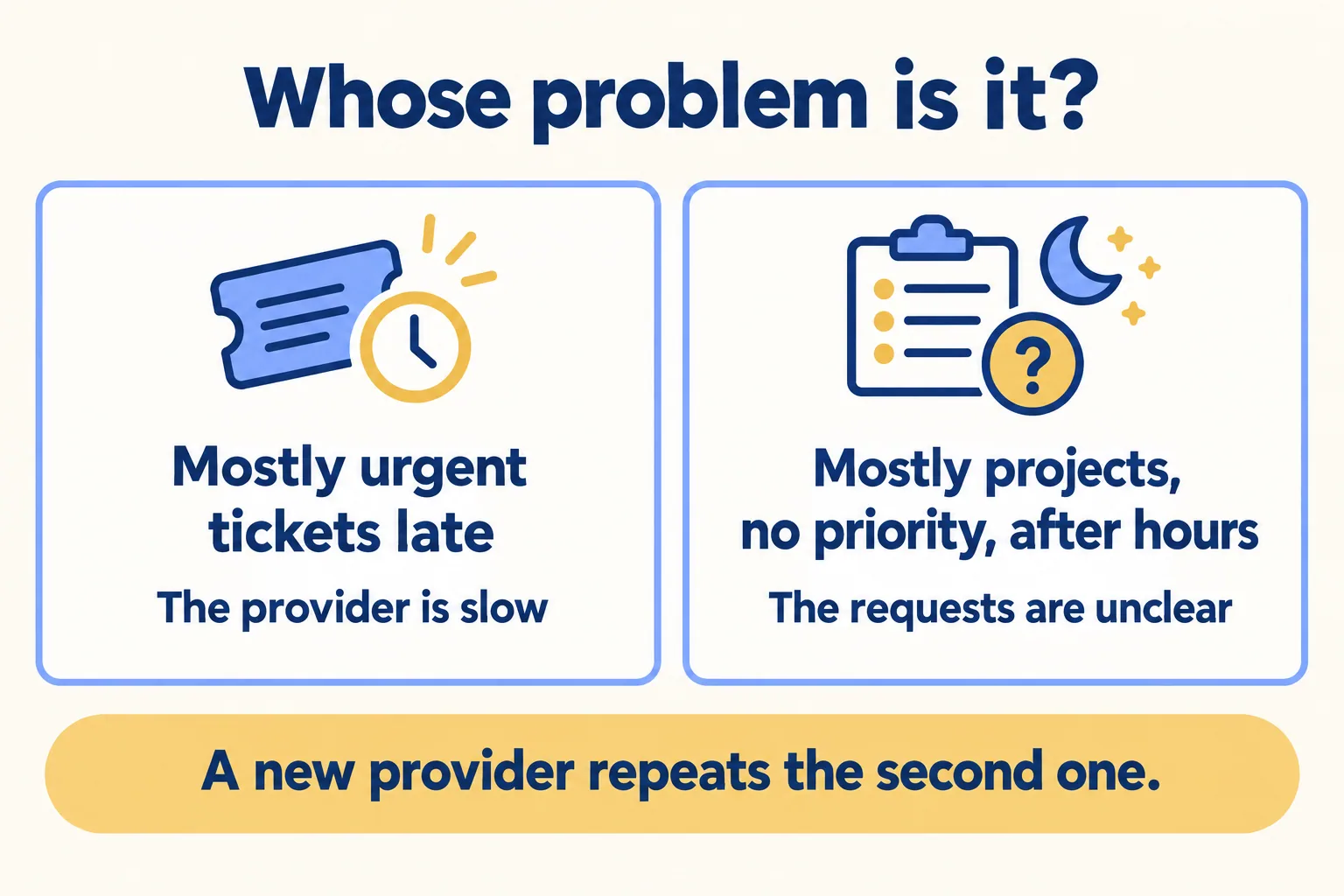
Add the five answers and apply one rule. If the slow tickets are mostly urgent or high ones that waited past the written promise, the provider is slow: raise it with the evidence, ask for service credits, and change provider if it repeats. If they are mostly projects, tickets with no priority, tickets outside the covered hours or tickets your staff never logged, the requests are unclear, and a new provider will repeat the problem.
What does Mindcat Desk change, and what does it cost?
Mindcat Desk does not provide IT support. It is the ticketing system that gives every request a number, an owner and an SLA clock on your working week, whoever answers the tickets. If you run the desk yourself, it is your queue. If a provider runs it, the free read-only owner login lets you see the queue yourself, so the five columns above are a report you can open, not an export you wait for. Customers and staff who raise requests are free, so only the people who answer count as agents.
Our page prices each agent a month in bands: AED 99 for agents 1 to 5, AED 69 for 6 to 20, AED 49 for 21 to 50 and AED 39 from 51. The shared plan has a monthly minimum of 5 agents, AED 495, so no one can buy a single agent at the per-agent rate. Twenty agents pay 5 × 99 + 15 × 69 = AED 1,530 a month. Up to 20 agents, the quick start is a fixed package we set up for AED 2,500, one time. Larger teams get a written plan. AI drafts on your own account, SMS and your phone system are billed at cost. Prices exclude VAT.
What it does not do today: Arabic screens are about 60 percent translated, and we finish the ones your team uses during setup. Ramadan hours and public holidays go into your calendars during setup each year. Phone-system call events and WhatsApp as a ticket channel are connected in setup too. Teams that sell and serve on WhatsApp should start with Mindcat Inbox.
We call the method Every request on the clock. Tell us how many agents answer requests, how they arrive and the response time you promise. We reply with the setup plan and the monthly price per agent, in AED. If you cannot yet say who owns the queue, we say start there before you buy anything.
