
If your clinic is licensed in Ajman, Ras Al Khaimah, Fujairah, Umm Al Quwain or Sharjah and a new record system is on the table, this is for you. It is not for a Dubai or Abu Dhabi clinic, which answers to a different exchange (see our NABIDH and Malaffi posts), and it is not for a clinic whose current system is connected and works. If you need a live Riayati connection from day one, read on: the checks below are yours, and Mindcat Clinic is not the right choice yet.
Why can Riayati decide a clinic's switch?
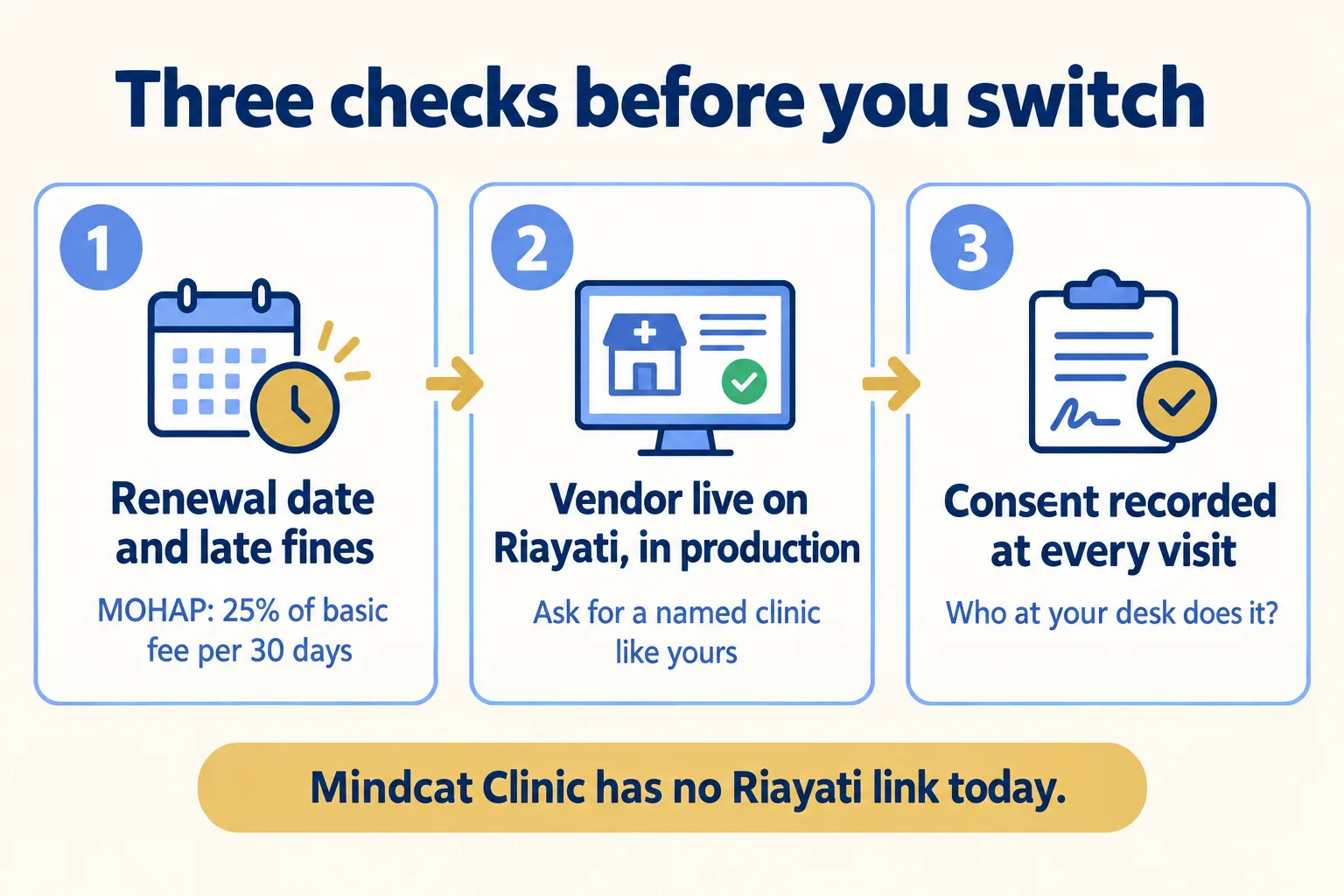
Because renewing the licence asks for it. Riayati is the national health record platform run by the Ministry of Health and Prevention (MOHAP). MOHAP's page for renewing a health facility licence lists the documents to bring. The last two are Tatmeen, MOHAP's medicine tracking system, and Riayati:
"Evidence of Registration in Tatmeen System"
"Evidence of Registration in the Riayati System"
The same page says the licence is renewed every year, and it sets the cost of missing the date:
"If the renewal is delayed, fines will be calculated at a rate of 25% of the facility's basic fees for every 30 days, up to a maximum of 6 months. After the 6-month period, the license will be legally auto-canceled."
MOHAP's fee list on that page puts a general medicine or general dental clinic at AED 5,000, so 25 percent of that fee is AED 1,250 for every 30 days. A record system you pick has to leave you able to show registration on the day you renew. That makes the switch a licensing choice as well as a software one.
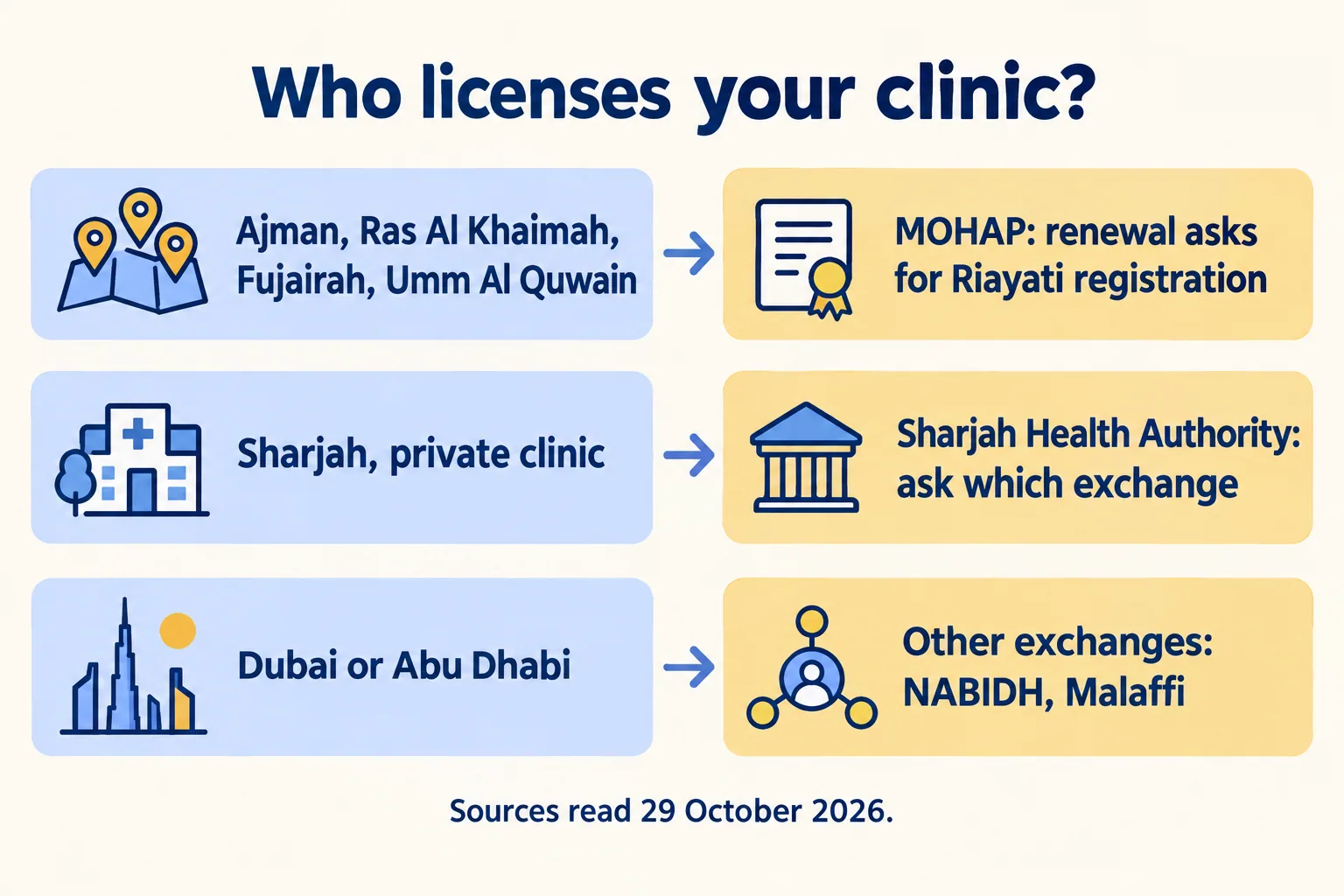
Which authority licenses your clinic?
The authority on your licence decides, not the emirate on your signboard. MOHAP licenses private clinics in Ajman, Ras Al Khaimah, Fujairah and Umm Al Quwain. Sharjah changed in 2025. A Sharjah Executive Council decision of 15 July 2025 applies to private health facilities in the emirate and its free zones. Zavis's licensing guide, updated 28 October 2026, reads it to mean that the Sharjah Health Authority (SHA) now licenses them and the professionals who work in them. Federal government facilities in Sharjah are outside the decision.
SHA's own service pages that we read list facility licence services but name no exchange. So for a Sharjah clinic, the first step in the wait below is a written question to SHA, not a guess in either direction. A group with branches in two emirates answers to two authorities, and each branch needs its own check.
What does a vendor on MOHAP's list prove?
Less than a badge on a website suggests. MOHAP's connected EMR page lists the healthcare systems connected to Riayati, split into three tabs: electronic medical record (EMR), practice management (PMS) and laboratory (LIS) systems. It describes them as platforms "that meet Riayati's integration criteria". That tells you a system has met the criteria. It does not tell you that your licence type, your branches and your front desk will connect the same way.
The connection also covers more than the clinical record. MOHAP's e-Claims Post Office runs on Riayati and carries eligibility checks, authorizations, claim submissions and electronic prescriptions between providers and insurers in the Northern Emirates. If most of your visits are insured, a switch is a claims decision too. Ask each vendor for four things in writing:
- Whether the Riayati connection is live in production for clinics today, and not just built. Pabau's guide to Riayati, a vendor's, gives the same test.
- The name of a clinic with your licence type that connects through the vendor, and permission to call it.
- Who signs the Riayati agreements and who sees a failed message on your side.
- Whether claims through the e-Claims Post Office are part of the price or a separate line.
What does your front desk change?
More than the software does. Riayati's confidentiality policy says a facility connected to Riayati uploads patient electronic records to the exchange, and that it needs no explicit patient consent to upload. Viewing is different. The policy says every facility must inform patients about Riayati and obtain their consent, opt-in or opt-out, at every visit, and that MOHAP may audit facilities to check it.
So a switch moves a consent habit as well as patient files. Before the move, ask who at your desk records the consent at each visit, where it is kept, and whether the new screen asks for it at check-in. The Riayati policy is a 2020 document with 2023 reviews, so read the current version your vendor works from.
When do we say wait?
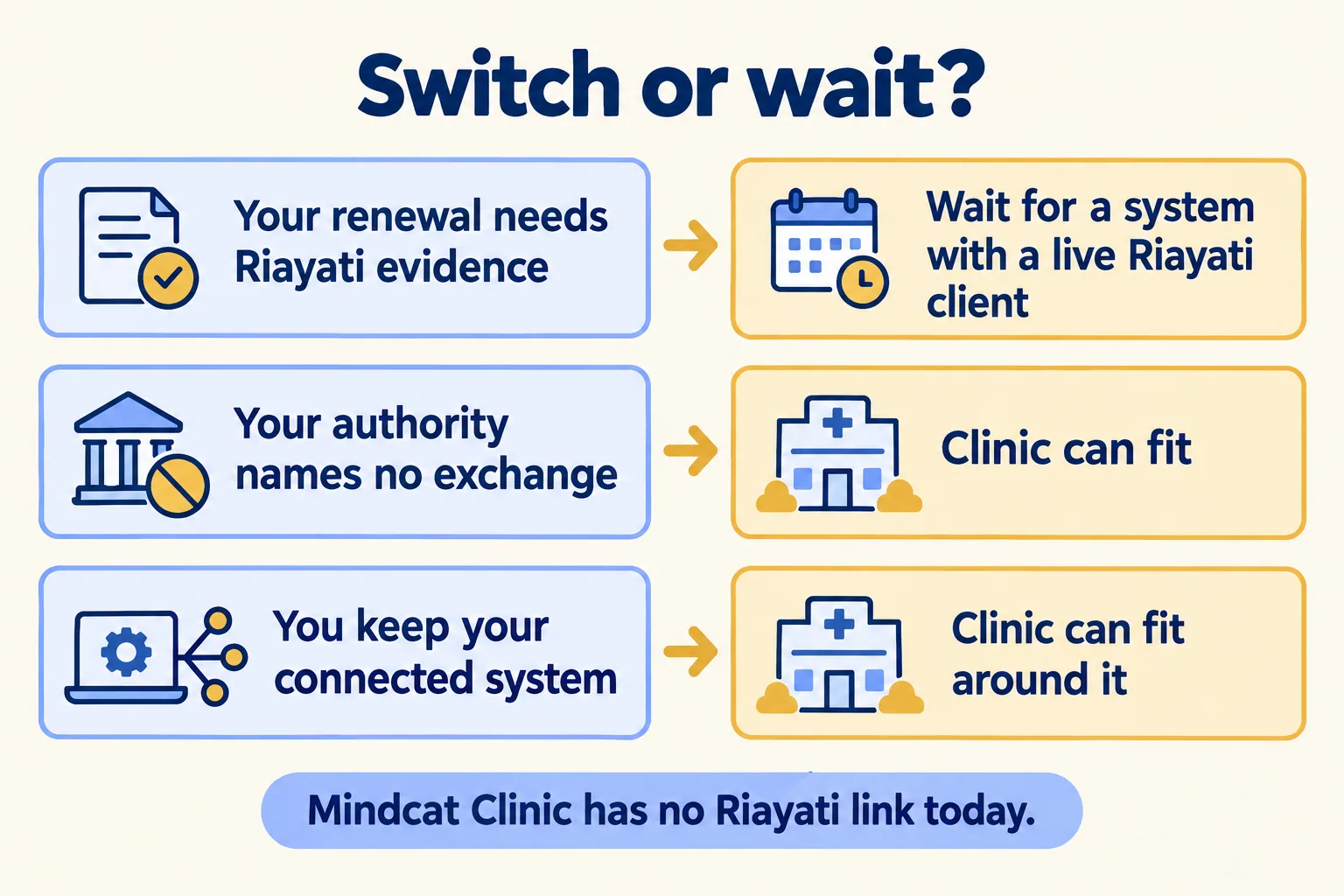
When your licence needs Riayati evidence at the next renewal and you need the new system connected before you switch. Mindcat Clinic has no Riayati link today. Our page says it in its table of what Gulf clinics need and in the FAQ: a connection is a separate project, the regulator decides whether it is accepted, and if your licence needs one before you switch, we are not the right choice yet. No date exists for it, so a clinic that needs the connection should pick a vendor with a live Riayati client.
If you are in that group, use the wait:
- Open MOHAP's renewal page and your licence. Put the renewal date on the calendar and count back the weeks you need to onboard.
- Find your current vendor on the connected list before you scope any move.
- Ask each vendor the four questions above, and write down the answers.
- Ask MOHAP, or SHA if you are in Sharjah, what counts as evidence of registration. We cannot answer it for you.
Dubai and Abu Dhabi clinics work under different exchanges and different rules. We cover them in our posts on switching clinic records and NABIDH and switching clinic records and Malaffi.
Who does Mindcat Clinic fit, and what does it cost?
It fits a clinic whose authority asks for no exchange link before the switch, and a clinic that keeps its connected system and wants something else moved. Our Clinic is aimed first at Saudi Arabia, which is why it has no UAE exchange link yet. What it gives you today: one patient record across branches, a log of who opened each record, a standard health-records API (FHIR), a full export of your data, and your copy set up in your own country. Not today: insurance claims, a ZATCA e-invoicing system, a card terminal connection, and finished Arabic screens (about half are translated).
For one dentist with no Riayati need, our page says a local app at SAR 199 costs less than we do. We fit the group that wants one record across branches.
A dental group with 10 dentists across two branches pays 5 × 249 + 5 × 179 = AED 2,140 a month. Our page prices each practitioner a month, in bands: AED 249 for 1 to 5 practitioners, AED 179 for 6 to 15, AED 119 for 16 to 40 and AED 89 from 41. Reception, clinic manager, billing and owner logins are free.
The price comes with a monthly minimum, so no one can buy one practitioner at the per-practitioner rate: the shared plan minimum is AED 890 a month, which covers up to 3 practitioners. Up to 5 practitioners, the quick start is a fixed package we set up for AED 2,500 one time; from 6 practitioners we set it up to a written plan. SMS and email reminder fees and your e-invoicing provider are billed at cost. Prices exclude 5 percent UAE VAT.
A clinic that only needs patients to pick their own slots wants Mindcat Bookings; this post is about the record.
You tell us your licence authority, how many practitioners and branches you run, and what you use today. We reply with the setup plan and the price per practitioner. If your licence needs Riayati first, we say wait. If it does not, tell us about your clinic and we start there.
