

If your clinic is DHA-licensed and you are thinking of changing record systems, this is for you. It is not for clinics outside Dubai's DHA licensing, nor for a clinic that already runs a system connected to NABIDH and is happy with it.
What does DHA expect when a clinic changes record system?
A switch is an event the Dubai Health Authority (DHA) wants to hear about. Its Guideline for Electronic Medical Record Transition in Healthcare Facilities (reference HISHD/GD-03, issued 25 June 2024, effective 25 September 2024) says a transition includes migrating data and connecting to government portals, naming NABIDH and eClaim. It sets a clock too: most facilities should finish within 60 days, and the whole replacement should not run past three months for a small facility.
Separately, on 26 May 2025 the DHA published External Circular 0954, titled "Implementation of Electronic Medical Record System Compliant with NABIDH Integration Requirements and Single Sign-On (SSO) Authentication". It comes with a supporting document headed "Health Facilities Compulsory to Integrate with NABIDH". We read the circular's page and title; the documents behind it are PDFs you should open yourself before you plan.
Vendors repeat the same point in plainer words. Zavis, a vendor, writes that changing your EMR is "a UAE healthcare regulator compliance event". Oryx, another vendor, warns that "switching EMR means having to do a new onboarding". Both are vendor statements, not clinic owners. We looked for a clinic owner or doctor describing their own switch and found none, so we will not invent one.
Which steps of the switch belong to NABIDH?
Section 15 of the guideline is four sentences long, and each one is a step:
- 01Tell the NABIDH team before you plan to change, by email to nabidh@dha.gov.ae. The notice should be sent at least one month before the transition (15.1 and 15.2).
- 02Make sure the new system can sign in to the NABIDH platform through single sign-on, one login that opens NABIDH (5.14). The guideline says to email the NABIDH team for the details.
- 03Tell the NABIDH team when the old system closes, so the connections and open ports can be closed (15.3).
- 04Support reconnection to NABIDH at the earliest after the transition (15.4).
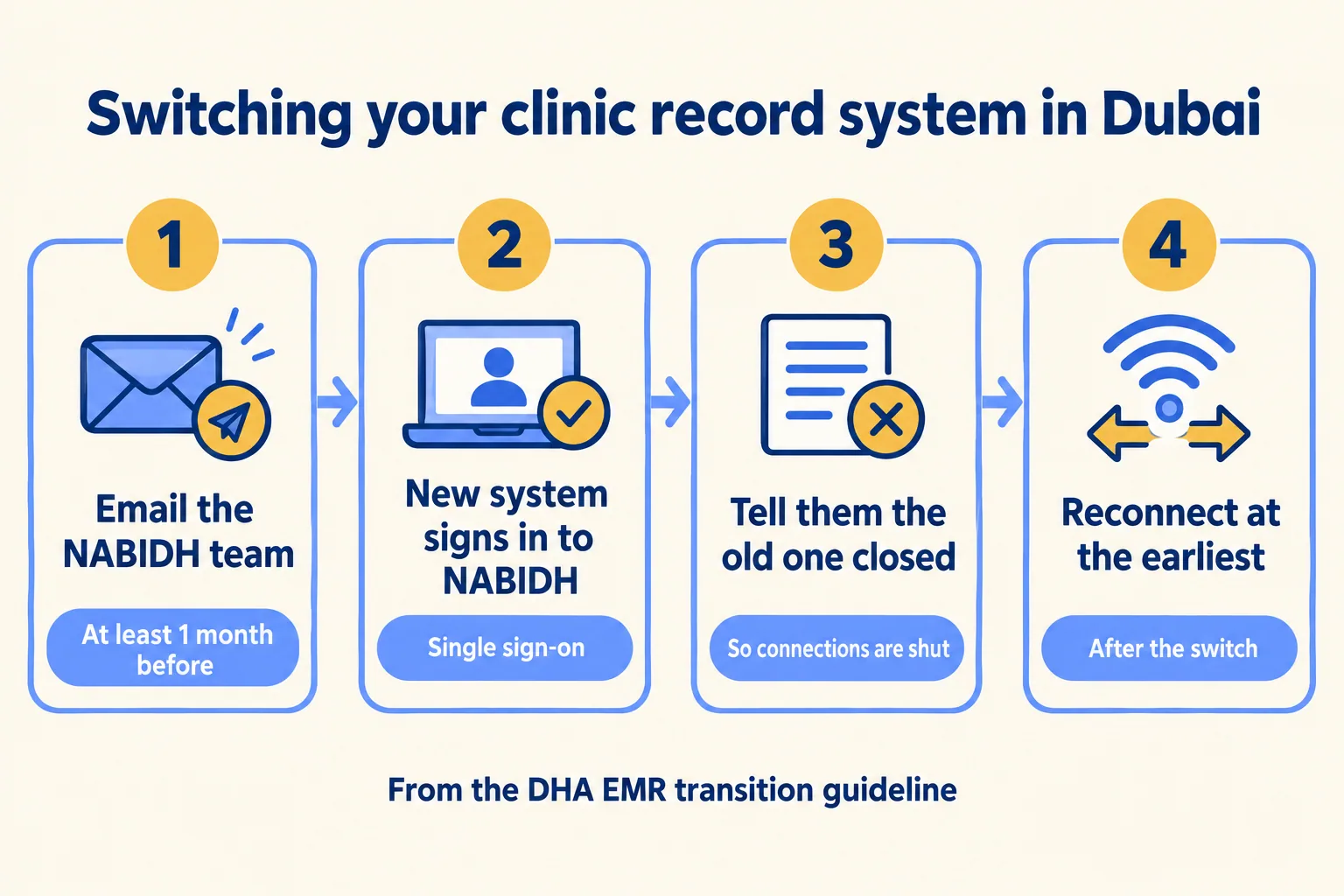
Count back from your go-live date. The one-month notice and a 60-day plan mean the decision to switch is made two or three months before the day staff open the new system. Old records do not disappear in the meantime: section 9 says records must be kept under Federal Law No. 2 of 2019 and DHA policy, stay visible and readable, and never be destroyed before their retention period ends.
How do you check a vendor's NABIDH claim?
Not with a badge. Almost every Dubai clinic software page says "NABIDH approved" somewhere, and the sources we read disagree on how you would check. A vendor review dated 21 August 2026 says the DHA publishes no list of connected vendors, and that the DHA said 91 record systems were connected by mid-2025 without naming them. Another vendor's guide, dated 7 August 2026, points to a connected EMR page on the NABIDH site. The NABIDH site did not show its content when we fetched it, so we cannot say which is right. Open the page yourself, and do not rely on either vendor.
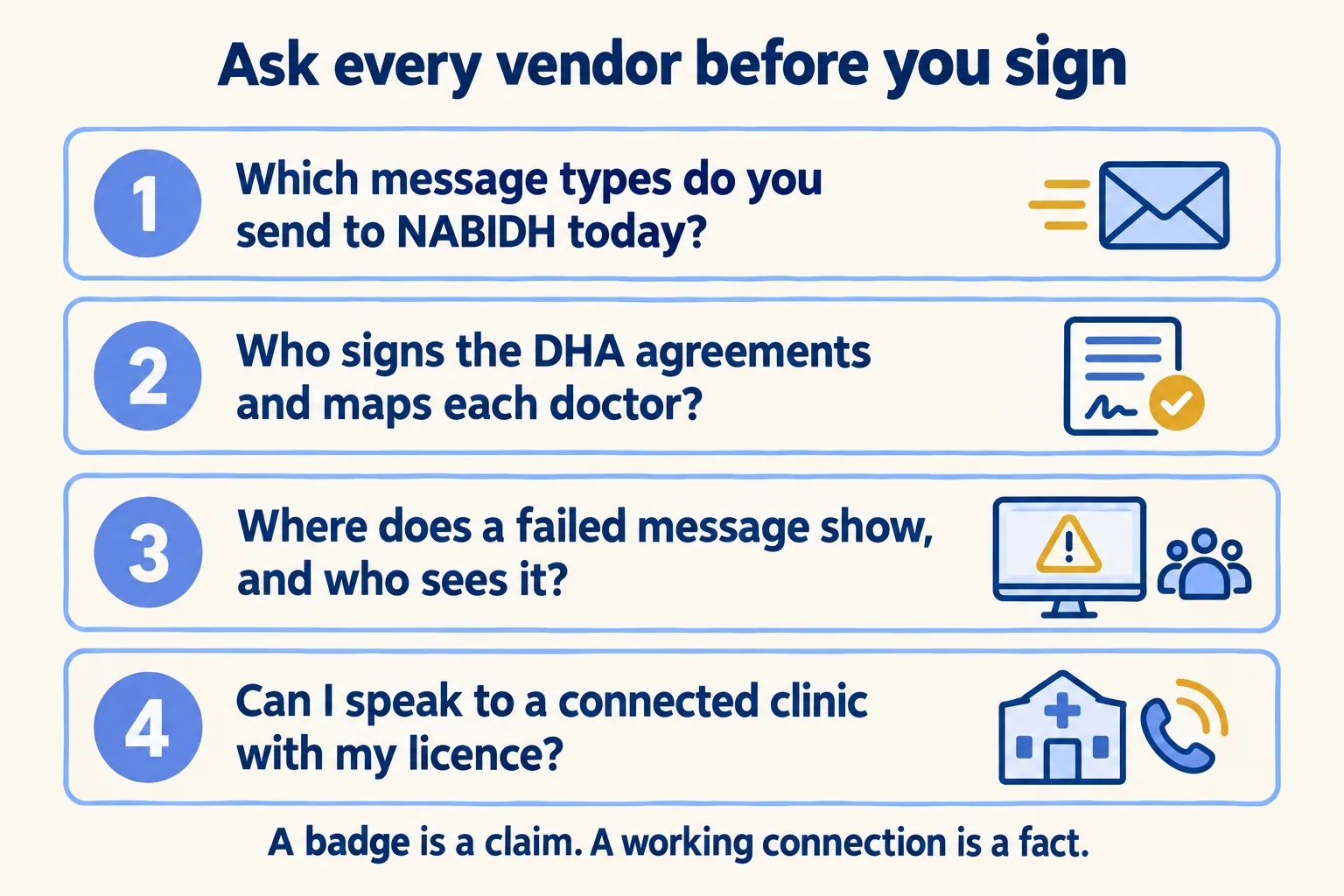
What you can do is ask questions a connected vendor answers on the call. The review's author, Pabau, a vendor, suggests asking which HL7 message types (the standard format NABIDH receives) the system sends today, who signs the DHA agreements and maps each practitioner, and where a failed message appears and who on your team sees it. Add one of ours: ask to speak to a clinic with your type of licence that is connected today.
Is data location the same question?
No, and mixing them up costs clinics time. NABIDH is about connecting to Dubai's exchange. Where the record sits is Article 13 of Federal Law No. 2 of 2019: health data about services given in the UAE may not be stored, processed, generated or transferred outside the UAE, unless a decision by the Health Authority with the Ministry allows it. Ask every vendor where your copy lives, in writing.
At Mindcat, for a UAE clinic we set up your copy in the UAE. That answers where the data sits. It does not answer whether the NABIDH connection exists, and we do not claim it does.
When do we say wait?
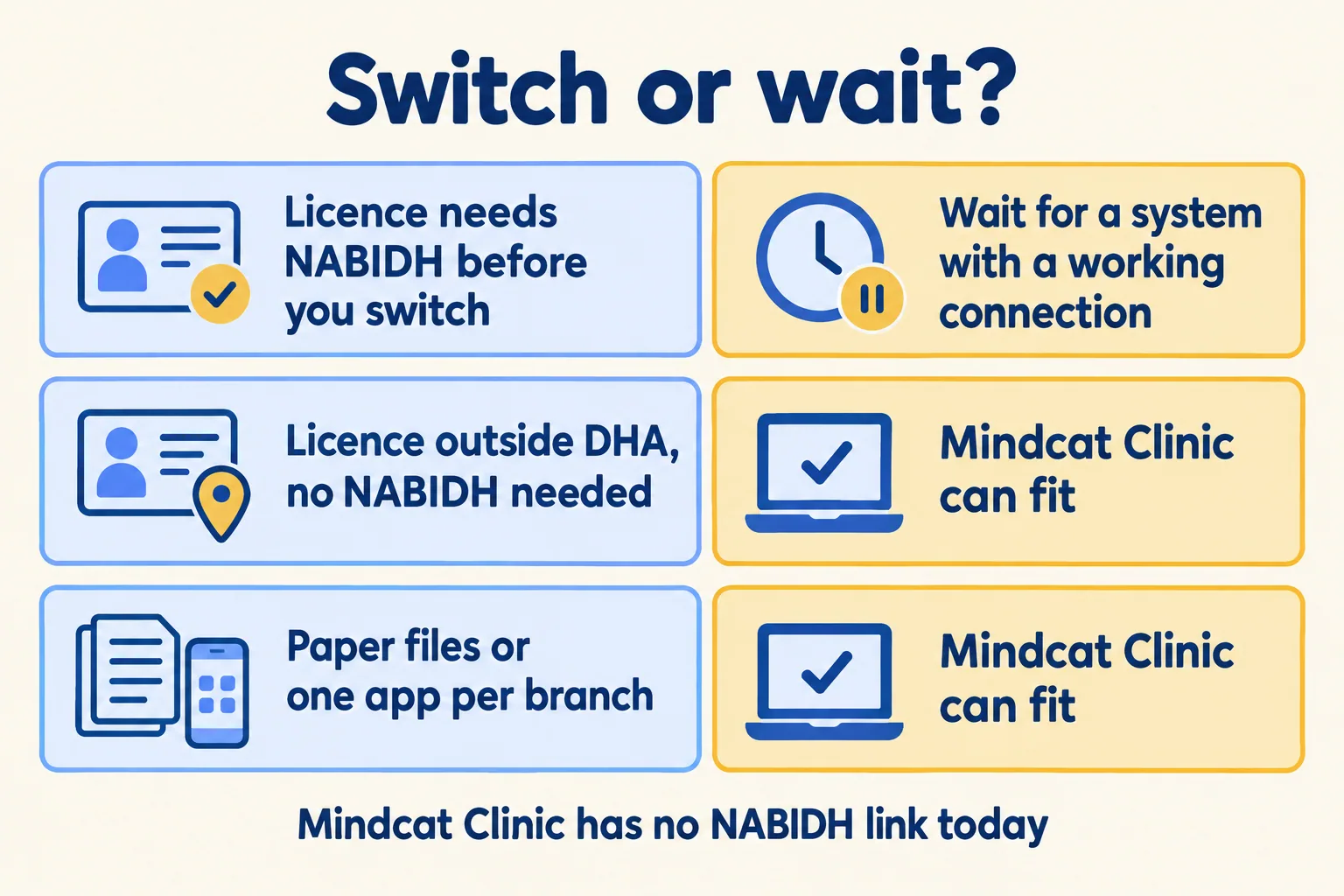
When your licence needs NABIDH before you switch. Mindcat Clinic has no connection to NABIDH, Malaffi, Riayati or NPHIES today. Each would be a separate project, and the regulator decides whether it is accepted. Our page says it in its table of what Gulf clinics need and in the FAQ: if your licence needs one of these before you switch, we are not the right choice yet. So we will not give a DHA-licensed clinic a go-live date, and we will not call Clinic ready for NABIDH.
If your group is DHA-licensed, here is what to do with the wait:
- Put the one-month notice date on the calendar now, and count back from it to the day you want to go live.
- Ask each vendor the four questions above, and write the answers down.
- Ask your DHA contact whether your licence needs a connection before you switch. We cannot answer that for you.
- Whether we build a NABIDH link is not decided: each connection is a separate project that the regulator has to accept. We will not give you a date we cannot keep.
Other emirates have their own exchanges: Malaffi in Abu Dhabi and Riayati in the northern emirates, with different rules and different lists. NPHIES is Saudi Arabia's insurance claims platform, which Clinic does not connect to either.
Who does Mindcat Clinic fit, and what does it cost?
It fits a clinic whose licence does not need a NABIDH link before you switch: a clinic still on paper files, one app per branch or a spreadsheet, or a Saudi self-pay clinic. What it gives you today: one patient record across branches, a log of who opened each record, a standard health-records API (FHIR), a full export of your data, and your copy set up in your own country. Not today: insurance claims, a ZATCA e-invoicing system, a card terminal connection, and finished Arabic screens (about half are translated).
Our page prices each practitioner a month, in bands: AED 249 for 1 to 5 practitioners, AED 179 for 6 to 15, AED 119 for 16 to 40 and AED 89 from 41. Reception, clinic manager, billing and owner logins are free. The price comes with a monthly minimum, so no one can buy one practitioner at the per-practitioner rate: the shared plan minimum is AED 890 a month, which covers up to 3 practitioners. Five practitioners are 5 × 249 = AED 1,245 a month. The page's own example for a group: 10 dentists across two branches, AED 2,140 a month, with a one-time setup of AED 9,900 (a managed setup on the shared plan).
Up to 5 practitioners, the quick start is a fixed package we set up for AED 2,500 one time. SMS and email reminder fees and your e-invoicing provider are billed at cost. Prices exclude 5 percent UAE VAT. Patients booking online themselves is Mindcat Bookings; this post is about the record.
We call the method One record, every branch. You tell us how many practitioners and branches you run, what you use today and which licence you hold. We reply with the setup plan and the price per practitioner. If your licence needs NABIDH first, we say wait. If it does not, tell us about your clinic and we start there.
