
If you count a leaver's notice days on a wall calendar and work out the pay from the last payslip, this is for you. It is not for a firm with nobody who owns the leavers' dates and pay. Name that person first.
What does the law fix, and what does your contract fix?
The law fixes the range. Your contract fixes the number inside it.
u.ae, the UAE government portal, explains Article 43 of Federal Decree-Law No. 33 of 2021 this way. Either side can end the contract for a legitimate reason if it gives written notice and the contract keeps running through the notice period. That period must be at least 30 days and no more than 90. Gulf News (updated 26 October 2026) says the same, adds that the exact length comes from the contract registered with the Ministry of Human Resources and Emiratisation, and says the period is the same for both sides unless a difference benefits the worker.
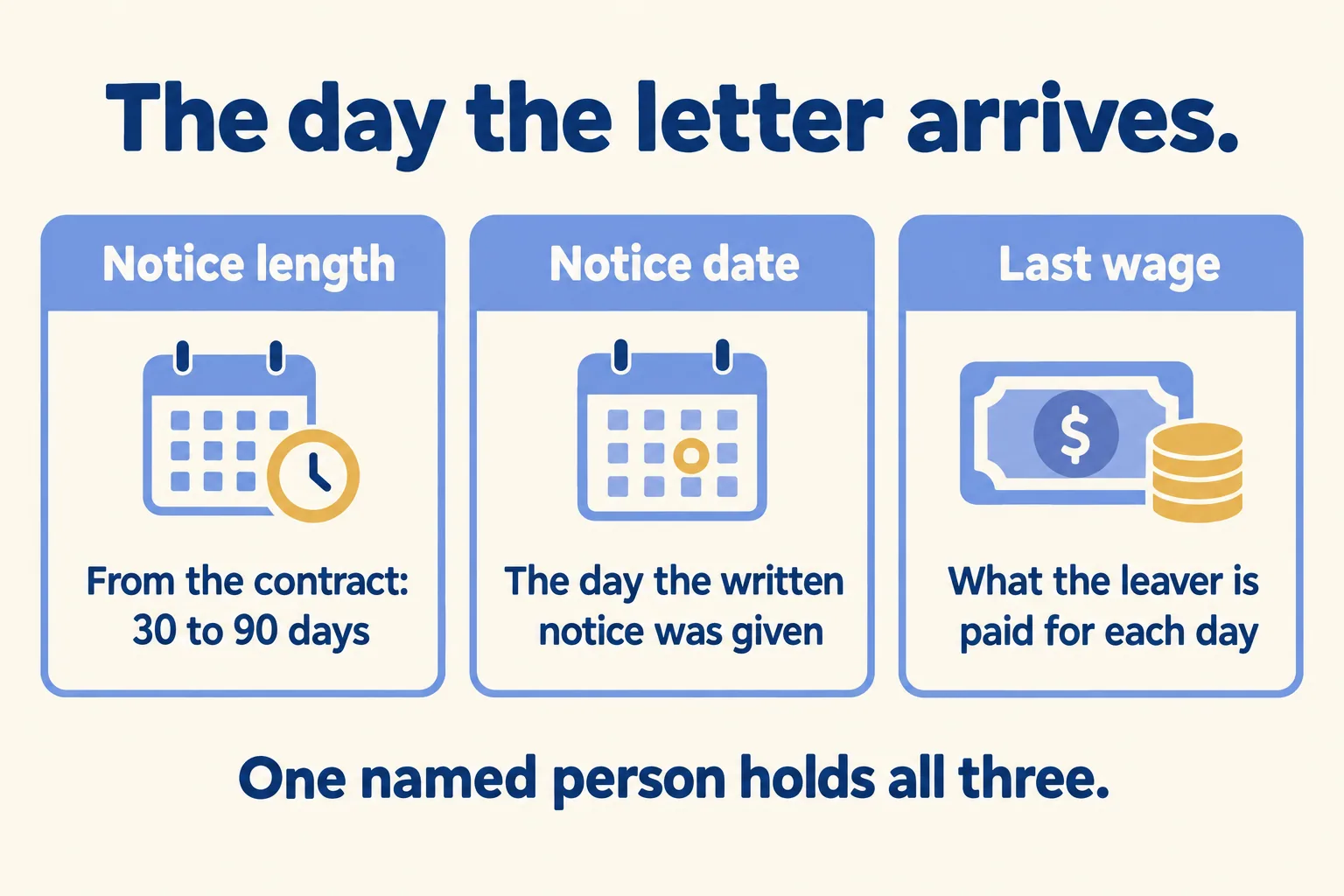
So when a resignation arrives on a Thursday, three facts decide everything that follows. How many days the contract says. The date the written notice was given. And the last wage. Whoever opens the letter needs all three in one place.
What is the leaver paid during notice?
The full wage, on the last wage received.
u.ae says the contract stays in force throughout the notice period and the worker is entitled to the full wage for it, based on the most recent salary. The employer can ask the worker to work during that time. The two sides can also agree to shorten or waive the notice, as long as the worker's rights for the notice period are kept.
One more rule helps the worker. When the employer ends the contract, u.ae says the worker may be absent one working day a week without pay to look for another job. The worker chooses the day and tells the employer at least three days before it.
If a leaver is released early by agreement, u.ae says the worker's rights for the notice period are kept. Put the agreement in writing and confirm what it covers before you settle.
What if the notice is skipped?
The party that skips it pays an allowance.
u.ae says a party that does not serve the notice period compensates the other with a notice period allowance, even if no harm was caused. It equals the worker's wage for the full notice period, or the part left unserved, worked out on the last wage received. It runs both ways. An employer that ends the contract on the spot owes it. A worker who walks out owes it.
A sample, arithmetic only: a wage of AED 6,000, a 30-day notice, and the employer pays instead of keeping the person on. The allowance is 30 days at AED 200 a day, AED 6,000. That is an illustration to show the sum, not a figure from a client.
Probation is different. Gulf News describes shorter notice during probation under Article 9 of the law, and the length depends on who ends the contract. We cover probation in its own post when we write it. Free zones differ too. DMCC's employment FAQ describes a 30 to 90 day range for a limited-term contract ended with a legitimate reason, and DIFC and ADGM have their own employment laws. If your licence is in a free zone, check with its authority before you use anything here.
Which two dates does each leaver need?
The end of notice, and the day the settlement is due.
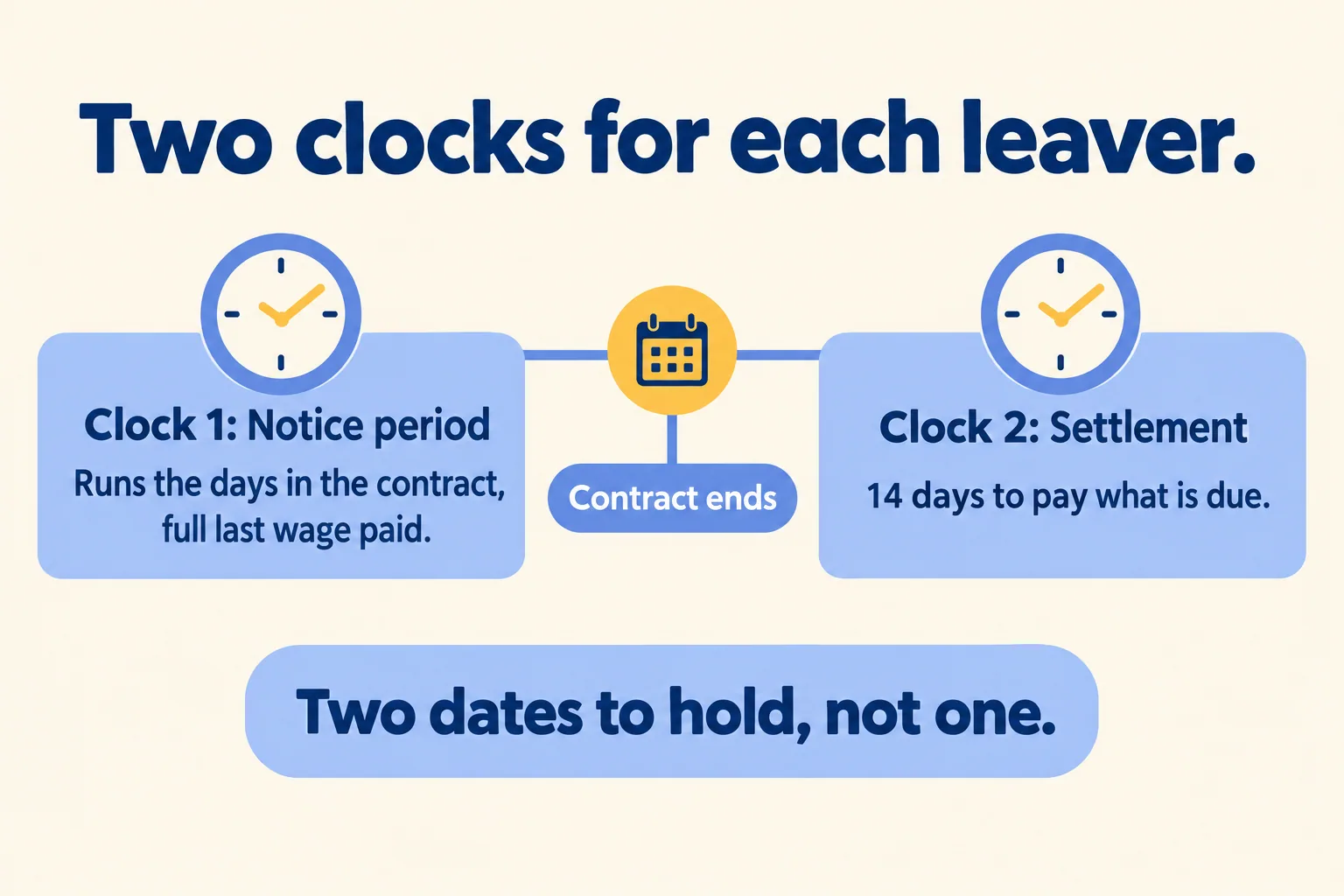
Notice is the first clock. It starts when the written notice is given and runs for the days in the contract. The second clock is the settlement. Our People page states the UAE gives you 14 days to pay a leaver's dues after the contract ends, from Article 53 of the same law, and Gulf News reports that garden leave does not start that clock. The contract normally ends when notice ends, and an agreed early release can change that date, so confirm it in writing. A leaver then has an end-of-notice date and, 14 days after the contract ends, a payment date.
Holding both dates matters more than holding the sum. You can recompute a sum. You cannot recover a payment date that went by while the person who knew it was on leave.
Sheet or system: how do we decide?
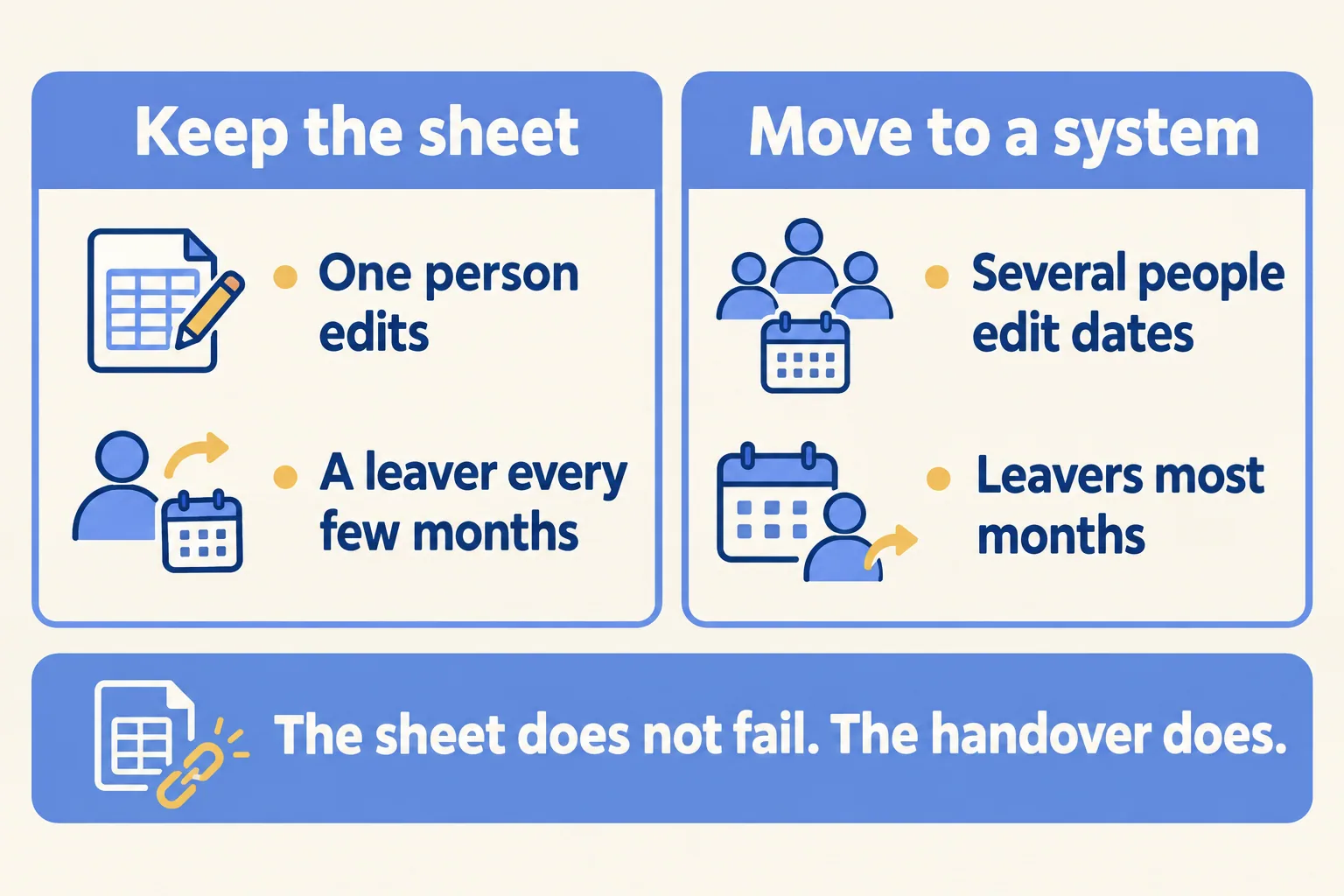
At Mindcat, we ask two questions before we say. How many people edit the leavers' dates? How often does someone leave?
If one person edits a one-page sheet and a leaver comes every few months, keep the sheet. Give it five columns: name, contract notice days, date of written notice, end-of-notice date, last wage. Add two for the settlement due date and whether it was paid. A shared sheet is cheaper than any software and it works.
Move it into a system when more than one person edits dates, or when leavers arrive most months. That is when a date goes missing, because two people each thought the other had it. The sheet did not fail. The handover did.
What does a system not do?
It does not decide the notice. Our People page says the software follows the leave and gratuity rules we set with you during setup. It does not read your contract and it does not choose a date. The final settlement lists gratuity, last salary, leave and advances so finance pays the leaver once, and approved leave reaches the slip.
We do not claim a notice countdown or a reminder, because the page does not list one. A system holds the records in one place. A person still decides the notice, signs the letter and checks the sum. Confirm any figure with your adviser or the regulator before you pay.
What would it cost?
Here is what the People page says today. You pay per employee on payroll a month, AED or SAR, and the price falls as you grow: 29 for the first 50, 18 for 51 to 200, 12 for 201 to 500, 8 above. The shared plan has a minimum of AED/SAR 990 a month. HR, finance and manager logins add nothing.
By that list, a 40-person firm is 40 x 29 = AED 1,160 a month, above the minimum. That is arithmetic on the page's prices, not a quote. The quick start, up to 50 employees, is a fixed AED/SAR 2,500 that we set up. Prices exclude 5 percent UAE VAT and 15 percent Saudi VAT.
Our method is called One run, one file. Tell us how many employees you pay, in which countries and sites, and how you pay them today. We reply with the setup plan and the monthly price per employee, in AED or SAR.
