

If visas, leave and the salary file all sit with one admin who also does something else, this is for you. This post is not for a firm with nobody who owns the salary file once the bank has it. Name that person first, because every option below needs one.
What does HR outsourcing in Dubai cost and cover?
It depends on which job you are buying. The word "HR outsourcing" covers three different services at three different prices, and the pages that rank for it mostly sell scope without saying which job a price pays for.
Element MEA, a Dubai HR consultancy, publishes ranges from the proposals it has reviewed. It calls them "directional practitioner observations", not tariffs or medians:
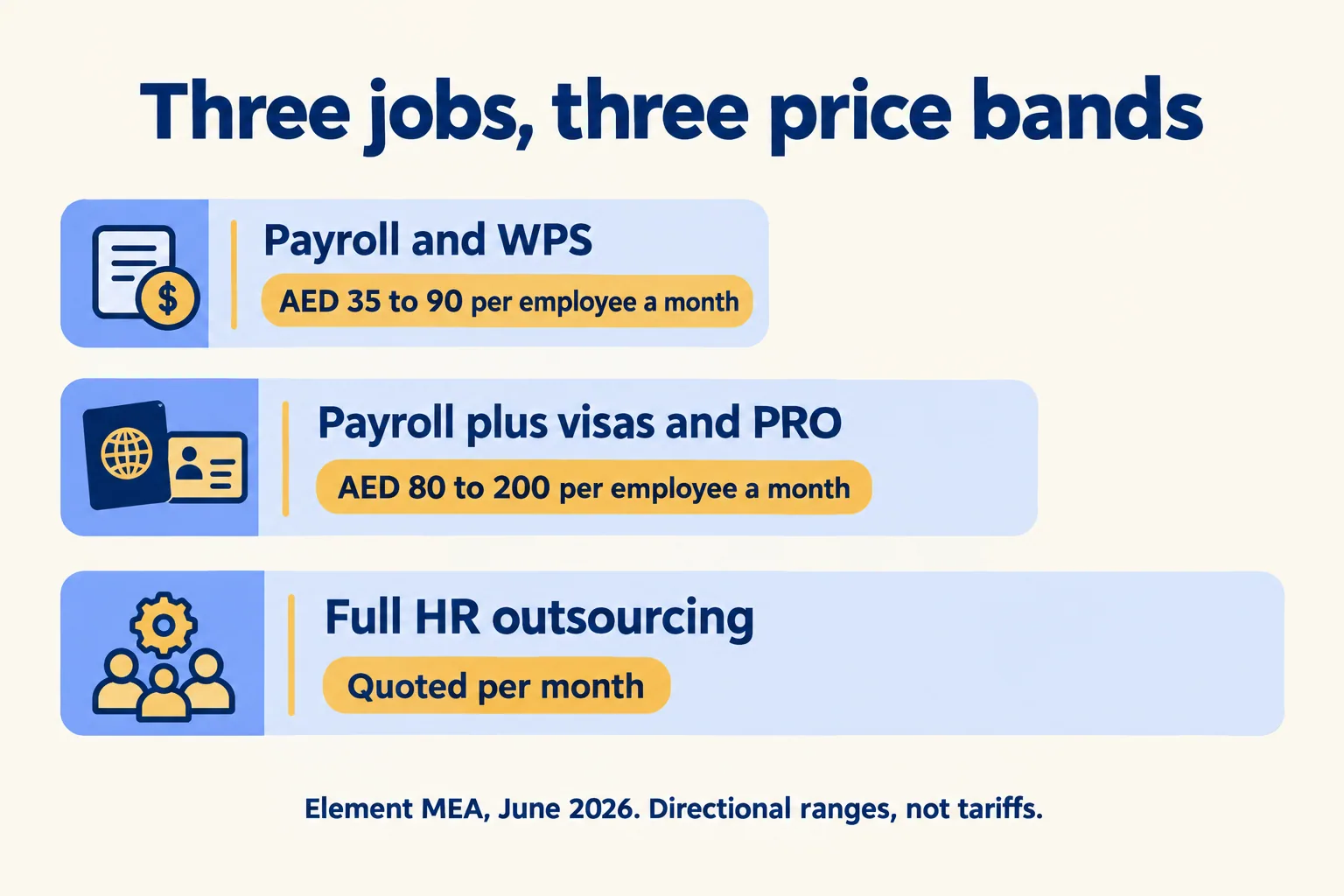
These are vendor figures. Read them as the order of magnitude, and ask each provider for its own quote. Two things follow from the table. A quote for payroll alone and a quote for payroll with visas are not the same product, so a low number may simply mean less is included. And for 100 people, tamdeed says its live prices apply to teams of one to ten, so above that you are asking for a custom quote on every line.
Element MEA's own advice is to ask each provider for a responsibility matrix before comparing two prices. We agree, and the rest of this post is a way to write yours.
Does outsourcing move the salary deadline?
No. This is the part of the decision that outsourcing does not change, so it comes first.
Under MOHRE Resolution 340 of 2026, salaries for the previous month are due on the first day of each Gregorian month, and at least 85 percent of the wages due must be transferred on time. The u.ae page, which carries MOHRE's text, lists what follows a late month:
- From the 2nd day after the due date, electronic alerts and notifications.
- On the 5th day, new work permits for the establishment are suspended.
- On the 16th day, for establishments with 25 workers or more, a labour dispute is registered automatically for the affected workers.
- On the 21st day, more severe steps apply to larger establishments, including attachment and referral to the Public Prosecution in the event of a repeat violation.
Read the full table for your size and sector on u.ae before you plan. A 100-person contractor is inside the 25-worker and 50-worker thresholds.
Article 5 lets an establishment delegate wage payment to a third party. Two law-firm summaries say the same thing about what it does not delegate. Kisser Legal writes that legal responsibility for timely payment "remains with the employing establishment in all circumstances", and that if the delegate fails to pay on time, the measures apply to the establishment, not to the delegate. Clyde & Co says employers "remain ultimately responsible". Providers say it too: tamdeed's page describes HR outsourcing as handing the administration to a provider "while your company remains the legal employer and visa sponsor".
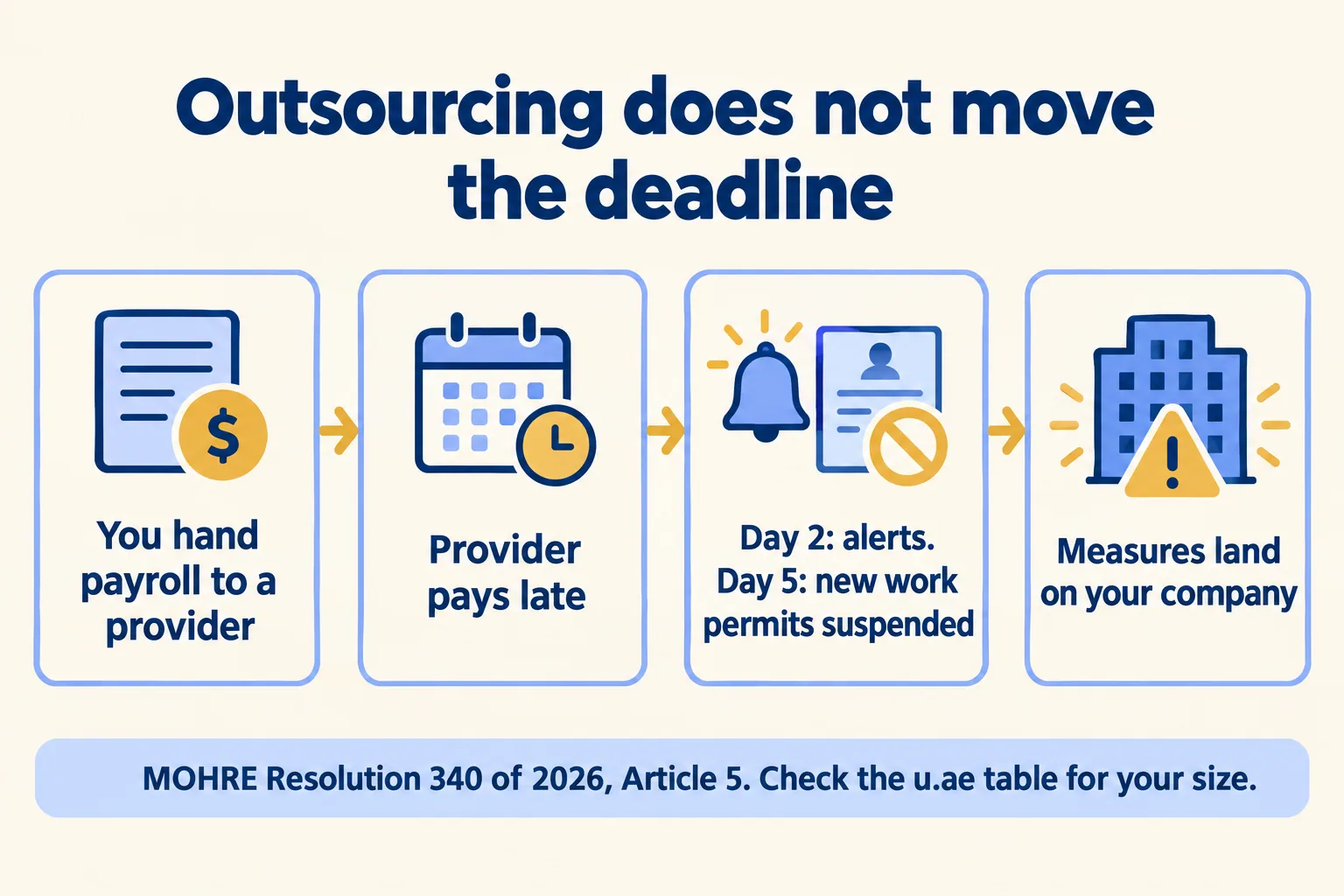
So whoever runs your payroll, the question for your company is the same: who on your side sees, before the 1st, that the file has been credited? That person is the first job below.
Which of the three jobs goes to whom?
"HR" for a 100-person contractor is three jobs with three different failure points. Give each to whoever can be held to it.
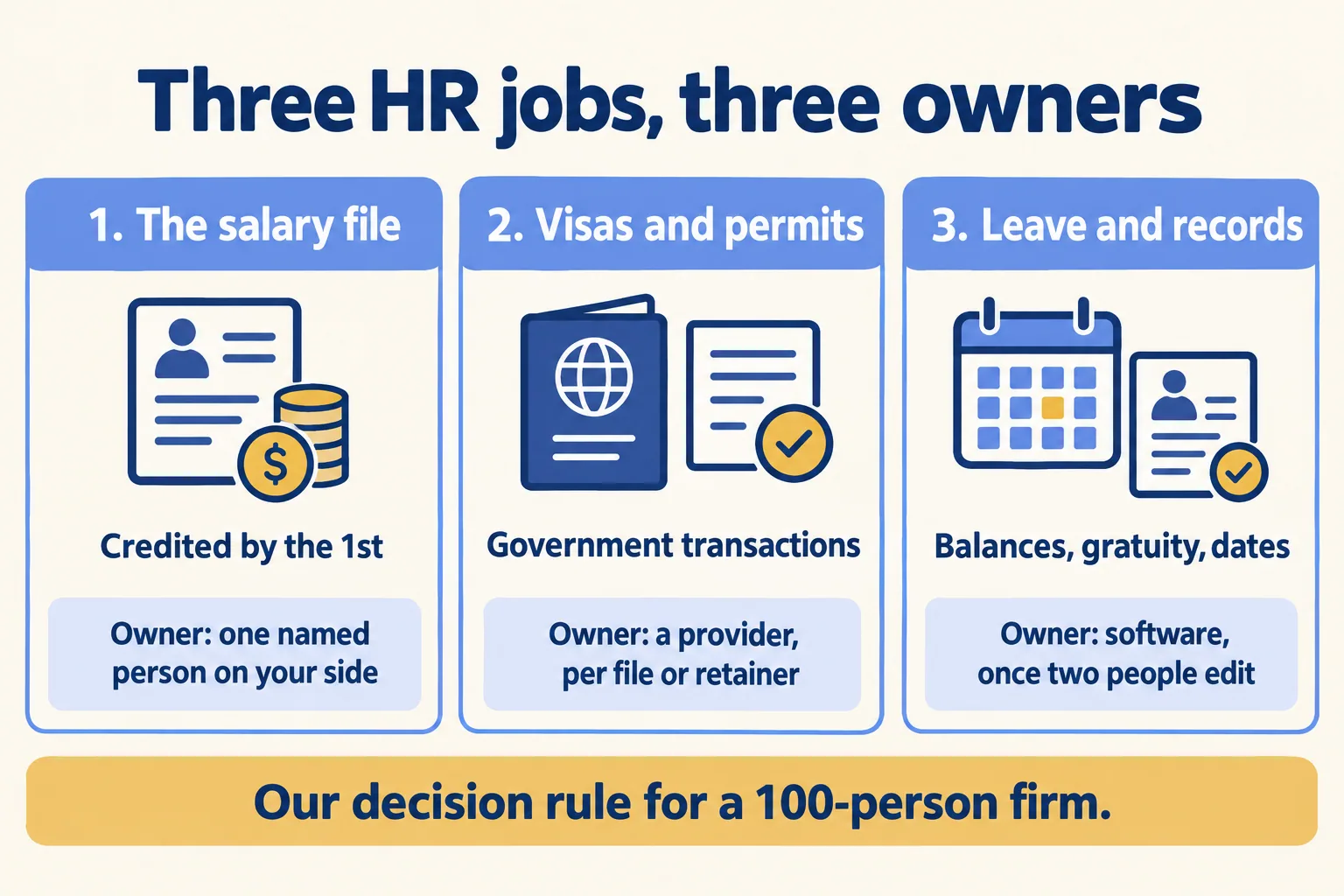
What the named person for job 1 checks before the 1st: the bank or exchange house has confirmed the file, the number of people paid matches the number on the payroll, and at least 85 percent of the wages due have gone out. Three checks, one name on them, and the owner does them whoever runs the payroll.
This is our rule, not a study. It differs from the vendor view in one way. PROXPAT's guide splits by headcount: under about 20 employees with steady numbers it says outsource, and with daily transactions it says in-house, often with a provider alongside. Headcount is a fair guide for job 2. It tells you little about job 1 or job 3, which stay with you at any size.
A test for job 2: count last year's visa, renewal and cancellation files. If a provider's per-transaction price times that count is less than a month of an officer's fully loaded cost, outsource the filing. PROXPAT's guide lists what an in-house officer costs beyond salary: their own permit, medical and insurance, gratuity accruing from day one, and cover for leave. The salary number is yours to fill in.
When is full outsourcing the right answer?
When coordination is the hard part, not the volume. PROXPAT puts it plainly: several entities or licences are a reason to outsource, because "the coordination across files is the hard part". Hiring in batches is the other case. A hiring drive for forty crew is a project with a start and an end, and a provider can staff it without you building a department for it.
Full outsourcing also fits a firm with no one on the payroll side at all. If nobody can own job 1, a provider that runs payroll and shows you the credit confirmation each month is better than a spreadsheet nobody owns. You still need one person who reads that confirmation before the 1st.
When does neither yet fit?
A crew under about 20 with steady headcount, no one editing leave records twice a month, and a payroll file the bank already accepts. Spend nothing until one of those changes. A retainer for 11 to 20 employees at AED 1,400 a month is a fair price when you hit the visa volume. Before that, pay per transaction.
"Neither yet" is not "never". These three events tell you it is over:
- A second person starts to edit leave or contract dates, and you now have two versions of one balance.
- A month where the file reaches the bank on the 29th because hours arrived late from a site.
- A hiring drive that doubles visa files in a quarter.
What does People do for job three, and what is left out?
Mindcat People covers job 1's arithmetic and all of job 3. It does not touch job 2. Here is what the live page describes.
- 01One monthly run makes every salary slip and the salary file in your bank's or exchange house's format. We build the file during setup and test it with them in a parallel month, one month run next to your current payroll.
- 02Leave, attendance, overtime and the end-of-service calculation sit on the employee record. Gratuity and overtime rules are set up for your contracts during setup.
- 03The employee record holds the Emirates ID, visa and iqama expiry dates, and an email goes to HR before each date. This is set up during setup.
- 04HR, finance and manager logins add nothing to the price.
What stays outside:
- Visas, work permits, Emirates ID, PRO and cancellations. People records the dates. It does not file anything. A provider or your PRO officer does.
- Recruitment.
- Sending the file to the bank. Your team uploads it, as today. There is no direct link to MOHRE, Mudad, Qiwa, Muqeem or GOSI.
- Your bank's or exchange house's own WPS fees.
If you want those expiry dates tracked across all company papers, such as trade licences and tenancy papers as well as staff papers, that is what Vault is for, with expiry emails.
What would 100 employees cost?
Here is what our page says today. You pay per employee on payroll a month: AED 29 for employees 1 to 50, AED 18 for 51 to 200. HR, finance and manager logins are free. For 100 employees that is 50 x 29 + 50 x 18, which is AED 2,350 a month.
The per-employee price comes with a monthly minimum, so no one can buy one seat at the per-employee rate. On the shared plan the minimum is AED 990, which covers up to 34 employees. At 100 you are above it. The page's own examples: 50 employees AED 1,450 a month, 150 employees AED 3,250.
Quick start is for up to 50 employees. At 100, setup is a managed setup, AED 9,900 one time, up to 200 employees. It covers importing your people, the structures, gratuity and overtime rules, attendance, the salary file with your bank and one parallel month. Prices exclude 5 percent UAE VAT and 15 percent Saudi VAT, and your bank or exchange house charges its own WPS fees.
Put that beside the payroll-only band: 100 employees at AED 35 to 90 a month is AED 3,500 to 9,000, and with visas and PRO coordination AED 8,000 to 20,000. Those are vendor ranges for a different job. The two lines are not the same service, so do not read one as a saving on the other. People does the arithmetic and the records. A payroll provider also takes on running the file. A PRO provider files the visas. Many firms of this size end up buying software for job 3 and a provider for job 2, and keeping job 1's owner in house.
What happens in the first working session?
We host People in the UAE and Saudi Arabia. We call the method One run, one file. For 100 employees, it starts with one call with whoever owns your salary file and your HR admin. We ask four things: how many people on how many sites, how hours reach the payroll today, which bank or exchange house takes the file, and what your last visa and renewal count was. Then you get a written plan, the go-live date and the monthly price.
If you are under 20 people with a steady crew, we will say wait, and point you to a PRO provider's retainer for the visas. If the leave balances and the salary file are the problem, tell us how many people you pay, on how many sites, and we reply with the plan and the monthly price. For who should own the file in the first place, read payroll company, Excel or software. Contractors can start from the facilities contractors page.
