
If clients ask for you by name but your card shows a company name they've never heard of, read this first. It is for the coach, consultant or adviser in Dubai who sells their own time and is choosing what goes on the page, the domain and the card. It is not for a firm with a team selling under one brand.
What is a personal brand?
Your name standing for the work, so people ask for you rather than for a firm. For one adviser, the personal brand and the business are usually the same thing. The question is only which name goes on the things clients see and save.
Most personal branding guides stop at the idea. The choice you face is smaller and more practical: your name or a business name, printed on a card, typed into a domain and written on an invoice. Get it wrong and you pay for it twice, once in print and once in a domain you no longer want.
Why does the name on the card cost a solo adviser?
Because the referral says one name and the card says another. A friend tells an owner in Business Bay to "talk to Leila". The owner searches for Leila and finds a card, a page or an email address that says something else. Now they have to work out whether it is the same person.
A naming-tool maker put the cost plainly (DEV, 21 November 2026): with a name that is not yours, "Strangers have to learn two things at once, who you are and what the thing is for." Our own Founder Page says the same about a shared company page: "It sells the firm. Your name sits under someone else's brand."
The same writer gives the fairest test we have read: "Would this name still make sense if someone else ran the company? ... If the answer is no, the name is describing the founder, not the product. That is fine when the founder is the offer."
When is a business name the better choice?
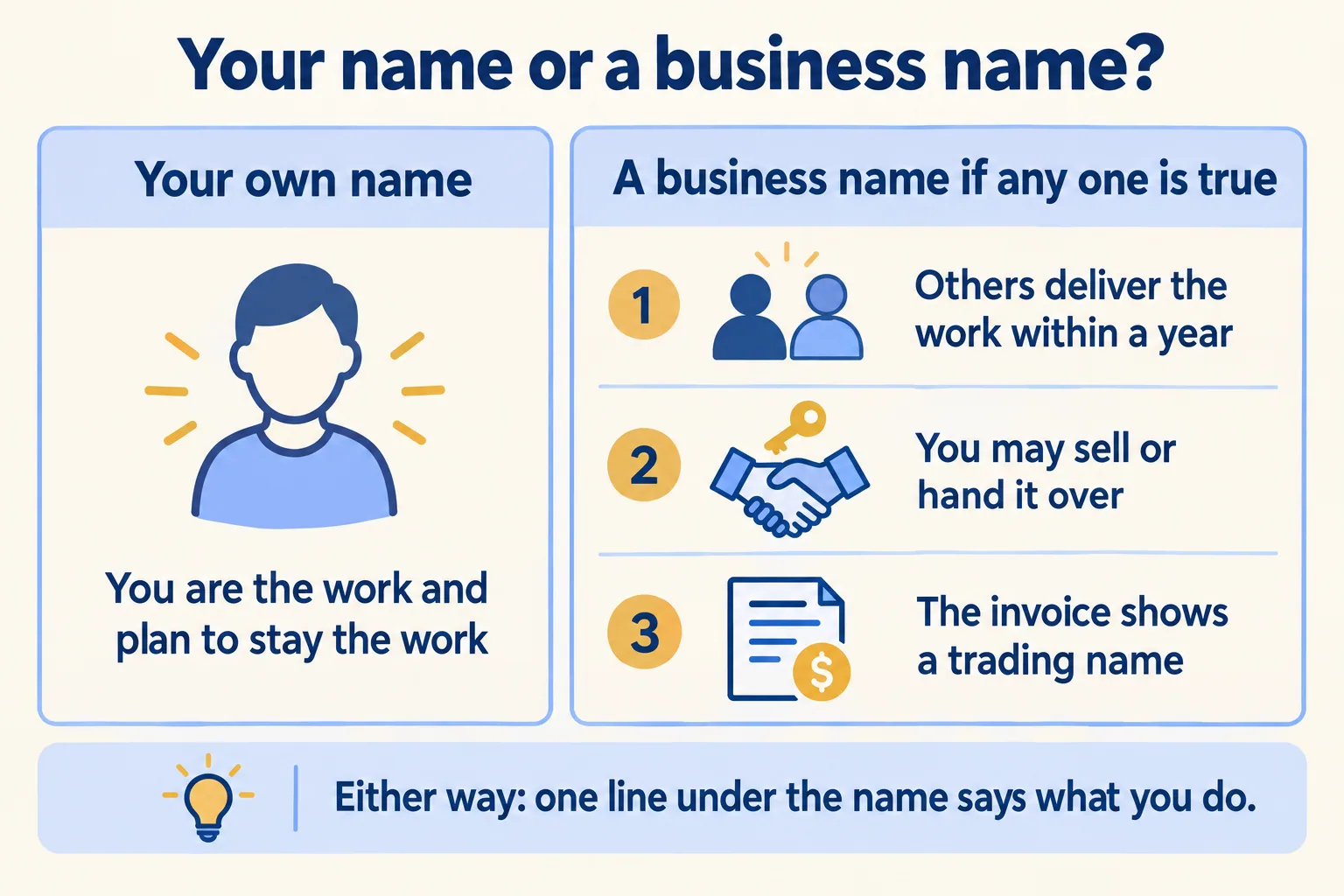
Our rule. Use your own name if you are the work and plan to stay the work. Pick a business name if any one of these is true:
- Someone else will deliver the work within a year. A social media consultant on the Being Freelance podcast traded under a company name because "I wanted people to be able to email clients on behalf of me". A copywriter on the same show chose a brand so that "if I added writers, I could keep the same name."
- You may sell or hand over the business. Ruth Gilbey, a coach who chose her own name, lists the cost on her podcast: "quite difficult to sell a personal brand to another company".
- Your licence already trades under a name clients will see on the invoice. If the invoice says one name and the card another, the client meets the mismatch at the moment they pay. Match the card to the invoice, or change what the invoice says.
None of the three true? Your name is the shorter path. Ross Simmonds, who started freelancing and later founded an agency, said on the same podcast: "especially in the early days of growth, people buy from people."
What do the .ae rules change?
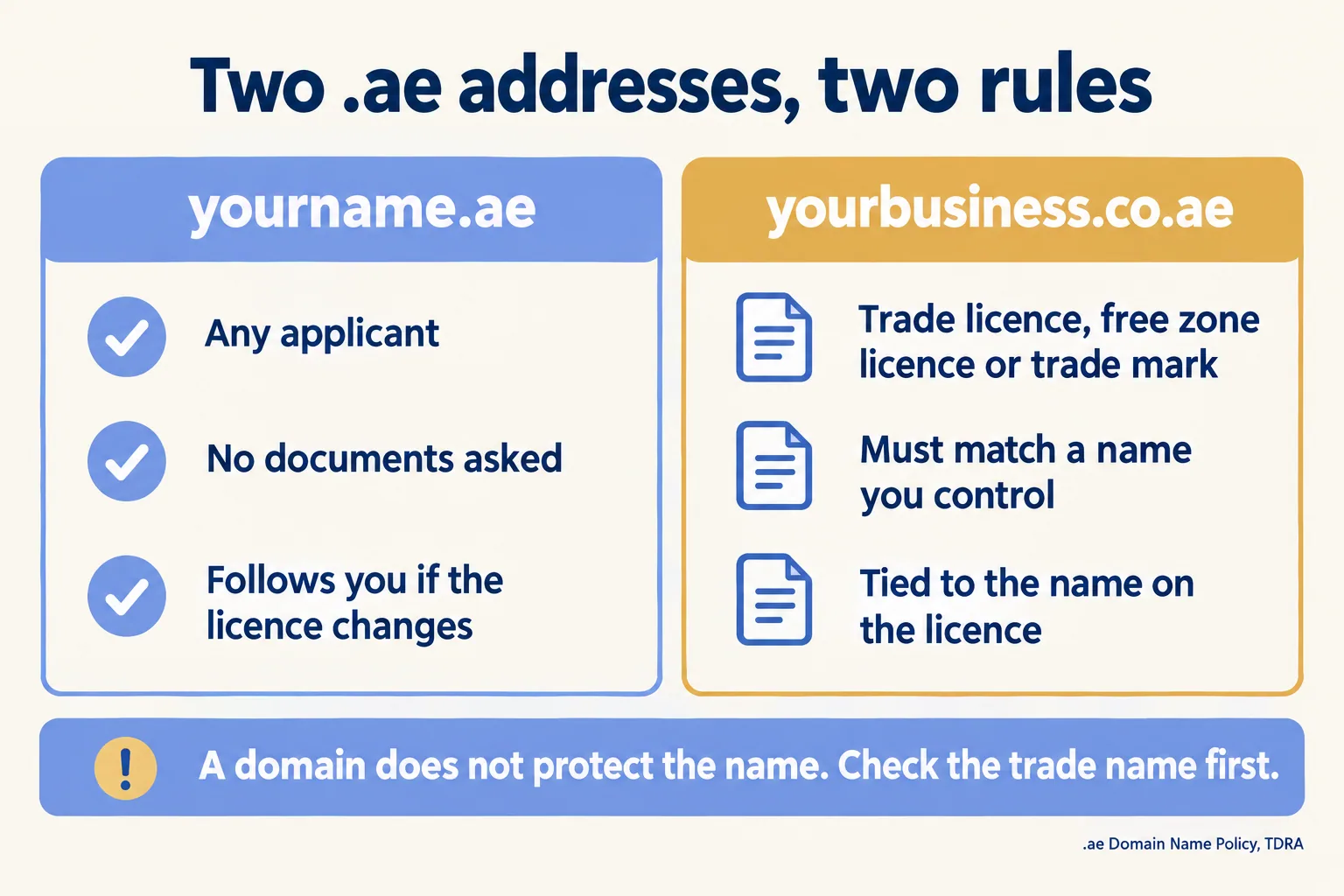
They turn this from a matter of taste into a real choice. The .ae Domain Name Policy (AEDA-POL-007, published by the TDRA) treats the two addresses differently.
| yourname.ae | yourbusiness.co.ae | |
|---|---|---|
| Who can register it | Any applicant. The policy says they "are not required to provide any documentary evidence" | "Commercial entities trading in the UAE": a trade licence, a free zone licence, or a UAE trade mark application or registration |
| What the name must be | Any name that meets the general rules | A match, acronym, abbreviation or close connection to a company, trading name or trade mark you control |
| If your licence changes (our reading of the rules above) | The domain stays eligible, because it never depended on a licence | Eligibility rests on the company, trading name or trade mark, so a name change means checking it again |
Two more lines from the policy matter. A registrant "does not own a Domain Name" but holds an exclusive licence to use it for a set period, so renewals are yours to keep track of. And the domain licence "does not of itself give rise to any intellectual property or other rights in the name". Owning the domain does not protect the name. Check the trade name with your licensing authority and ask a lawyer before you print.
For one adviser, that points to a simple order: buy the plain .ae in your own name first. Our post on buying a .ae domain in your own name covers how.
How do you get both: your name and what you do?
Put your name first and one line under it. On the Being Freelance compilation, a copywriter who had traded under a brand "reverted to his name and added on what he does": his name, then "Brand Copywriter". Ruth Gilbey gives the same advice for starting out: use your own name, then use "the strapline and messaging to explain what you do and how you help people."
The line does the work a business name would do. "Career coach for new arrivals in Dubai" tells a stranger what you are for. Your name tells the friend who referred them that they found the right person.
And if you grow, the two can live side by side. Simmonds kept building his own name while building the agency's, because "not every client is going to work with Ross".
How do the card, the page and the invoice line up?
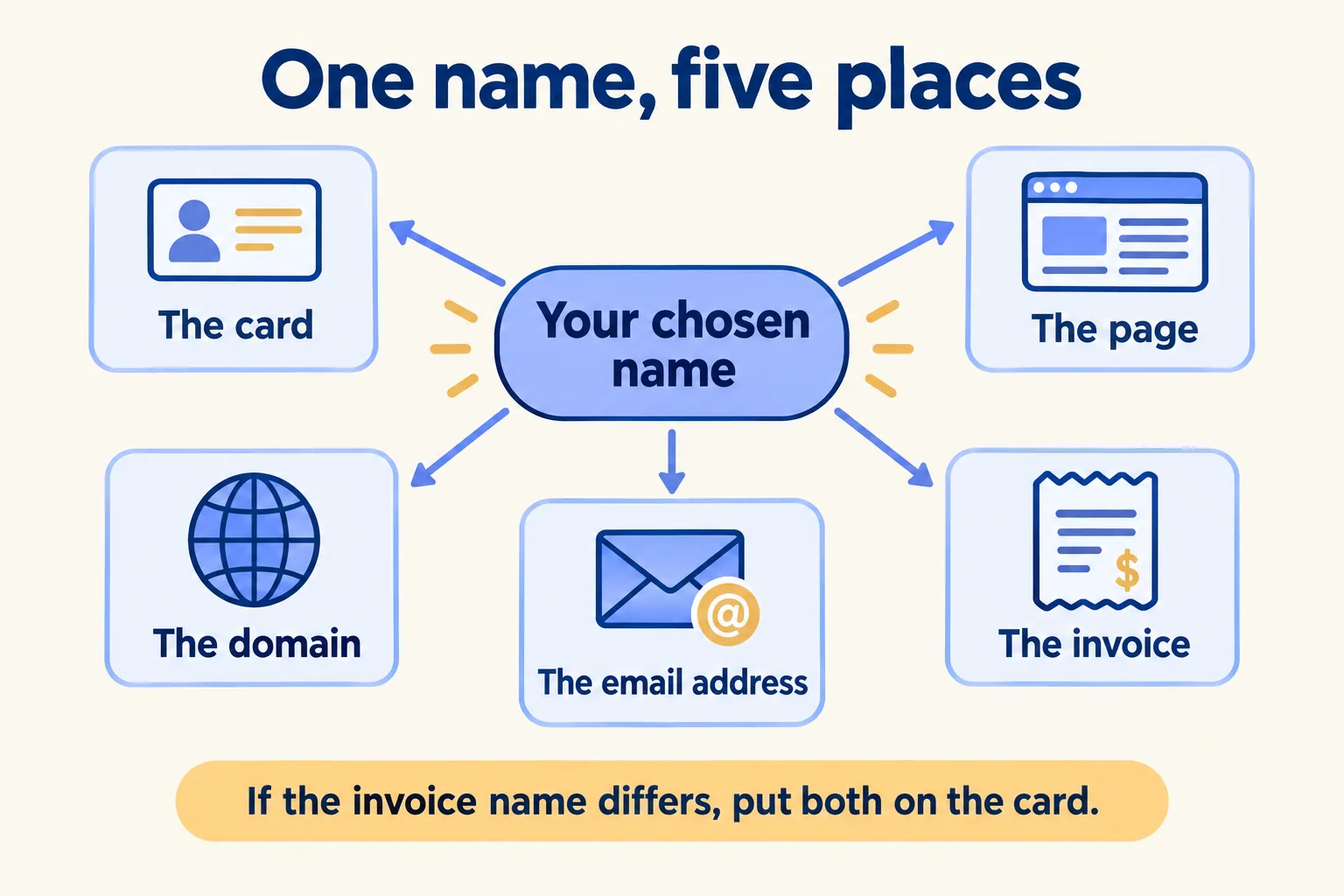
Whichever name you choose, five things should say it the same way:
- The card. One name and one web address you own. Our post on what to print on a business card keeps it to that.
- The page. Your name at the top, the one line under it.
- The domain. Bought in your name, at the registrar.
- The email address. On the same domain. See when to move off a gmail.com address.
- The invoice. The name your licence trades under. If it differs from the card, put both on the card: your name, then "trading as" and the licence name. Check the wording with your licensing authority before you print.
Then check the two places most clients meet your name first: the profile name on your WhatsApp Business account and your LinkedIn headline. Same name, and the same one line under it.
Who is this not for?
If you run a firm with a team selling under one brand, the business name is already the answer; this rule is for one person selling their own time. If you are about to hire someone to deliver the work, decide the business name before you print anything.
At Mindcat, we call the method Own the booking: the page, the domain and the contact sit in your name. A Founder Page is AED 4,200 once (AED 4,000 plus AED 200 VAT at 5 percent), on one invoice from Mindcat Technology Consultants FZE. You buy the domain from the registrar, in your name, at the registrar's price. We build the page on whichever name you pick, with your photo, one accent colour and one line from your own bio.
If clients ask for you and find something else, send us your bio line and the name you want on the page. We reply by email within 24 hours.
