
If your proposals go out from a gmail.com address, read this first. It is for the adviser, coach or consultant in Dubai who sells their own time and is starting to pitch people who have never met them. It is not for you if referrals fill your diary and you never send a proposal to a stranger.
Does a gmail.com address cost you work?
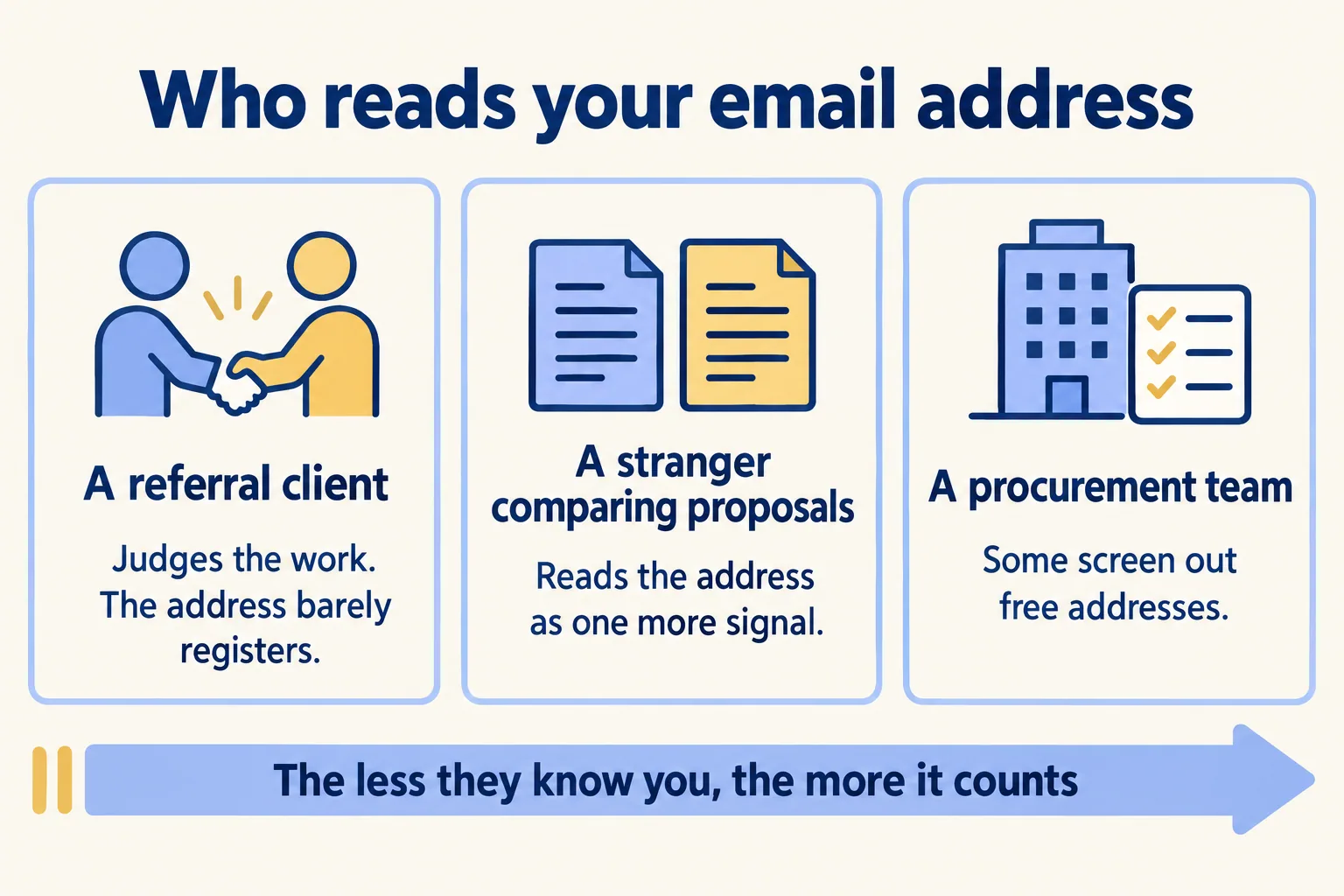
With the clients you have now, almost never. They came through someone they trust, they have seen your work, and they judge that. The address starts to count when the reader does not know you yet.
A studio owner who hires freelancers put it plainly on LinkedIn: "It's not that a studio wouldn't hire you if you used @gmail, but since anyone can get a free account it feels less certain that this person is a professional if it's the first time speaking with them." The other side, in the same thread, from a freelancer: "My Gmail has never been an issue for me before with clients."
Both are true, because they describe different readers. Mail Minted, a company that sells business email and says so, splits it the same way. With referral clients, the address "barely registers". For small businesses comparing providers it is "a thumb on the scale". For "larger companies, procurement processes, corporate clients", it says, "the free address genuinely costs you", because some vendor processes flag free-mail addresses.
When can you keep the free address?
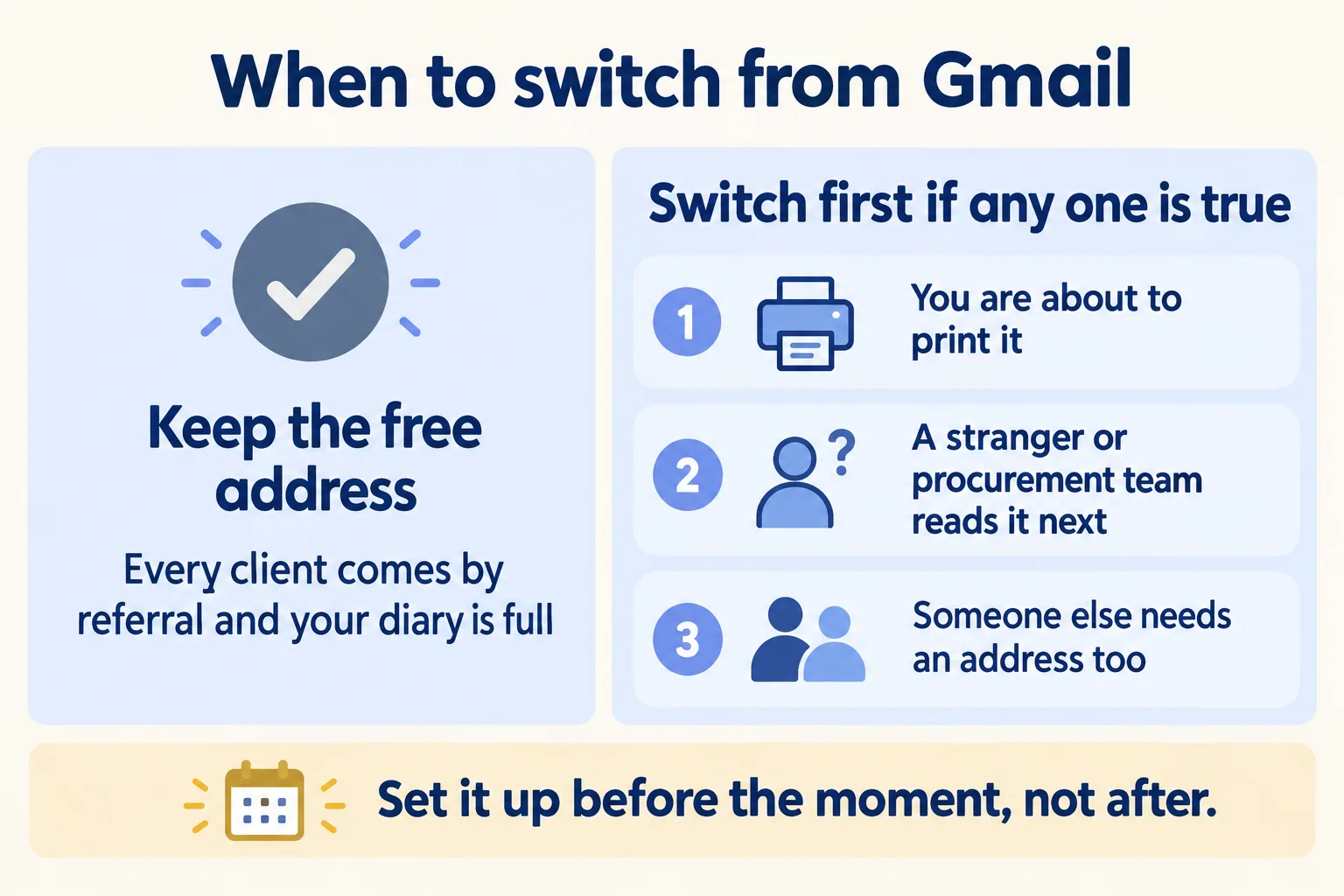
When every client still comes by referral and your diary is full. One LinkedIn writer on the subject: "if you are getting all your clients through word of mouth and you're fully booked.... It probably doesn't matter."
Most guides on a custom email domain tell you how to set one up. Few tell you when to wait. Our answer: if nobody who reads your email is meeting you for the first time, spend the money on something else this month. The address is not what your business needs yet.
Which three moments mean switch now?
Our rule. Keep the free address until one of these is true. Then set up email on your own domain before it happens, not after.
- You are about to print it. A business card, a proposal template, the contact line on your page. Mail Minted's line: "printing a free address commits you to it." Our post on what to print on a business card puts one web address you own on the card. The email address beside it should match.
- A stranger or a procurement team is your next reader. A cold pitch, a tender, a company's supplier form. This is the reader who has nothing else to judge you by yet.
- Someone else needs an address too. An assistant, an associate, a second adviser. Each one on a separate free account is a business nobody can see as one.
Why does the domain matter more than the look?
Because of the day something goes wrong with the account. The look is the reason people talk about. Recovery is the reason that costs you.
Mail Minted again: "A free account can be locked by automated systems with no warning and, in practice, no appeal." When that address is on every invoice and in every client's contacts, you lose the inbox and the address together. With your own domain it goes the other way. An address on it "can be repointed to a new provider in an afternoon", because the domain, the part everyone knows, belongs to you.
That holds only if the domain is registered to you. A domain bought by a designer or a friend in their own name gives you an address you still cannot move. Start with buying a .ae domain in your own name, and the address follows it.
What are you paying for, and to whom?
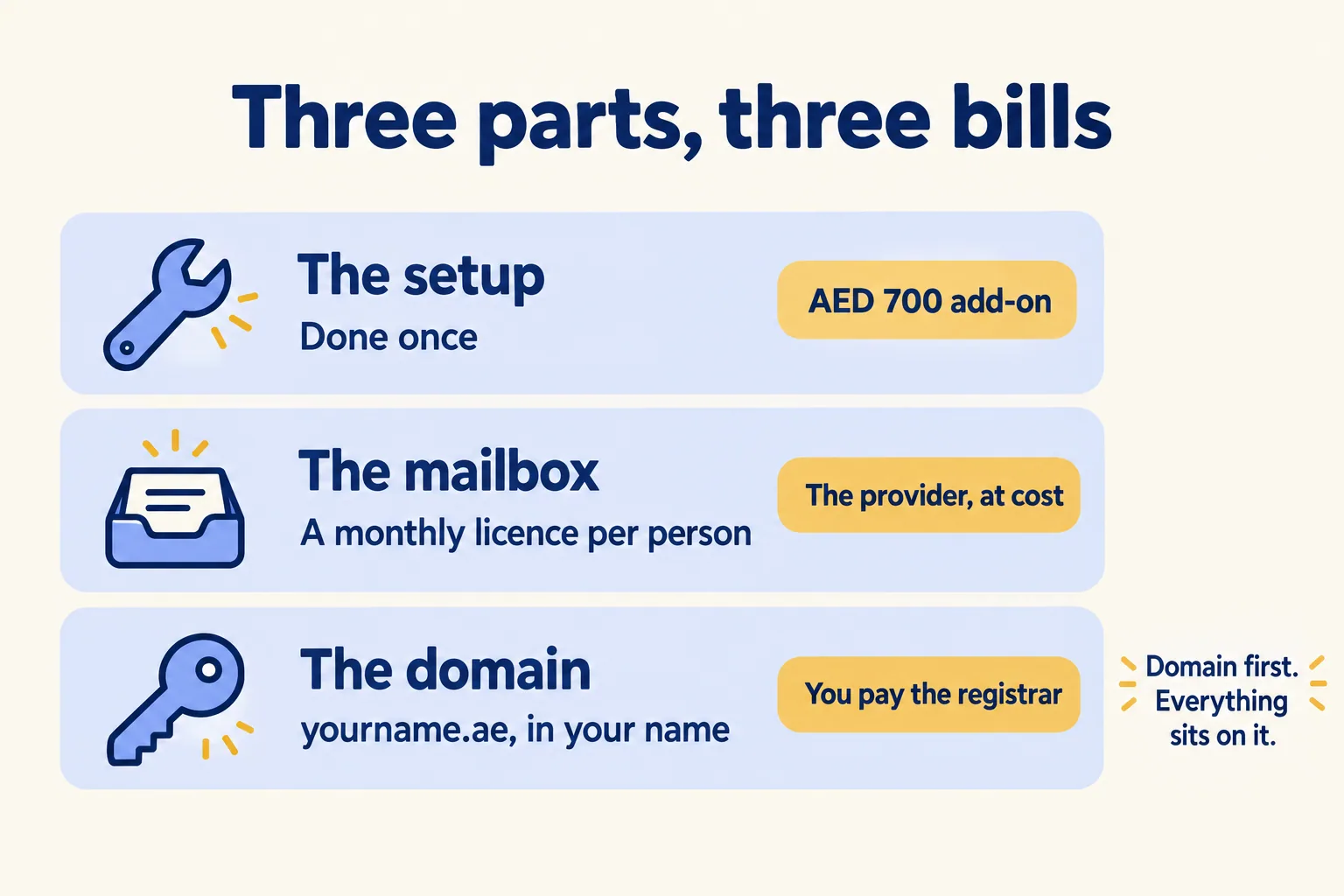
Three parts, and buyers often blur them into one price.
| Part | What it is | Who you pay |
|---|---|---|
| The domain | yourname.ae, the part people remember | The registrar, directly, in your name, at their price |
| The mailbox | The inbox itself, a monthly licence per person | The mailbox provider. On a Founder Page it is billed at cost |
| The setup | Pointing the domain at the mailbox and making the address work, once | On a Founder Page: the Email on your domain add-on, AED 700 before VAT |
The mailbox price is the provider's, and it changes. Google's UAE pricing page showed the Starter plan at USD 7 a user a month, with an introductory USD 3.50, when we read it on 16 November 2026. Check the provider's own page on the day you buy. Which provider to pick is a separate question, and the answer depends on what you already use.
The domain stays yours whichever provider you choose. That is why the order matters: domain first, in your name, then the mailbox on top of it.
How do you switch without losing a reply?
Do not close the old account. Mail Minted's advice is the safe one: set up the new address, "forward the old Gmail to it and keep the old account alive indefinitely as a catch-net", reply only from the new address, and let the old one fade "over a year rather than a day."
Then change it everywhere you control in one sitting: your signature, your page, your link in bio, your LinkedIn contact line and the next print run of cards. A client who saved the old address still reaches you, and every reply they get comes from the new one.
Who is this not for?
If referrals fill your diary and you never pitch a stranger, keep the free address and come back the month that changes. If you have not bought a domain in your own name yet, do that first; an address on someone else's domain is not yours to move.
At Mindcat, we call the method Own the booking: the page, the domain and the address sit in your name. A Founder Page is AED 4,200 once (AED 4,000 plus AED 200 VAT at 5 percent) on one invoice from Mindcat Technology Consultants FZE. Email on your domain is an add-on at AED 700 before VAT, with the mailbox licence billed at cost. You buy the domain from the registrar at the registrar's price.
If your next proposal goes to someone who has never met you, send us your bio line and the domain you own. We reply by email within 24 hours.
