
If you hand out printed cards with only a phone number, read this first. A client who meets you once has nothing on the card to check before they call. This is not for you if you only get referrals and never hand out a card.
What can a client check from your card?
Nothing, if the card carries a name and a number. The person you met goes home, wants to know you are real and registered, and has two options: call you cold or search your name and hope.
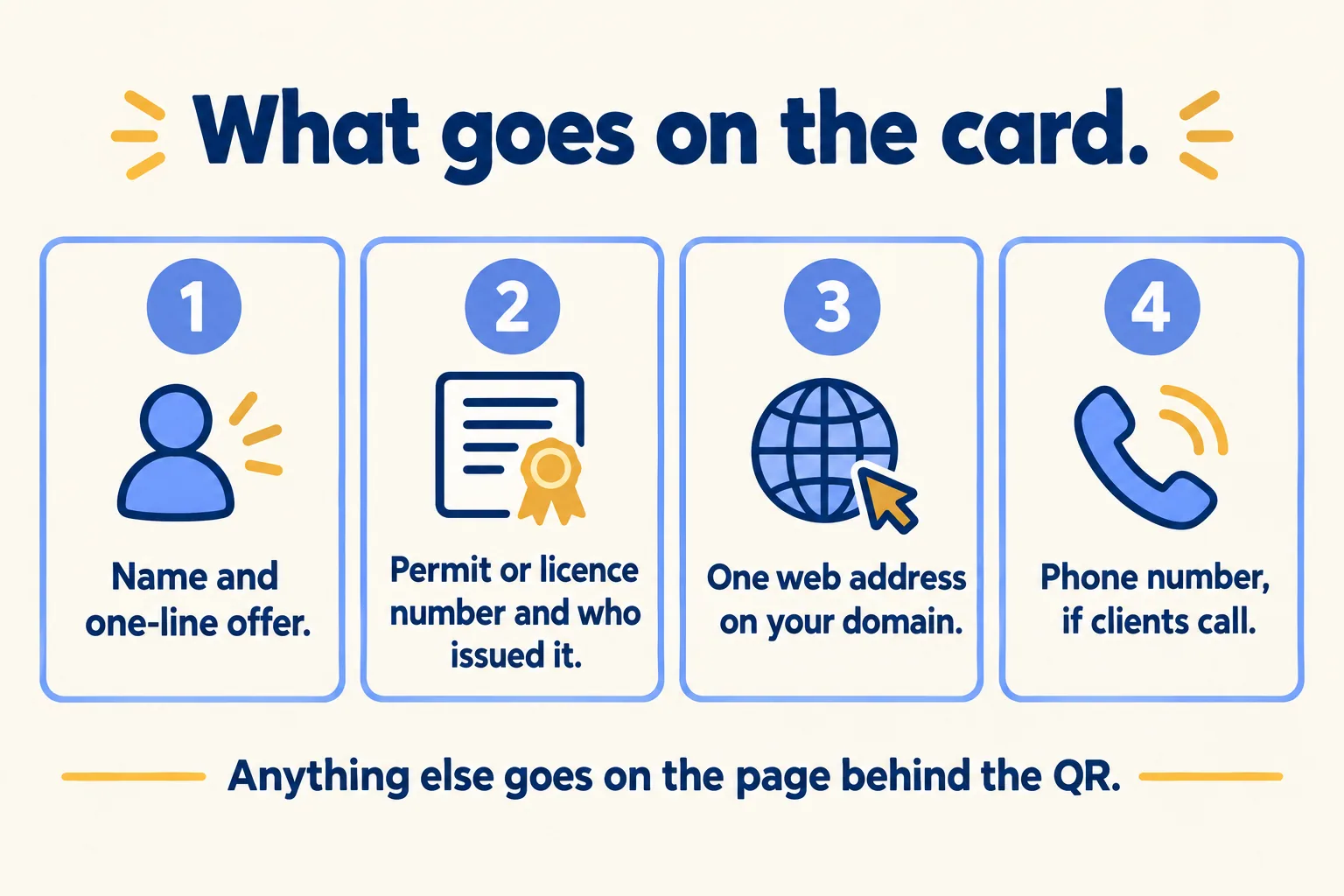
Give them a check that takes ten seconds. Four things pass that test:
- Your name and one line on what you do for whom.
- Your permit or licence number, with the authority that issued it.
- One web address on a domain you own.
- A phone number, if clients call you.
Everything else goes on the page behind the address. Printers' category pages sell the card itself. What an independent adviser should print on it, and what the QR should open, is left to you.
Permit or licence: which one goes on the card?
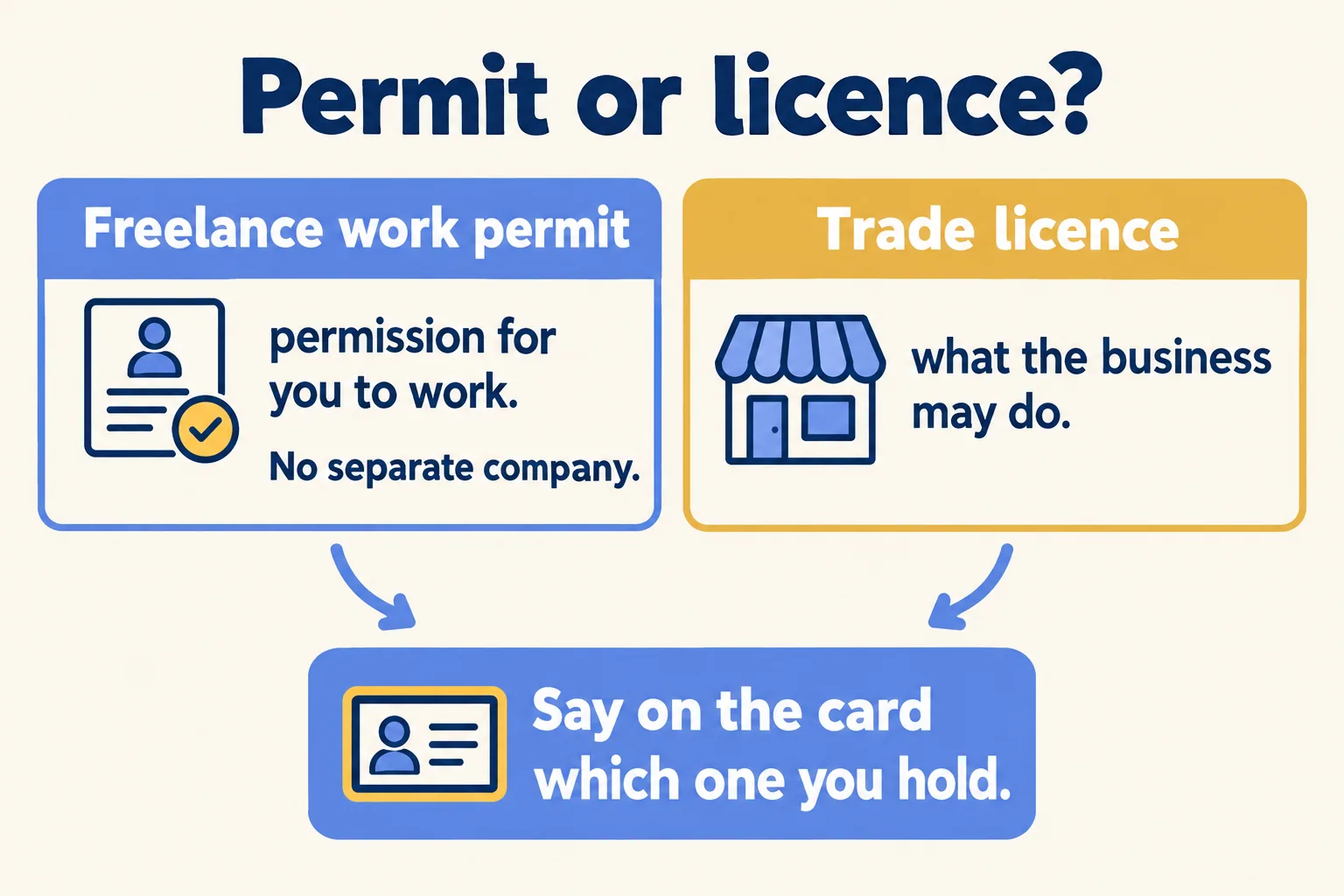
They are different documents, and the card should say which you hold. Sources describe a freelance permit as a permit to work, with no separate legal entity, and a trade licence as what the business is licensed to do. A client who looks up the wrong one finds nothing, and may read nothing as a warning.
The receipt is a lookup anyone can run. The UAE Government's page on verifying business licences, dated 27 October 2026, says "Several channels and platforms can be used to get information about a business licence. These include websites of DEDs in each emirate and National Economic Register." For Dubai it links Dubai Economy and Tourism's licence search, which takes a licence number or a trade name. A free zone licence is checked with the free zone itself.
If you are still deciding whether the permit is enough yet, see freelance permit in Dubai: website now or wait.
Try it before you print. Search your own number the way a client would. If it does not come up, find out why before the card goes to a printer.
Does the licence number have to be on the card?
Sources disagree on this. QX137, in a guide dated 20 September 2025, says Dubai-licensed businesses "are required to display their trade licence number in business communications." One Bit Launch, dated 27 February 2026, says the requirement applies to businesses transacting online, and that for a site that does not take orders it is "less explicit, but displaying it is still strongly recommended."
Ask the authority that issued your licence which rule applies to you. Then decide on the card as a seller: the licence line costs a few characters, and it answers the first thing a cautious client wonders.
If you sell through a website or a social account, TDRA has a separate service, the NOC for Practicing E-Activity. Its service page says a website used for the activity must have a national .ae domain and social accounts are listed by name and link. That ties your card's web address to a domain you own, and buying a .ae domain in your own name is the first step. Read the service page and confirm with TDRA before you rely on it.
Where should the QR point?
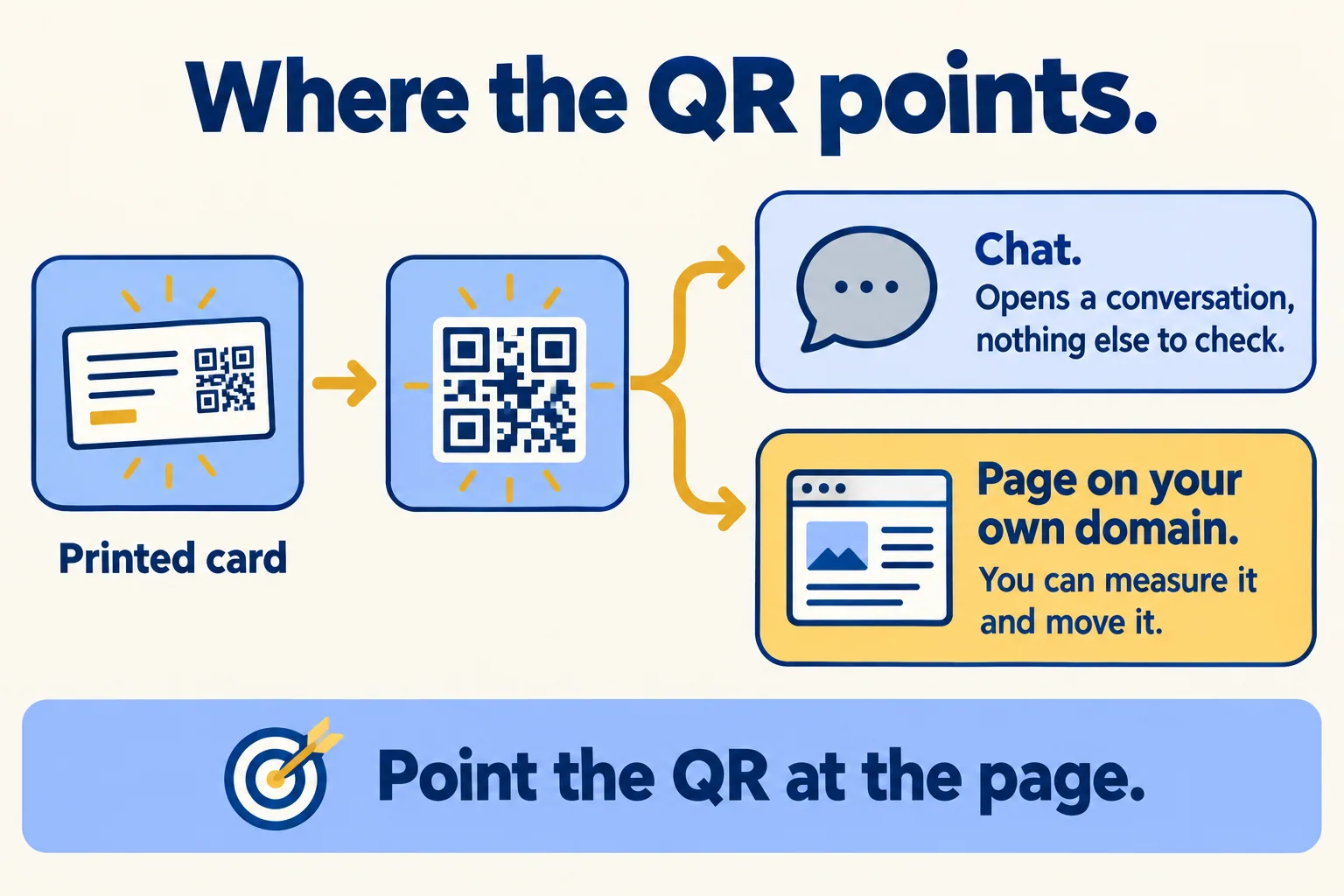
At a page you control, not at a chat. WhatsApp's own help centre says your QR code "won't expire unless you reset it or delete your WhatsApp Business account," and that you can set a pre-filled message the customer can edit. It describes no scan counts. A QR to a page on your own domain is one you can measure on that domain, and one you can move if your number changes.
We covered the other failure in a QR card that points at the card vendor's domain: the same card, on someone else's address.
How many cards should you print?
The smallest run you will hand out in a quarter. A licence number can renew, a title can change, and a domain can move. A card printed for a year carries every one of those risks. Print less, reprint when something changes, and keep the QR pointing at a page you can update.
Our rule in one line: print a quarter's worth, put on it only what a client can check in ten seconds, and aim the QR at the page.
What does the page cost, and what do we add?
A Founder Page is AED 4,200 once, which is AED 4,000 plus AED 200 VAT at 5 percent, on one invoice from Mindcat Technology Consultants FZE. The domain is bought by you from the registrar at the registrar's price. Add-ons are priced before VAT: a Dubai headshot AED 1,500, a LinkedIn rewrite AED 1,200, and email on your domain AED 700, with the mailbox licence billed at cost. Hosting is optional at AED 199 a month. Extra work is quoted in writing at AED 900 an hour.
At Mindcat, we call the method Own the booking: the page and the book button sit on a domain you own, on the contact you already use. We do not print, design or program cards. The card is yours; we build what it points at.
If you hand out cards and a client cannot check anything on them, send us your bio line and the domain you own. We reply by email within 24 hours.
