
If you send people from your bio to a page that is not on your own domain, read this first. A link list works while the people tapping it already know you. This is not for you if your diary is full from referrals, or if you are a creator with many unrelated links to share.
What does a stranger see when they tap your bio link?
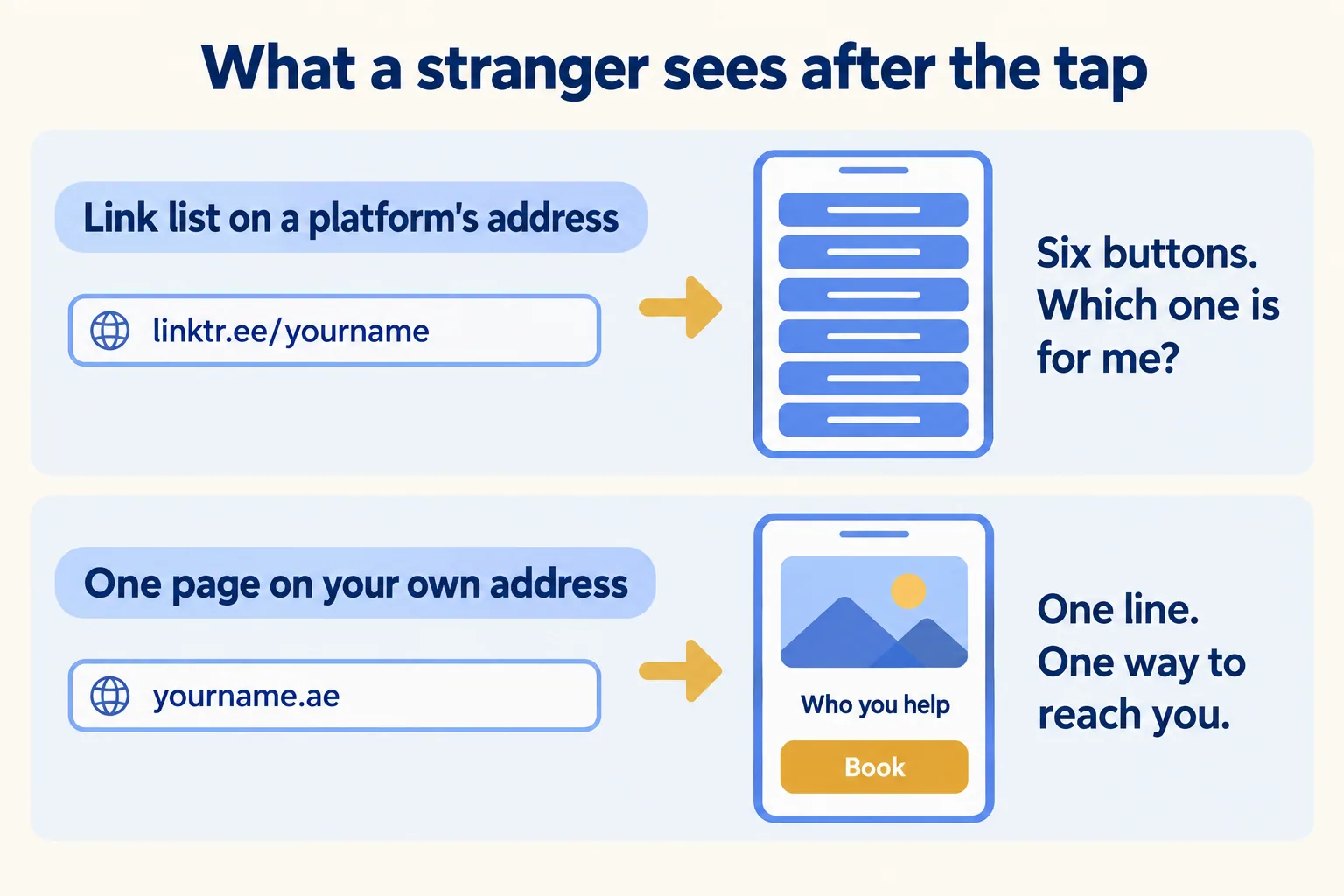
A list. A friend gives a Business Bay owner your name. They search for you, find your Instagram, tap the link in your bio and land on a page of buttons. It may be a clean page. It does not say who you help, what a first session looks like or how to reach you without choosing one of six buttons.
Trainaq, a vendor of coaching software, puts it this way in a post dated 21 October 2026. A link-in-bio page is enough when your followers "already know you and only need a quick route to WhatsApp or a payment link". It is not enough to win clients who have never met you, because it "answers none of these on the page itself": who do you coach, what does it cost, how does it work, how do I start. Trainaq sells a rival website builder, so read that as a vendor's view. The test below lets you check it on your own link.
Whose address is it?
Not yours, unless you paid to make it yours. Linktree's pricing page, read on 2 November 2026, lists a free plan and Starter, Pro and Premium plans, with prices shown in local currency. Two reviews dated 2026 agree on the free plan: the address stays linktr.ee/yourname. They disagree on the fix. NiftySite (25 April 2026) says a custom domain needs Starter or higher. linksync (4 July 2026) says it is locked to Pro. Both are third-party reviews, so check Linktree's own page on the day you decide.
Francesca Segato, a web designer, calls the same thing "living in someone else's house". Her point is practical: when the bio points to linktr.ee/yourname, the domain, the design rules and the visitor data are the platform's. If the platform changes its terms, the address you printed on every card does not move with you.
NiftySite adds a second cost. It says Google does not rank Linktree pages meaningfully for a name or a service. You can test that in ten seconds: search your own name, then search what you do plus Dubai, and see whether your link page appears.
When is a link-in-bio page enough?
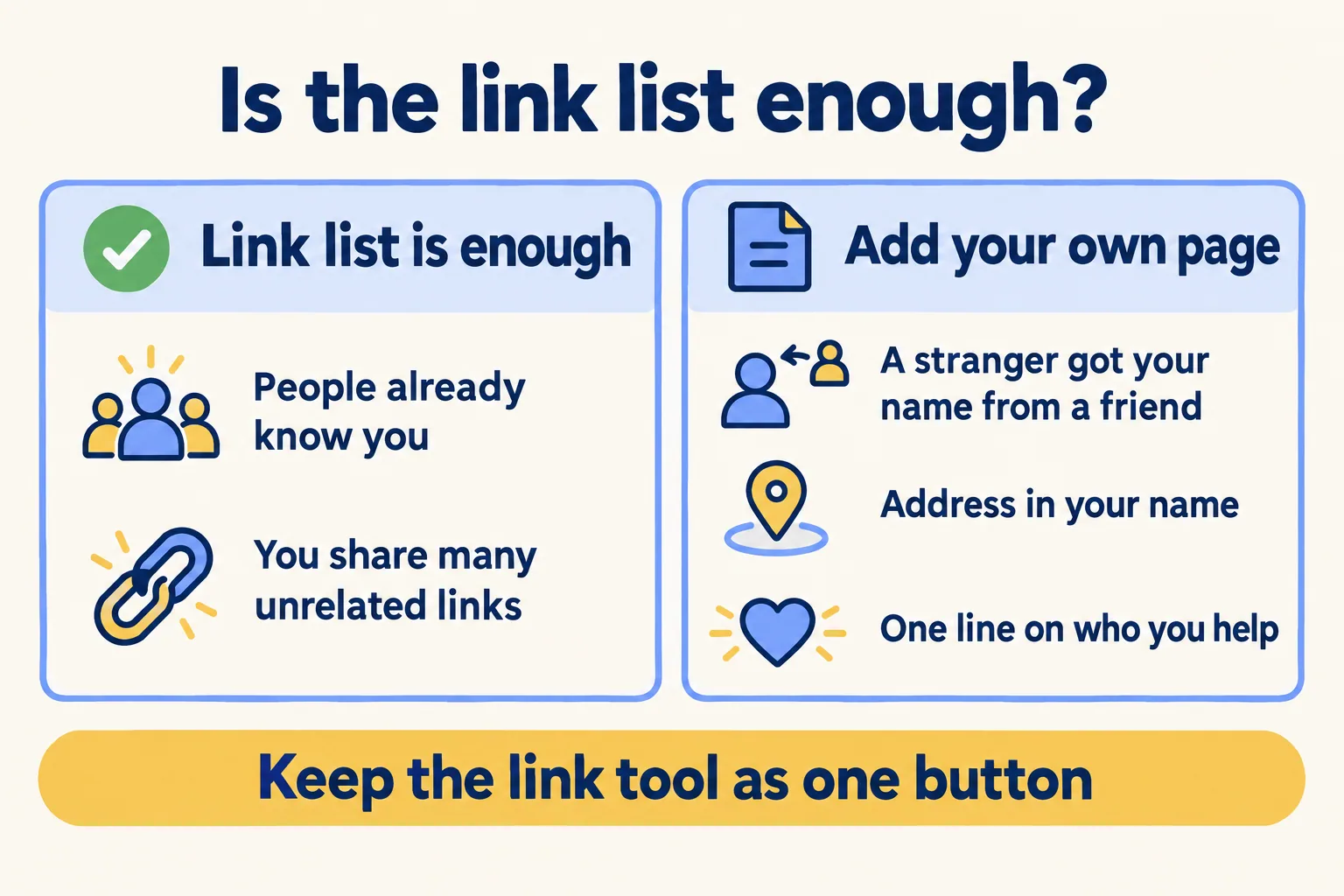
Often. If you are a creator with a podcast, brand deals, a shop and several channels, a link list is the right tool. NiftySite says so, and so does Trainaq: keep it, and put your coaching page near the top.
It is also enough while everyone who taps already knows you. A follower who wants your WhatsApp does not need a first screen that explains your work.
It stops being enough on the day a stranger gets your name from a friend. That person has no reason to read six buttons. They want one line that says who you help, and one way to reach you.
What is the one-minute check?
Here is the rule we use with a Dubai adviser. It takes one minute and costs nothing.
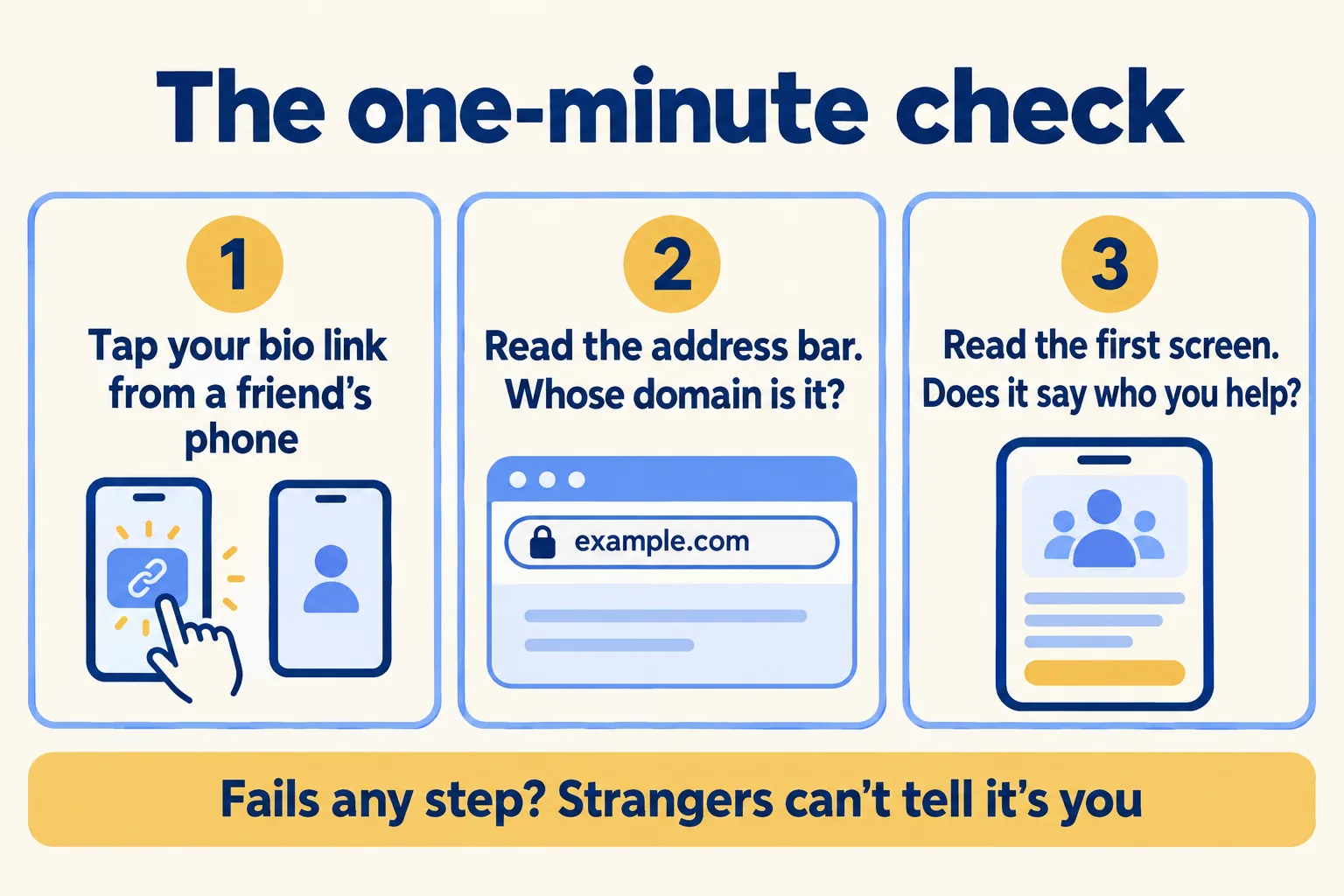
- Take a friend's phone, not yours, so you are not logged in.
- Open your Instagram or LinkedIn profile and tap the link in your bio.
- Read the address bar. Whose domain is it?
- Read the first screen without scrolling. Does it say who you help?
- Tap the main button. Does it open a contact you actually answer?
If the address is yours, the first screen names who you help and the button reaches you, keep what you have. If any of the three fails and strangers reach you through that link, you have a gap that costs you first messages and you will never see it.
What do you put behind the bio link instead?
One page on a domain in your name. Trainaq and Segato land in the same place from different sides. Trainaq: "put your website's address in your bio, and it does both jobs". Segato runs a links page on her own domain, at her own address, so a visitor who wants to know more is already on her site. A single well-built page, she writes, is "worth infinitely more than an elaborate Linktree".
You keep the link tool if you like it. It becomes one button on your page, or the page becomes the link in the tool. The change is which address a stranger sees first, and who controls it.
That is what a Founder Page is: one page in your name, on a domain you own, with your photo, one line about who you help and one book button. The button opens the Gmail, LinkedIn or WhatsApp you already answer. A client who arrives from your bio can reach you with your name already in the first line. We do not sell link-in-bio tools or cards.
If the domain is the open question, read how to buy a .ae domain in your own name first. If you hand out a QR card, check whose address sits behind it. If you are still at the permit stage, read the permit post.
What does it cost, and what do we add?
This is what the live Founder Page states today, on 2 November 2026.
The page is one page, without a shop, a blog or a booking calendar. If you would rather build it yourself in a page builder, the live page says that has the lowest cash cost and costs you your evenings.
You see the page before it goes live, and a yes puts it on your domain. We never hold your domain. The few days to go live start when your domain and your bio line reach us.
Our method is called Own the booking. You tell us what you sell and where people book you today, and we reply by email within 24 hours. We do not promise a Google listing or leads. Mindcat is a Dubai company, founded in 2022. If your bio link is not on your address, tell us what you sell and where people book you today.
