
Founder Page (one page on your own domain for coaches and consultants)

UAE

Handing out a QR business card? Read whose address is behind it first

By Shivanath DevinarayananPublished 6 min read
Written forOperations or sales lead at a mid-market UAE business“Leads go cold before anyone replies.”

The short answer

Is a digital business card enough for a Dubai adviser, or should the QR point at your own page?

Scan your own card and read the address it opens. If it sits on the card vendor's domain, only the vendor decides whether it still works. If it sits on a domain in your name, the card is fine. At Mindcat, we build a Founder Page on your own domain for the card to point at.

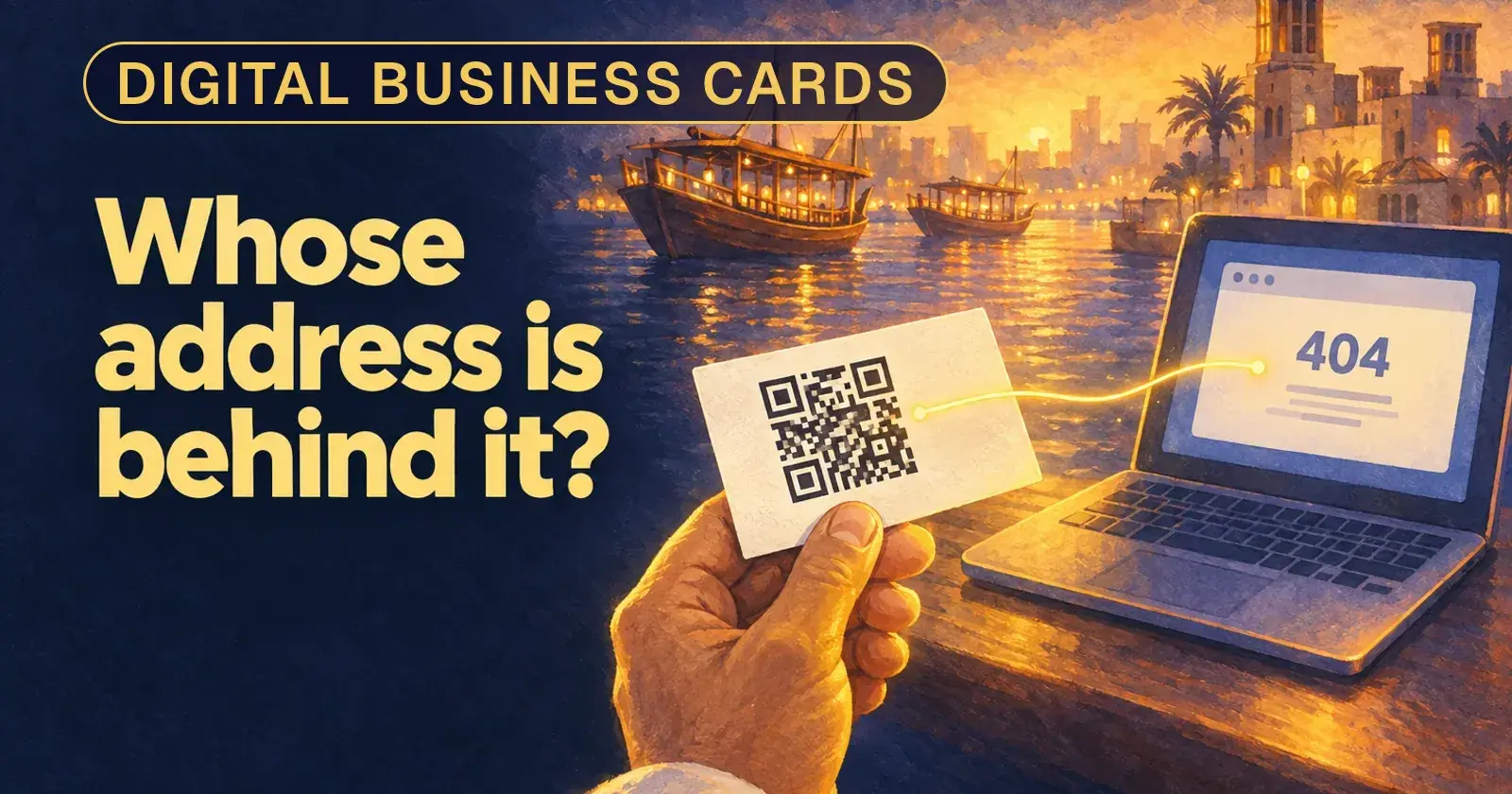
A hand holds a QR business card, a gold line leads to a laptop showing a 404, with the words Whose address is behind it

Takeaways

  1. 01A QR code is a printed web address. Whoever controls that address controls what your card does.
  2. 02Vendors differ when a plan ends: one says paid cards return a 404, another says trial cards stop and standard cards keep working.
  3. 03An NFC chip holds a web address, not your details. A locked chip can never be rewritten.
  4. 04A digital card is enough when you only swap contact details at events and a dead link would cost you little.
  5. 05The fix is a one-page fallback on a domain in your name, then a card that points at it.

If you hand out a QR card and the link behind it sits on someone else's domain, read this first. A card that points at an address you do not control works only while someone else keeps it running. This is not for you if your clients arrive only by referral and never ask for a link.

What is behind the QR code on your card?

An address. A QR code is a printed web address, nothing more. One card vendor, NexaLink, puts it this way in an article updated on 9 August 2026: "A QR code is just a printed URL: it keeps encoding the same address forever." If that address is on the vendor's domain, "only the vendor can decide whether it still resolves, and you cannot redirect it."

So the test costs nothing. Scan your own card. Copy the address from the browser bar. Read the domain. If it ends in the card company's name, the page behind your card is theirs. If it ends in a domain you bought in your own name, it is yours.

The same article has a table of five card platforms. Its summary is that only one documents a customer-owned domain, and that one needs an enterprise plan with a 100-seat minimum. That is one vendor's table, checked on 9 August 2026, and it says some of its figures for other platforms are unconfirmed. Read it as a prompt to ask your own vendor, not as a ruling on any of them.
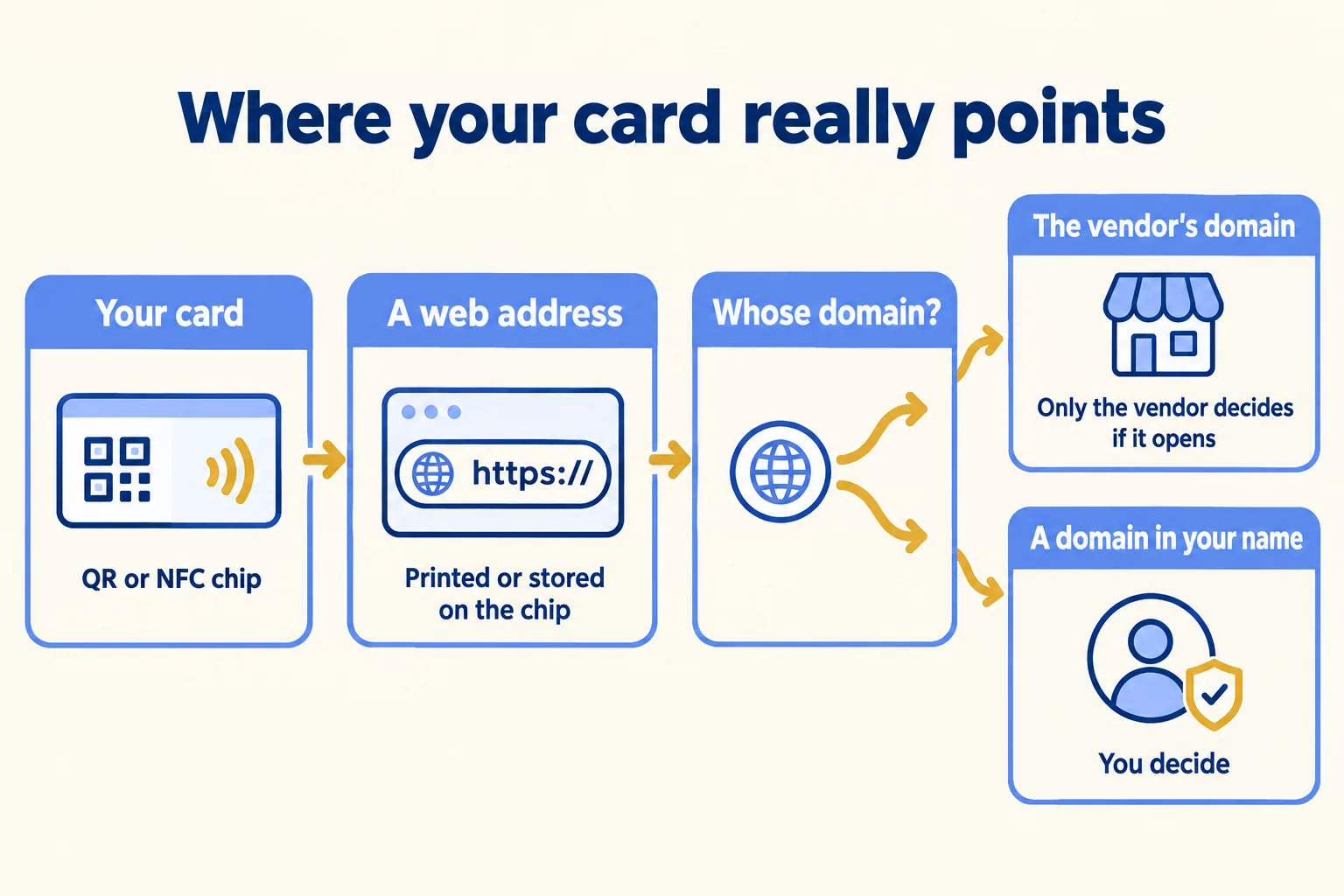
A card holds a web address. On the vendor's domain, only the vendor decides if it opens. On a domain in your name, you decide
Where a card's address can sit.

What happens when the subscription ends?

It depends on the vendor and the card, which is the point. Here is what three vendors say on their own pages.

SourceDateWhat it says
FollowMySite25 September 2026On monthly or yearly plans, once the end date passes the public card returns an HTTP 404. It does not fall back to a reduced page. Lifetime plans have no end date.
Cardless Club, reporting on the V1CE help page19 October 2026Free trial cards stop working when the trial ends or the subscription is cancelled, with no free-plan fallback. Standard cards keep working with or without a subscription.
NexaLink9 August 2026A card on the vendor's domain depends on the vendor for as long as the address is used. A custom domain is documented on its Business and Agency plans.

Three vendors, three outcomes. We do not say what any other vendor does. Before you pay, ask yours one question in writing: what does the link show on the day after my plan ends, and can I point it somewhere else?

The reason it matters is the person who scanned. They hold a card from a meeting, open it a month later to book you, and see a 404. They do not call the card company. They book someone else.
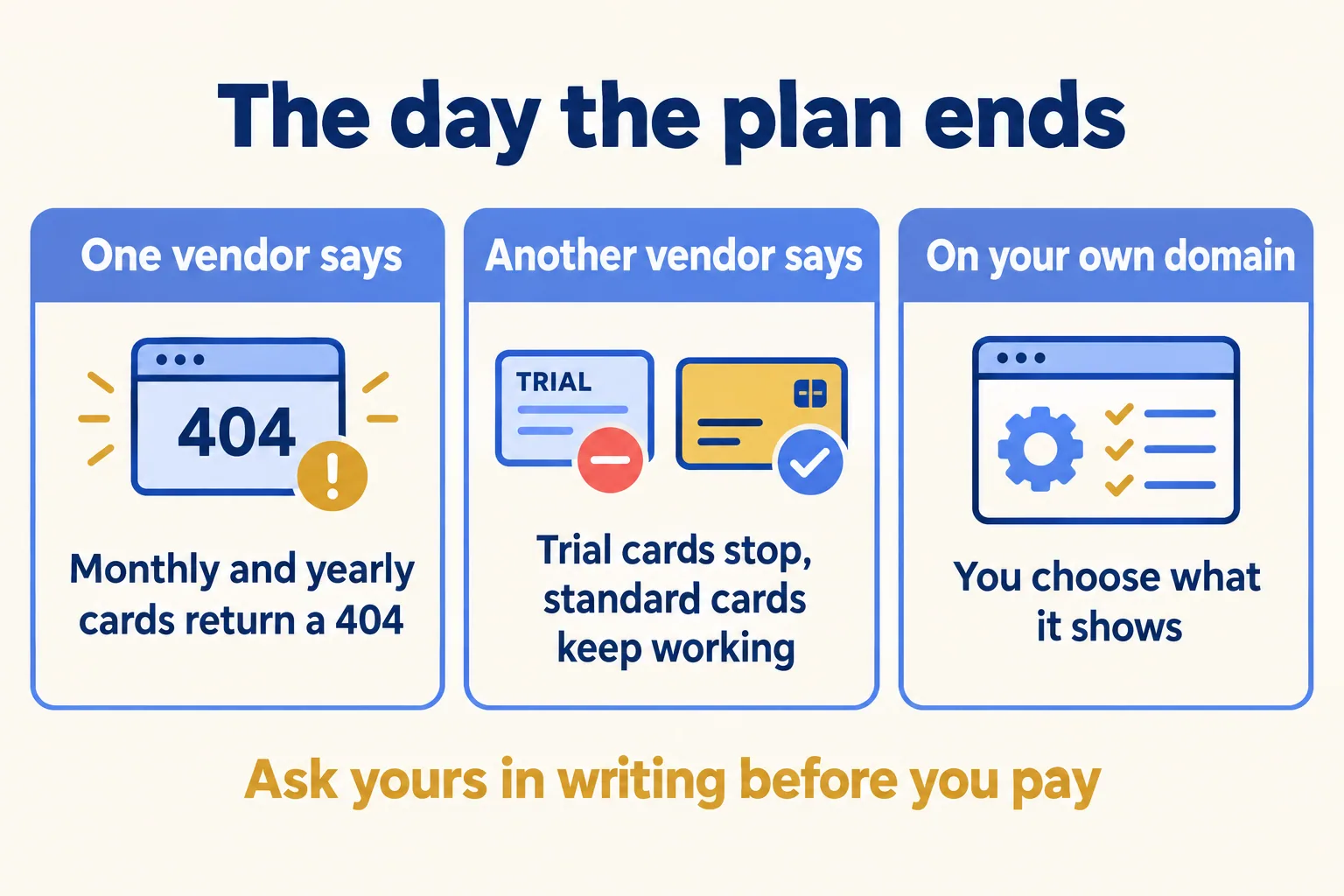
One vendor says monthly and yearly cards return a 404. Another says trial cards stop and standard cards keep working
Two vendors' own words, read on 26 October 2026.

Is the chip the problem?

No. The address is. Cardless Club explains that an NFC chip "stores one short thing: a web address." Your name, number and links sit on the page that address opens, not on the card.

So an NFC card does not die when a plan ends. It holds an address that may open nothing. There is one more detail to ask about. Cardless Club says an unlocked chip can usually be rewritten with a free app, and a locked chip "can never be changed, by you or anyone." If you are about to order a batch, ask whether the chips are locked, and to what address.

When is a digital card enough?

Often. If you meet people at events and only need to swap contact details, a vendor-hosted card does that job. If the link lapses, you lose little: they have your number and can message you.

It stops being enough when the card is how a client books you. You hand it to someone in a meeting, they take it home, and they use it next week or next quarter. That is when a dead link costs a booking, and you will not know it happened.

Here is the rule we use. Open the card. If the address sits on a domain in your name, keep the card. If it sits on the vendor's domain and clients reach you through it, put your own page between the card and the vendor.
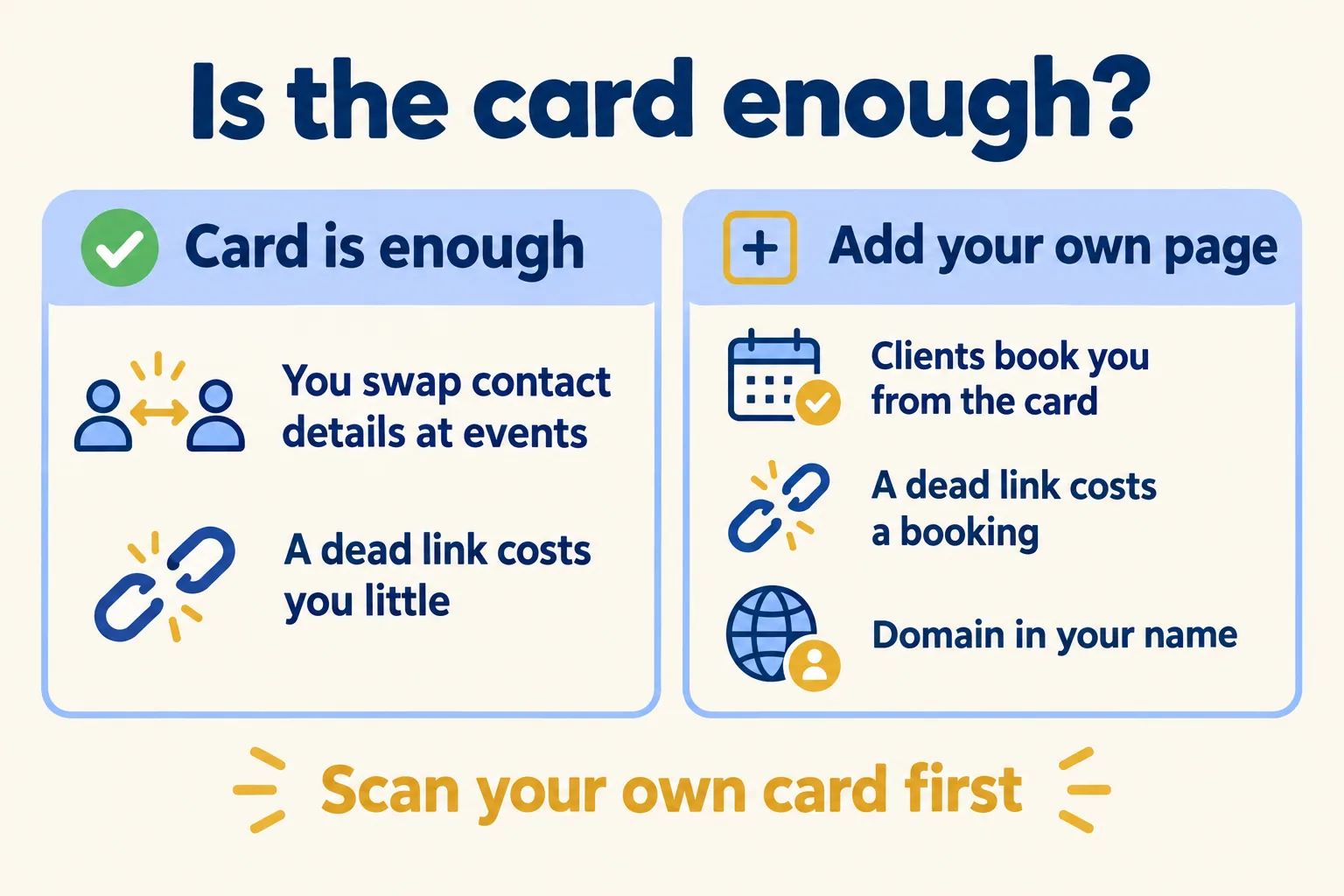
A card is enough if you only swap contact details at events. Add your own page if clients book you from the card
When the card is enough, and when it is not.

What do you put behind the card instead?

One static page on a domain you own, with your name, role, phone, email and one link. FollowMySite recommends the same thing as the rescue move: point your tags at it and use it for any future printing. It adds that a domain the vendor registers for you is not yours by default, so register your own, in your own name.

That is what a Founder Page is. The live page describes it as one page in your name, on your domain, booking to the contact you use. The address of that page is what goes on the card. If you ever change card supplier, the card changes and the address stays.

We do not sell, print or program cards, NFC tags or QR codes. A Founder Page does one thing: it gives the card somewhere safe to point. If the domain is the open question, read how to buy a .ae domain in your own name first. If you are still at the permit stage, read the permit post.

If a card already points at a vendor's address, you do not need to throw it away. Put your own page live first, then ask the vendor to forward the old address to it, if its plan allows. Our Founder Page is built for that move.

What does it cost, and what do we add?

This is what the live Founder Page states today, on 26 October 2026.

LineAmountWho you pay
Your domainThe registrar's priceThe registrar, in your own name
Founder Page, setupAED 4,000 plus AED 200 VAT (5 percent), AED 4,200 onceMindcat Technology Consultants FZE
Hosting, optionalAED 199 a month, only if we host itMindcat
Email on your domain, optionalAED 700 before VAT; the mailbox licence is billed at costMindcat, and the mailbox provider at cost

There is no monthly minimum on a Founder Page. The few days to go live start when your domain and your bio line reach us. You see the page before it goes live, and a yes puts it on your domain. We never hold your domain.

Our method is called Own the booking. You tell us what you sell and where people book you today, and we reply by email within 24 hours. We do not promise a Google listing or leads. Mindcat is a Dubai company, founded in 2022. If your card's address is not yours, tell us what you sell and where people book you today.

Filed under

Founder Page (one page on your own domain for coaches and consultants)qr code business cardnfc business carddigital business card dubai
Useful to someone on your team?

FAQ

Questions teams ask next

What happens to a digital business card when I stop paying?
It depends on the vendor and the card. One vendor says monthly and yearly cards return an HTTP 404 once the end date passes. Another says its trial cards stop working when the trial ends while standard cards keep working. Ask your vendor in writing what happens on the day the plan ends.
Does an NFC business card stop working if the company shuts down?
The chip stores a web address, so it keeps holding that address. Whether the address still opens a page depends on whoever runs it. If the chip is unlocked you can usually rewrite it to a new address. A locked chip can never be changed.
How do I check who owns the link on my card?
Scan your own card, copy the address from the browser and look at the domain. If it ends in the card vendor's name, it is theirs. If it is a domain you bought in your own name, it is yours.
Do I need a website if I have a digital business card?
Not to swap contact details at an event. You need one page on your own domain if clients reach you by card and a dead link would cost you a booking. It can be a single page with your name, role, phone, email and one link.
Does Mindcat sell or print business cards?
No. We do not sell, print or program cards, NFC tags or QR codes. A Founder Page is one page in your name on a domain you own, and its address is what you put on your card. It is AED 4,200 once, which is AED 4,000 plus AED 200 VAT at 5 percent, on one invoice from Mindcat Technology Consultants FZE.

Sources

  1. 01NexaLink: What happens when you cancel a digital business card (updated 9 August 2026)Accessed 26 Oct 2026
  2. 02FollowMySite: What happens if you stop paying for a digital business card (25 September 2026)Accessed 26 Oct 2026
  3. 03Cardless Club: NFC card stopped working after subscription (19 October 2026)Accessed 26 Oct 2026
  4. 04Mindcat Founder Page: price, scope and FAQ (live page)Accessed 26 Oct 2026
Shivanath Devinarayanan, founder of Mindcat

Written by

Shivanath Devinarayanan

Founder, Mindcat Consulting · Salesforce MVP Hall of Fame

Runs 200+ agents in production. Reads every brief that comes in and signs the work that goes out.

About Shivanath

Founder Page · tell us what you sell

People book you through

We reply by email within 24 hours. No payment on this page.

Or email info@mindcat.ai.