

If staff ask IT for help over WhatsApp, email and in the corridor, and nobody can list what is open, this is for you. It is not a guide to the ITIL exam, and it is not for a team with no one who owns the queue: a framework or a tool will not create that person.
Why does ITIL come up before there is a desk?
Usually because something went wrong in front of the boss. A laptop sat broken for a week. A new joiner had no email on day one. Someone who once worked at a bank says the answer is ITIL, and the room nods.
ITIL is a real framework, with a lot of good guidance in it. The trouble is the order. A 40-person company with requests spread across a WhatsApp group, two mailboxes and the IT person's mobile has no desk yet for a framework to improve. NOCKO, a Dubai IT provider, describes it bluntly: "someone calls the IT guy, the IT guy fixes it, and nothing is written down. There is no ticket number, no timestamp, no SLA clock."
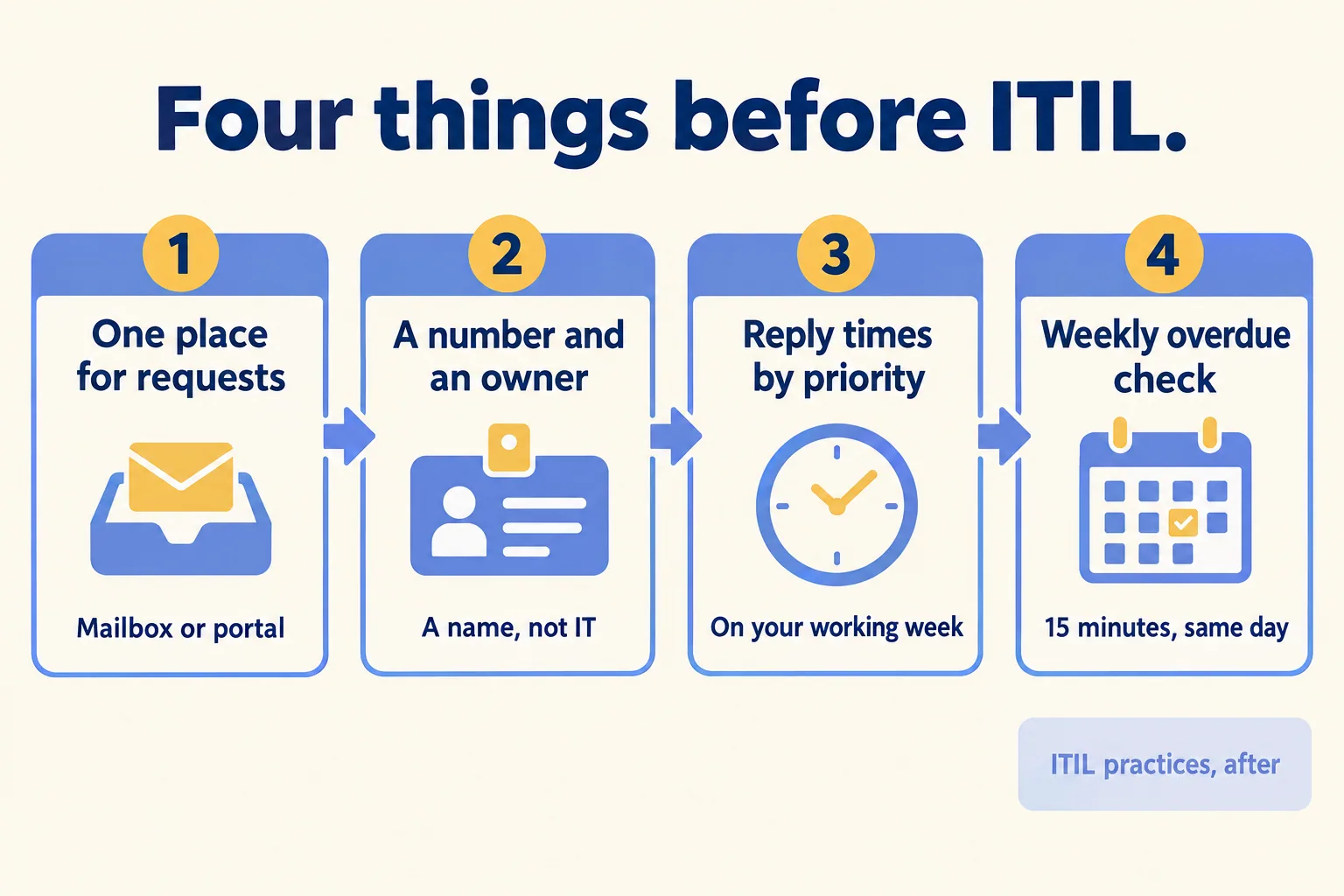
That is the starting point we see too. The fix is four plain things, and none of them needs a course.
What do the people behind ITIL say about starting small?
They agree with the order. Gartner published a note on 27 February 2026 called "Why ITIL (Version 5) Will Not Improve Your ITSM Maturity". Its public summary says heads of IT operations "may view the new ITIL 5 framework as the answer. Unfortunately, it's not, especially as the concepts are a distraction if the fundamental elements are not in place."
ITIL's own community says the same from the inside. Helen Clarke, writing on PeopleCert's community site on 11 February 2026: "Two organisations can both be 'using ITIL' and look completely different and that's by design." Easit, a service-desk software maker, wrote that "it is possible to work with ITIL without implementing everything, and start with the processes that provide the most value."
So starting with four things follows the framework's own advice. PeopleCert launched ITIL (Version 5) with its Foundation exam on 12 February 2026, and ITIL.com calls it "an evolution not a revolution" on ITIL 4. Nothing in the new version changes what a first desk needs.
Which four things come first?
Put them in this order. Each one depends on the one before.
- One place where every request arrives. One mailbox or a portal. Requests that still come by WhatsApp or in the corridor get copied in by whoever receives them, the same day.
- A number and an owner on each request. The number lets anyone ask "where is 1042?" The owner is a name, not "IT".
- Three or four priorities, each with a written first-reply time. Write them down and count them on your real working week: Monday to Friday in Dubai, Sunday to Thursday in Riyadh, shorter days in Ramadan. A clock that counts Saturday is wrong every week, which we cover in our post on SLA agreements for Gulf service desks.
- A weekly look at what is overdue. Fifteen minutes, same day each week. What is late, who has it, and does anything keep coming back?
MSP Vendors, writing for IT service providers on 3 March 2026, lands in the same place: focus on "clear categorization, escalation paths, and SLA tracking", because "forcing full ITIL adoption can slow down operations instead of improving them." They write for MSPs, but a 40-person in-house team has even less room for overhead.
The five-minute test
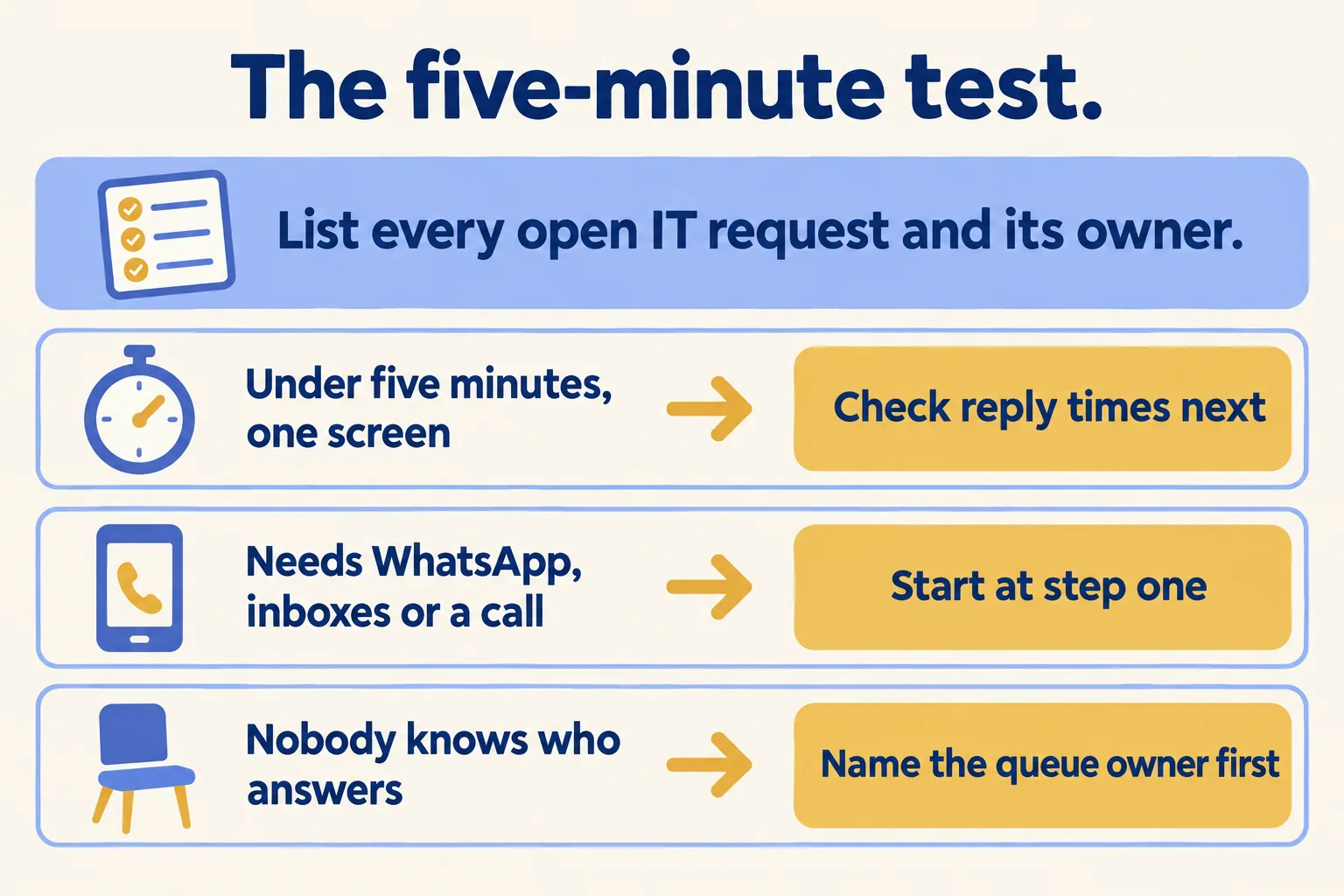
You can run this today, before anyone books a course. Ask whoever handles IT to list every open request right now, with the name of the person who owns each one.
- It takes under five minutes, from one screen. You have steps one and two. Check whether reply times are written down (step three) and whether anyone looks at overdue work each week (step four).
- It needs a scroll through WhatsApp, two inboxes or a phone call. You are missing step one. A framework will not help yet. One place for requests will.
- Nobody knows who should answer. Name the owner of the queue first. Until that person exists, no tool or framework changes anything.
When does ITIL earn its place?
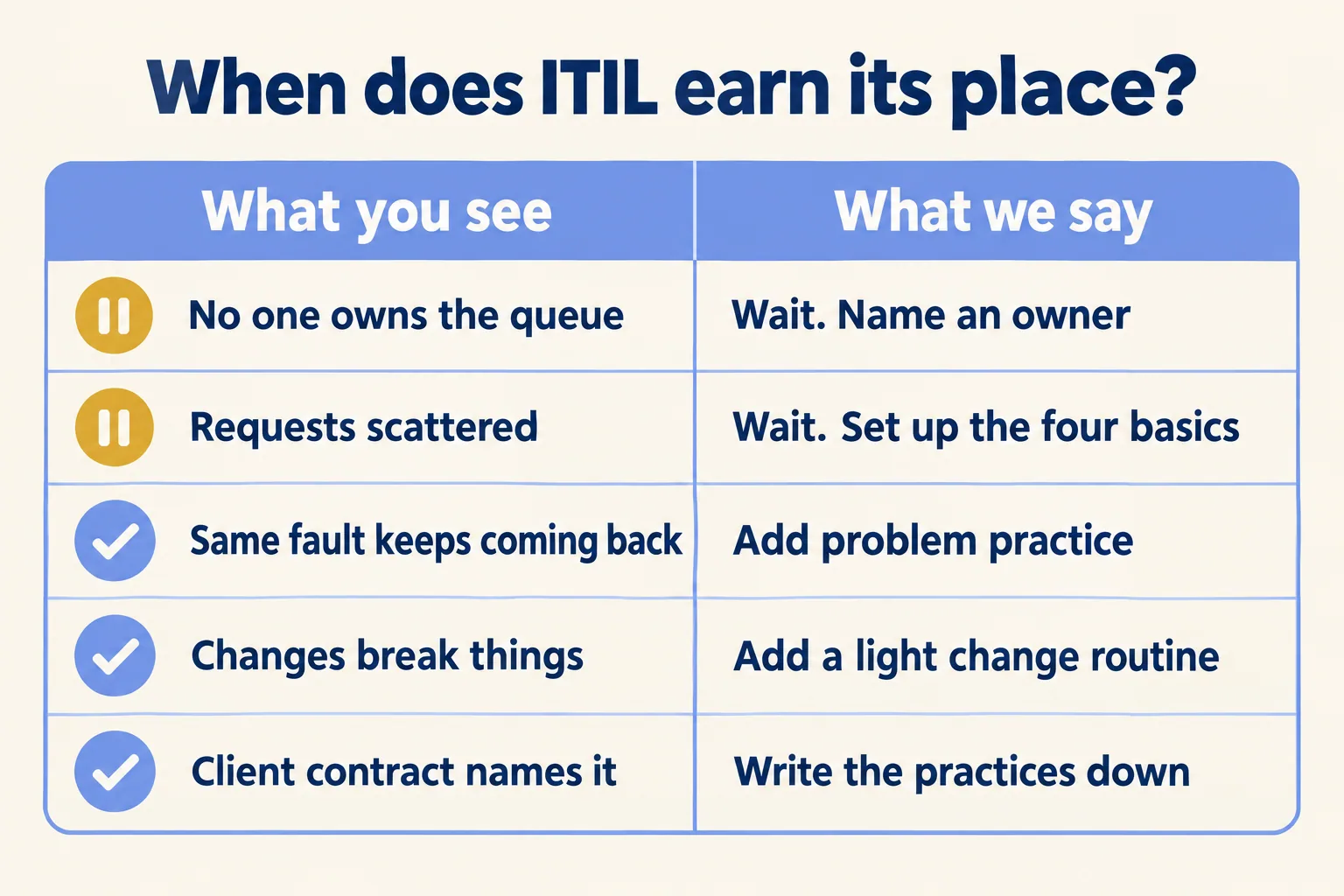
Once the four run for a couple of months, the weekly look starts telling you things. That is when parts of ITIL become useful, one practice at a time. Here is how we decide.
- The same fault keeps coming back. The printer on the second floor, the VPN every Sunday morning. Fixing it each time is incident work. Finding why it keeps happening is what ITIL calls problem management, and it is the first practice we suggest adding.
- Changes keep breaking things. A Windows update or a new firewall rule takes people offline. A light change routine (who approves, when, how to roll back) earns its place here. Keep it light for low-risk changes, as Clarke's post suggests.
- A client contract names ITIL practices or reply times. Then you need them in writing, and the weekly overdue look becomes your monthly report.
- Your IT people want the certification. That is a fair career step. ITIL Foundation is an exam for people, not a badge for the company.
If none of these is true yet, the framework can wait. Its own writers recommend the same order.
What does Mindcat Desk set up, and cost?
Mindcat Desk is one way to get the four in place without building them by hand. Requests by email, phone or the portal get a number, an owner and a reply deadline counted on your own working week. Public holidays go into the calendar during setup, and Ramadan hours are added during setup each year. The open list shows what is overdue and who has it, which is the weekly look on one screen. We wrote about telling a slow provider from scattered requests in IT support slow? Read one month of tickets first, and about when to keep the desk you have in stay, upgrade or move.
Mindcat Desk makes no ITIL claim. It has no change, problem or configuration-record module, so the practices in the last section stay a way of working, written down by you.
Each agent is priced a month in bands: AED 99 for agents 1 to 5, AED 69 for 6 to 20, AED 49 for 21 to 50 and AED 39 from 51. The shared plan has a monthly minimum of 5 agents, AED 495, so nobody buys a single agent at the per-agent rate. Staff who raise requests are free. Up to 20 agents, the quick start is a fixed package we set up for AED 2,500, one time. It covers groups, priorities, one reply-time rule on your working week with public holidays, one support mailbox, the customer portal and saved replies in Arabic and English. Larger teams get a written plan. AI drafts on your own account, SMS and your phone system are billed at cost. Prices exclude VAT.
WhatsApp tickets are connected during setup if you want them, with Meta's fees on your own account. If your team mostly sells and serves on WhatsApp, rather than answering staff requests, start with Mindcat Inbox instead.
If nobody in your company will own the queue, wait: no desk and no framework fixes that. We call the method Every request on the clock. Tell us how many people answer IT requests, how requests arrive today and the reply time you want to promise. We reply with the setup plan and the monthly price per agent, in AED.
