

If your web agency added free heatmaps to your site and nobody has watched a recording since, this is for you. It is not for a site with no heatmap tool and nobody reading its reports: start by counting taps instead.
Do you need free heatmaps on a small site?
Usually not all the time, and never on every page. The free tool most agencies add is Microsoft Clarity. It does two things: heatmaps, which pool where many visitors clicked and scrolled, and session recordings, which replay what one visitor did, mouse movement included. Microsoft's own FAQ says it is "a free service forever", and it is quick to install. That is why it appears on brokerage and clinic sites as a favour from the agency.
The question for an owner is not whether the tool works. It is which question it answers, and on which pages. A recording answers "why do people stop on this page?" It does not answer "which ad brought the enquiry?" That is a count, and counting needs far less data about each visitor.
What does Microsoft Clarity keep, and who sees it?
Read Microsoft's pages before the script goes on a page with a form. These are the lines that matter to a clinic or broker, from Microsoft Learn, read on 27 November 2026:
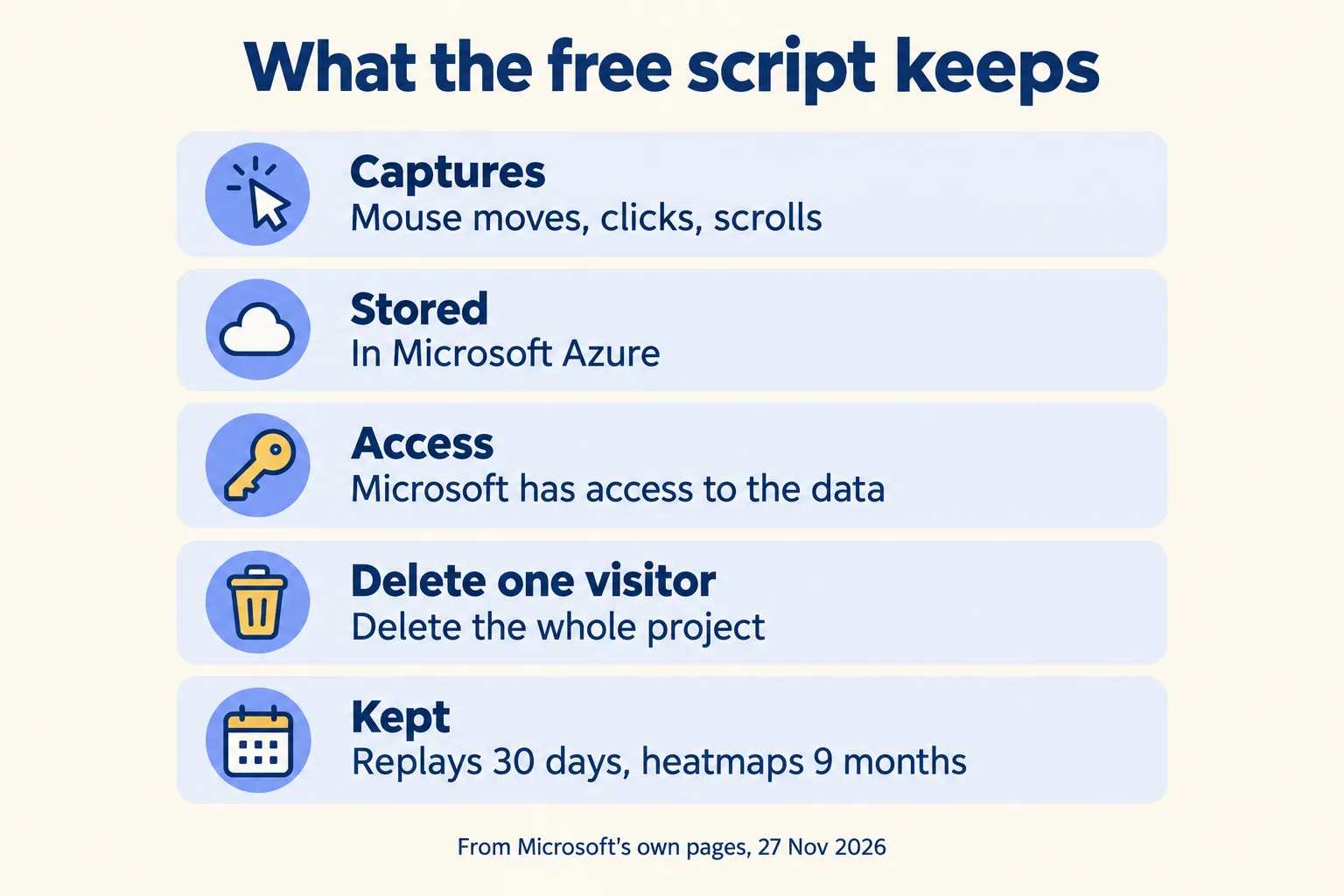
None of this makes the tool unsafe. Microsoft states it plainly, and its FAQ says Clarity does not sell data. Microsoft says it operates as a data controller and points to the Microsoft Privacy Statement, so read that statement as well as your agency's setup note. It also means three things for an owner. A recording of your enquiry page sits on Microsoft's servers, not yours. A patient or buyer who asks you to delete their data cannot be handled one person at a time. And a recording you label to keep stays for nine months.
Which pages should never load the script?
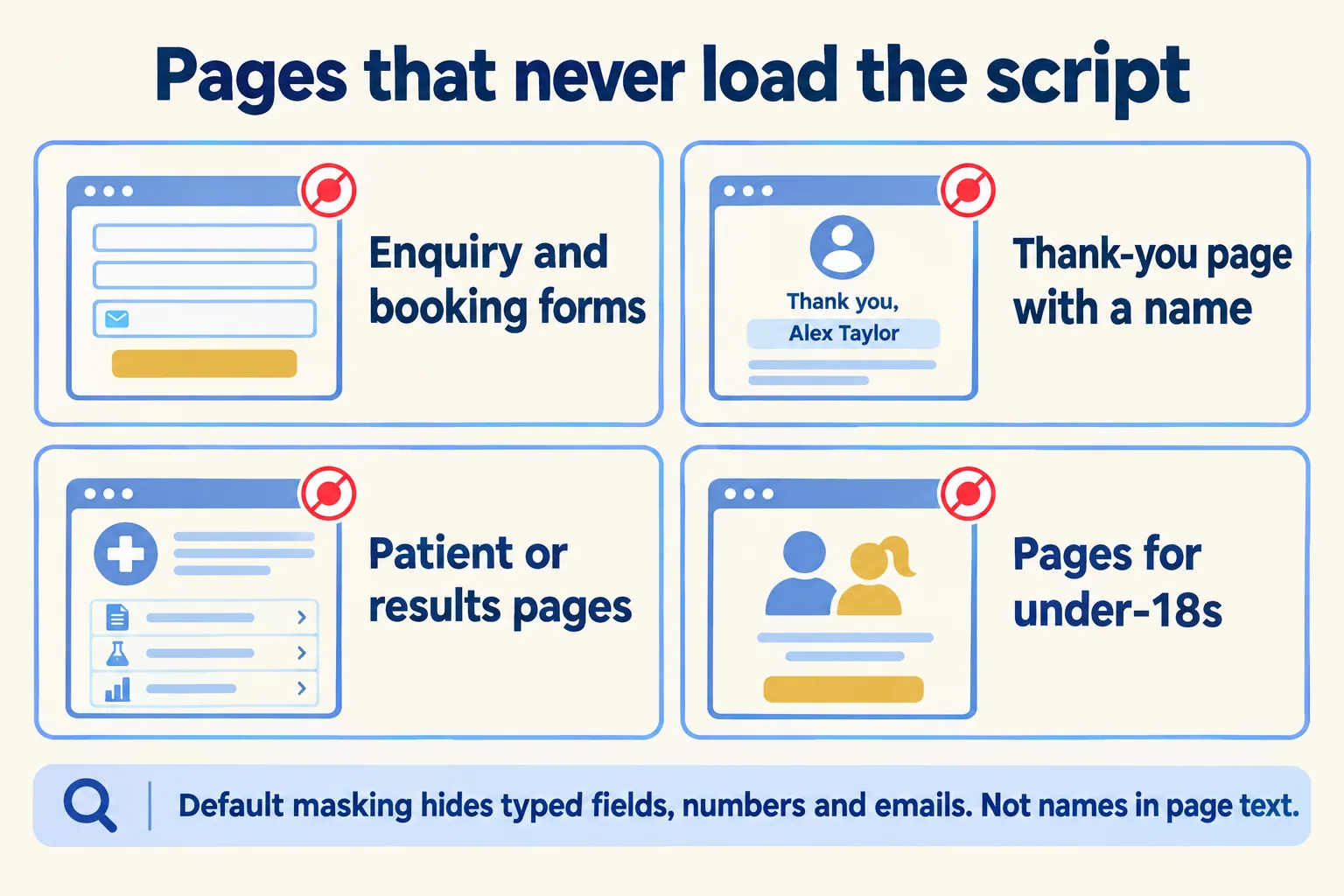
Any page where a visitor types or reads their own details. In practice:
- the enquiry, booking and "register interest" forms
- the thank-you page, if it repeats the visitor's name, date or unit
- a patient portal, results page or appointment page
- a page for children or teenagers, which Microsoft's FAQ rules out
The reason is masking. Microsoft masks content "by default", but the detail matters. Text typed into input boxes and drop-downs is masked in every mode. Text the page shows is a different case: in the default Balanced mode, Microsoft classifies only "numbers and email addresses as sensitive content". A thank-you line that says "Thank you, Fatima, see you Tuesday at 4" is ordinary text. Clarity also does not mask content inside style sheets, and changes to masking apply to new recordings only, never to ones already taken.
The simplest fix is the one a DevNJ guide from 18 November 2026 gives first: do not load the tag on those pages at all.
Start by asking the agency for the list of pages the tag fires on today. If it goes in through a tag manager, the fix is a trigger that skips those page addresses. If it sits in the site's template, the developer leaves it out of those templates. One catch: many booking widgets and modern sites change the page without a reload, so a rule that only checks the first address can keep recording into the form. Ask the developer to confirm the recording stops on those steps, or to load the script only on pages that cannot lead to a form without a full reload. Already recorded the forms for months? Playback data goes after 30 days, but labelled or favourited sessions stay nine months, so ask which ones are labelled. Deleting the project removes all of it.
Our rule: count first, record second
Count the taps on every page. Record only to answer one named question, on the pages that question needs, for a set window.
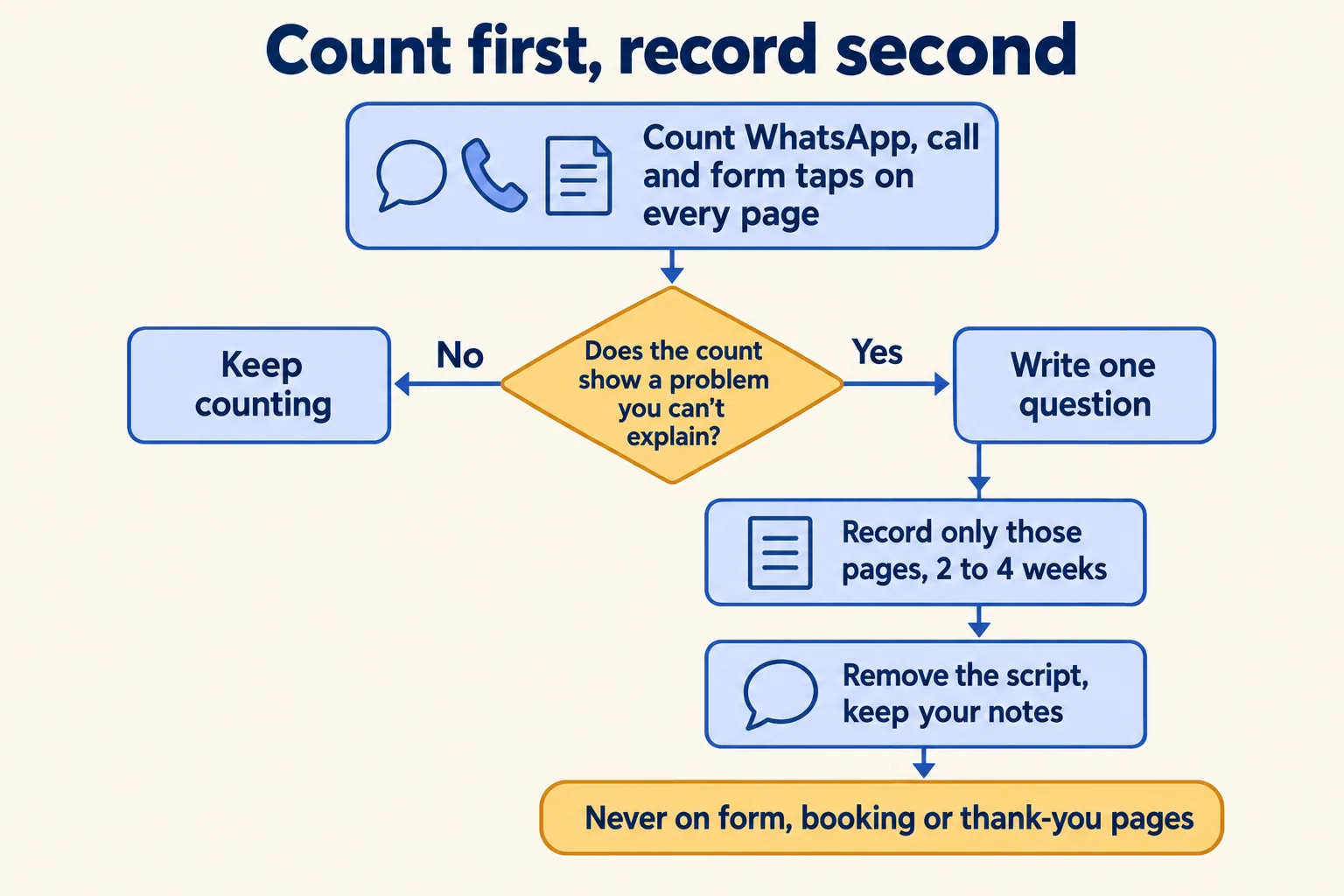
Counting tells you which pages and which ads lead to a WhatsApp tap, a call or a form. Each WhatsApp button, phone link and form submit gets a tag, and the report shows the taps by page and campaign, with no recording of anyone. That is the number a broker or clinic owner acts on, and we covered how to set it up in our post on call tracking and tap counts. Recordings come in when the count shows a problem you cannot explain: the listing page gets visits and no WhatsApp taps, or people start the booking form and few finish.
The DevNJ guide sets out when recordings pay off on a small site, and we agree with its table:
Where the table says recordings help with a form or a booking flow, our rule for clinic and broker sites is stricter. Count arrivals at each step, and record only the pages before anyone types a detail: the listing, the treatment page, the price section.
On a site with a few hundred visits a month, ask three people to book an appointment while you watch. The same guide says sitting next to someone using the site "teaches faster than watching 100 recordings".
How long should a recording run?
When the count does show a problem worth watching, this is how we run it:
- 01Write the one question down: for example, why visitors open the listing page and never tap WhatsApp.
- 02Load the script only on the pages that question needs. Never on a form, booking, thank-you or patient page.
- 03Run the replay test below before the first real visitor is recorded.
- 04Record for two to four weeks, then watch the recordings in one sitting with the agency.
- 05Write down what you will change, remove the script, and keep your notes, not the recordings.
Removing the script at the end is the step most sites skip. A tag left running after the question is answered keeps recording with nobody watching, and the heatmap data stays for nine months.
How do you test the masking?
Ask the agency to do this on the live page before the window starts, and to send you the replay:
- Walk through every page in the window as a visitor would, then carry on into the form and the thank-you page with test data: a made-up name, a phone number, an email.
- Open that session's replay in Clarity.
- Check that the recording stops before the form. If any form or thank-you step appears, the exclusion is not working. On the recorded pages, any field or line that shows a test detail should show masking characters, not the name.
- Check the page address too. A booking link that carries the name or phone number in the URL needs fixing on the site first.
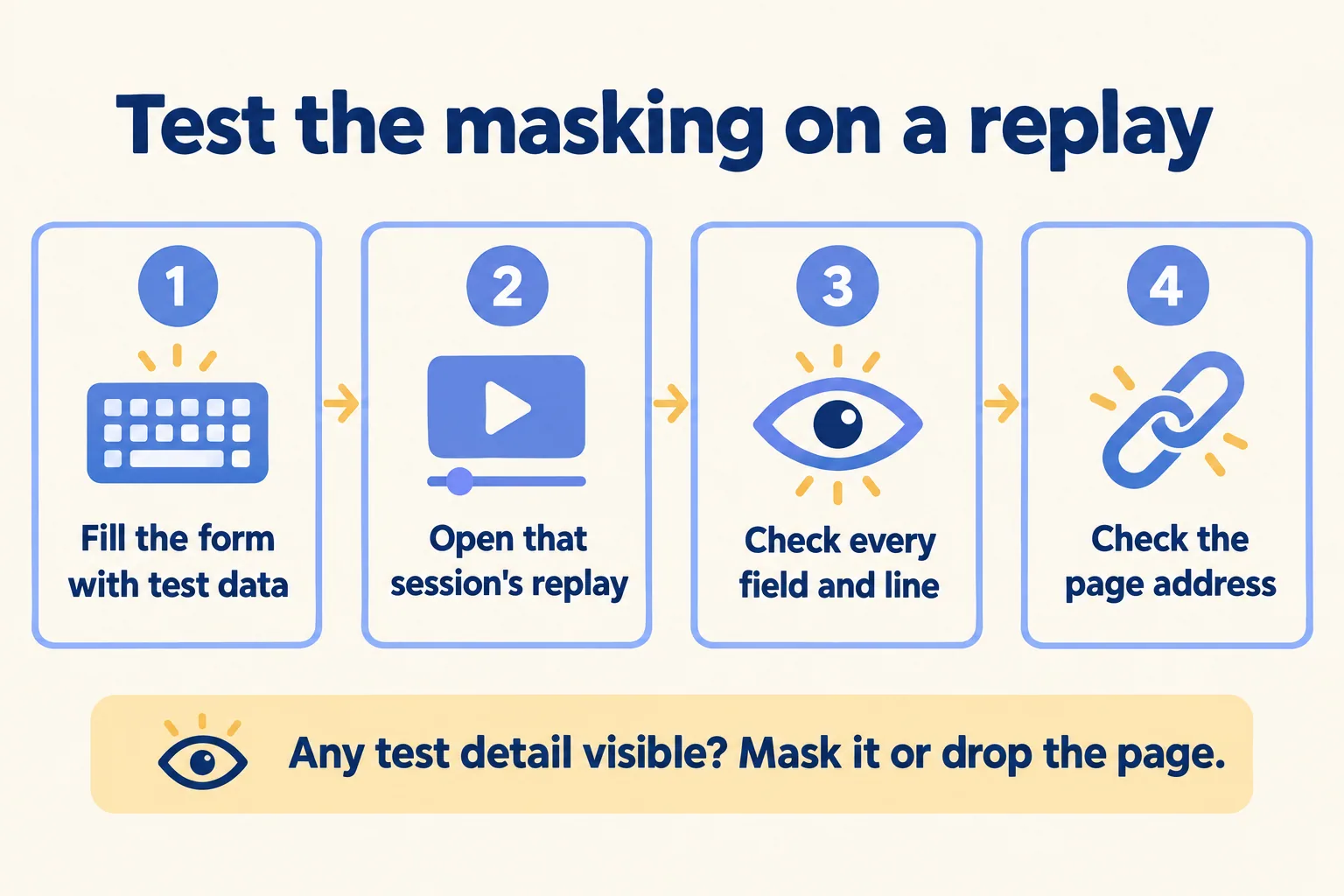
If any test detail shows, mask that element (Clarity has a data-clarity-mask attribute for it) or take the page out of the window.
What else should a clinic or broker check?
Visitors from Europe. Off-plan buyers and medical tourists often browse from the EEA or the UK. Since 31 October 2025, Microsoft says Clarity needs a valid consent signal for visits from the EEA, the UK and Switzerland, and without it recordings and funnels "might be limited". If your banner is not wired to Clarity, those visits may not be recorded as you expect. Ask the agency one more question while they are there: is ad_storage granted? When it is, Microsoft says "Clarity shares data with Microsoft Ads". Make that choice on purpose. And whatever the region, Microsoft's FAQ says to tell visitors about the cookie Clarity uses, so the privacy page should name the tool while it runs.
Health and personal data rules. The UAE's Personal Data Protection Law (Decree-Law 45 of 2021) covers data that identifies a person, including online identifiers. For clinics, Federal Law 2 of 2019 keeps health data about services provided in the UAE inside the country, unless the health authorities allow otherwise. Whether a recording of your booking page counts as health data is for your counsel. Ask before the script loads anywhere on a clinic site. We set out which of these questions are ours and which are counsel's in our post on GDPR and UAE websites.
When is counting the taps enough?

Most of the time. If the question is "which campaign brought the bookings?" or "does the Arabic page get more WhatsApp taps than the English one?", a count answers it. You do not need to see any one visitor to know how many people the billboard QR code sent to the unit page, and how many of them tapped WhatsApp.
Recordings earn their place on a site with real traffic and one stubborn step: a booking flow people abandon, or a price section nobody reaches. For a clinic, see what we set up on our clinics page.
Where Mindcat Analytics fits
Our method is counted in the region. Mindcat Analytics counts visits, campaigns and up to five tracked clicks per website (WhatsApp, call, form, booking or brochure), tagged during setup with your web team. Your copy runs in the UAE or in the Kingdom, the script sets no cookies by default, and the visitor's IP address is not stored. A shared read-only link per website is there if the agency or a partner needs the numbers.
It does not record sessions or draw heatmaps. If the count shows a page you need to watch, run the window above with the tool your agency prefers, on that page only, and we keep counting on the rest.
The price, from the live page: AED/SAR 99 per website a month for the first five websites, lower from the sixth, with a shared minimum of AED/SAR 499 a month and logins free. The quick start is a fixed AED/SAR 2,500 package we set up for one to five websites; your web team adds the script. Prices exclude 5% UAE VAT and 15% Saudi VAT.
Tell us how many websites you run and where your visitors are. We reply with the setup plan and the monthly price per website, in AED or SAR.
