
If a client asks for the best time to post on Instagram and you answer with a chart made from someone else's accounts, this is for you. It is not for a brand that posts twice a month: post when you have something worth saying.
Is there a best time to post on Instagram?
Not one that holds for every account. Instagram's head, Adam Mosseri, wrote it plainly on Threads on 16 June 2026: "There's no universal best time to post. If you really want to optimize, check your insights to see when your followers are actually online."
The large studies agree with him by disagreeing with each other. A Technobezz roundup updated on 15 November 2026 set the four big 2026 studies side by side:
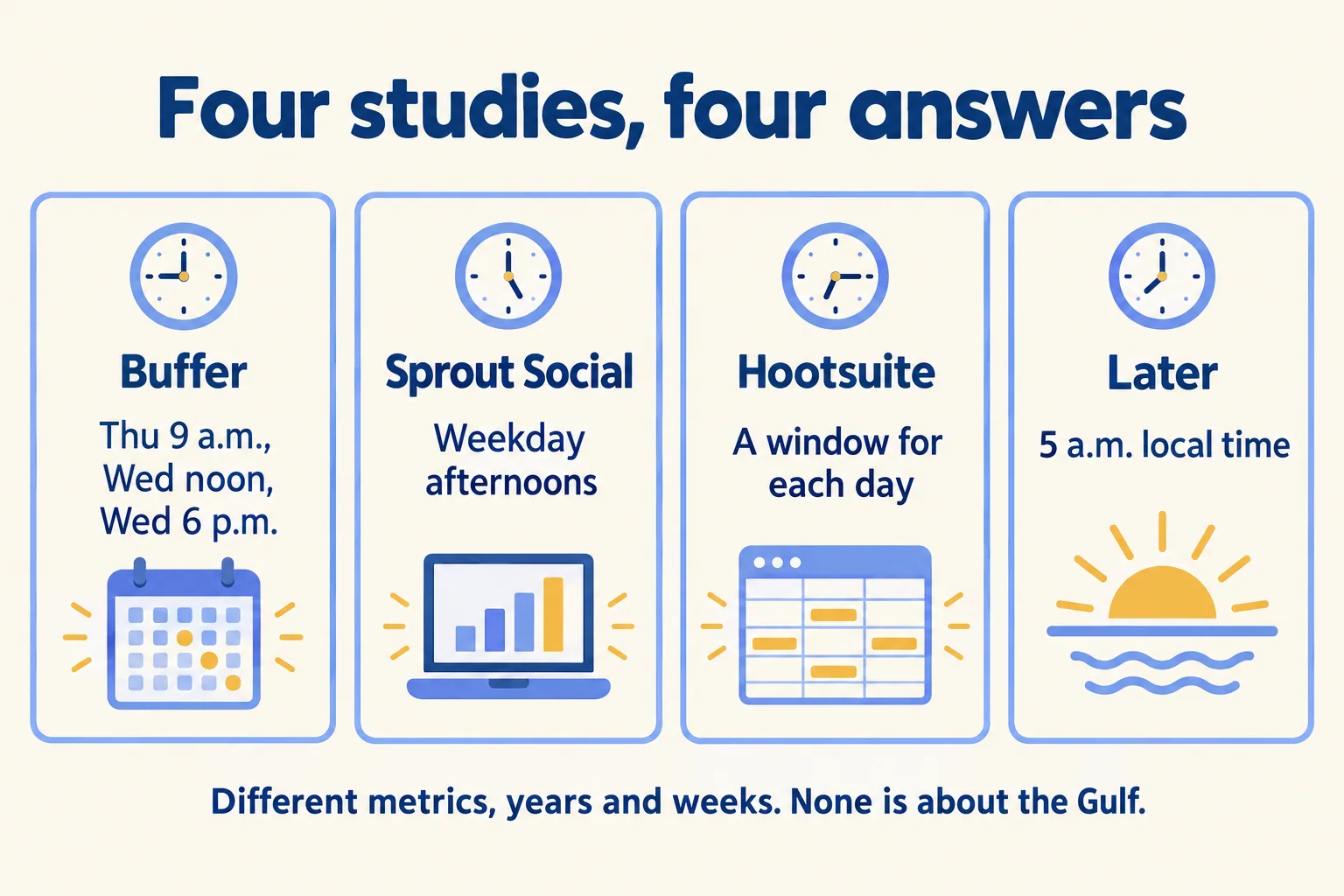
"The studies don't measure the same thing," Technobezz writes. One counts median engagement rate, one counts total interactions, and they cover different years. Buffer's own page adds that results vary by industry and tells readers to "lean on your own data to fine-tune". Send a client any one of these slots and you have picked a study, not a time.
Whose weekend is in the chart?
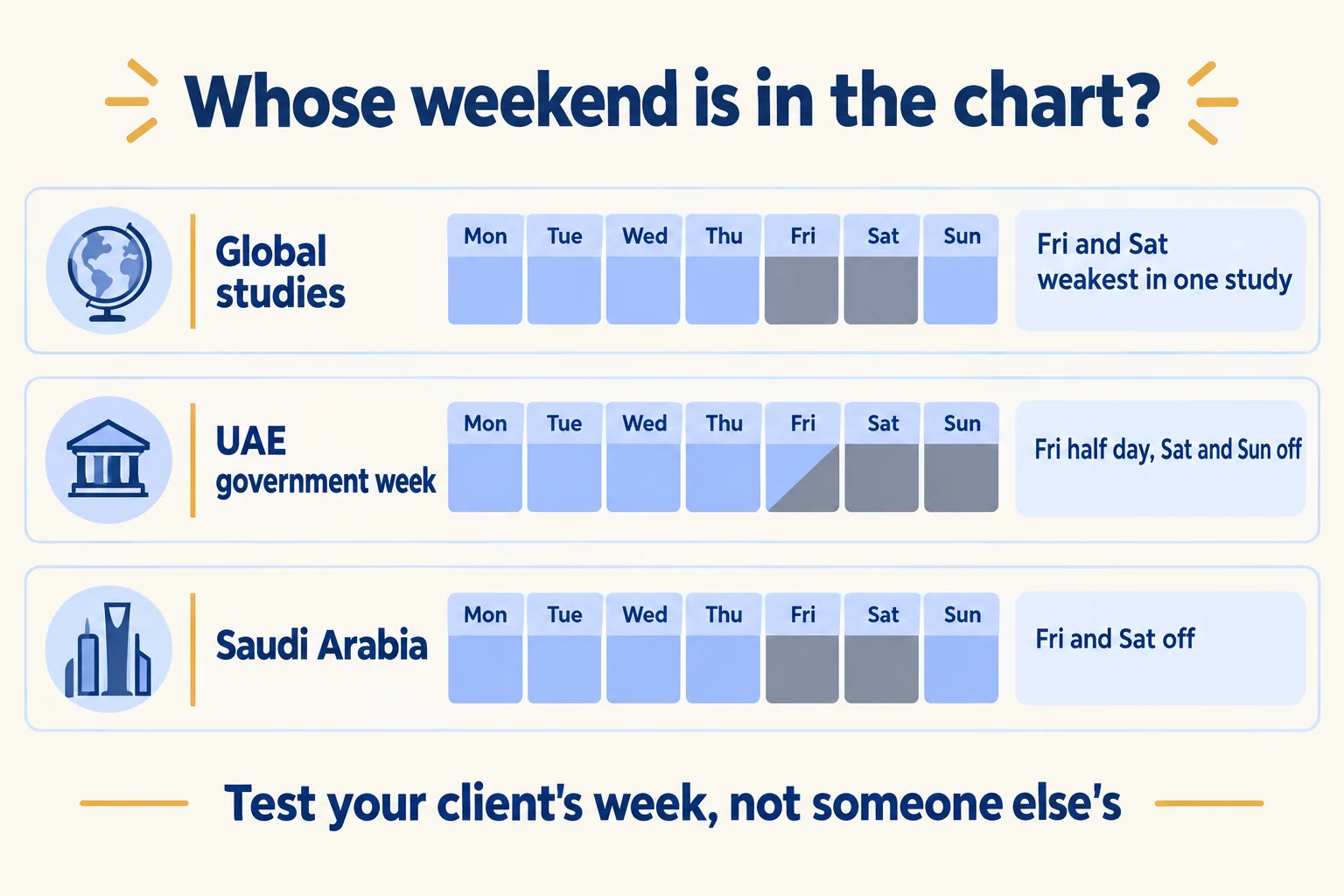
The studies report times in the audience's local time, but the week behind them is mostly a Western one. Buffer's weakest days are Friday and Saturday; Sprout Social says "Avoid weekends". In the Gulf, the weekend is not one fixed pair of days.
The UAE federal government works Monday to Thursday, 7.30 a.m. to 3.30 p.m., and Friday until noon, with Saturday and Sunday off (u.ae, in force since 1 January 2022). Sharjah's government works four days and rests Friday to Sunday. Private firms choose their own weekend. Saudi Arabia works Sunday to Thursday and rests on Friday and Saturday.
Then Ramadan moves the whole day. Ramadan 2027 is expected to begin on Monday, 8 February, subject to the moon sighting (The National). A weekday table built on 2024 and 2025 data says nothing about the hour after iftar.
None of this gives you a better slot. It tells you a borrowed chart is a guess about someone else's week, so a Friday or a Ramadan evening belongs in your test rather than off it.
Our rule: when a chart is enough
A posting-time chart is a first guess for an account with no history, and nothing more. For a new brand account, with no follower insights yet, pick one of the study slots, convert it to Gulf time, and post consistently. That is a fine answer for the first weeks.
Once the account shows its own follower activity, the chart's job is over. From then on, the client's numbers decide, and a study slot is only one of the slots you test.
Which number answers the question?
Two screens in Instagram's own insights do the work, and they answer different questions.
Most active times. Open the Professional dashboard, tap Total followers and scroll to Most active times. It shows when the account's followers are on Instagram, by day and by hour. Guides note the hours show in your own time zone, so a team reading from Kochi or London converts them to Gulf time first. Insights need a professional (business or creator) account, and guides put the threshold for this chart at about 100 followers. It counts followers only, and it counts presence: a tall bar means many followers had the app open, not that they saw your post.
Followers versus non-followers. A Reel's insights split its views between followers and people who do not follow the account. A whattoupload guide from 5 November 2026 puts the rule well: "If most views arrive in the first hours from followers, timing to your followers' active hours matters. If most arrive days later from non-followers, the Reel is being recommended and timing matters little."
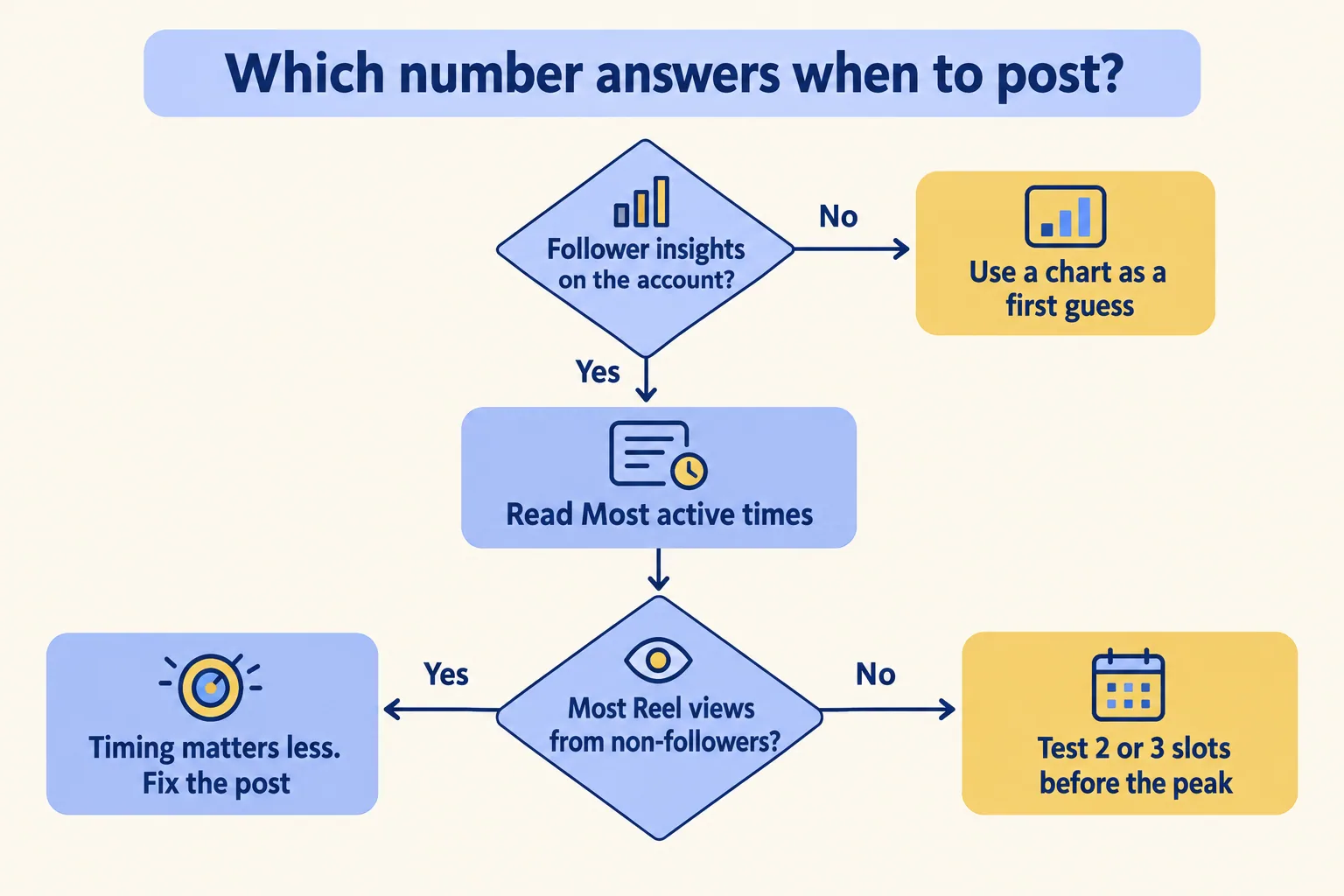
Buffer writes that Mosseri suggests posting 30 to 60 minutes before your audience is likely to come online. So the slot you test sits just before the tall bar, not on it.
The four-week test we run
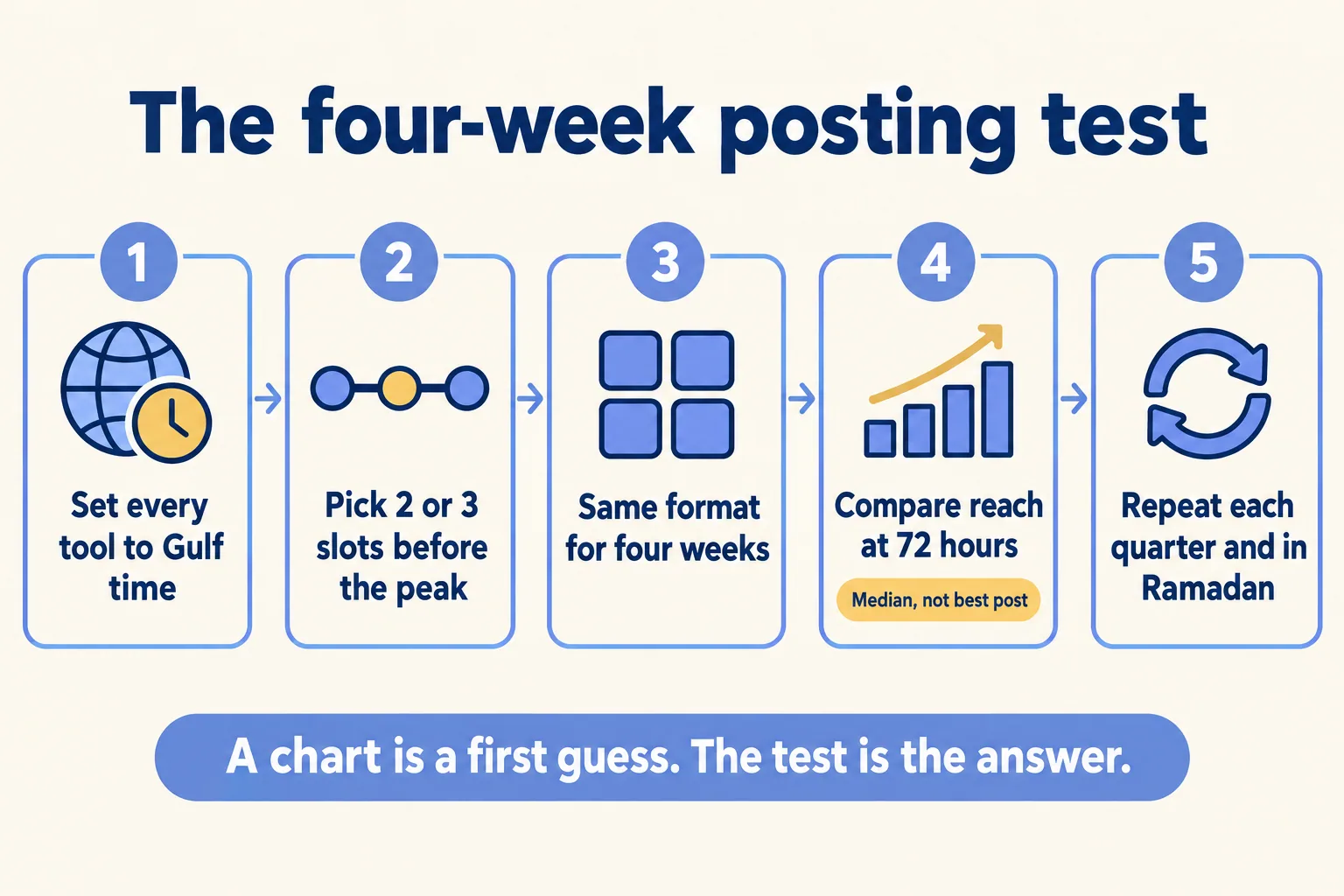
- 01Set the scheduler, the client report and the insights reading to Gulf Standard Time (UTC+4), so 7 p.m. means 7 p.m. in Dubai and Riyadh.
- 02Pick two or three slots just before the peaks in Most active times. Include a Friday slot if the client's buyers work a Gulf week.
- 03Keep the format the same for four weeks: same post type, similar length, the slot is the only thing that changes.
- 04Read each post's reach 72 hours after it goes out and compare slots by the median, not by the best post.
- 05Repeat each quarter, and again in the first week of Ramadan with a slot after iftar.
Why the median: one post that travels can make a slot look good for a month. Why 72 hours: every slot gets the same three days to collect reach, so a late post is not judged early. These are our method's choices, not Instagram's rules; keep them the same across slots and the comparison is fair.
Two or three posts a week gives each slot four to six posts in four weeks. That is enough to drop a slot that is clearly behind, not to crown one by a few percent. If the slots come out close, keep the one that suits the team and run the test again next quarter.
Two client types need one change each. A brokerage that sells through messages should read DMs and link taps per slot next to reach. A restaurant that posts a dish, an offer and a Reel in one week can rotate the same type through each slot, so every slot gets one of each.
A sample reply to the client, written as one: "There is no single best time; Instagram says so. Your followers are most active from 8 to 10 p.m. on weekdays. For four weeks we will post at 7.30 p.m. on Tuesday and Thursday and at 1 p.m. on Friday, then send you reach for each slot." The client gets a plan and a date for the answer, which is more than a chart gives them.

When does timing matter less?
When the account grows through Reels shown to people who do not follow it. If the split says most views arrive from non-followers over several days, the slot is a small lever. The same whattoupload guide points to the skip rate (did the first three seconds hold people?) and sends, and says to separate "did the video work" from "did the time work". Tell the client that, and spend the next month on the post rather than the clock.
Timing still matters for posts tied to a moment: a launch, a live session, an offer that ends tonight, or a restaurant post before dinner in the client's city.
For a brand that posts twice a month, skip the test. Post when there is something worth saying, and read the insights once a quarter.
Where Mindcat Social fits
The test needs three things a phone and a sheet make hard across several clients: every slot on one calendar, the client's approval before the slot, and the same time zone everywhere.
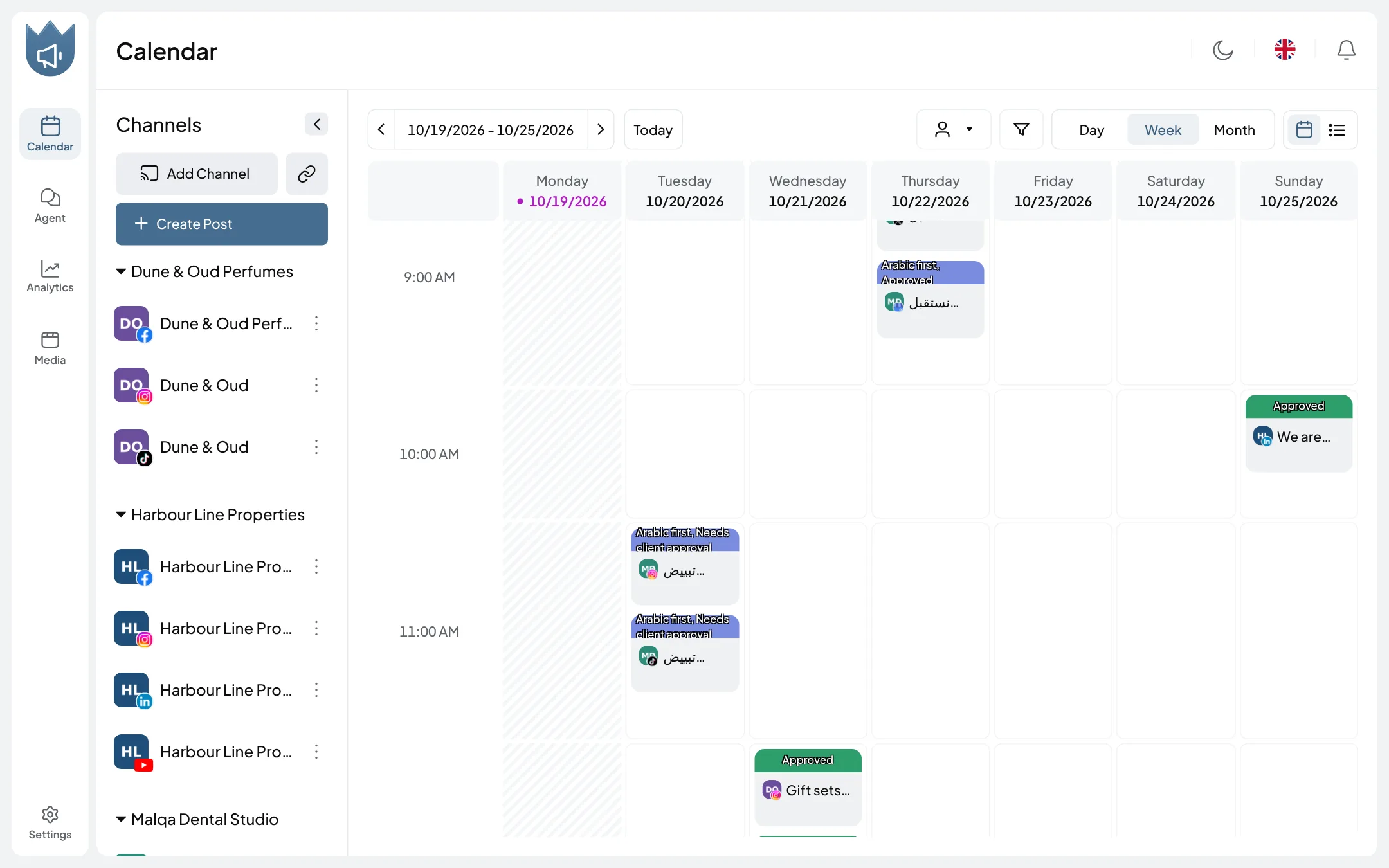
Our method is one calendar, client-approved. Mindcat Social puts every client's posts on one calendar, posts each one at the slot you choose, and lets the client approve from a preview link without an account. It does not suggest a best time; your team reads the client's Instagram insights and sets the slot. Analytics per channel work once each network's connection includes analytics access, which we set up with you. Publishing to each network starts once its platform app is approved during setup. The calendar week starts on Monday and dates are Gregorian.
We covered when Meta's own free scheduler is still enough in Is free Instagram scheduling enough?, and how clients approve from a link in our post on client approval. More for agencies is on our marketing agencies page.
The price, from the live page: AED/SAR 49 per connected channel a month for the first 10 channels, lower above that, with team members free. The shared option has a minimum of AED/SAR 690 a month, which covers up to 15 channels. There is no self-serve start: setup is done with you, from AED/SAR 1,900 for up to 10 channels. Paid platform API access (such as X) and AI provider usage are billed at cost. Prices exclude 5% UAE VAT and 15% Saudi VAT.
Tell us how many clients and channels you post for and how approvals work today. We reply with the setup plan and the monthly price per channel, in AED or SAR.
