
If your launch page is finished and the brokers are still waiting for the link because nobody free can publish it, this is for you. A drag-and-drop deploy can put it live today. The work is the second change, and the lead that arrives after the first. If a developer already deploys your site from Git, you do not need this.
Why does a finished page sit in a zip file for a week?
Because putting it live has always needed someone who knows Git, a terminal or a server login. The designer exported the page on Sunday. The launch event is Thursday. The one developer who could publish it is on another project, and the brokers are already asking for the link to send on WhatsApp.
Your designer can already hand you the finished page as a file. The gap is no longer making the page. It is getting it onto a link the brokers can send, safely, without waiting for one person.
What does a drop actually do?
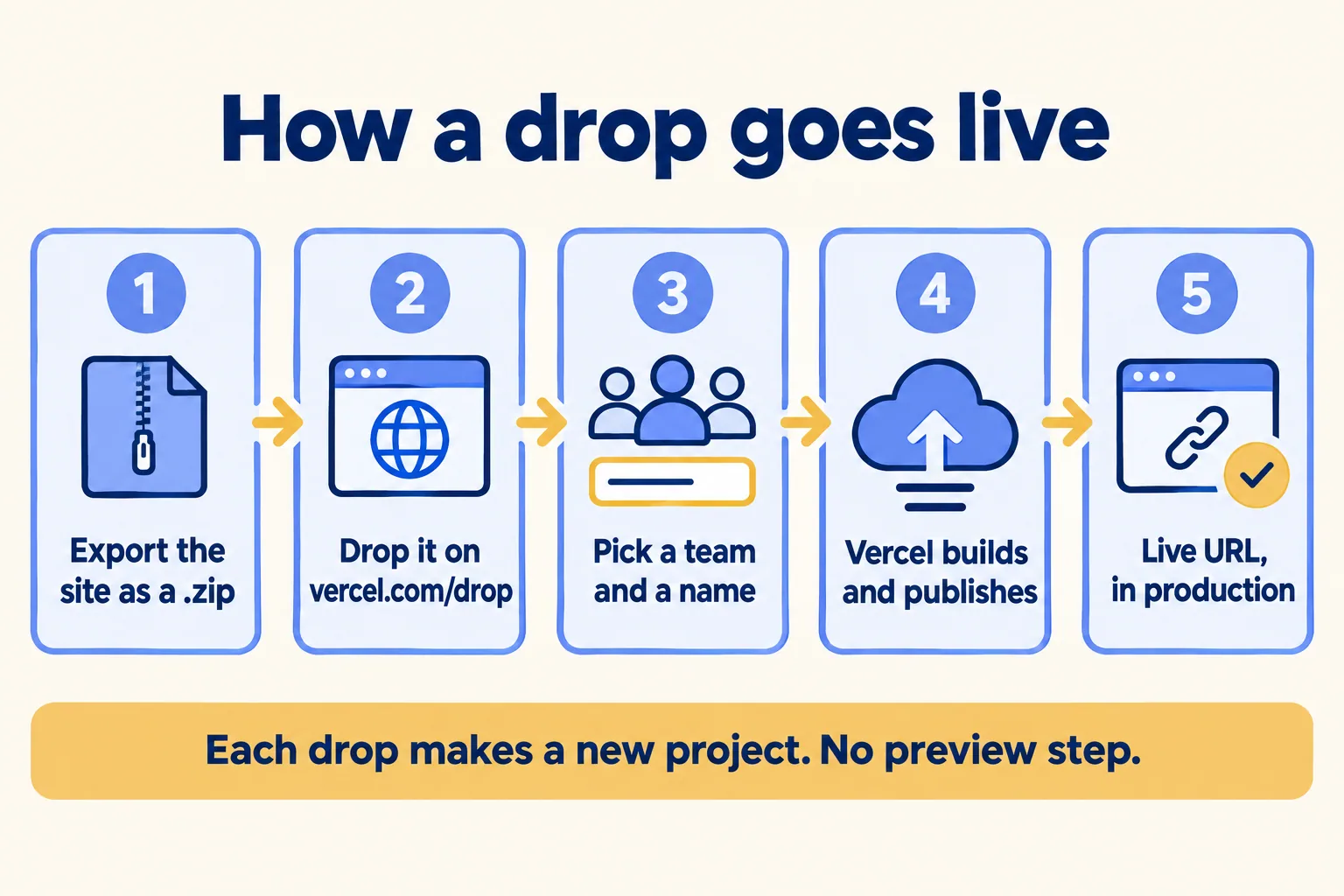
It takes a file, a folder or a .zip, builds it if it is a framework project, and publishes it to production. No Git, no terminal, no local setup. Vercel's docs list the steps:
- 01Go to vercel.com/drop.
- 02Drag in a file, folder or .zip, or choose one.
- 03Choose the Vercel team and enter a project name.
- 04Select Deploy. Vercel detects the framework, if there is one, and builds it.
- 05You get a live URL. The deployment is production from the first drop.
Two details matter before you drag anything. A Vercel account is required (the Drop page says Hobby works). And for a static folder with no index.html at the top, Vercel asks which page to serve at the root, or "No root page", in which case / returns a 404. Pick the page, or your brokers send a link that opens on an error.
Where does the second change go wrong?
On the second drop. Vercel's Drop page says each drop on vercel.com/drop creates a new project and does not redeploy into an existing one. So when marketing fixes a price on Tuesday and drops the new zip on the same page, they get a second project with a second URL. The link the brokers already sent still shows Monday's price.
The docs give the right way: drop the folder onto the existing project in the Vercel dashboard, and Vercel creates a new production deployment of that project. Same project, same URL. Nothing warns you on vercel.com/drop; the only sign is a new address.
The second gap is quieter. Every drop goes straight to production, so nobody sees the change on a private link first. Vercel's own comparison with Netlify Drop puts it plainly: iterating on a dropped project means connecting Git or using the command-line tool. That is where previews start. And undo is limited by plan: Instant Rollback on Pro and Enterprise returns production to any earlier production deployment, Hobby only to the one before. A rollback does not change environment variables, and it cannot recall a lead the form already sent.
What does it cost to run a dropped page?
Drop has no price of its own. It runs on your Vercel plan, and the plan is the decision.
A sample month for one launch page, with the assumptions shown: the Pro fee of USD 20 includes one deploying seat, USD 20 of usage credit and a CDN tier of 1 million requests and 1 TB of transfer. If the page stays inside those, the month is USD 20 (about AED 73). Each extra person who deploys adds USD 20; people who only view are free. Above the credit, usage is pay as you go, and every new team starts with an on-demand budget of USD 200 that you can change, with an optional pause at a hard limit.
A property launch page sells something, so it is commercial. Run it on a Pro account in your company's name, not on someone's personal Hobby login. That also settles who owns the domain and the page when the designer moves on.
Vercel publishes no file size limit for Drop. Its docs say larger folders take longer on slower connections. Vercel has no compute region in the UAE (its 19 regions put Mumbai nearest). For a static page that matters less than where the form sends its data, which is the next point. The AED figure uses the dirham's fixed rate of 3.6725 to the dollar; Vercel bills in USD.
What does a launch page for an off-plan project look like?
Here is the shape we would use for a Dubai brokerage with a launch on Thursday. It is an illustrative example, not a client.
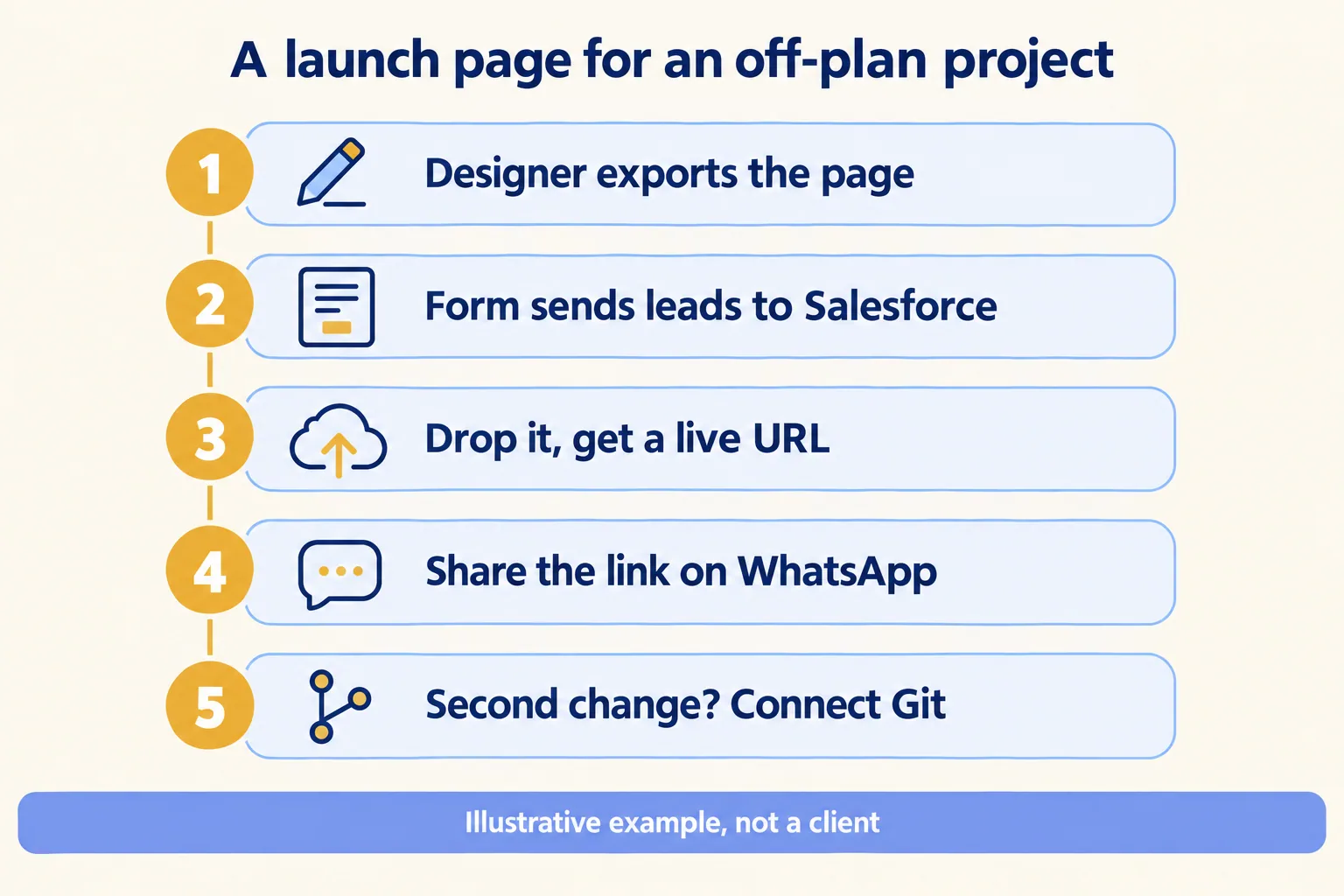
The form is the part to get right before the drop. A static page can post its form straight to Salesforce Web-to-Lead, with no server of its own. That is how our own contact form works on mindcat.ai (which runs on Netlify, not Vercel): the browser posts the lead to Salesforce and Salesforce sends the visitor to a thank-you page. So the buyer's name and number go to your Salesforce org, not to the page host. A public form also draws bots. Our own landing page forms carry a hidden field that people never see and bots fill in, so junk can be dropped before it reaches a broker. Add the consent line your legal team wants under the UAE PDPL (Federal Decree-Law No. 45 of 2021), and any advertising permit details your compliance team requires, before the drop.
Then the order is simple. Drop it on Monday, check the root page and send one test lead, and share one URL. If anyone changes anything after launch, connect a Git repository to that same project the first time. If you want the page on your own .ae address, keep the domain where it is registered and point it at the project; we explain why in keeping your .ae domain where it is.
What happens to the lead after the form?
That is where launches are won or lost, and no deploy tool touches it. The page going live a day sooner does nothing if the lead then waits until morning. Decide before launch day who gets each lead, how they hear about it, and how fast they answer.
In Salesforce, that is an assignment rule that names the broker, and an alert they will actually see. If buyers expect a reply on WhatsApp, the reply should go out on a company number, not a broker's personal phone, so the conversation is still yours when the broker leaves. Our WhatsApp setup does that: one company number, a shared inbox, and the lead written to Salesforce. See how the lead side runs for real estate brokers.
What do you write in the security questionnaire?
When a bank, a hospital or a large client sends a security questionnaire, split each answer between what Vercel covers and what stays yours.
For a dropped page, the one line most teams cannot answer is "who can publish to production". On Drop it is anyone with a deploying seat on the team, with no review step. Write their names down.
When do you stop dropping and connect Git?
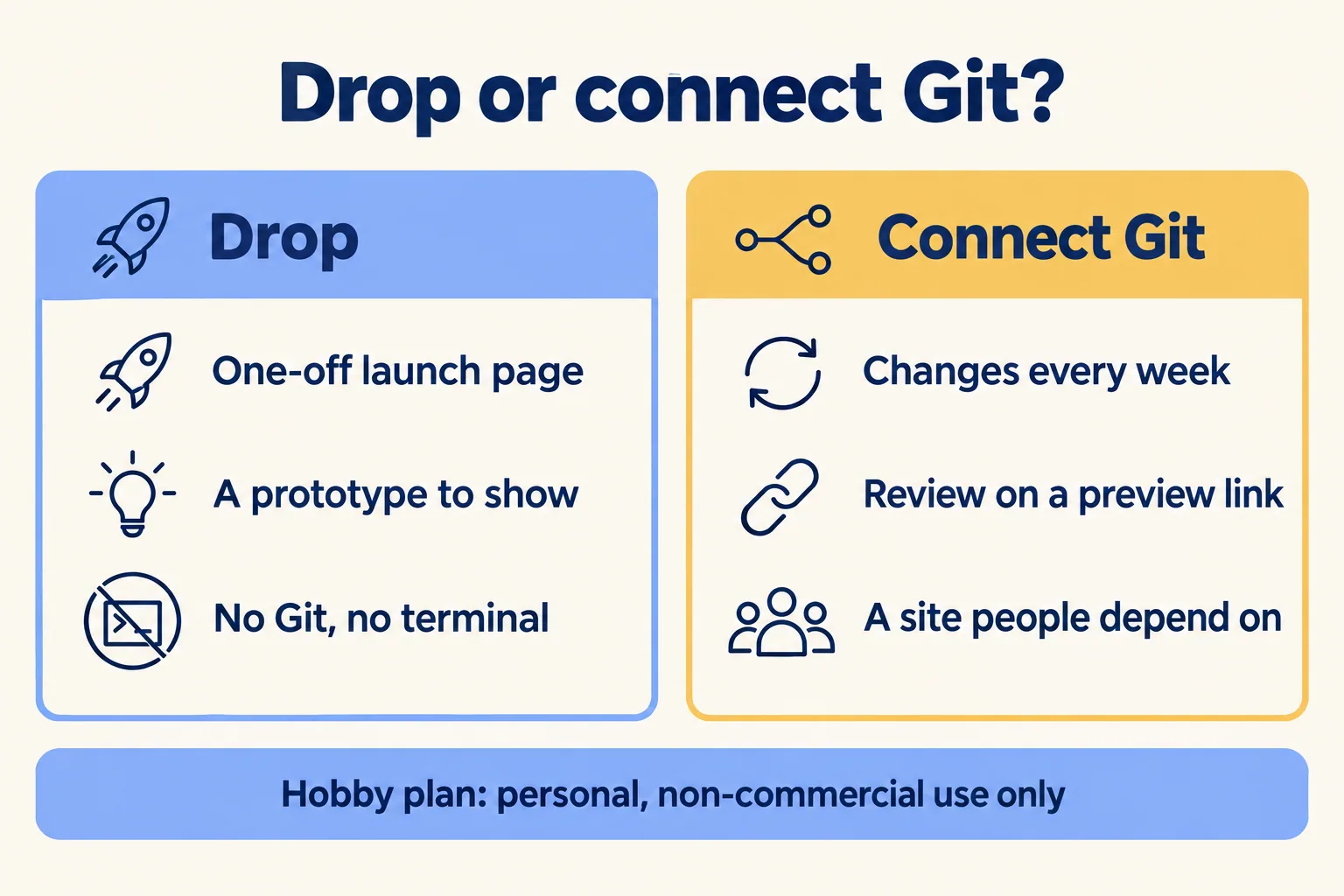
Before the second change. Our rule: drop once for a page that is a one-off or a prototype to show. The moment someone asks for an edit, connect the project to Git, so the edit lands on its own preview link and a person approves it before customers see it.
That is the method we use on everything we build on Vercel, and why we call it "Preview every change": no edit reaches customers until someone has opened its preview link and said yes. See how preview deployments work, and the rest of what we build on Vercel. We are not a Vercel partner and are not affiliated with Vercel; we use its product names and pick it per job.
This is not for a team that changes nothing after launch day and has a developer on hand anyway: drop it, or let the developer deploy, and skip the setup. It is also not for a site that must keep server code or data inside the UAE; we would keep that part where it runs today and say so in writing.
When we take on a page, the assessment is free. A single launch page rarely needs more than that. When the job is bigger (the Git connection, the preview step, and one tested lead from the form to the right broker and their WhatsApp), the first build week is a fixed AED/SAR 14,900, credited in full if you sign the build within 60 days. You hear back within 24 hours from the person who signs the work. After go-live, a Run plan keeps it patched and changing. Your Vercel account stays in your company's name, and Vercel bills you for it.
