

If approvals still live in WhatsApp, email and Excel, this is for you. It is not for teams happy on Microsoft Teams, and it is not for a team of five with nothing anyone will ever need to look up. We do not move you for the sake of it.
Why is this question loud this month?
Because a vendor asked it in public. On 9 November 2026, the Salesforce regional vice president for Slack and Service in India told Analytics India Magazine: "Many enterprises are coming back to us because WhatsApp is not very secure. There have been a lot of personal data leaks." TechGig and Lapaas Voice repeated the pitch the next day.
That is a Salesforce sales line, and we report it as one. The warnings behind it were Indian, but the same groups run approvals in Dubai and Riyadh offices. The same article recalls two real warnings. In June, CERT-In flagged malware aimed at WhatsApp Desktop and Web users. In August, India's cybercrime agency I4C warned about hijacked WhatsApp accounts used to impersonate senior executives and issue "fraudulent fund-transfer instructions". Lapaas Voice adds the fair reading: those incidents "do not establish that WhatsApp's end-to-end encryption was broken."
So the useful question is narrower than "Slack or WhatsApp". It is: which of your team's conversations need something a group chat does not give you? The same question applies to the approval sitting in an email thread or a tracker spreadsheet.
What does a WhatsApp group keep for the company?
Very little, by design. WhatsApp's privacy policy says your messages "are stored on your device and not typically stored on our servers". Its help page says it cannot restore your chats for you, "because your chat history isn't stored on our servers."
For a person, that is privacy. For a company, it means three things:
- No company copy. Each member's phone, and that member's own backup, holds the history. When a supervisor leaves, the decisions they were sent leave on their phone.
- No shared search. A manager searches their own phone, chat by chat. A decision from March is found only if someone remembers which group it was in.
- No record of who approved. A thumbs-up in a busy group is an approval only as long as everyone agrees it was one.
One software founder moved an 8-person team from Slack to WhatsApp groups and wrote about it. Three weeks later: "I had lost track of seventeen separate threads of work, missed two customer commitments because they were buried in a 400-message group chat." The team moved back. The founder's guide ends where we do: Slack for internal coordination, WhatsApp for customers.
Slack keeps the history in a workspace the company runs. Slack's search help lists filters by channel (in:), person (from:), date (before:, after:) and thread (is:thread). What an admin can export depends on the plan: public channels on every plan, private channels and direct messages on Business+ and Enterprise after the owner applies.
Which conversations should move?
Our rule, so you can argue with it. Move a conversation to Slack when it passes any one of three tests. Leave it in WhatsApp when it passes none, or when the other side is a customer or partner who lives on WhatsApp.
- Found later. Someone will need to find it next month: a shift handover, a vendor quote, a site decision.
- Approved by name. A named person must say yes: a discount above the limit, a leave swap, a payment.
- Acted on elsewhere. Someone does the work in another system afterwards: an order in the ERP, a case in Salesforce, a job in the maintenance tool.
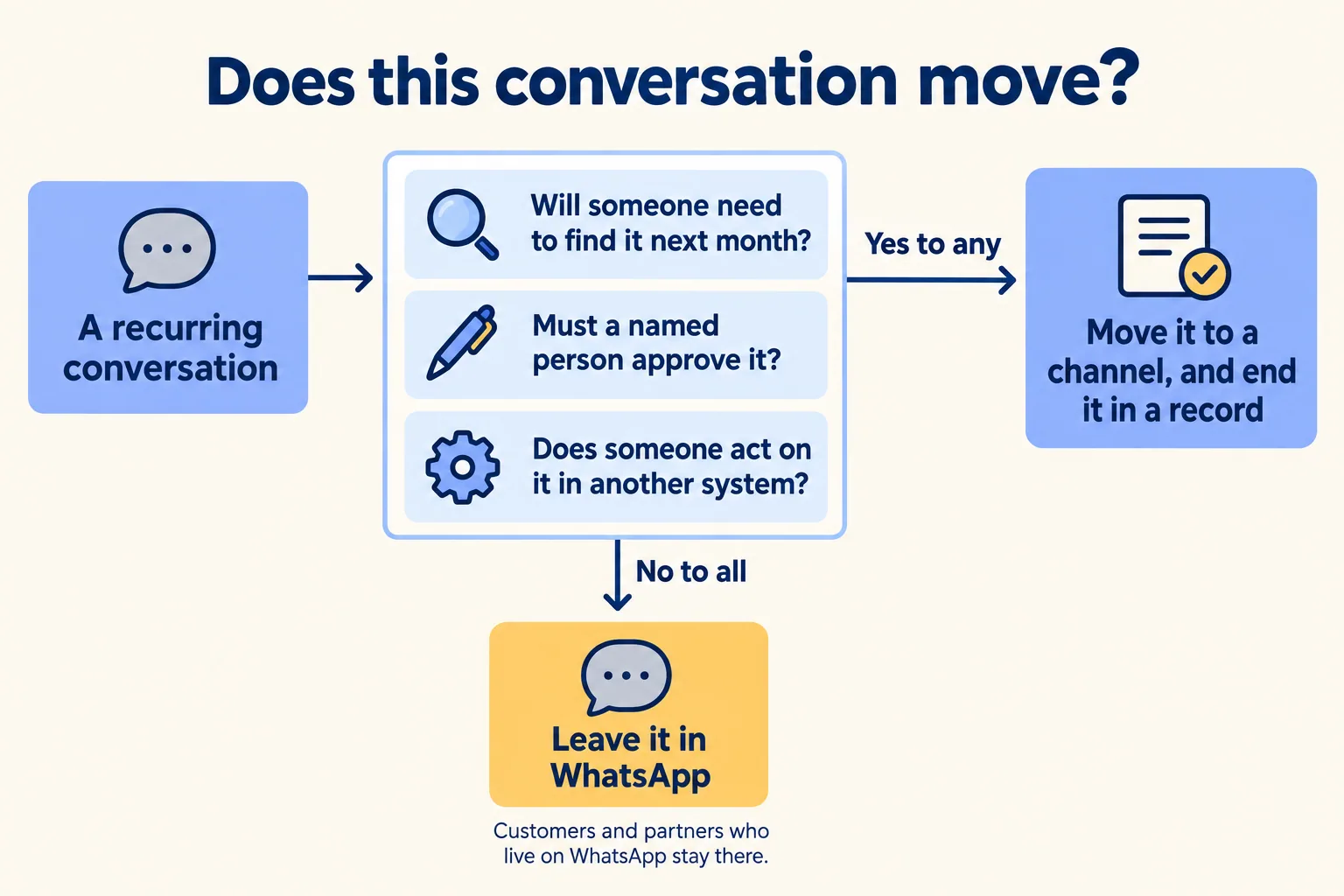
The receipt is on our own Slack page, in the answer to "What happens to our WhatsApp groups?": "We map them to channels, agree which conversations move, and train people on the new place. Customer WhatsApp can stay; internal decisions move to Slack." The move is partial on purpose. Asking customers to install another app costs you replies, and a driver's "reached the gate" ping has nothing in it worth finding next month.
"Found later" means found by someone other than the people in the chat. A delivery update can matter in a dispute, but the proof of delivery belongs in the delivery record, not in the chat, so the chat itself can stay. The same tests sort email and Excel: an approval in an inbox fails "found later" for everyone outside that inbox, and a tracker row with no named approver fails "approved by name".
A conversation that moves does not end in a thread. An approval ends where the approver is named and the answer is kept. We wrote the three blanks to fill before you build one: approver, silence and record.
Does moving make a payment approval safe?
No. This is the part the vendor pitch skips. I4C's warning was about hijacked accounts posing as executives. A Slack account can be taken over too, and a fake instruction reads the same in any app.
What protects a payment is the path, not the chat tool:
- The request arrives as a message. In any app.
- Someone checks it by a second route. A call to a known number, or the request already open in the finance system.
- A named approver signs off. By role, with a backup when they are away.
- The approval is kept in a record. Who, when, which amount, where anyone can find it later.
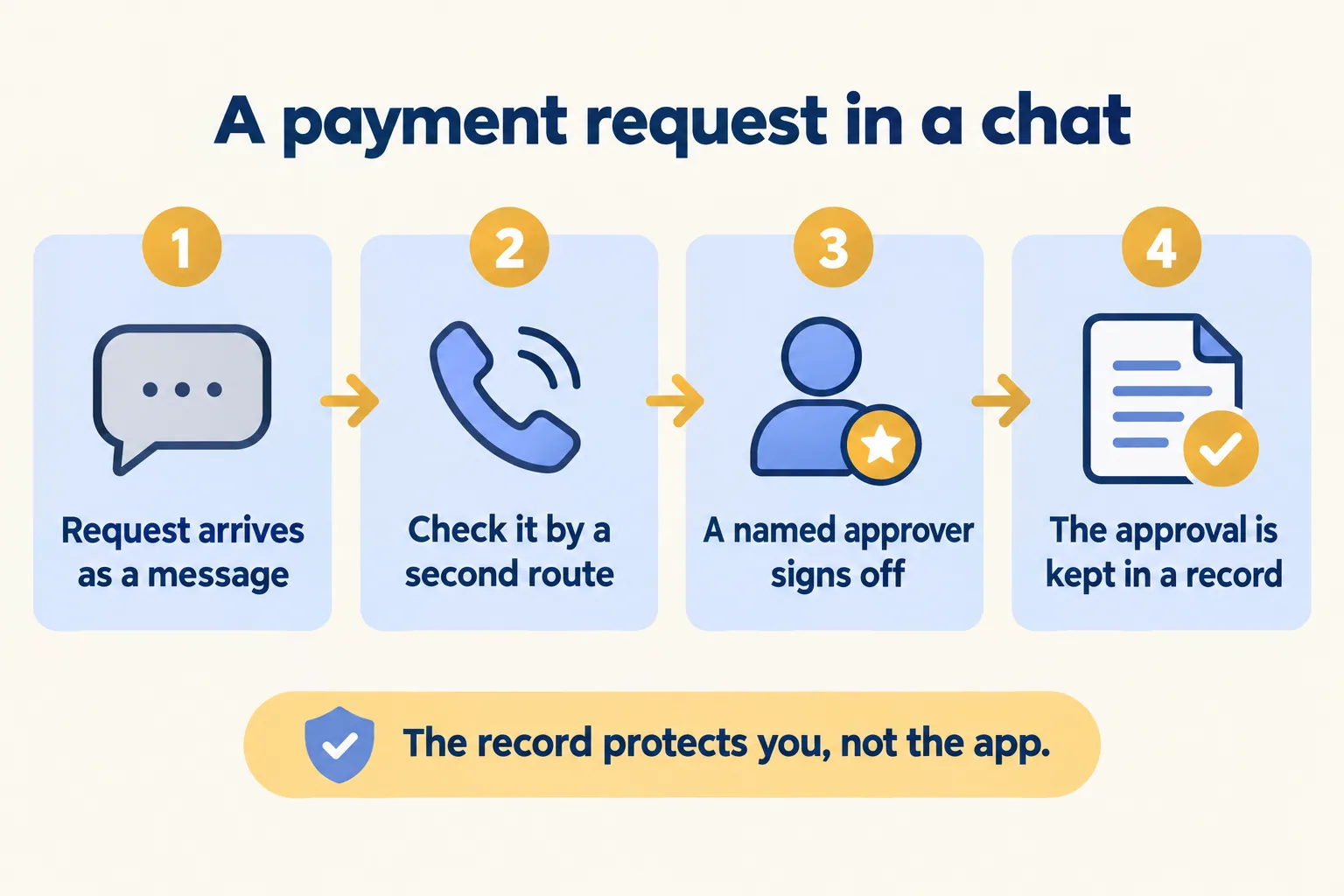
Slack makes steps 3 and 4 easier to build, because a workflow can name the approver and write the answer to a record. A WhatsApp group makes them hard, because the history sits on phones. That is the honest case for moving money approvals first.
What does a sample team's list look like?
Here is a sample, labelled as one, for a 40-person trading and delivery team in Kochi or Dubai. It is how we write the list, not a client result.
| Conversation | Found later | Approved by name | Acted on elsewhere | Where it goes |
|---|---|---|---|---|
| Supplier payment release | yes | yes | yes | Slack, then the finance record |
| Discount above the limit | yes | yes | yes | Slack, then the CRM |
| Leave and shift swaps | yes | yes | no | Slack |
| Shift handover | yes | no | no | Slack |
| Vendor quote comparison | yes | yes | no | Slack |
| Complaint escalation, inside the team | yes | no | yes | Slack, then the case |
| Delivery updates to customers | no | no | no | |
| Driver arrival pings | no | no | no | |
| Quick replies to a partner | no | no | no | |
| Team birthday wishes | no | no | no |
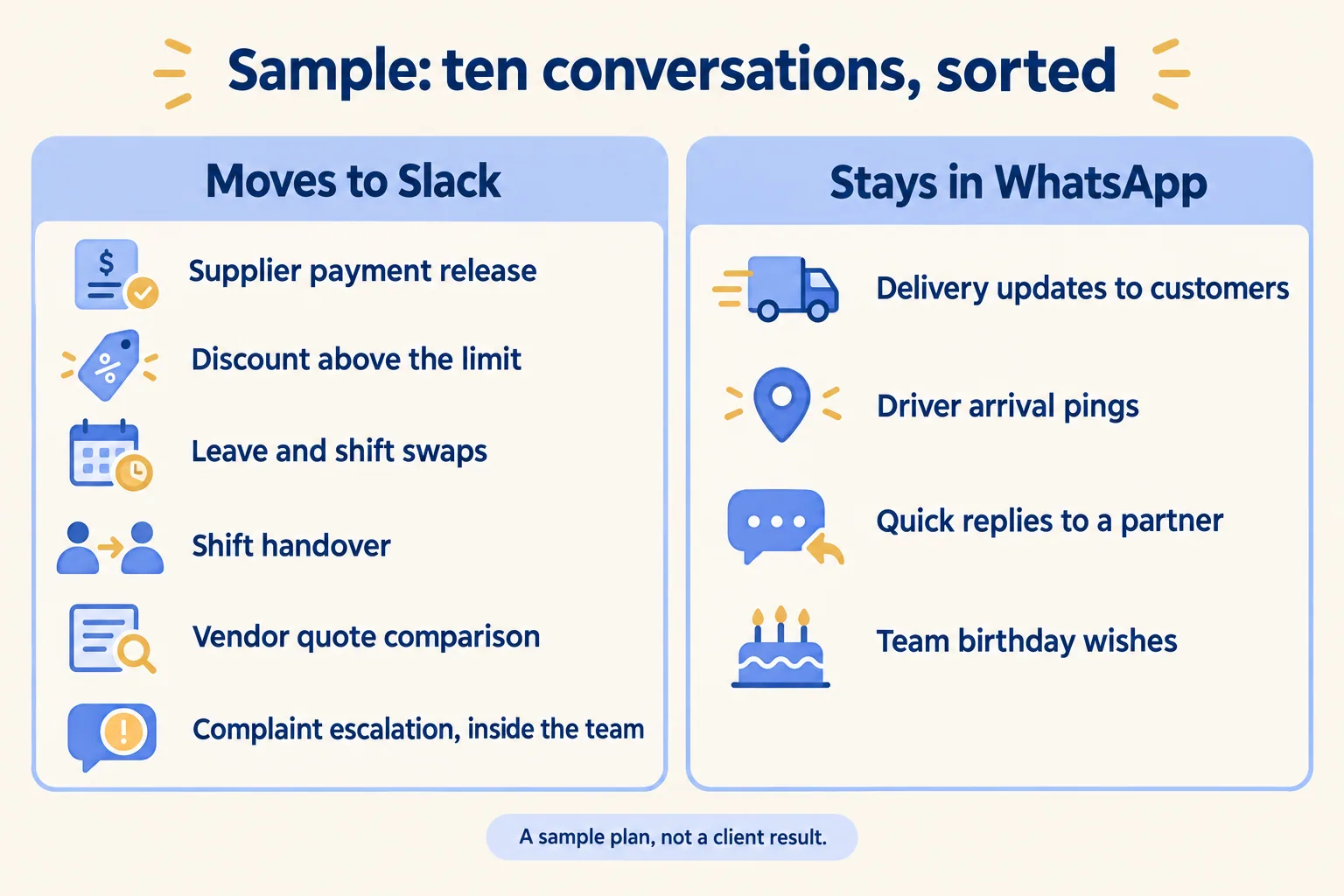
Vendor quotes arrive on WhatsApp and the vendor stays there. Whoever receives a quote attaches it to the channel or the purchase record, so the comparison and the choice sit in one place.
Two things in the sample matter more than the rest. The complaint stays on WhatsApp with the customer while the team's escalation moves, so one problem can live in both apps on purpose. And the four rows that stay are not failures to move. They are WhatsApp doing what it does well.
When the customer side of WhatsApp needs more than a phone (several agents, one number, replies that reach Salesforce), that is a different job. See WhatsApp for customer conversations. If shift staff are the ones on the groups, the field version of this list is ten channels per role.
Who is this not for?
If your team is happy on Microsoft Teams, stay. If you pay for Microsoft 365 and still approve in WhatsApp, the three tests work in Teams channels too; see where Slack and Teams each fit before you add a second tool. If nothing your team says on WhatsApp ever needs to be found, approved or acted on, keep the groups.
If approvals still live in WhatsApp, email and Excel, tell us the decision you chase most. We call the method Pick your ten, part of Run the Work in Slack: you give us the process, we sort your ten recurring conversations by the three tests, and write what to build first and what to leave alone. Bring the group names and one week of the approvals you chased; the person who chases them is the right one to list them. For handoffs between teams that list is the first page. Licences come from Salesforce today. We help you pick the plan and work with your Salesforce account team.
