
What changes on 27 October?
If approvals run in Slack, this change is yours as well as IT's: it decides who answers when Slack itself fails and how fast. A discount waiting for sign-off in #deal-desk, an escalation room, an incident room: when Slack stalls, those stall, and someone has to file the case. Slack's help center says that starting 27 October 2026, Slack support moves to Salesforce Success Plans. You are moved automatically, at no additional cost, and you keep your Slack sign-in. As of today, 8 October, that is 19 days away.
Slack's US page says "Success Plan". Its UK and New Zealand pages say "Success Subscription". It is the same article, so we use "plan".
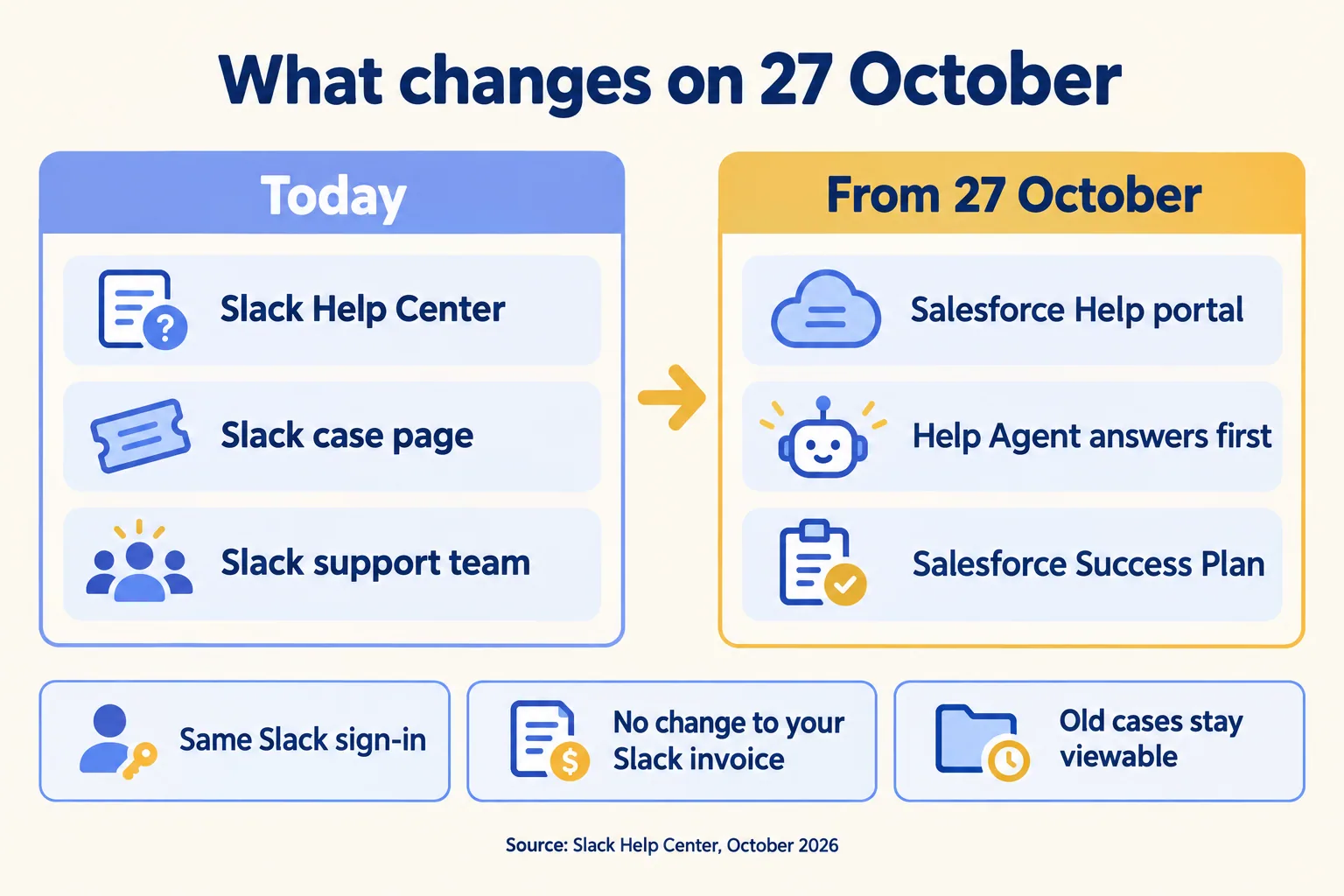
Support goes through Salesforce Help, with the Agentforce Help Agent answering first. Slack describes it as "faster self-service content, streamlined case creation and management, and our AI-powered Help Agent." Cases you open from 27 October are managed there, and your earlier case history stays on the Slack case page.
Now the line most people will stop at: "No action is required." That is true of the account and not of the way your team works. Slack's own article lists four things that change anyway: new cases live in a different portal, the Salesforce Success Plan terms apply, each workspace may get its own notice, and a Slack subscription can end up beside a second Success Plan you already hold for Salesforce. Nothing breaks. But the person who files the next case needs to know where.
Which plan does your workspace get?
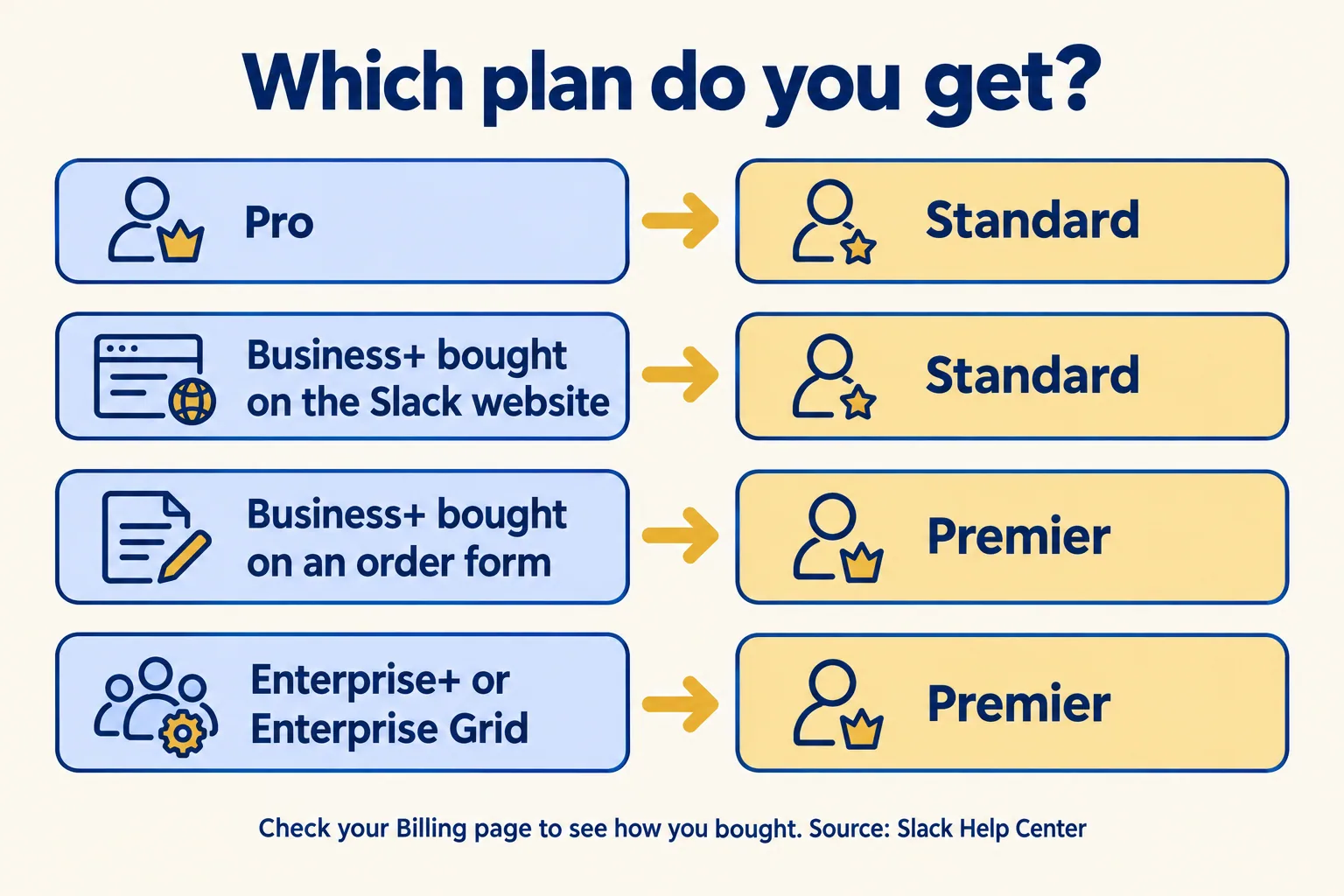
It follows how you bought Slack, not how big you are. Slack maps each subscription to one of two Salesforce plans.
The split in Business+ is the part to check. Two workspaces on the same plan name can land on different support levels, because one was bought online and one on an order form. Slack says your Billing page shows which you have. If you run several workspaces, each moves according to its own subscription.
Customers who chose to keep support in a FedRAMP environment, and GovSlack customers, are outside this change for now.
When does yours switch?
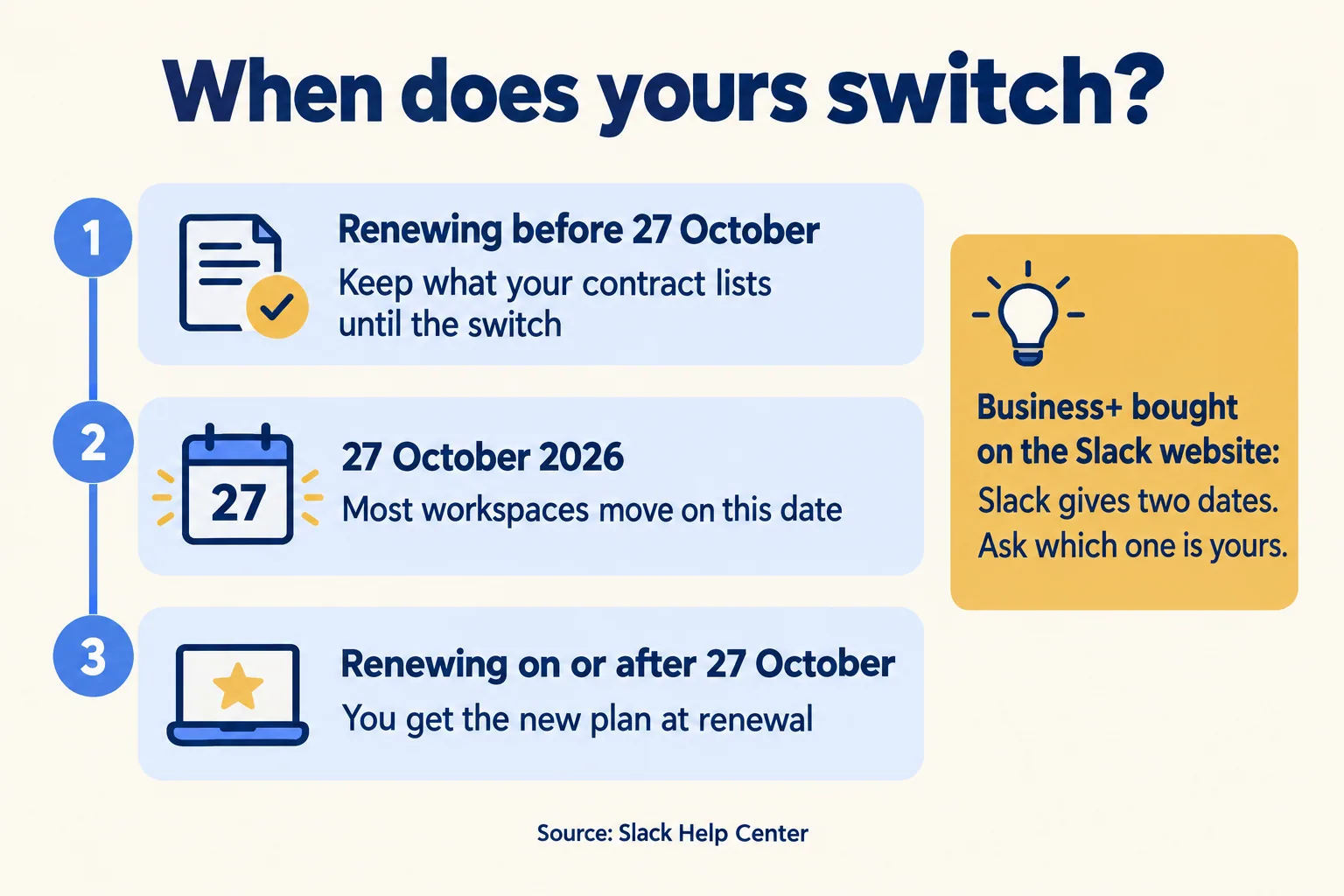
On 27 October for most, and at renewal if yours comes later. Slack gives three cases.
One gap: for self-serve Business+, Slack's article gives two dates. Its "Do I need to do anything" answer says you move at your next billing cycle. Its renewal answer says a self-serve workspace renewing before 27 October moves to Standard on 27 October. The article does not reconcile them. If that is you, check the email Slack sent and ask Slack which date applies.
What do Standard and Premier promise?
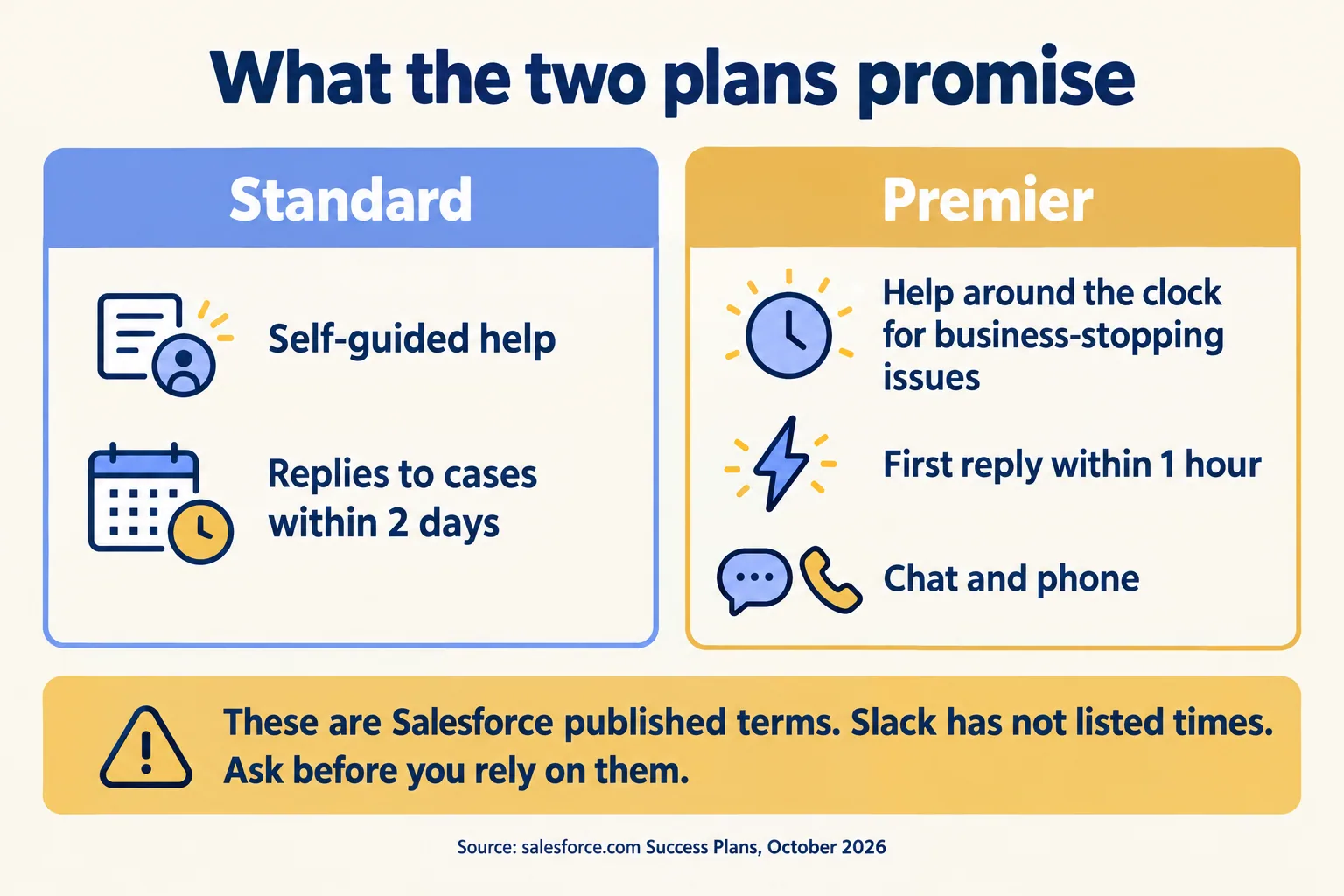
Salesforce publishes response targets for its own products. Slack has not listed any for Slack. Slack's article names the plan and gives no response targets. It says Slack will "send follow-up communication" on 27 October with more detail. So the numbers below are Salesforce's, from its Success Plans pages, and may not carry over unchanged.
If your workspace is on Standard, plan for a case to wait up to two days until Slack tells you otherwise. If it is on Premier, a business-stopping issue should get a first reply within the hour, but ask Slack to confirm in writing what "business-stopping" covers for a Slack outage. Our reading is that this matters most where Slack carries approvals. If Slack carries your approvals, two days of waiting means two days of stalled approvals.
What should you do before 27 October?
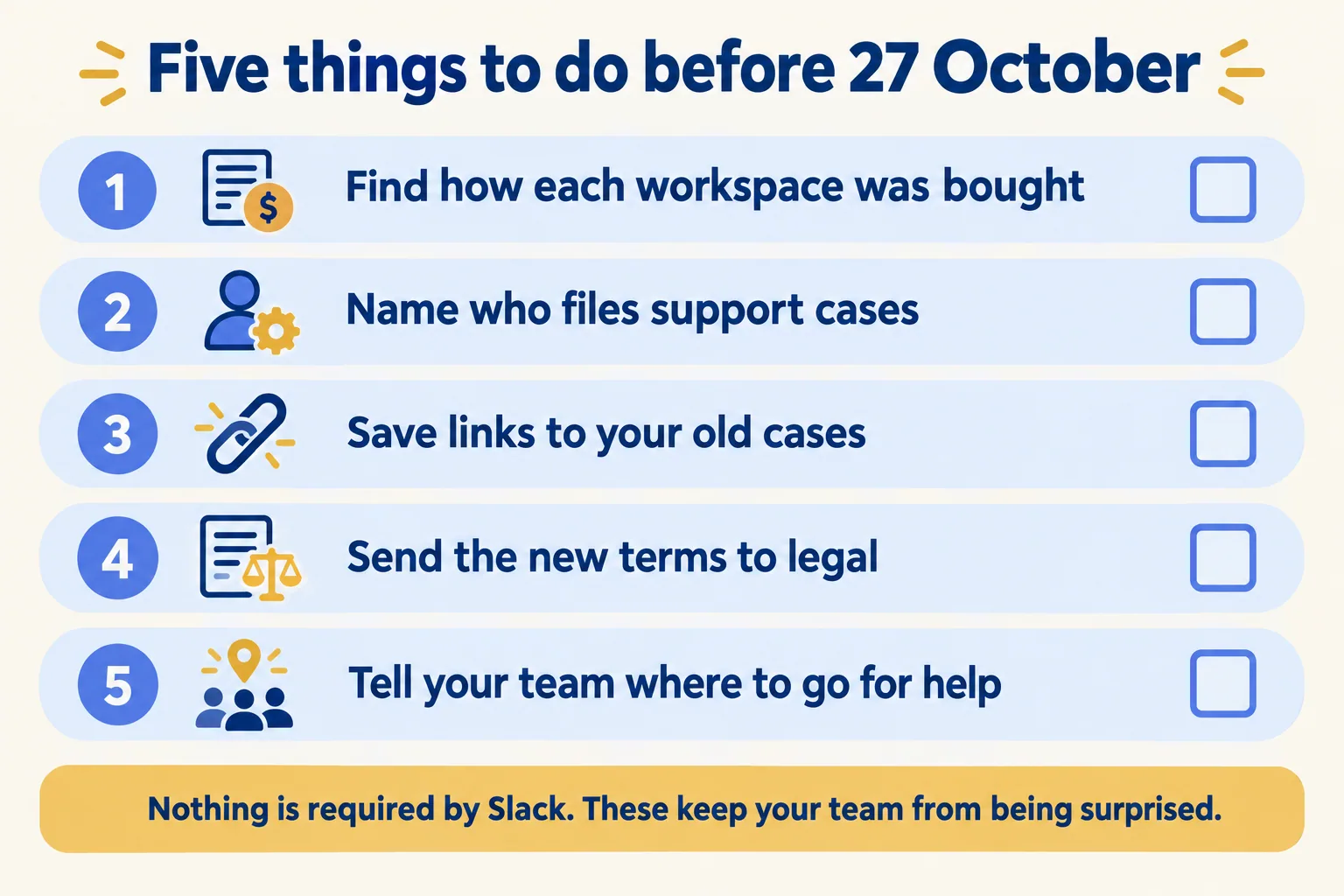
Five checks, none required by Slack, all cheap. They stop the first case after the switch from being a scramble.
- 01Find how each workspace was bought. Open the Billing page: self-serve or order form decides Standard or Premier.
- 02Name who files support cases. One person, not IT in general, and a backup. Have them sign in to Salesforce Help with their Slack credentials on 27 October to see the path.
- 03Save links to the cases you care about. Your history stays on the Slack case page, but you want the numbers to hand.
- 04Send the Salesforce Success Plan terms to legal. Slack says the Success Plan terms and conditions will apply.
- 05Tell your team where to go for help, in the channel they already use, with the new path in one pinned post.
Then ask Slack three things in writing: which date applies to each workspace, what the response targets are for Slack incidents, and whether a case open on 27 October moves or stays. Slack says it will write again on the day, so keep the thread.
What would we do first?
We would list what stops when Slack stalls. At Mindcat, we run our own work and approvals in Slack, and we set it up for clients the way we use it ourselves. We are not Slack and we do not resell it, so your support contract is with Slack and Salesforce. Our part is the process side.
Take discount and quote approvals, one of our ten Slack use cases. Here is the four-line version, as an example of the format and not a finding about your team:
We would write those four lines for each workflow you run in Slack. The list is the first page of our Pick your ten note. The note is a short written document that names the ten Slack use cases that fit your work, what to build first and what to leave alone. The four lines also show whether Standard is enough, or whether a Premier-level answer is worth asking about at your next renewal.
If you want that list for your own workspace, send us the process that leaks between desks. You hear back within 24 hours from the person who signs the work, and what you get is a written note, not a demo.

Related reading: Run the Work in Slack, Slack security, and Slack or Microsoft Teams.
