

If someone on your team starts maternity leave next month and nobody has written down what her slip pays on day 46, this is for you. It is not for a firm with nobody who owns HR records: the slip can only pay what someone has entered, so name that person first.
What does the law fix?
The days and the split. Your contracts fix the rest.
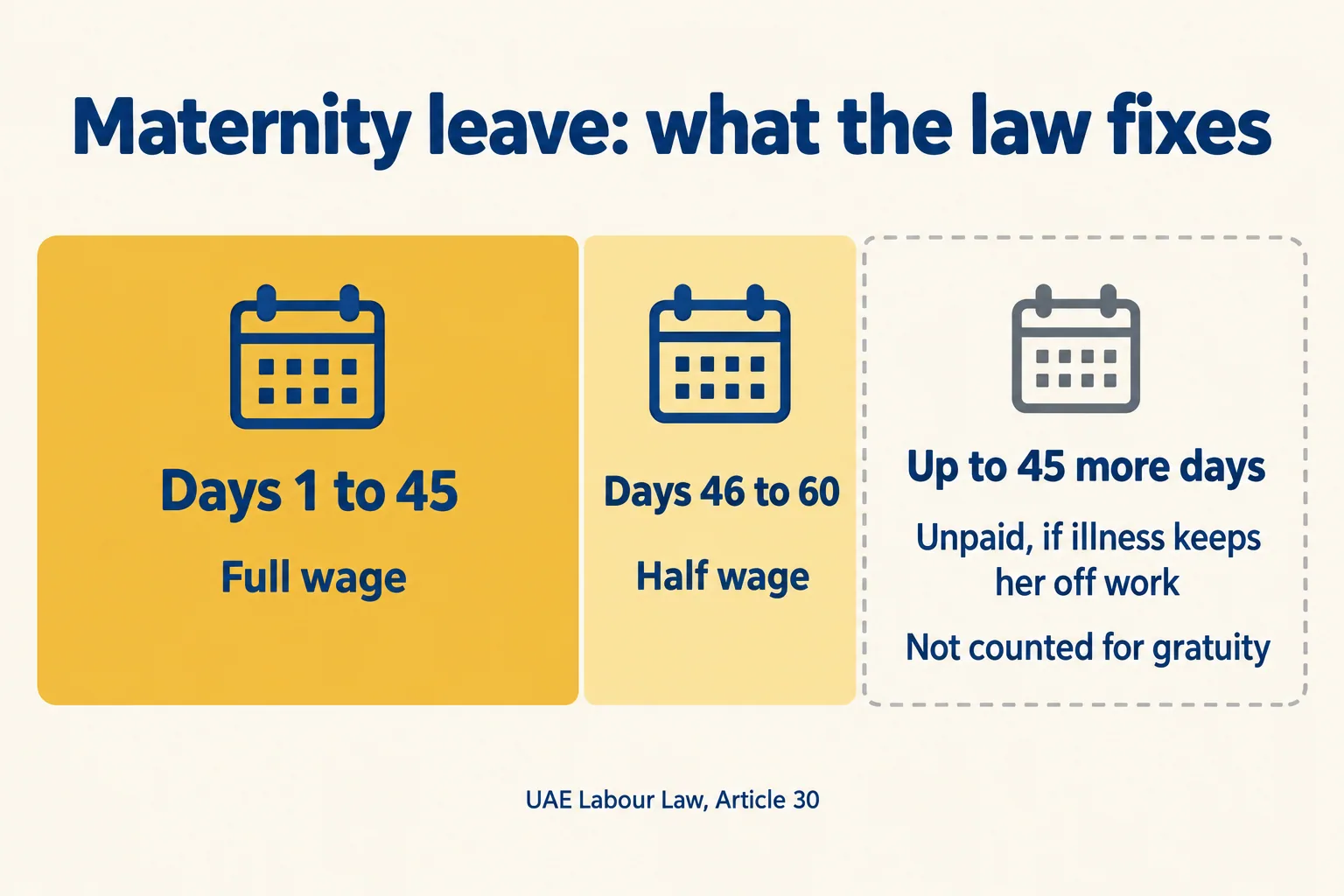
Article 30 of Federal Decree-Law No. 33 of 2021, the UAE Labour Law for the private sector, gives a female employee 60 days of maternity leave. The first 45 days are "with full wage". The next 15 are "with half wage". The article sets no minimum length of service. Its one condition on timing is that the birth takes place six months or more into the pregnancy.
She can start early. The employer must grant the leave when she asks, from the last day of the month before the month she expects to give birth, on a certificate from the medical entity. u.ae words it as up to 30 days before the expected date. And Article 30 says her service may not be ended, and she may not be given notice, because of the pregnancy or the leave.
These are mainland rules. DIFC and ADGM have their own employment laws, and some free zones publish their own. Check which one your company is under before you use anything here.
What does full pay mean in your contracts?
This is the decision most firms skip, and the published guides do not agree on it.
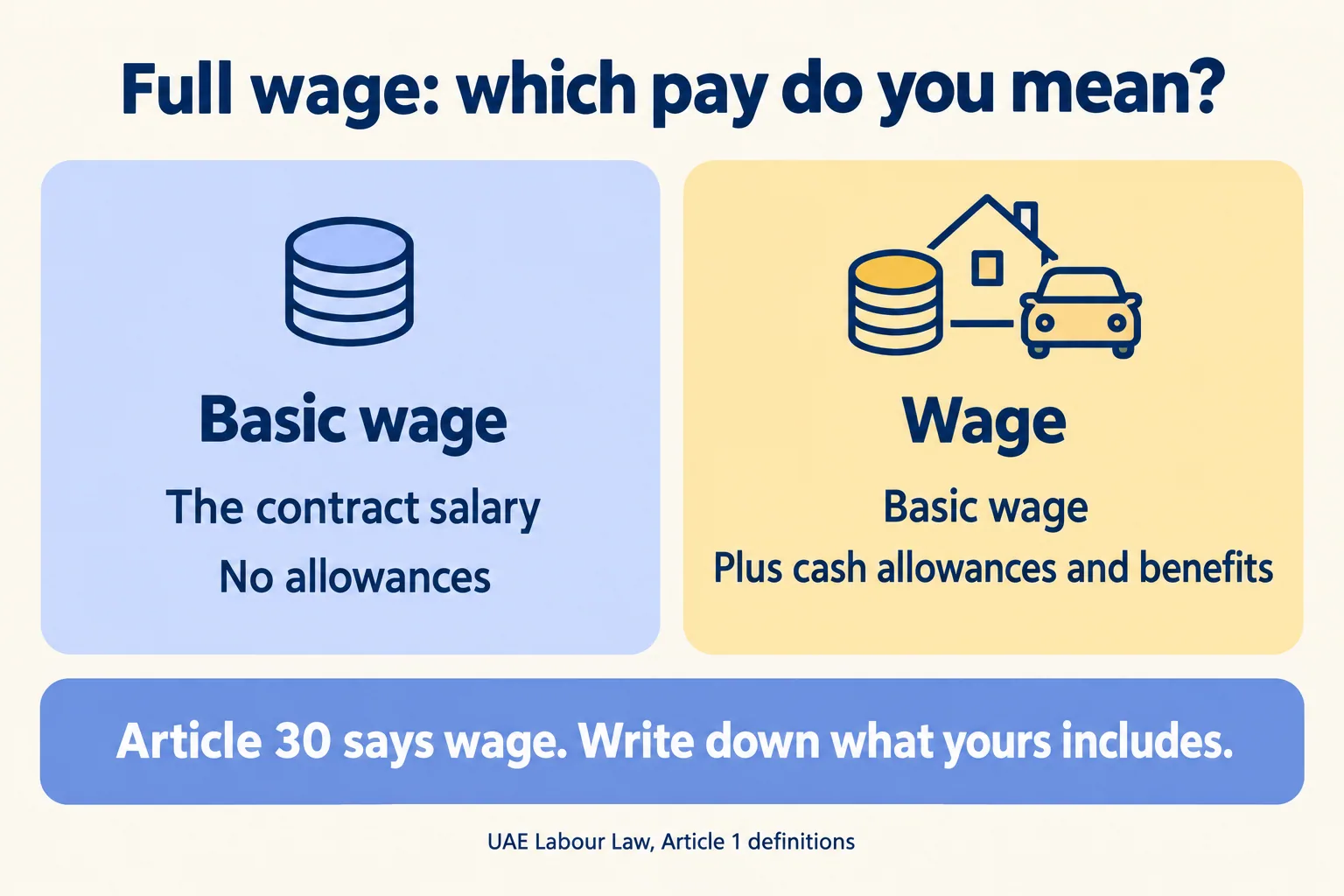
The law uses two words. Article 1 defines basic wage as the wage in the contract, without any allowances or benefits in kind. It defines wage as the basic wage plus the cash allowances and benefits in kind set under the contract or the law. Article 30 says "full wage" and "half wage", not basic wage. Gratuity, under Article 51, is the one that says basic wage.
The guides read this differently. An accounting practice, Velmont Crest, pays the 45 days on the registered total salary, basic plus allowances. Mai HRMS, an HR software vendor, says full pay is "basic salary plus housing allowance for most employees" and that the contract and company policy govern. Both tell you to read the contract first.
So write it down once: which components of her salary are paid in full for 45 days and at half for 15. Put it in your leave policy, and have whoever signs the payroll agree to it before the leave starts. If a contract is unclear, ask MOHRE or a lawyer before the first slip, not after.
Which month's slip changes?
The month that holds day 46. Every month before it looks like a normal month on the slip.
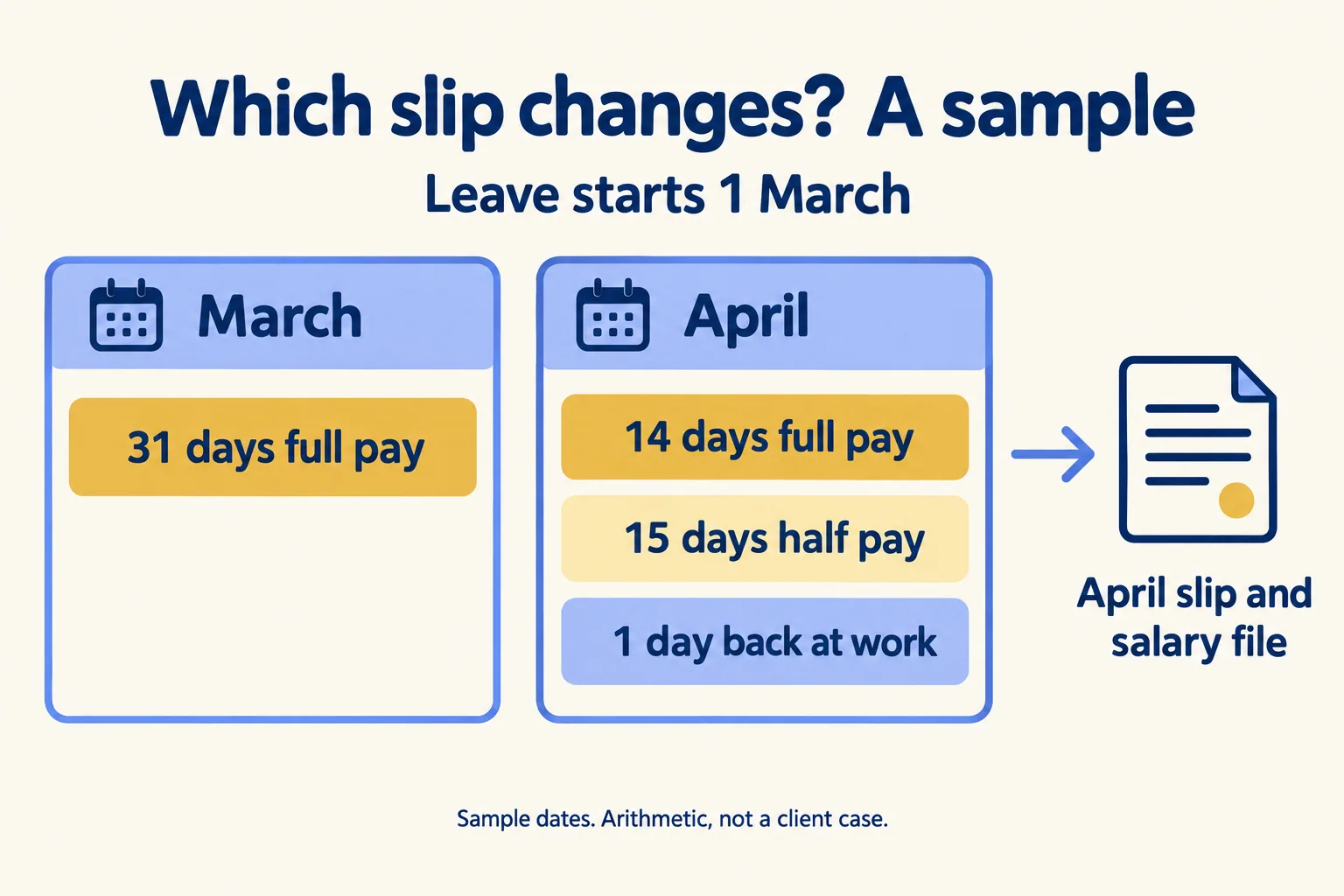
A sample, arithmetic only. The baby is due in March, and leave starts on 1 March. Days 1 to 31 are March, all on full pay. Days 32 to 45 are 1 to 14 April, still full pay. Days 46 to 60 are 15 to 29 April, on half pay. She is back at work on 30 April.
So March looks normal, and April does not. April pays 14 days in full, 15 days at half and 1 day worked: 22.5 days of pay out of 30. April has 30 days. In a 31-day month or February, use the day rate your payroll already uses for any part month. If the April run pays her as a normal month, the half-pay days are overpaid, and the May run has to take it back from someone with a newborn. That is an illustration of the count, not a case from a client.
Velmont Crest names the error it sees most: the leave "processed as a single 60-day block at full pay, missing the half-pay portion entirely". It also notes that the salary file for that month carries the reduced figure. Under WPS, the bank file for April pays the April slip, so the two have to match.
What happens after the 60 days?
Three more clauses, and each one lands on a different record.
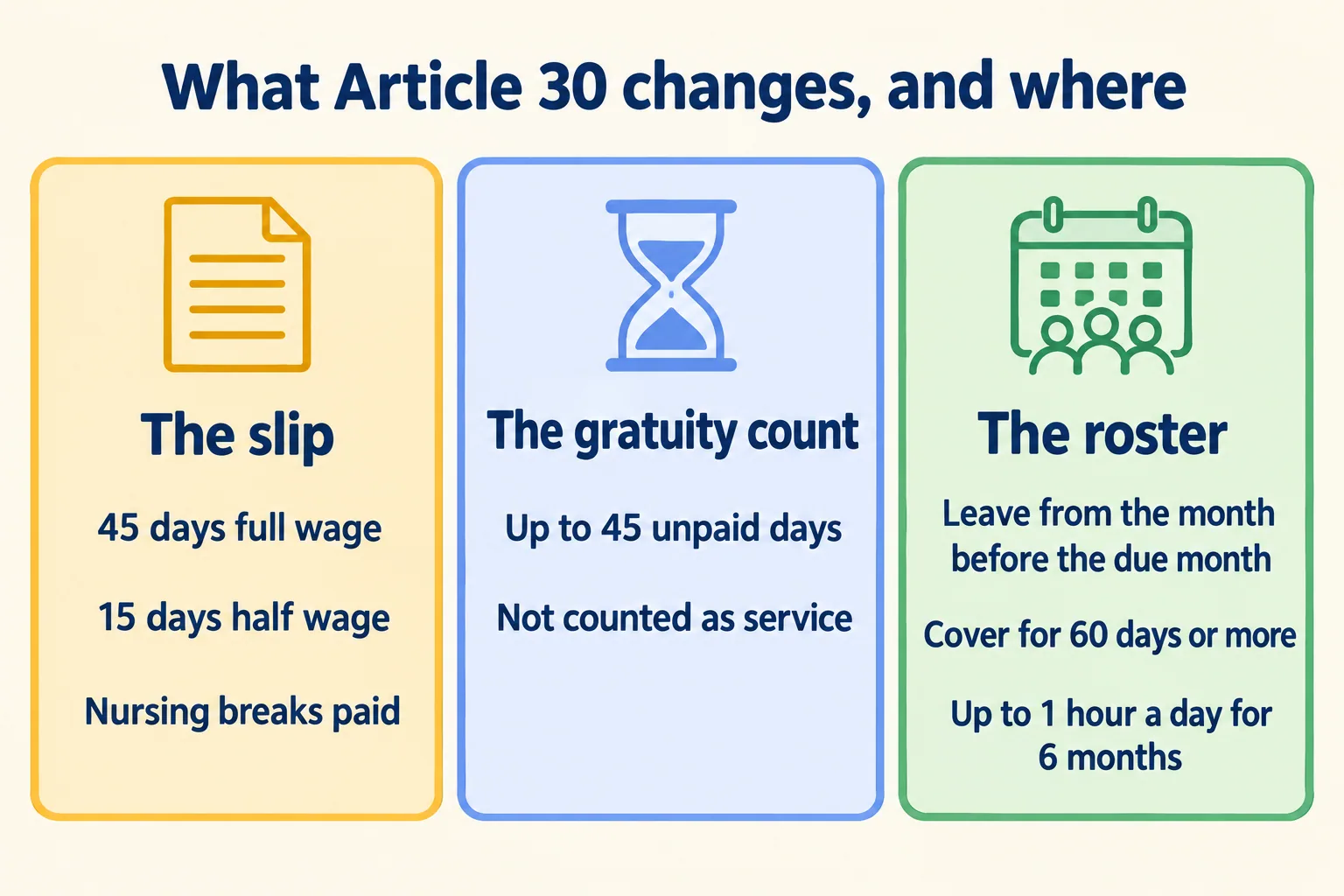
Up to 45 unpaid days. If illness from the pregnancy or the birth keeps her, or her child, from work, she may be absent up to 45 more days without pay, in one block or several, proven by a medical certificate. Article 30 says these days are not counted as service for end-of-service gratuity. That changes the gratuity count as well as the slip.
A sick or disabled child. If the child needs a constant companion, on a medical report, she gets 30 more days with full pay after the maternity leave, and may extend them by 30 days without pay.
Nursing breaks. For six months from the birth, after she is back, she gets one or two breaks a day to breastfeed, together no longer than one hour. u.ae says they are fully paid. That changes the roster, not the slip.
Keep the days as separate numbers on her record: full-wage days, half-wage days and unpaid days. The 60 days are paid days. Article 51 leaves unpaid days of absence out of the service count, and Article 30 says the same of the extra 45. Whoever settles her gratuity later, maybe years later, needs those numbers apart.
Who owns the count, and who covers the work?
One named person owns the count. Usually the HR officer, sometimes the payroll officer. Her manager owns the cover.
Before the first day, the owner does four things: files the medical certificate with the expected month, writes the start date and the date of day 46 in the leave record, confirms the pay base with payroll, and puts day 46 in the calendar of whoever runs that month. If she starts earlier than planned, the owner moves every date the same day.
Her manager writes the cover plan: who takes her work for the 60 days, what waits, and who answers her clients or suppliers. List the approvals she signs today and name who signs each while she is away. Move client and supplier threads off her phone to a shared number or inbox before she goes, so nobody chases her WhatsApp. Plan for longer than 60 days. She may add annual leave, and Article 30 keeps her other leave rights intact, or the unpaid days if she is unwell. Agree with her how she would like to be contacted while she is away, by WhatsApp or email, and then keep to it.

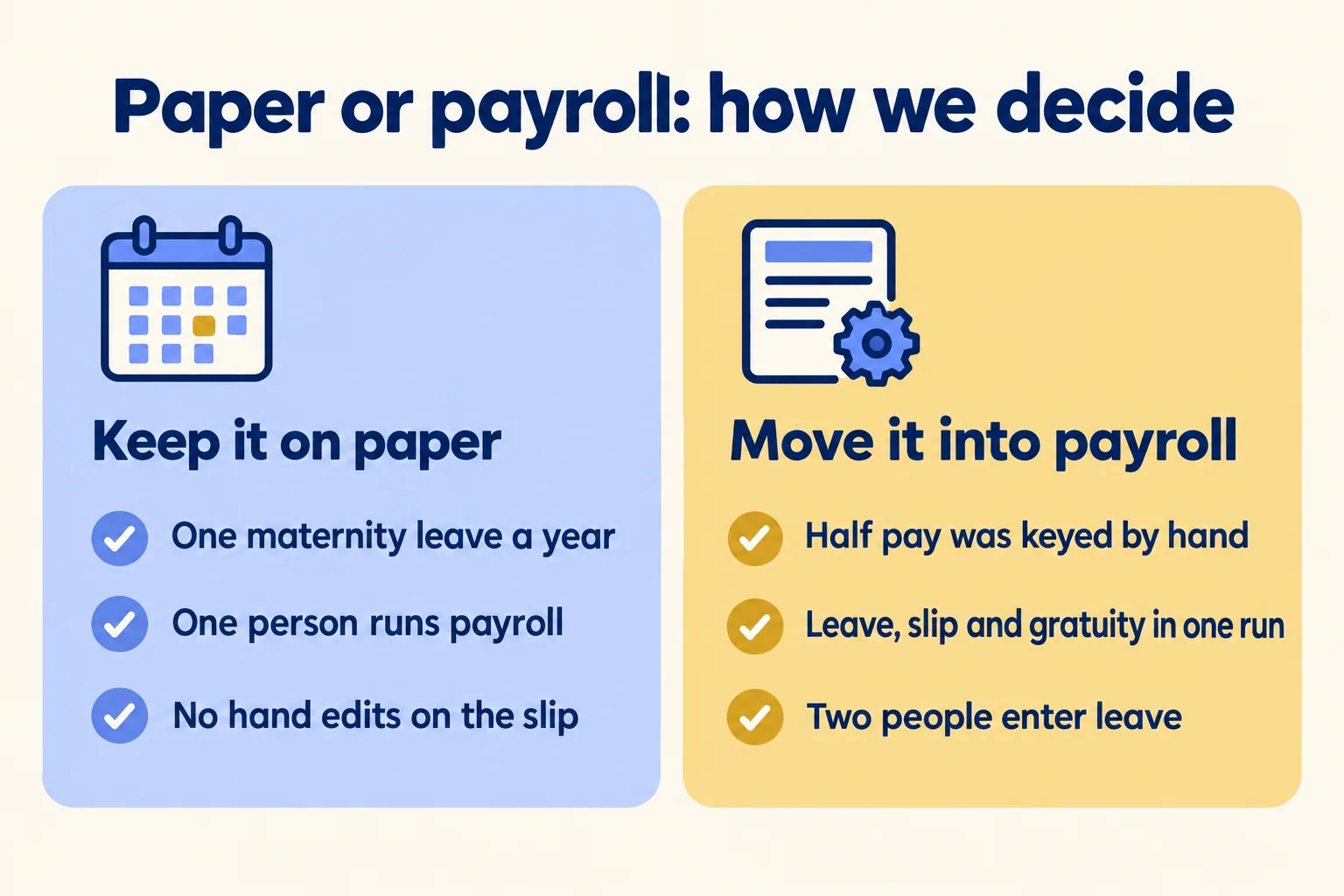
Paper or payroll: how do we decide?
At Mindcat, we ask two questions before we say. How many maternity leaves do you run in a year? Who keys the slip?
Keep it on paper and a shared calendar when you see one maternity leave a year, one person runs payroll, and nobody edits a slip by hand. Give the record five lines: start date, date of day 46, last day, pay base, return date. Paper costs nothing and works when one person keeps it.
Move it into the system that makes the slip once half pay has been keyed by hand, when two people enter leave, or when leave, the slip and the gratuity have to land on the same run. At that point the leave record and the payroll run are kept in two places, and they drift apart.
What does a system not do?
It does not decide what full pay means in your contracts. You do, and we set the leave type and the half-pay rule on day 46 to match it during setup. It does not check a medical certificate, file anything with MOHRE or send a notice unless one is set up.
Our People page lists leave per policy with balances, says approved leave reaches the next run, and says the run makes every slip and the WPS file. The quick start includes our UAE template with leave types and the gratuity rule. A person still decides each case. For a disputed one, confirm with MOHRE or a lawyer before you act.
What would it cost?
Here is what the People page says today. You pay per employee on payroll a month, AED or SAR, and the price falls as you grow: 29 for the first 50, 18 for 51 to 200, 12 for 201 to 500, 8 above. The shared plan has a minimum of AED/SAR 990 a month. HR, finance and manager logins add nothing.
By that list, a 40-person firm is 40 x 29 = AED 1,160 a month, above the minimum. That is arithmetic on the page's prices, not a quote. The quick start, up to 50 employees, is a fixed AED/SAR 2,500 that we set up, with your leave balances imported from our template. Your bank or exchange house charges its own WPS fees. Prices exclude 5 percent UAE VAT and 15 percent Saudi VAT.
Our method is called One run, one file. Tell us how many employees you pay, from how many sites, and how leave reaches payroll today. We reply with the setup plan and the monthly price per employee, in AED or SAR.
