
If your Arabic call transcripts read well and still get the caller's request wrong, this is for you. It is not for teams with no recorded calls to test on, or with no one who owns the call after the transcript.
Why can a fluent transcript still get the call wrong?
Because fluent Arabic on the page is not proof that it is what the caller said. Some speech models translate Gulf speech into formal Arabic, and some write a clean sentence the caller never spoke.
When researchers at MBZUAI built Mixat, a set of 15 hours of Emirati podcast speech, they ran three widely used speech models over it. The authors wrote that "none of the models provide satisfactory transcriptions for this dataset". One general model scored 12.06% word error on the English-only sentences and 195.98% on the Arabic-only ones (Mixat, SIGUL 2024; see also Telonic, 30 September 2026). The reason, as the authors put it: the model "translates the sentences into MSA, and the translations are often correct", so it "performs the wrong task". Read on its own, that transcript looks fine.
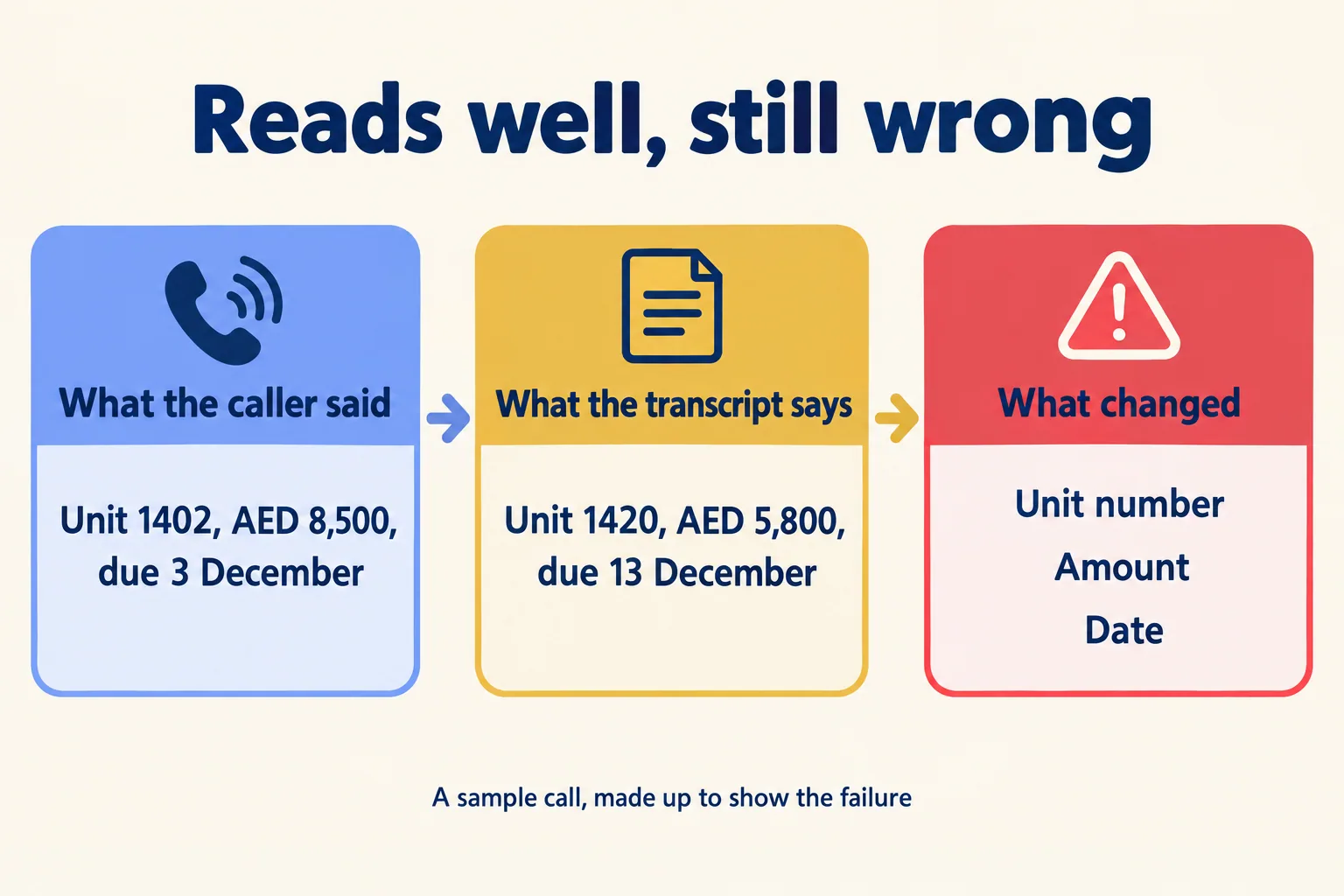
A UAE test on real voice orders found the quieter version of the same failure. Reflekt Lab ran 12 models over 54 WhatsApp voice notes from a grocery delivery service in October 2026. Given an order for lentils, tomatoes and onions spoken in Urdu, one model "produced a clean, natural Gulf Arabic sentence about making karak tea and bringing coffee. Nothing about it looks wrong." (Reflekt Lab, 11 October 2026.) A garbled transcript gets caught. A fluent wrong one goes straight into the agent's summary. On a property call, that is the caller asking about the third instalment on unit 1402 and the record showing unit 1420, a different amount and a different date, as in the made-up sample below.
The gap is mostly dialect. On a Saudi broadcast test set, one widely used open model scored 27.95% word error on Modern Standard Arabic and 59.92% on Gulf dialect (Telonic, citing the published results). Phone audio makes it harder. A 2026 preprint on Saudi and Gulf speech puts it plainly: call centres "mix regional dialects, code-switching, and spoken digit strings such as identity and account numbers. All of this arrives on 8 kHz narrow-band audio." (Abdelkhalik, preprint, October 2026.) Those digit strings are the fields an agent writes back.
Why is one accuracy score the wrong test?
Because the score most vendors quote, word error rate, counts every word the same, and your agent does not use every word the same.
Word error rate is the share of words that are wrong, missing or added against what was said. It can pass 100%, as Mixat shows, when a model writes more wrong words than were spoken. It also punishes answers a person would accept. A May 2026 benchmark of five commercial systems on Saudi and Egyptian Arabic mixed with English found that word error rate "inflates the magnitude of quality gaps by approximately 3x by penalising semantically correct transliteration choices", such as an English word written in Arabic script (Abdoli and others, Perle AI research, May 2026).
Mixing is normal here. In Mixat, 1,947 of 5,316 sentences, about 36%, switched between Emirati Arabic and English. "The next instalment", "the unit", "the due date" are often the English words inside an Arabic sentence, and they carry the request.
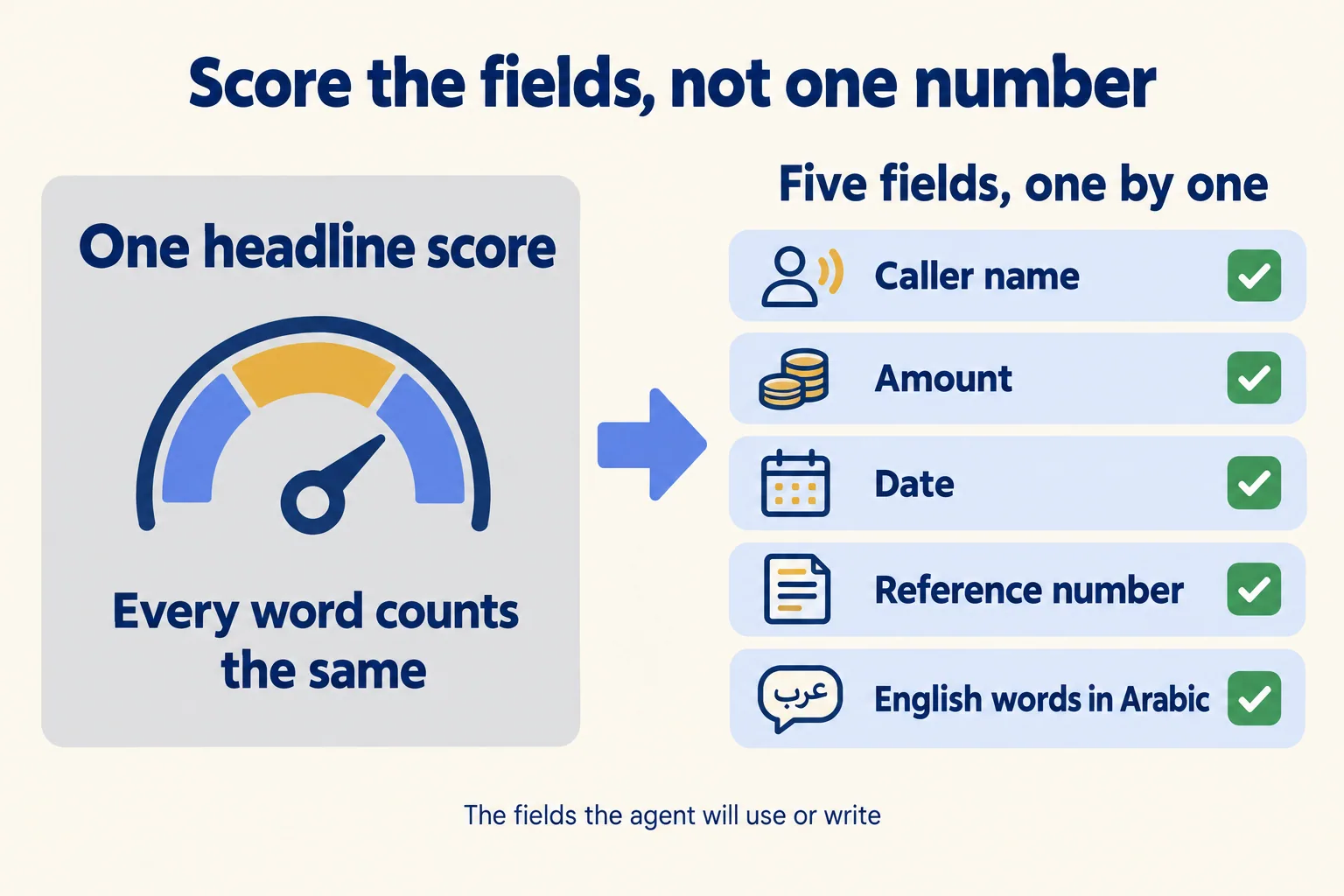
So a model can post a poor word error rate and still get every booking right, or a good one and still drop the amount. Reflekt Lab scored its test the way a shop would: did the transcript name the products the customer ordered? That is the right shape of test. Score the fields the job needs.
How do we test speech to text on your own calls?
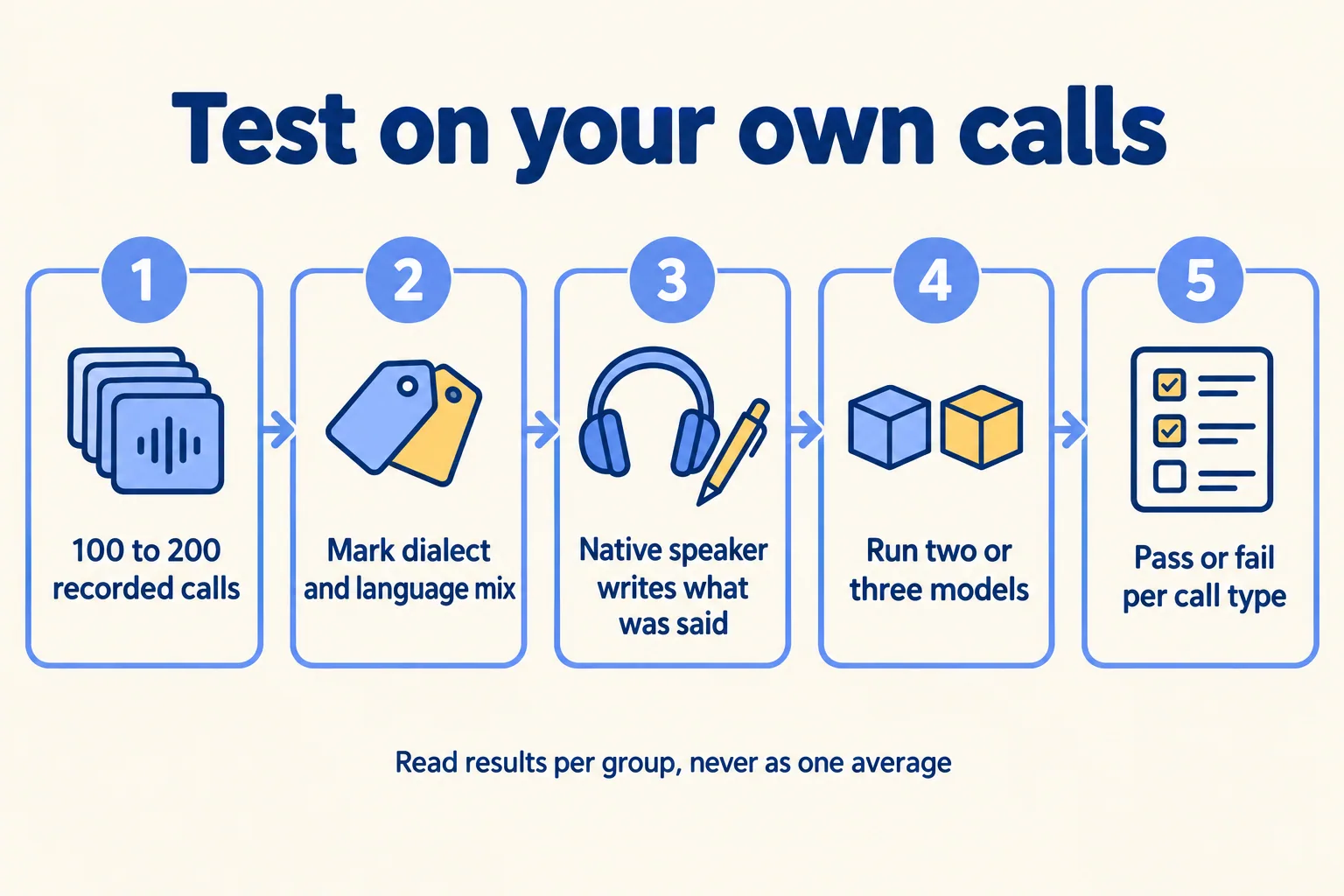
With your recordings, a native Gulf speaker and a scorecard written before any model runs. At Mindcat, this is the first part of the shadow step in our method, Spec, shadow, gate.
- 01Pick 100 to 200 recorded calls of the kind the agent would take, recorded with the caller's notice under your recording policy. Include phone audio, noisy calls, and callers who mix Arabic and English.
- 02Mark each call by dialect and language mix: Emirati or other Gulf, other Arabic dialects, English, mixed. Results are read per group, never as one average.
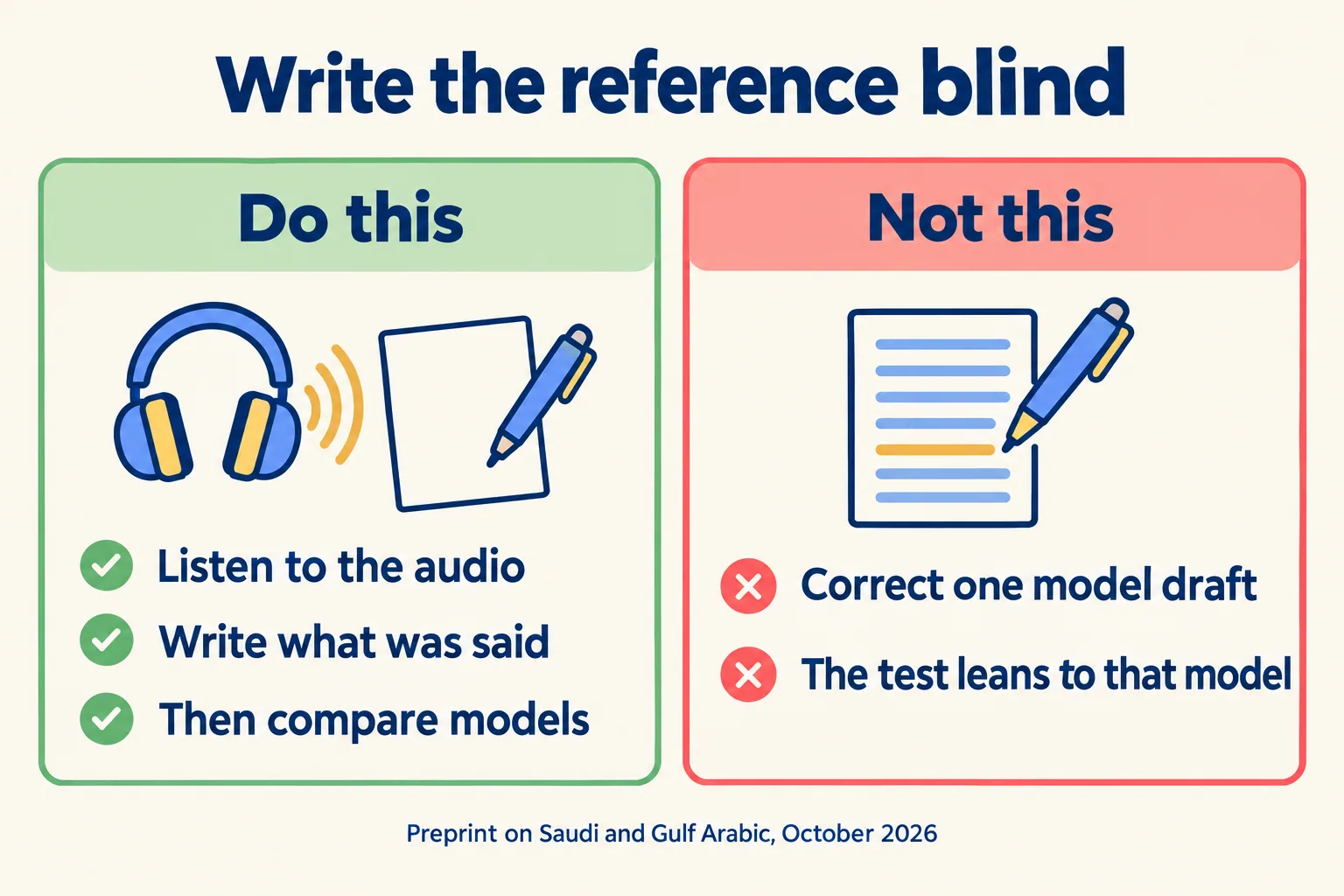
- 03A native Gulf speaker on your team, who knows your callers' words, writes what was said from the audio alone, before seeing any machine transcript.
- 04Run two or three models on the same calls. Try each with language detection on and with Arabic fixed, because the setting changes the result.
- 05Score each call type on the fields the job needs: names, amounts, dates, reference numbers, English product words. A call type passes or it stays with a person.
Two of these steps come from what the published tests found.
The reference is written blind. Correcting a machine draft is faster, but the October 2026 preprint found that "references made by correcting machine drafts favour the drafting system". If your reviewer tidies one vendor's transcript, the test is tilted toward that vendor before it starts.
The language setting is tested both ways. Reflekt Lab had concluded earlier in the year that telling Whisper the audio is Arabic was the most useful setting. On the UAE orders it was wrong: four of the 18 voice-only orders were partly or fully in Urdu, and every model fixed to Arabic "turned them into nonsense". Left to detect the language, one model went from 16 recovered products to 22 of 31. Your callers decide which setting wins.
One more decision comes before any model runs: where the audio is processed. Recordings of customers are personal data under UAE PDPL (Federal Decree-Law No. 45 of 2021). Agree with your data protection officer which vendors and regions may receive the test calls, and how long each keeps them, before the first file is sent. When a vendor ships a new model version, run the same test set again before the agent uses it.
Here is a scorecard shape, as a sample and not a client's result. Each row is one field, each column one model, and each cell is how many of the sample calls got that field right, read by the reviewer.
Does the model matter more than the test?
Less than the test set. The gap closes most when a model meets native-checked speech from the dialect it will hear.
Hamsa, an 11-hour set of conversational Emirati speech transcribed and checked by native speakers at the Technology Innovation Institute (TII) in Abu Dhabi, was used to fine-tune existing models. Whisper-v2's word error rate dropped "from over 40% to below 25%" (Hamsa, Interspeech 2026). TII's Falcon-ASR, released on 7 October 2026, reports 22.73% word error on TII's own internal Emirati evaluation, which is the vendor's figure on the vendor's test (TII).
Both point the same way. A set of your own calls, written out by a native speaker, is the asset. It ranks the models you try today, it tells you whether a newer one is better on your callers, and it is the material any fine-tuning would start from. A published ranking is scored on someone else's callers. Yours is the one that decides.

Which calls go to the agent, and which stay with a person?
The scorecard decides, one call type at a time. This is our rule, so you can argue with it.
What the scorecard points to
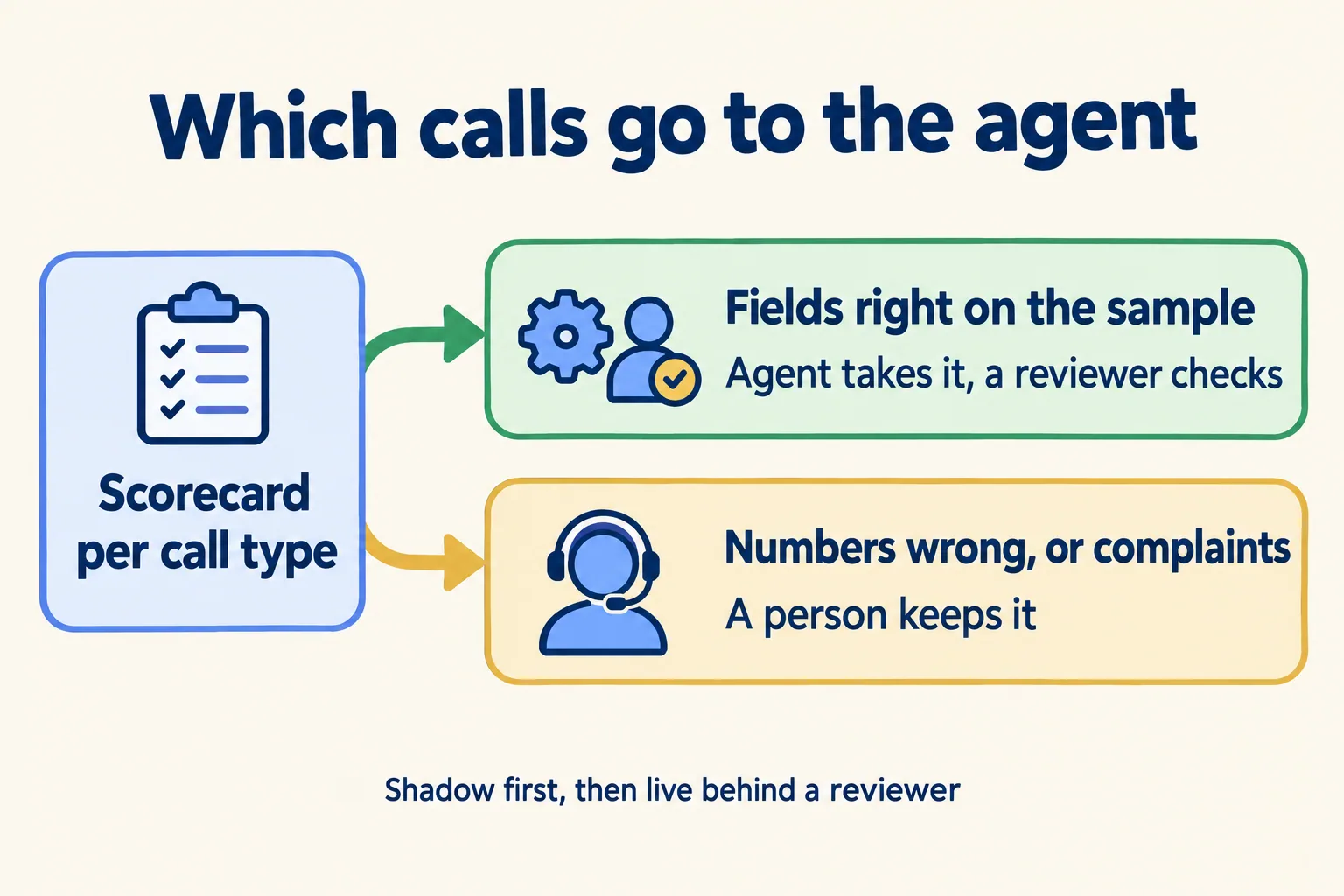
Passing the transcript test does not put the agent live. Then the full method runs: the spec names the job, what the agent writes and who approves; the shadow run puts the agent beside the person on live calls while it writes nothing, and a reviewer who speaks the dialect marks its answers; the gate opens only on the call types that earned it. Our post on what to fix first when calls after 7 pm go unanswered covers how to count which calls are worth testing at all.
If your customers send voice notes on WhatsApp rather than call, the same test applies to the notes, and the offer is a different one: see our WhatsApp page. If your sales team takes calls on personal mobiles that record nothing, there is nothing to test yet. A recorded line, used with notice, comes first. For calls your team places rather than takes, read the UAE rules for outbound calls first.
What does it cost to find out?
The test costs you 100 to 200 calls you already recorded and a few days of a native speaker's time. The assessment from us is free: a short read of the org and a written note.
If you go ahead, the first build week is a fixed AED/SAR 14,900 (about USD 4,050), credited in full when you sign the build within 60 days. It ends with a written scope and a date. Telephony and model use are billed at cost. The number to weigh it against is what a wrong amount or a lost booking costs you on the calls the agent would take, and the scorecard shows you which those are.
When are we the wrong answer?
When you have no recorded calls to test on, start recording with notice and come back. When no one owns the call after the transcript, an agent has nobody to hand the exceptions to. And when most of your calls are disputes, a person should answer them, and we will say so.
If one call type looks ready, send us the call type and how you record it. We write back with how we would build the test set and what a first build week would cover.
