

If only your planner can update the programme and the site hears about a new date on WhatsApp, this is for you. It is not for a firm with nobody who owns the programme after the planner sends it.
Why does the contract decide before the price does?
Because a client can require the format. The programme clause or the main contractor's specification can ask for a baseline programme in a named tool. If that tool is Primavera P6, nothing you buy instead will be accepted in its place. So the first question is not which tool is cheaper. It is what the document you signed asks for.
That question also sorts the money. A firm whose contract names P6 has to pay for P6 and a person who can use it. A firm whose contract names nothing is free to choose, and one planner's licence is the wrong first purchase for a six-job team where six people need to update dates.
What does P6 cost a Gulf contractor?
One reseller's public page, read on 22 October 2026, lists US prices:
Those are US figures and a reseller's own list. For the Gulf, you get a quote, so ask for it in writing with the yearly support line. As a sum to hold the quote against: five Primavera Cloud users at USD 130 a month come to 5 × 130 × 12 = USD 7,800 a year before VAT, and that is only the minimum.
The licence is not the whole bill. A G2 reviewer quoted on ProjectManager.com puts the other half in one line: "It is costly to own and train your people on it."
What does a P6 specification ask for?
More than a file in the right format. A planning firm that converts MS Project programmes into P6 states it plainly: the imported programme "will not meet the client's P6 specification", because the logic, calendars, work breakdown, constraints and critical path have to be rebuilt to comply. The same firm says most specifications also require weekly and monthly updates once the baseline is approved, usually a native file and a PDF by a set time each week. It sells that service, so read it as a vendor's view. The point holds for any tool: a client who writes a specification is buying a programme built to it, not an export.
So if your contract names P6, you need a planner who can build and update to the specification. That is true whether you own the licence or rent the planner's.
Which tool do we tell you to keep?
We answer from the clause, not from what we sell:
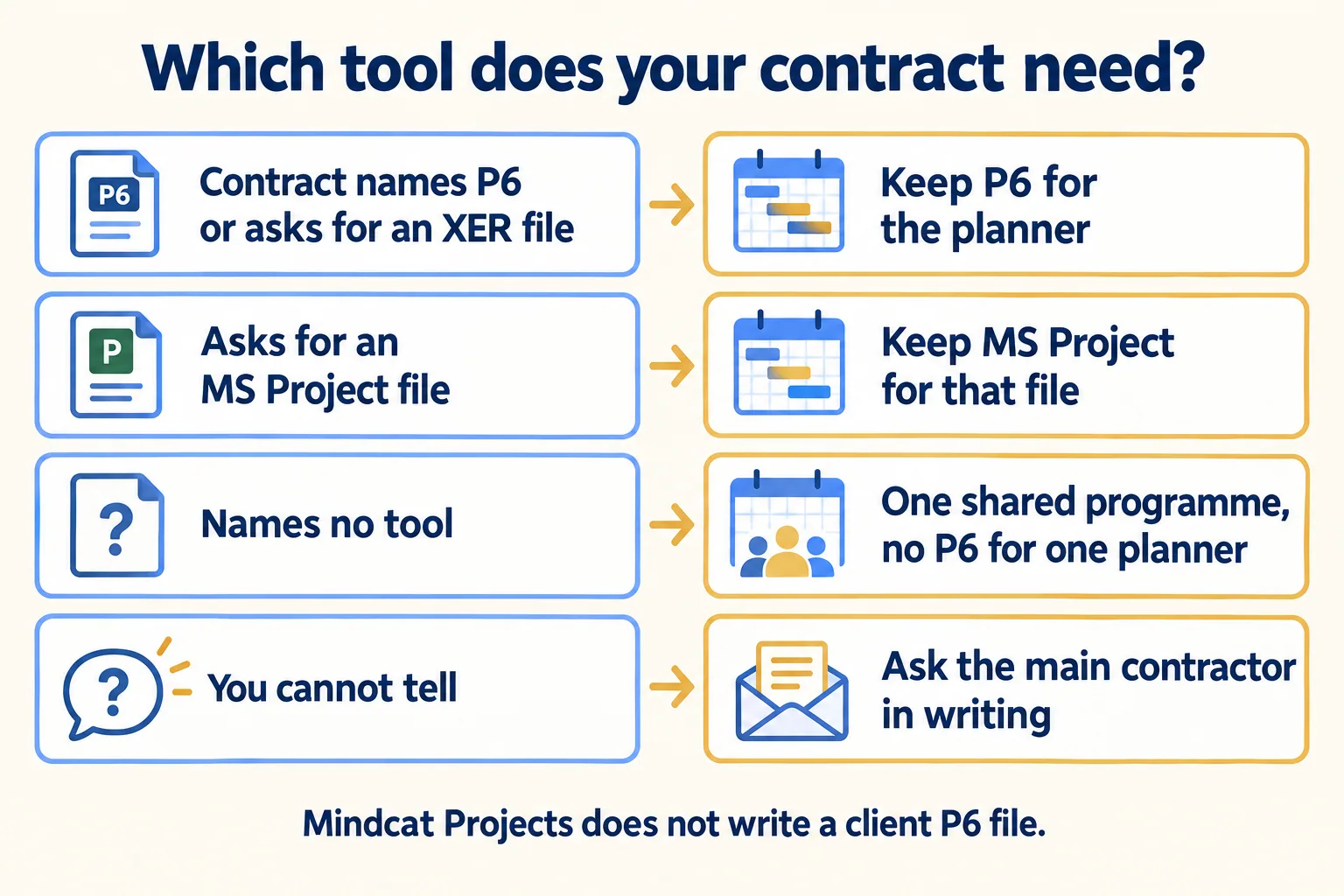
The second column has a limit on our side that we say out loud. Projects keeps one live programme per job that your site engineers, planner and project managers update, and your client reads on a free login. Baseline comparison, Gantt PDF export, portfolio and resource management belong to the maker's Enterprise add-ons, outside our member price. If a clause needs those, price them before you commit.
How do you check in an afternoon?
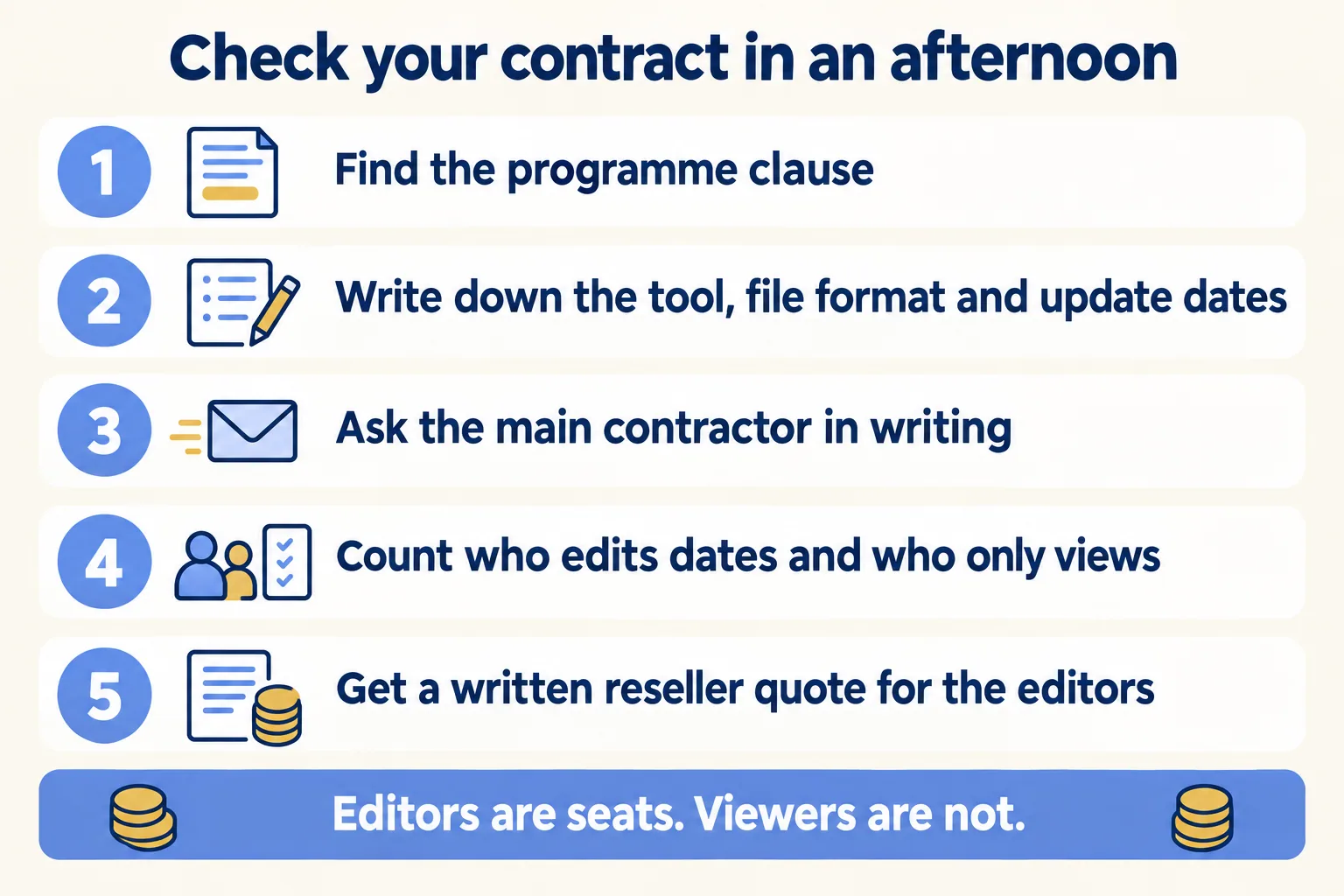
- 01Find the programme clause in the contract and the main contractor's specification. Write down the tool, the file format and how often updates are due.
- 02Ask the main contractor in writing if anything is unclear. A written answer is the only one that settles a dispute.
- 03Count who edits dates today and who only needs to see them. The editors are your seats; the viewers are not.
- 04Ask a reseller for a written quote for the number of editors, with support, and a person who can build to the specification.
- 05Decide: P6 if the clause needs it. Otherwise one shared programme, and MS Project only for a file the client wants to open.
What does Mindcat Projects do, and what does it cost?
It is for a fit-out or MEP contractor with several live jobs where the planner is the only person who can change a date. It gives each job a Gantt programme, one status list across the jobs, site engineers who update their tasks from a phone, and a free read-only login for the client and the consultant. Programmes are loaded in setup from Excel or an MS Project or Primavera export, and your copy is hosted in the UAE or Saudi Arabia. Not today: it does not write a client's P6 file, the Arabic screens are partly translated and read left to right, and updates reach people by email and in the app, not WhatsApp. It is not connected to Dubai Municipality, Civil Defence or DEWA portals.
Our page prices each member a month in bands: AED or SAR 179 for members 1 to 10, 69 for 11 to 30, 45 for 31 to 100 and 29 from 101. The price comes with a monthly minimum, so no one can buy one member at the per-member rate: the shared plan minimum is AED/SAR 2,499 a month and covers up to 10 members, and your own copy starts at AED/SAR 5,349 a month, covering up to 78 members. For 30 members the bands come to 10 × 179 + 20 × 69 = AED 3,170, so the AED 5,349 minimum applies. The quick start is a fixed package we set up for AED/SAR 2,500 on the shared plan, up to 10 members. Our page's comparison table, checked on 10 October 2026, lists P6 or MS Project on the planner's desk as licensed per planner, by quote from a reseller. The maker's Enterprise add-ons are billed at cost. Prices exclude 5 percent UAE VAT and 15 percent Saudi VAT.
We call the method One programme per job. You tell us how many live jobs and members you run, how you plan them today and where it should run. We reply with the setup plan and the monthly price per member. If your contract needs P6, we say keep it. If it names no tool, tell us about your jobs and we start there. For the trade in full, see Projects for fit-out contractors.
