

If a Civil Defence comment means someone rebuilds the programme on Sunday before the client meeting, this is for you. It is not for a team with no one who owns the programme after the first approval, or for a job small enough that one planner's file is working.
Which approval times do the authorities publish?
Fewer than you would like. Mitchell's Commercial Real Estate read the published service standards in August 2026. Some stages have a stated time. The two that cover most mainland fit-outs do not.
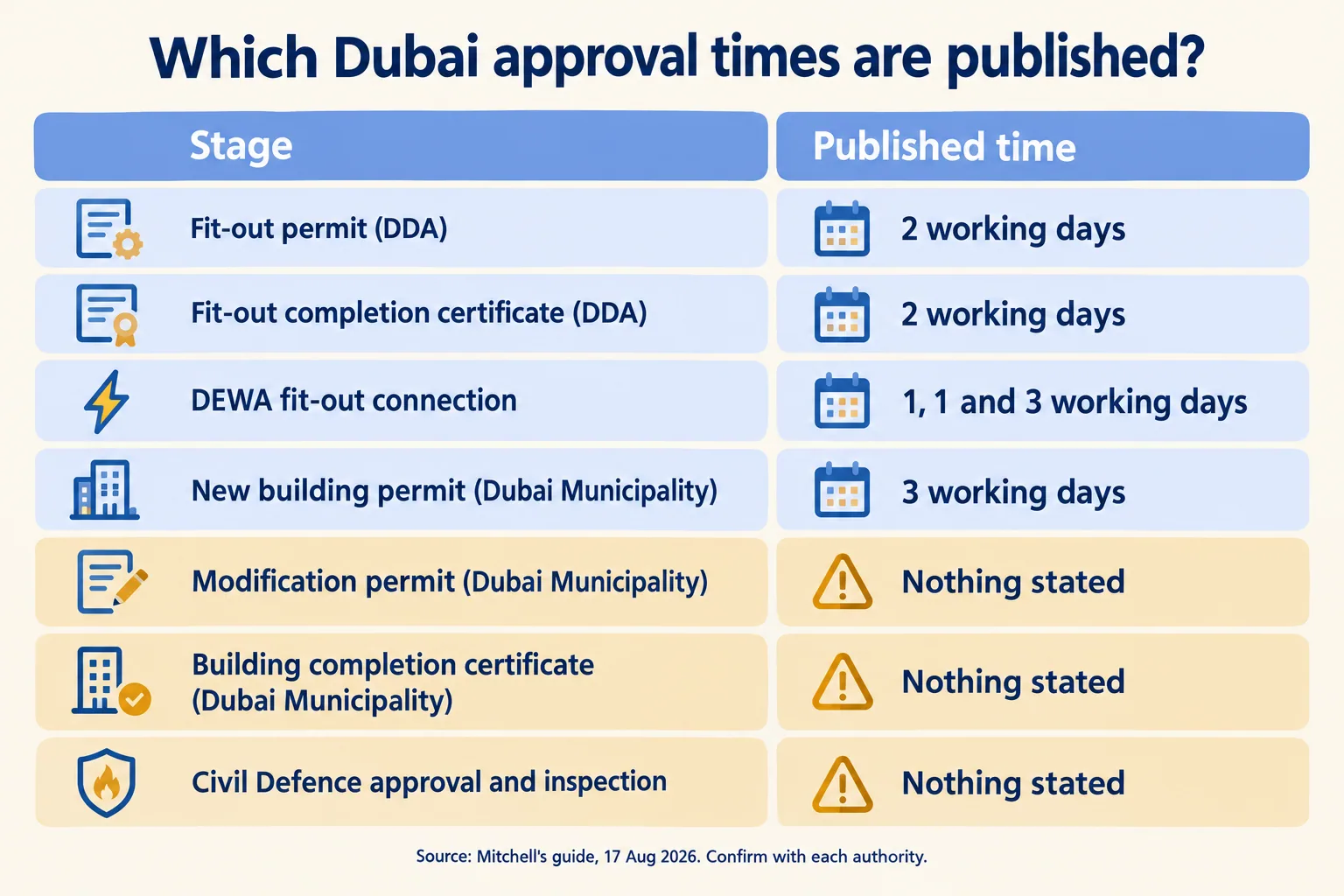
Mitchell's adds that the day-counts circulating for Civil Defence trace back to marketing pages, not to an authority, so it repeats none. The firms that do give numbers disagree. V Square says a standard municipality fit-out permit takes 5 to 10 working days, up to six weeks if the submission is commented. Redesign says 10 to 12 working days from a complete file, and four to eight weeks from lease signing to permit in hand, because almost no first file is complete.
If you type one date against "Dubai Municipality" in your programme, you are typing a guess. Hold a range, and build the comment round into it.
Why does the order matter more than the speed?
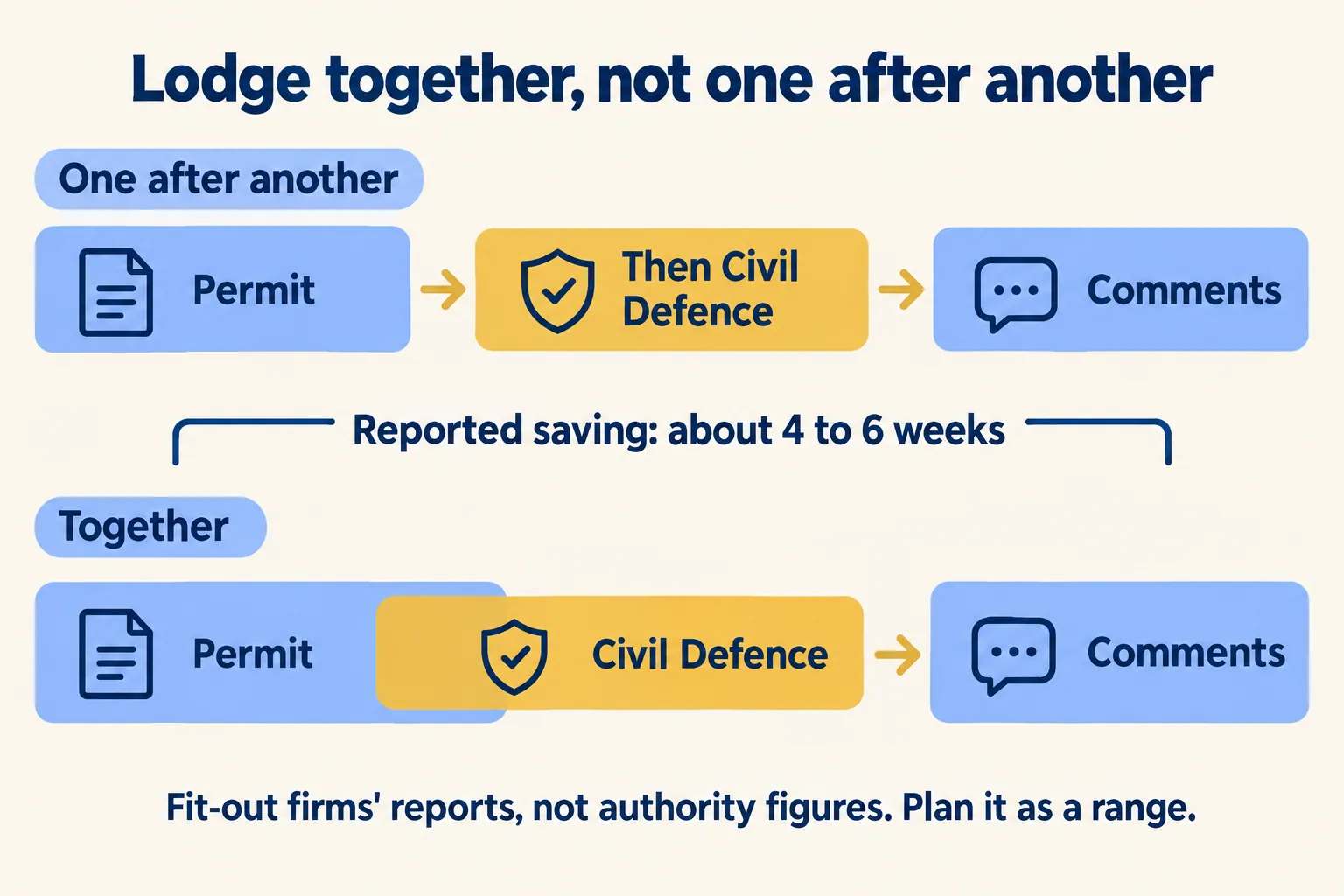
Because the biggest saving is in how you lodge, not how fast anyone reviews. V Square calls lodging Civil Defence in the same window as the permit the single largest saving, and says the sequential habit is widely reported to add four to six weeks. Redesign says the same: open the Civil Defence package with the municipality file, not after it. Both are fit-out firms, not authorities, so read the weeks as a range.
Which authority takes the main file depends on the land: Dubai Municipality on the mainland, the Dubai Development Authority in the TECOM districts, Trakhees in JAFZA and the Palm, DMCC in JLT towers, DIFC in DIFC. Confirm it before anyone draws, or the drawing set is produced for a reviewer who never sees it.
What gates handover at the end of the chain?
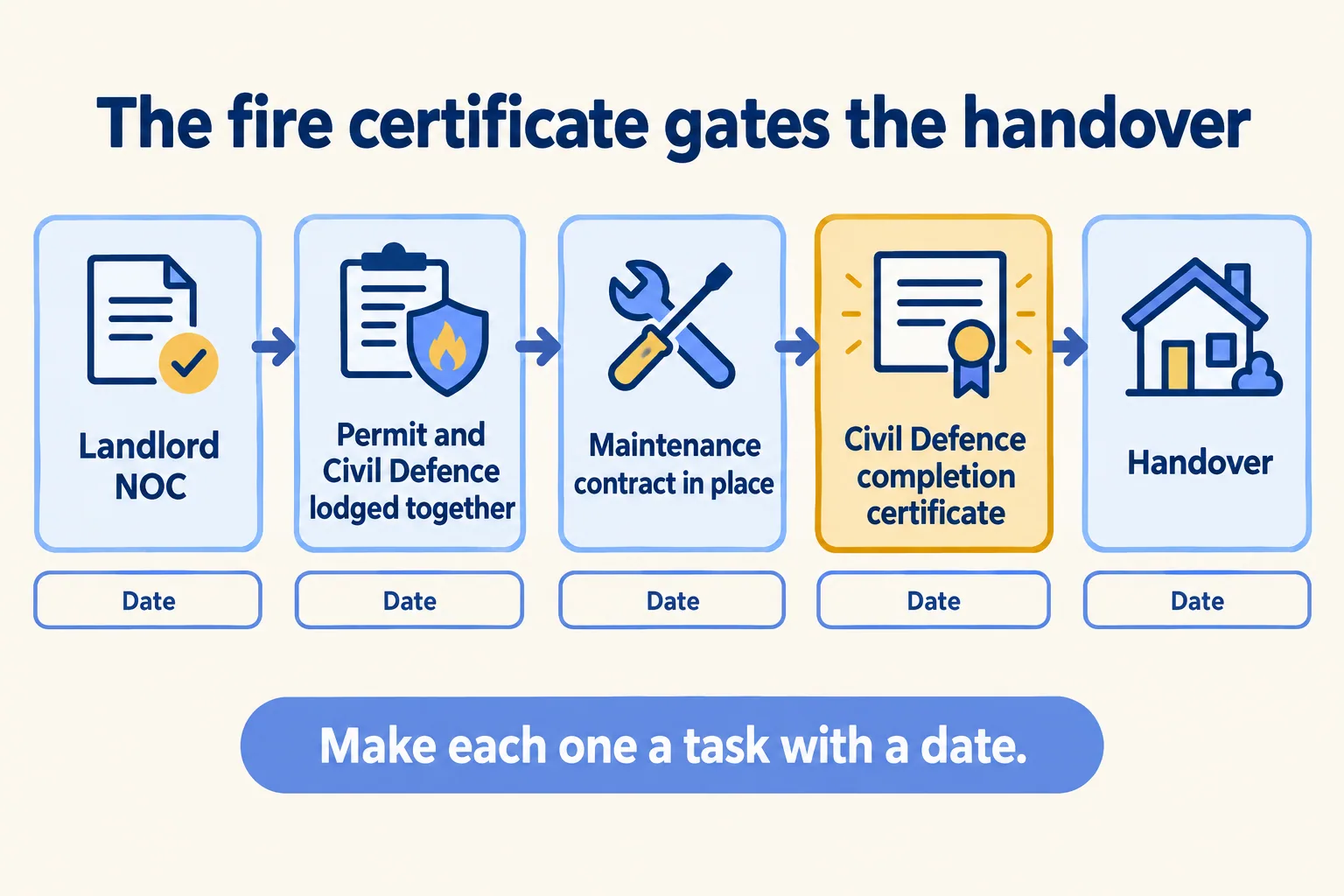
The fire sign-off. Mitchell's reports that the Dubai Development Authority will not issue its Fit-Out Completion Certificate without the Dubai Civil Defence Completion Certificate, and advises getting the fire certificate before applying for the statutory one, not alongside it. V Square adds that an annual maintenance contract must be in place before the Civil Defence inspection can be booked. That is one firm's claim, so check it with your consultant.
For a contractor the lesson is plain. The completion certificate is not a reminder on someone's phone. It is a task with a predecessor (the inspection), a predecessor of its own (the maintenance contract) and a successor (handover). If the building then goes to a maintenance contractor, that handover is a separate job: see Mindcat Maintain.
How do we build the programme as ranges?
This is our rule, not a study. When we tell a fit-out firm how to lay out a job, we ask for four things:
- 01Name the authority for the building first, and write the landlord's NOC as the first task, because nothing is lodged without it.
- 02Give every approval a low and a high date, and build one round of comments into the high one.
- 03Lodge the main permit, Civil Defence and DEWA together, and link demolition and first fix to the high date.
- 04Add the Civil Defence completion certificate and the maintenance contract as tasks that must finish before handover.
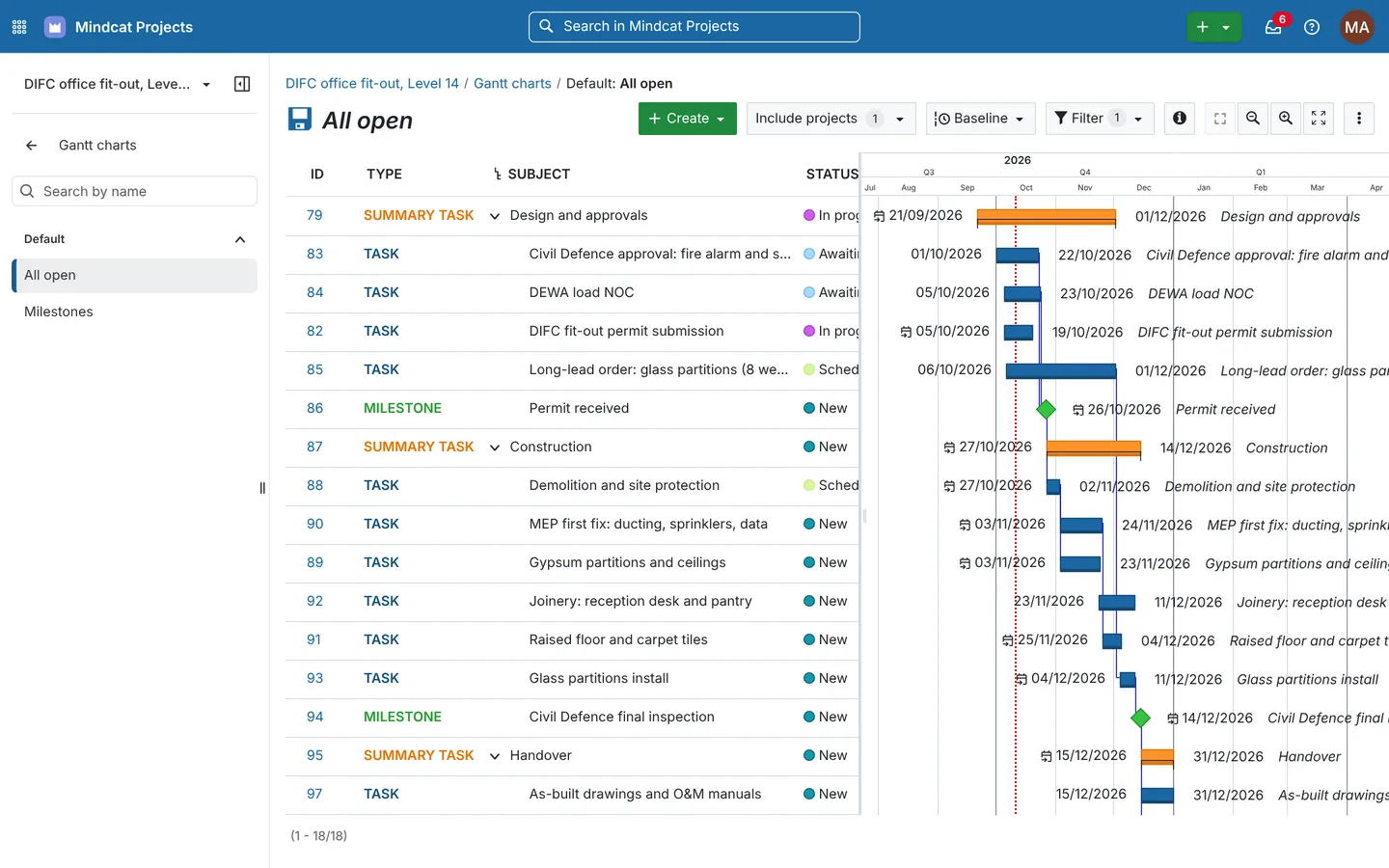
The receipt is what happens on the day a comment comes back. Our sample job, a DIFC office fit-out on our page, shows it. Before: Civil Defence returns the sprinkler layout, the planner moves dates in Excel on Sunday, and the tenant hears on Tuesday. After: the site engineer posts the comment on the Civil Defence task from a phone, the project manager moves that one date, demolition, MEP first fix and the partitions that follow it move with it, skipping your weekend and public holidays, and the client reads the new date in her own login the same day. Linked tasks follow only when they are set to move automatically, which we do during setup.
Excel or project planning software?
Match your jobs to the row.
If you landed on the first or last row, close this tab and fix the order. That is a real answer, and we would rather say it before you pay us.
What does Projects do, and what is left out?
Mindcat Projects is project software we host and run in the UAE or Saudi Arabia. Each job has one Gantt, tasks linked so one follows another, milestones for the permit and the final inspection, and a free read-only login for the client. Site engineers update their tasks from the phone's browser, with nothing to install. Fit-out and MEP firms will recognise the shape: see Mindcat for fit-out contractors. The screen below is the sample DIFC office fit-out on our page, not a real job.
What it leaves out matters as much:
- There is no link to Dubai Municipality, Civil Defence, DEWA or any authority portal. Each submission is a task, and you lodge it as you do today.
- Linked tasks move automatically only after we set them that way during setup.
- Team planner, baseline comparison, Gantt PDF export and portfolio and resource management are the maker's Enterprise add-ons, billed at cost, from EUR 5.95 per user a month at the maker's list price with a 25-user minimum.
- Arabic is partial and runs left to right. We put the screens your team uses most into Arabic during setup.
- There are no WhatsApp updates. Updates go by email and in the app, so the engineer posts the comment on the task, and the job group stays where it is.
What would 30 members cost?
Our page prices each member, meaning anyone with a login who creates or edits tasks, logs time or runs meetings (project managers, planners, site engineers, QS and admins): AED 179 a month for members 1 to 10, then AED 69 for 11 to 30. For 30 members that is 10 × 179 + 20 × 69 = AED 3,170 a month, plus 5 percent UAE VAT. Clients, consultants and anyone with read-only access add nothing, and there is no per-project fee.
The per-member price comes with a monthly minimum, so nobody can buy a few seats at the per-member rate. For your own copy hosted by us in the UAE, the minimum is AED 5,349, which covers up to 78 members. A company with 30 pays AED 5,349, not AED 3,170. On shared servers, up to 10 members, the minimum is AED 2,499, and the quick start is a fixed package we set up for AED 2,500 one time.
At 30 members you are in the managed setup: one working session with your operations lead, then a written plan, the go-live date and the monthly price. Setup loads your live jobs from an Excel, MS Project or Primavera export, so you do not retype them. It also covers statuses for your approval stages, your working week and public holidays, logins for your team and read-only logins for your client, and training in Arabic and English. Annual prepay takes 15 percent off our part.
Weigh that against what a bad month costs you now: the Sundays spent moving dates, and the client who hears last. We will not put a number on that for you. Only your last handover can.
What happens in the first working session?
We call the method One programme per job. You tell us how many live jobs and members you run, how you plan them today (Excel, MS Project or Primavera) and where it should run. We reply with the setup plan and the monthly price per member, in AED or SAR. If your approvals rarely come back with comments, or your Excel file works with an owner, we will say so and point you back to the order. If the comment round is the part that breaks you, tell us about your live jobs and we start from them.
