

If your team inherited a Nuxt site from an agency and someone has suggested moving it to Vercel, this is for you. Read the version number before you read any hosting price.
Which Nuxt do you have, 2 or 3 and later?
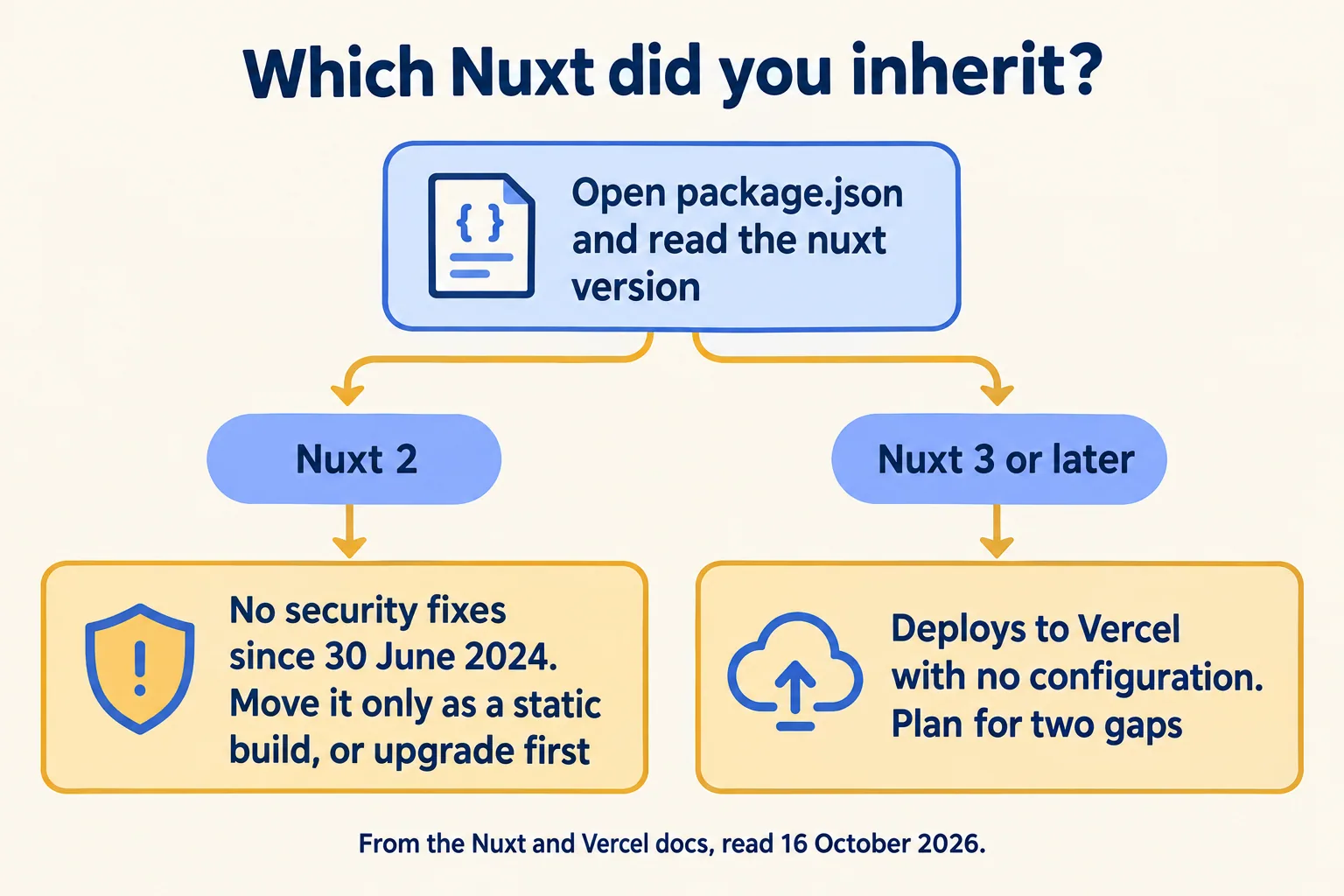
The version decides almost everything. Open package.json in the repository and look at the number next to nuxt.
Nuxt 2 reached end of life on 30 June 2024. The Nuxt team says it stays on npm and keeps working, but gets no more updates, "such as security and browser compatibility fixes". Vue 2 ended on 31 December 2023. Paid extended support exists through HeroDevs, which the Nuxt team names.
Vercel's own Nuxt page is blunt about it: the Nuxt team does not recommend deploying legacy Nuxt on Vercel "except as static sites". If you must move a Nuxt 2 site, build it with nuxt generate. Vercel says plainly: "We do not recommend deploying legacy Nuxt projects with server-side rendering".
Is staying on Vue a risk now?
Not from the hosting side. On 8 July 2025 Vercel announced that NuxtLabs, the team behind Nuxt and Nitro, was joining Vercel. The same post says Nuxt and Nitro "will remain independent, open source projects with an MIT license, public roadmap, and open governance", and that Nitro will serve "all frameworks and vendors openly, neutrally, and without lock-in".
Nitro is the server engine under Nuxt, and Vercel's own Nitro page says it "enables deployments from the same codebase to any platform". So Vercel is one good home for a Nuxt site, not the only one. The risk worth managing is the one you already have: a site built on a version that no longer gets security fixes.
What works with Nuxt on Vercel, and what does not?
For Nuxt 3 and later, Vercel deploys static and server-rendered sites "with no configuration required". Vercel's support matrix shows two gaps you should know before you plan.
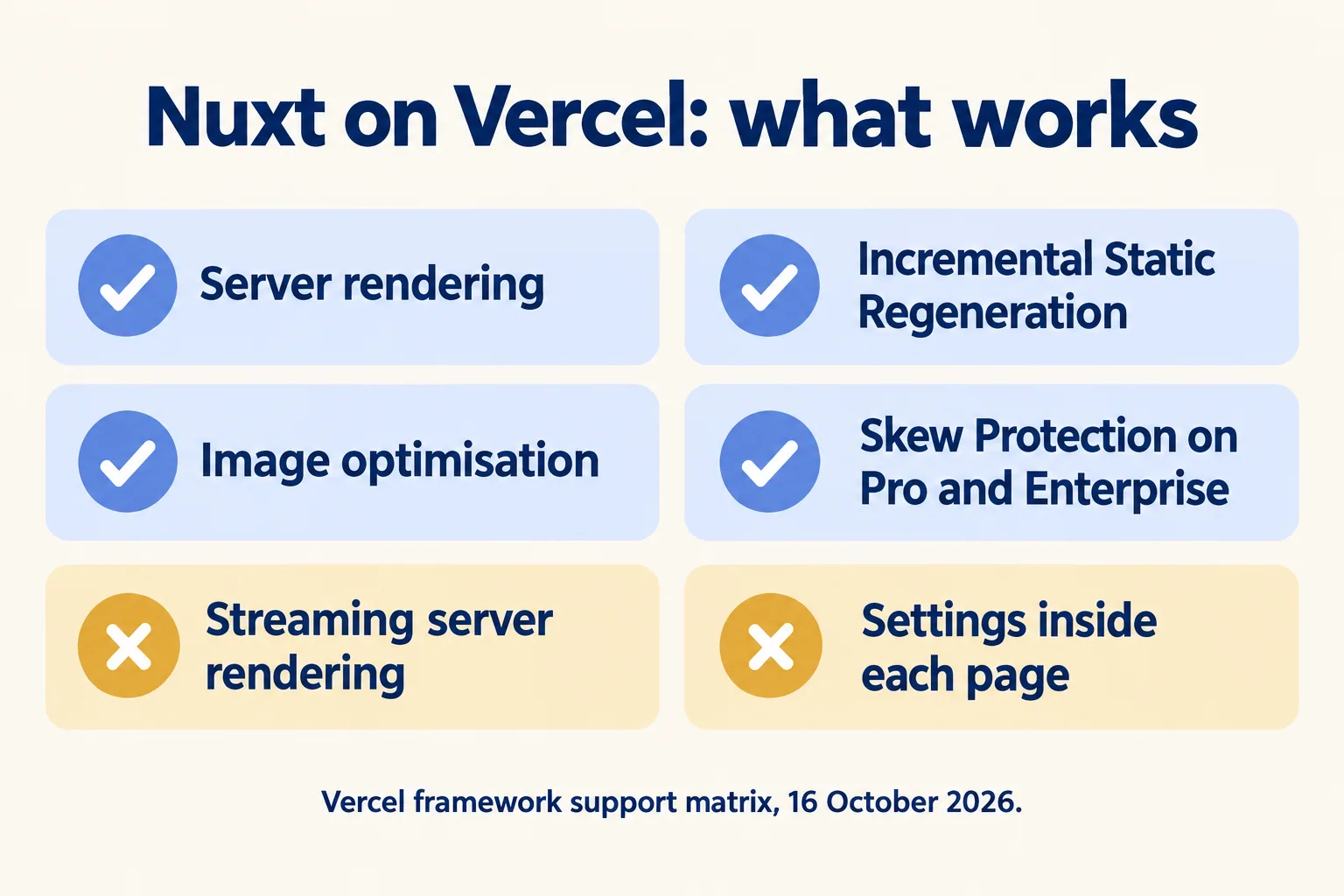
Two more details from the same page. Nuxt's pages, API routes and server middleware are bundled into a single Vercel Function by default. And if the old site writes files to disk on the server, that stops working: Vercel's docs point to a Redis store, such as Upstash from the Vercel Marketplace, for anything the app writes.
What does it cost to run?
The same as any business site on Vercel. As of 16 October 2026, Pro is USD 20 a month with one deploying seat and USD 20 of usage credit, extra deploying seats are USD 20 each, viewer seats are free, and usage above the credit is metered. The Hobby plan is for non-commercial, personal use only, so a hotel or clinic site does not belong there.
In one line: USD 20 a month for each deploying seat, and well under a dollar of usage for the sample below, inside the included credit. Our arithmetic for the hotel example below, from list prices at Mumbai rates, not a measured bill: the static pages sit inside Pro's included 1 million CDN requests and 1 TB of transfer. Assume 20,000 availability checks a month, each 100 ms of Active CPU and 2 GB held for 300 ms. That is 0.56 CPU hours (USD 0.08), 3.3 GB-hours (USD 0.04) and USD 0.01 of invocations, so the platform fee and seats are the whole bill.
We are not a Vercel partner and earn nothing from your Vercel bill. Our own site runs on Netlify. What stays portable: Nuxt and Nitro are MIT-licensed and Nitro builds for other hosts. What is Vercel's: the isr route rule's cache, Skew Protection and your project settings.
The bigger cost is the upgrade, if you need one. Nobody can price a Nuxt 2 to Nuxt 3 move without reading the code, because it depends on how many old modules the agency used. We say that in writing before we quote it.
Mind the region. Vercel has 19 compute regions and none in the UAE or Saudi Arabia; Mumbai (bom1) is the nearest. A static build served from the CDN does not care. Server-rendered pages that call your booking system do, so put the functions near that system.
What would we do for a hotel apartments site?
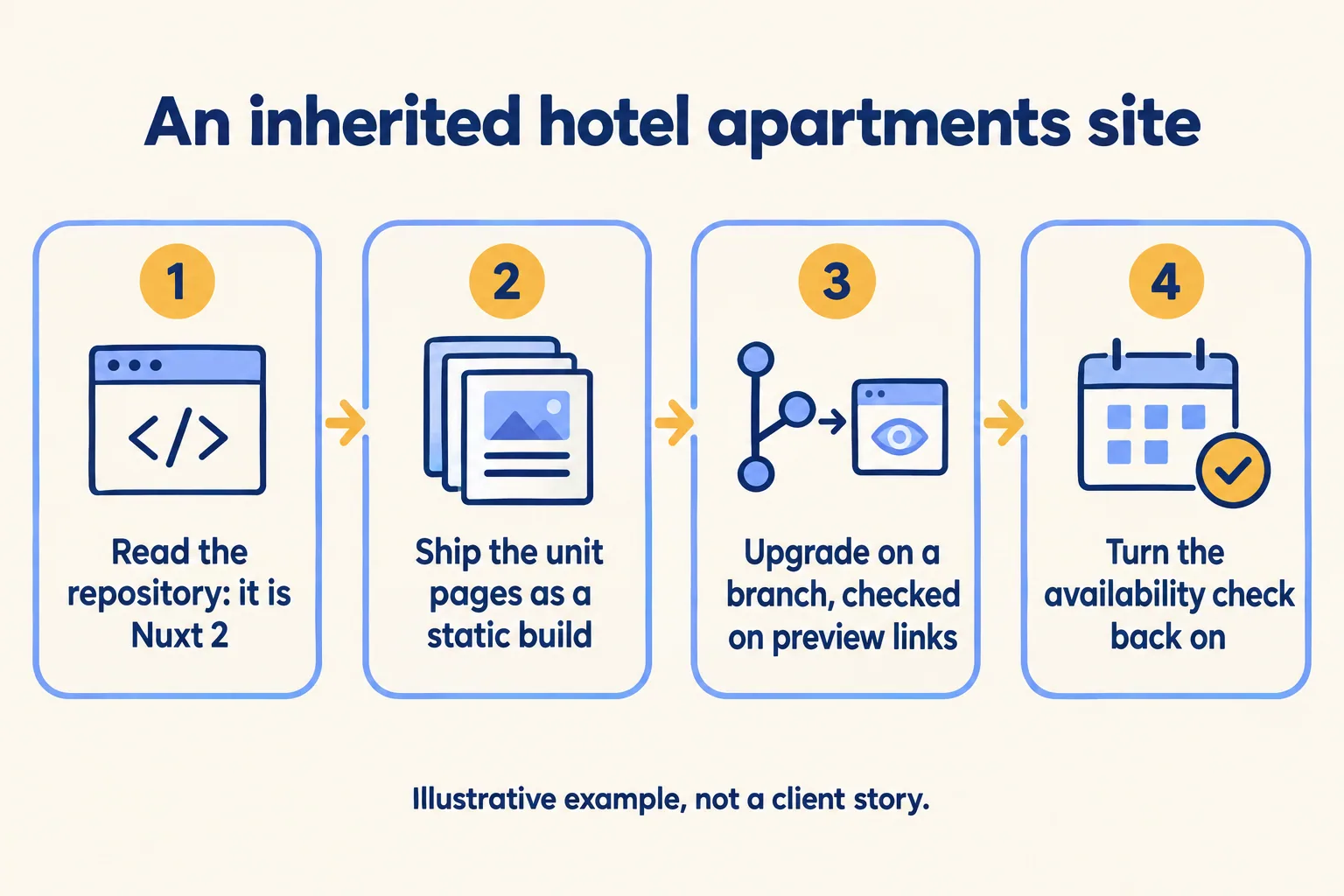
Take a sample Dubai hotel apartments group with a Nuxt 2 site an agency built three years ago. It shows unit pages, photos and an availability check against the booking system. This is an illustration, not a client story.
- 01Read the repository. package.json says Nuxt 2, so the site has had no security fixes since mid-2024.
- 02Split the pages. Unit pages, photos and the area guide are content. Only the availability check calls a server.
- 03Ship a static build now with nuxt generate, on a Pro team in the group's name. The availability check moves to the booking system's own widget for a few weeks.
- 04Upgrade to Nuxt 3 or later on a branch. Each step gets a preview link the revenue manager checks on a phone.
- 05Turn server rendering back on for availability once the upgrade passes, with the function region set near the booking system.
If the booking side is the real pain, a site upgrade will not fix it. See how we work with hotel apartments, and Mindcat Stays for unit and booking records.
What goes on the security questionnaire?
Vercel splits the answers in its shared responsibility model, read on 16 October 2026. Here is who writes each line.
If a contract says data must be processed inside the UAE, Vercel cannot meet it today. Say so before you sign, not after.
For a bad month, set Spend Management. Vercel sends alerts at 50%, 75% and 100% of the amount you set, and pauses production when you reach it if Pause Production Deployments is on. A budget alone does not stop usage, and the check can lag by several minutes. If a change breaks the site, Instant Rollback on Pro returns production to any earlier production deployment from the dashboard; environment variable changes are not rolled back with it. For a Nuxt 2 site, the line to write is that it runs a version with no security fixes since June 2024, so upgrade before the questionnaire is due.
Upgrade, move or leave it: which one?
Here is the rule we use, in order.
If your Nuxt site is a few pages that nobody has changed in a year, leave it where it is and spend the budget on the thing customers complain about.
What happens on the first call?
We call the method Preview every change: each change gets its own preview link, someone on your side approves it on a phone, then it goes live, and any release can be rolled back. Send us the repository, or tell us who holds it, and where the site runs today. The written assessment is free and says what to upgrade, what to keep and what it costs to run. The first build week is a fixed AED/SAR 14,900, and a Run plan keeps the site patched afterwards. There is more on how we build and run sites on our Vercel page.
