

If your developer, or the agency you hired, is about to build your site or portal in Next.js and every account will sit in the agency's name, this is for you. Settling it before the first commit means sending five invitations. Settling it after launch means asking a supplier you are leaving to transfer each account.
What goes wrong when the agency owns the accounts?
The code is the easy part to take back. The hard part is everything around it: the repository in the agency's GitHub, the hosting project on the agency's team, the domain on a developer's card, and the API keys typed into a dashboard only they can open.
Two rules on Vercel make this sharper than most owners expect. The Hobby plan "restricts users to non-commercial, personal use only", so a business site on a free account is on the wrong plan from day one. And on a Pro team, a commit from a private repository in a GitHub organisation deploys only if the commit author is a member of the Vercel team. Whoever pays for the team decides who can ship.
Which five things do you own before work starts?
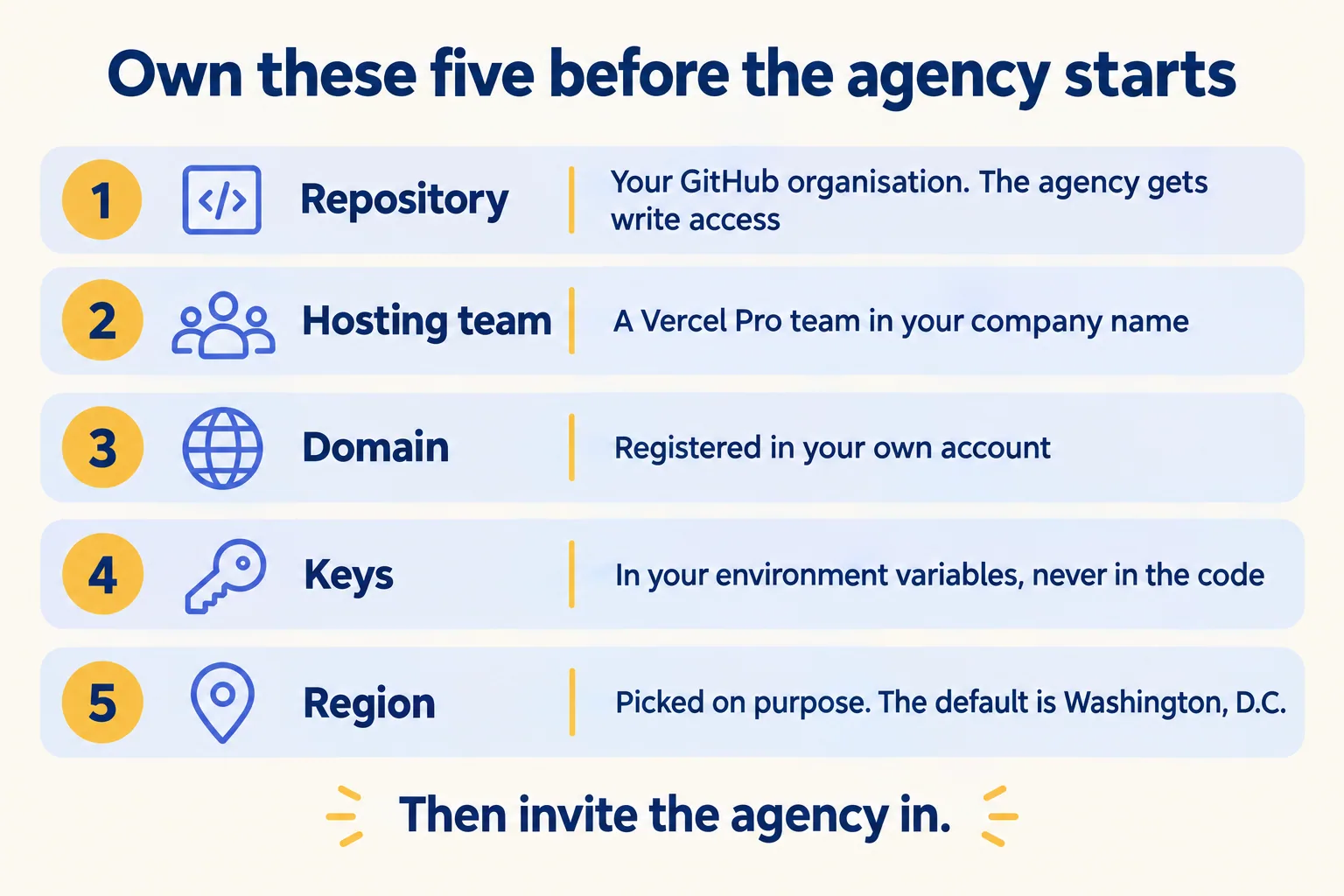
Put these in your company's name on day one, then invite the agency in. None of them slows the build. If the site is already live on the agency's accounts, the same five items are your transfer list: a Vercel project can move between teams, and nothing needs rebuilding to move it.
- 01The repository. A GitHub organisation your company owns. The agency gets write access; you keep admin.
- 02The hosting team. A Vercel Pro team in your company's name. The agency's developers join as members, which is also what lets their commits deploy.
- 03The domain. Registered in your account, wherever you buy it. Vercel cannot register .ae or .in names today, so those stay with your local registrar and point at the site.
- 04The keys. Payment, CRM and messaging keys go into your team's environment variables, never into the code or a shared chat.
- 05The region. Pick it on purpose. Vercel Functions run in Washington, D.C. (iad1) unless someone changes it, and there is no region in the UAE or Saudi Arabia.
The region is the one owners skip. Vercel's regions page says to run functions in the same region as your database. If your CRM data and your customers are in the Gulf, the nearest compute region is Mumbai (bom1). If a contract or regulator says the data must stay in the UAE, settle that before anyone picks a platform.
Does Next.js tie you to Vercel?
No, and you should hear that from your agency in writing. Next.js is an open-source framework that Vercel maintains, and Vercel's own docs say it "works when self-hosting".
The difference shows up in caching. On Vercel, pages built with Incremental Static Regeneration (ISR) are cached and persisted to durable storage. Self-hosted, ISR "is limited to a single region workload" and by default keeps pages in the Next.js cache, which expires. Someone on your side then runs servers, storage and a CDN.
Our rule: if nobody on your team will be on call for servers, host on Vercel and keep the accounts in your name. If you already run servers in a UAE data centre and must keep the app there, self-host and budget for the person who runs it.
What does it cost to run, as of 16 October 2026?
Vercel prices a business site as a monthly fee, seats and metered usage. These are Vercel's numbers on 16 October 2026, in US dollars, before VAT.
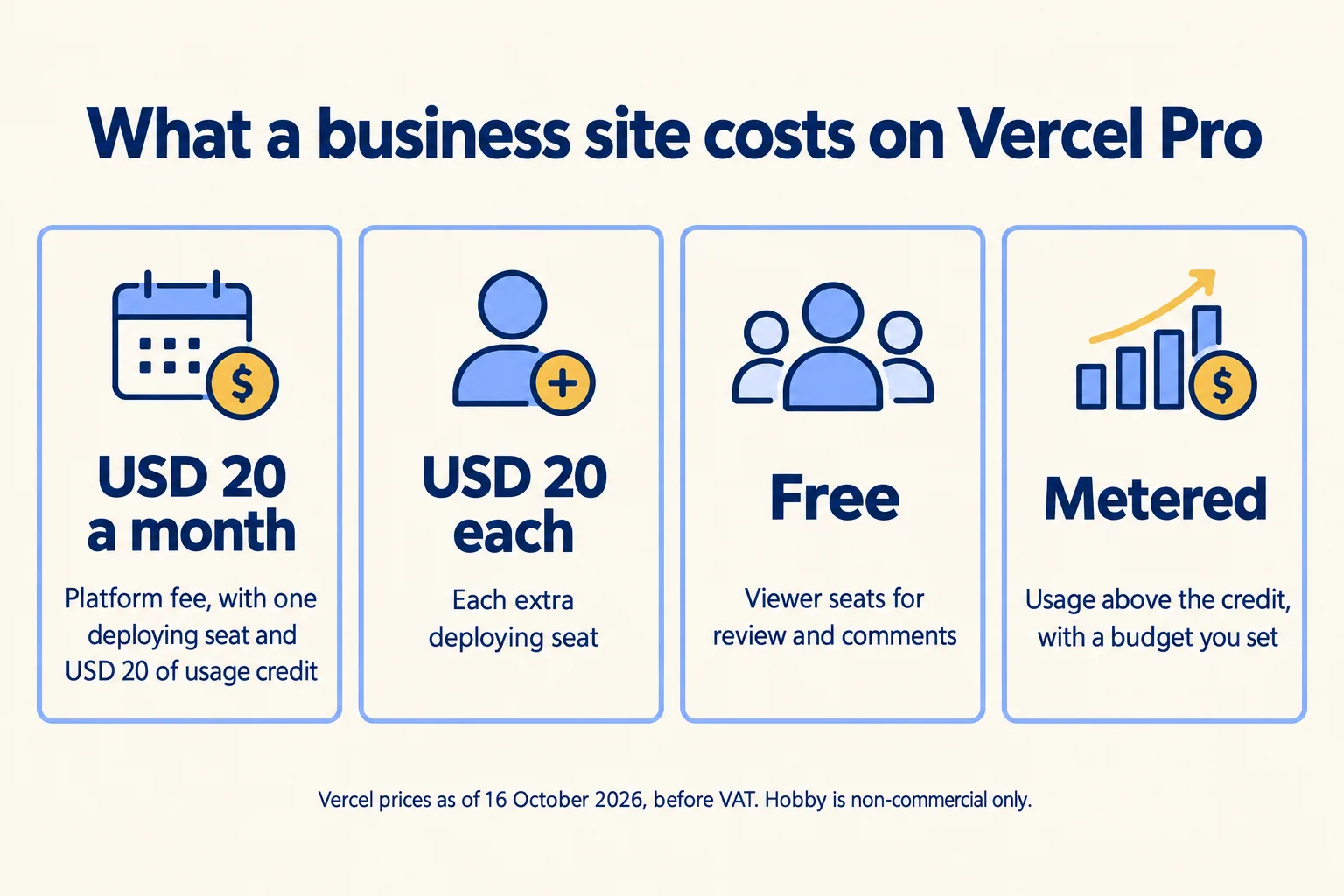
In one line: USD 20 a month for each deploying seat, and well under a dollar of usage for the sample below, inside the included credit. Here is our arithmetic for a listings site, from list prices at Mumbai rates, not a measured bill. Assume 100,000 requests a month reach a function, each uses 50 ms of Active CPU, and each holds 2 GB of memory for 200 ms with no sharing. That is about 1.4 CPU hours (USD 0.19), 11 GB-hours of memory (USD 0.13) and 0.1 million invocations (USD 0.06): under USD 0.40, inside the USD 20 credit. Pro's Flat Rate CDN tier also includes 1 million CDN requests and 1 TB of data transfer a month. With your own seat and two agency developers, the bill is about USD 60 a month, and every dollar above the platform fee is seats.
We are not a Vercel partner and earn nothing from your Vercel bill. Our own site runs on Netlify.
Two things follow. Seats are the line that grows: three agency developers who deploy are three seats on your bill, and your marketing team can review previews on free viewer seats. And usage has no fixed monthly figure, so ask the agency to set the budget and the alert before launch, not after the first invoice.
What does this look like for a Dubai brokerage?
Here is how we would set it up for a sample Dubai brokerage that has hired an agency for a listings site. It is an illustration, not a client story.
The brokerage creates a GitHub organisation and a Vercel Pro team in its own name. The agency's two developers join as members. The domain stays with the brokerage's registrar and points at the site. The form keys for Salesforce and the WhatsApp number sit in the team's environment variables.
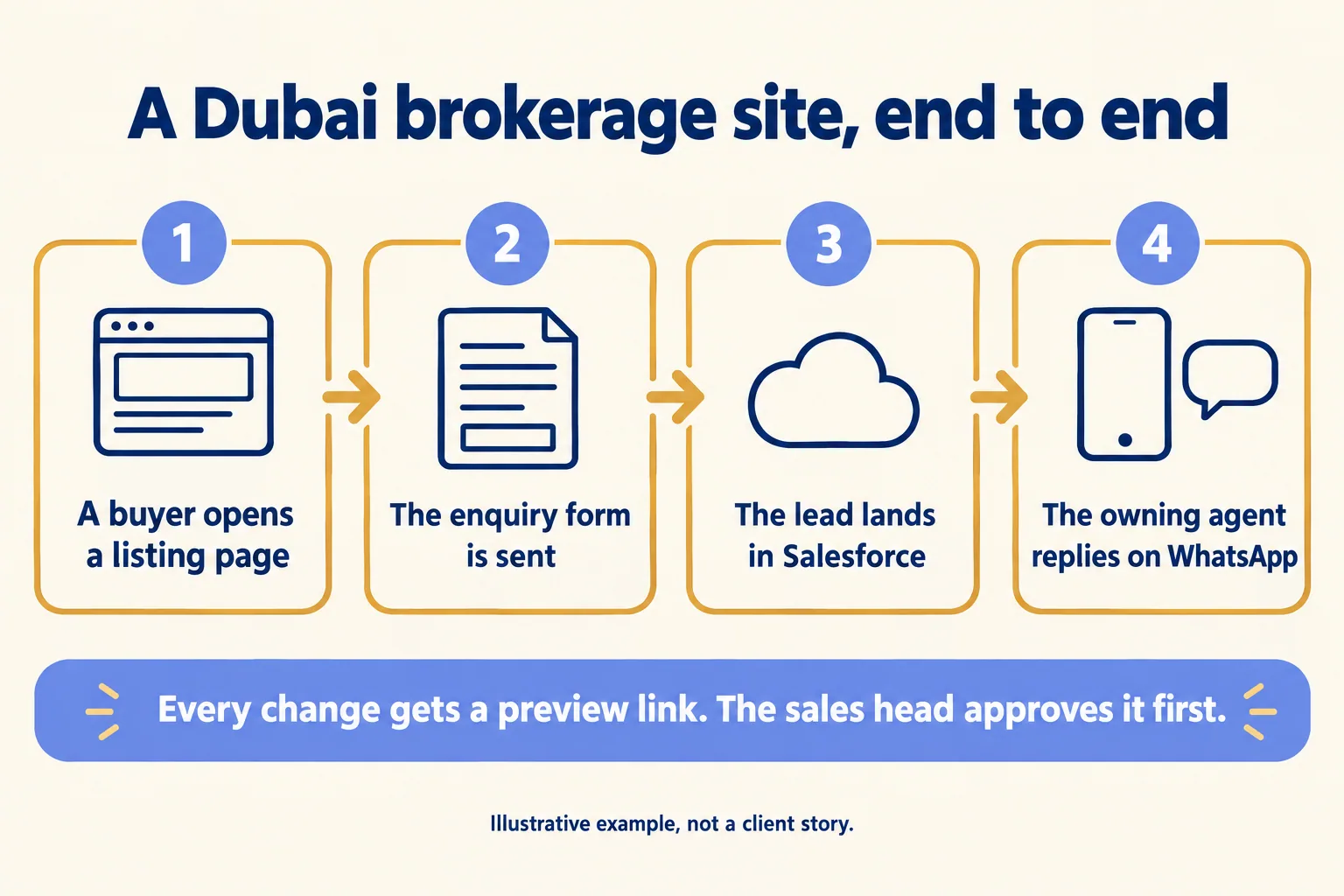
A buyer opens a listing page served from the CDN. The enquiry form posts to Salesforce, and the agent who owns the lead replies on WhatsApp. Each change the agency makes gets its own preview link, and the sales head approves it before it goes live. If the brokerage changes agency next year, it removes two members from its team. Nothing moves.
For the lead side of that work, see how we set it up for real estate brokers.
What goes on the security questionnaire?
Vercel splits the answers in its shared responsibility model, read on 16 October 2026. Here is who writes each line.
If a contract says data must be processed inside the UAE, Vercel cannot meet it today. Say so before you sign, not after.
For a bad month, set Spend Management. Vercel sends alerts at 50%, 75% and 100% of the amount you set, and pauses production when you reach it if Pause Production Deployments is on. A budget alone does not stop usage, and the check can lag by several minutes. If a change breaks the site, Instant Rollback on Pro returns production to any earlier production deployment from the dashboard; environment variable changes are not rolled back with it.
What should the agency hand over at the end?
Ask for these in the contract, so the last invoice depends on them.
- 01A list of every environment variable by name, what it is for, and who issues it. Names only, never the values.
- 02The production branch protected, so nothing reaches the live site without a reviewed pull request.
- 03One rollback tested in front of you. On Pro you can return to any earlier production deployment.
- 04The spend budget and alerts set, and the name of the person who gets them.
- 05Admin on every account back with you, and the agency's access removed or written down.
If your site is a few pages that change twice a year and takes no leads, you do not need a Next.js development company; a simple site builder is cheaper to own.
What happens on the first call?
We call the method Preview every change: each change gets its own preview link, someone on your side approves it on a phone, then it goes live, and any release can be rolled back. You send the site or app you want built and where it runs today. The written assessment is free and says what to build, what to keep and what it costs to run. The first build week is a fixed AED/SAR 14,900. After go-live, a Run plan keeps it patched and changing. Everything sits in your accounts from the first day. More on the work we do around this is on our Vercel page.
