A marketing manager and a developer in a Dubai brokerage office check a property listing page on a laptop and a phone.

Vercel · Frameworks

The agency handed over a Next.js site and nobody owns the server. Run it where it needs no setup.

Your site was built in Next.js. Then came the handover: a server one person set up, prices that go stale until someone rebuilds, a slow page on campaign day. On Vercel, Next.js deploys with no configuration. Every change gets a preview link, pages refresh on a timer you set, and server pages scale up with traffic and down to zero when it is quiet.

Salesforce consulting partner since 2010 · MVP Hall of Fame · 200+ agents in production · UAE, India and US desks

The problem

What goes wrong after the handover.

What Next.js is

Next.js, in plain words.

Facts from Vercel’s own pages, checked on 16 October 2026. The sources are at the end of this page.

What it is
A full-stack React framework maintained by Vercel. It also runs when you host it yourself.
Setup
Zero configuration on Vercel: import the repository or run vercel in the project folder.
Pages that refresh
ISR pages are cached and kept in durable storage. Vercel states ISR content updates go out globally in 300ms.
Server pages
Server-rendered pages run on Vercel Functions, which scale with traffic and scale to zero when not in use.
Only on Next.js
Next.js is the only framework with Runtime Cache in Vercel’s framework support table.
Also on the page
Skew Protection, Routing Middleware for A/B tests and flags, Data Cache and Speed Insights.

How it works

From your repository to a live site that refreshes itself.

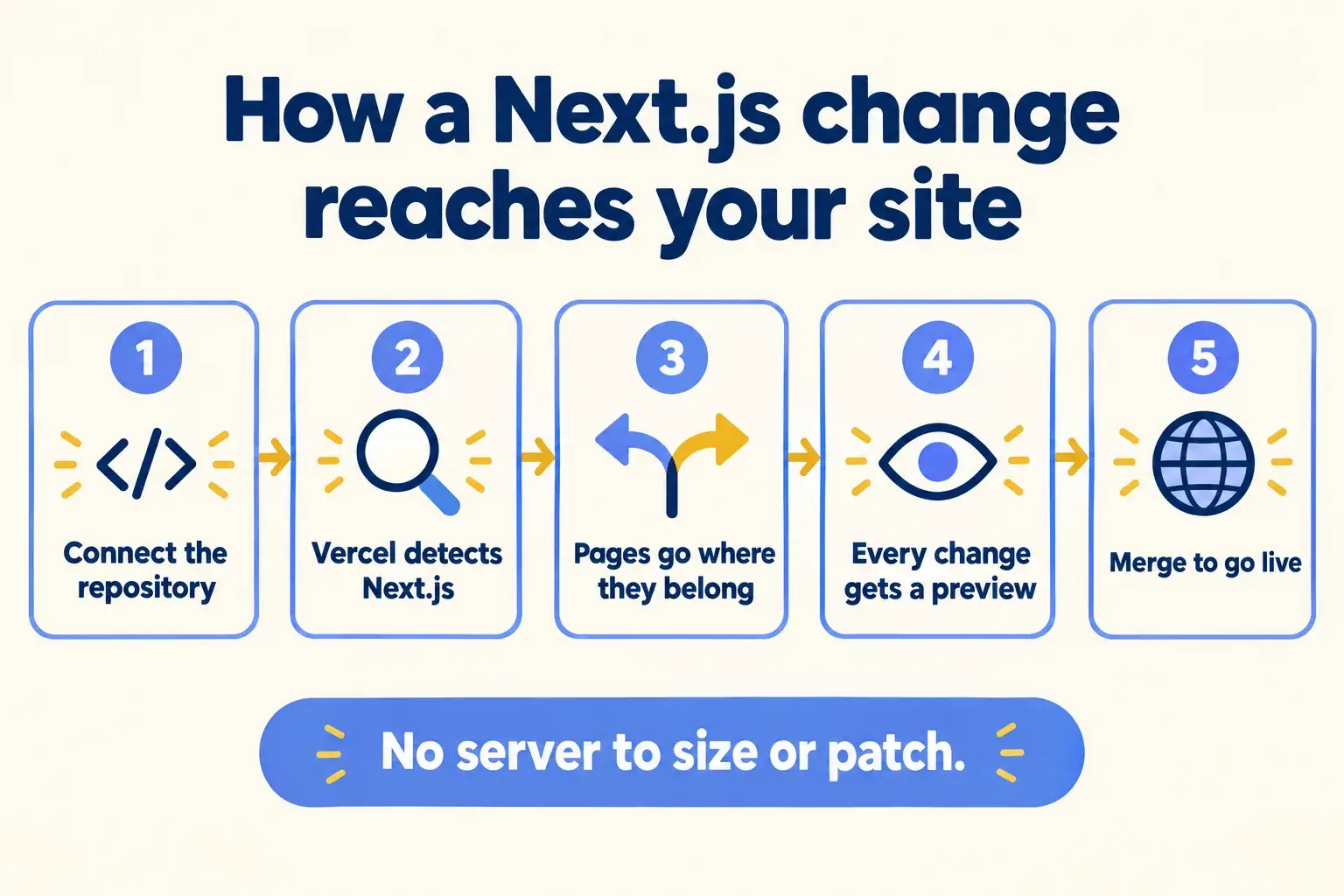
Five steps. Vercel reads the framework and decides which pages are static, which are cached and which run on a server.

Five steps: connect the repository, Vercel detects Next.js, pages are split, each change gets a preview, merge to go live.

Infographic

The same steps are written out below.

Step by step

What happens at each step.

  1. Import

    Connect the repository

    Import it at vercel.com/new or run vercel in the project folder.

  2. Detect

    Vercel detects Next.js

    It sets the build for you. There is no server to size.

  3. Split

    Pages go where they belong

    Static pages to the CDN, dynamic routes to Functions, ISR pages cached and stored.

  4. Preview

    Every pull request gets a preview

    Your team checks the real page before customers see it.

  5. Live

    Merge to go live

    Production updates on your domain, and one click rolls it back.

How it fits together

Where Next.js sits between Salesforce and your buyers.

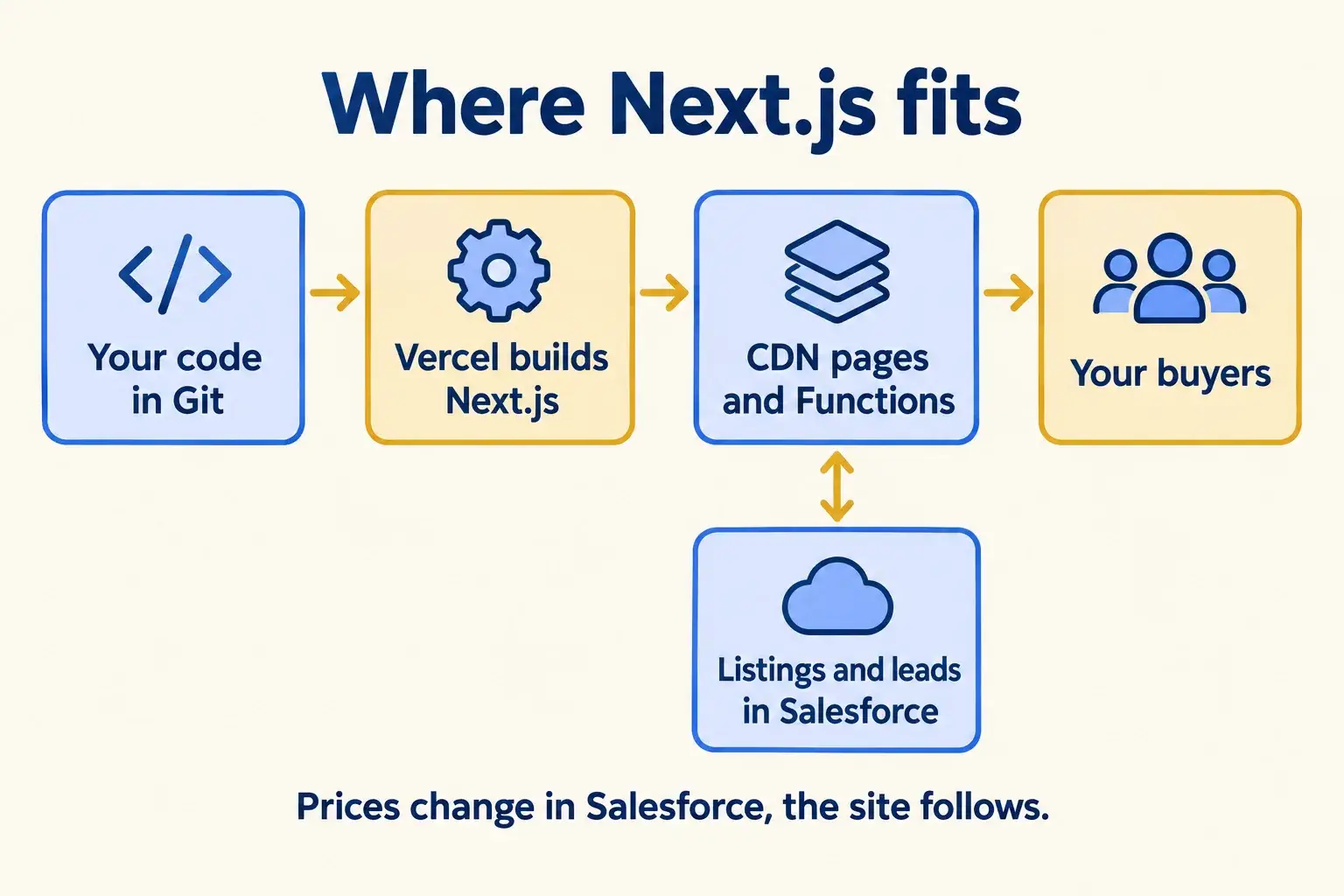
The code lives in your Git repository. Vercel builds it, serves static pages from the CDN and runs the rest as Functions. Listings come from Salesforce, and enquiries go back to it.

Code in Git builds on Vercel into CDN pages and Functions, with listings from Salesforce and leads back to it.

Infographic

Where it sits next to the systems you run today.

Use cases · worked examples

One worked example in each industry.

How Next.js fits into the work of the industries we serve, one step at a time.

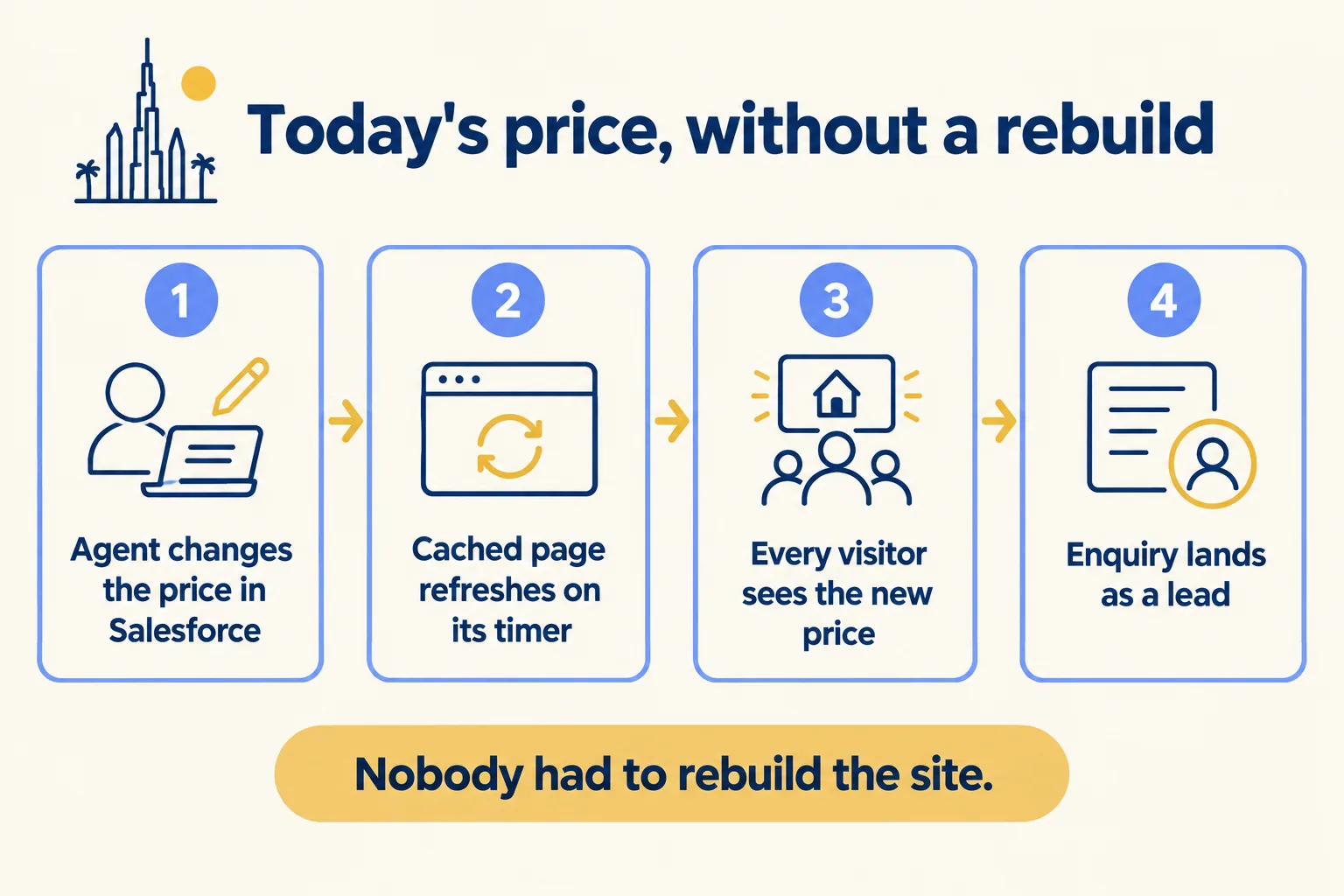
  1. A listing price changes in Salesforce, the cached page refreshes on its timer, and a buyer enquires on the new price.

    Example 1 · Real estate, Dubai · Infographic

    Marketing manager at a Dubai secondary-market brokerage

    Today: We change prices in Salesforce every morning. The website shows them on Thursday, when the agency rebuilds it. Agents send buyers screenshots of the CRM instead.

    After: Listing pages become ISR pages that read from Salesforce and refresh on a timer the brokerage sets. Nobody rebuilds the site to change a price.

    Worked example, step by step

    1. 09:00Listing agent. Drops the price of a two-bed in Dubai Marina in Salesforce.
    2. 09:05Website. Visitors still get the cached listing page, fast.
    3. 09:10Vercel. The page’s refresh time passes. The next visit rebuilds it in the background with the new price.
    4. 09:11Buyers. Every visitor now sees the new price, wherever they are.
    5. 09:40Buyer. Sends an enquiry from the listing page.
    6. 09:40Salesforce. The enquiry lands as a lead for that listing’s agent.

    The site shows this morning’s price, and nobody had to rebuild it.

    Real estate brokers
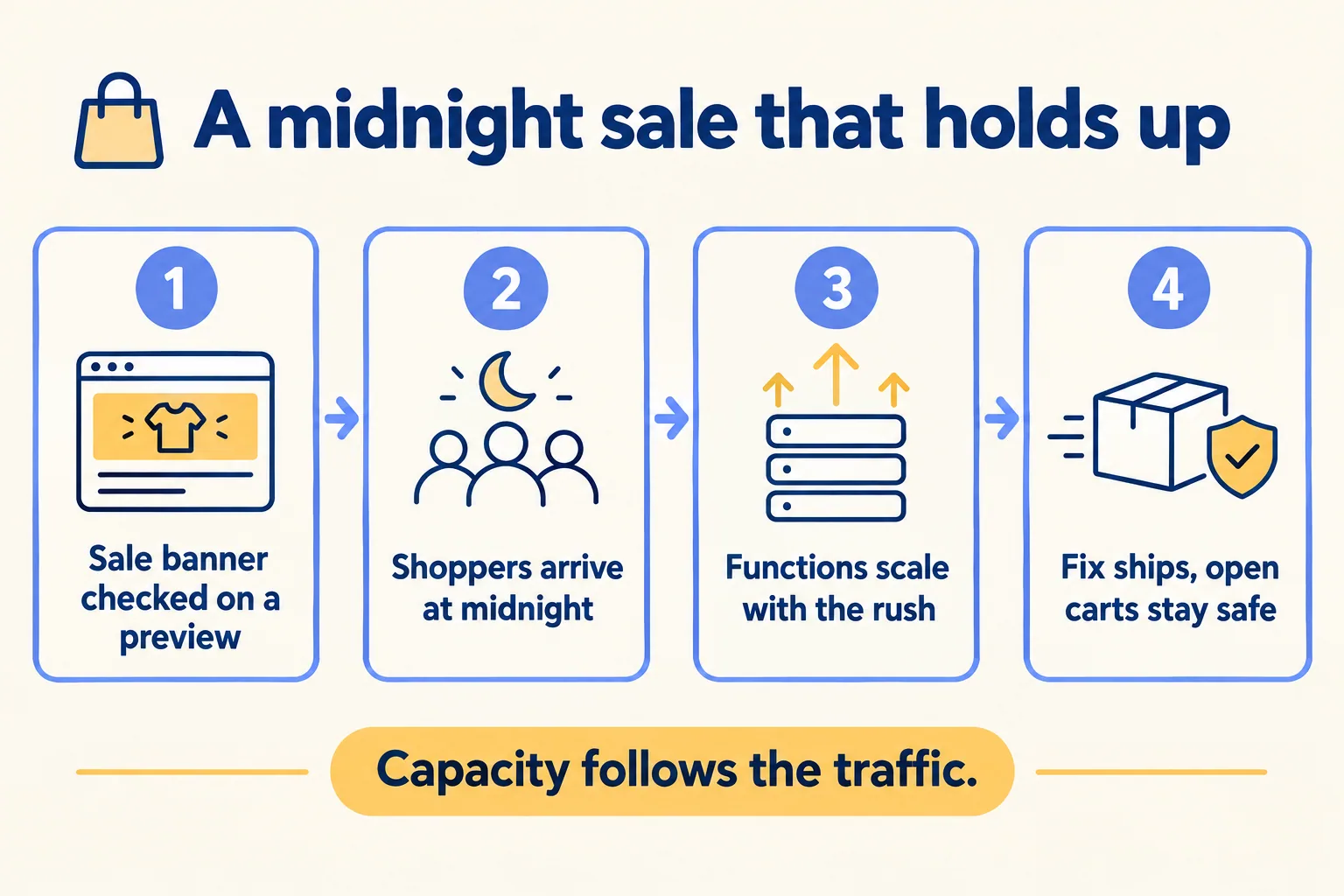
  2. A midnight sale: cached product pages, cart Functions that scale with traffic, and a fix that does not break open carts.

    Example 2 · Retail, Riyadh · Infographic

    E-commerce lead at a Riyadh fashion retailer

    Today: Our White Friday sale starts at midnight. Last year the product pages crawled for the first hour, and a fix we shipped mid-sale broke carts people already had open.

    After: Product pages are cached on the CDN. Stock and cart run as Functions that scale with the rush. Skew Protection keeps shoppers on the version they opened while a fix goes out.

    Worked example, step by step

    1. 23:30E-commerce lead. Checks the sale banner on a preview link and approves it.
    2. 00:00Shoppers. Arrive from the SMS and WhatsApp campaign.
    3. 00:01Vercel. Serves product pages from the CDN and scales the stock and cart Functions with the traffic.
    4. 00:40Developer. Ships a fix to the size filter.
    5. 00:41Vercel. Skew Protection keeps shoppers with a cart open on the version they started with.
    6. 03:00Vercel. The Functions scale back down as the rush ends.

    The sale runs on capacity that follows the traffic, and the mid-sale fix leaves open carts alone.

    Retail and e-commerce
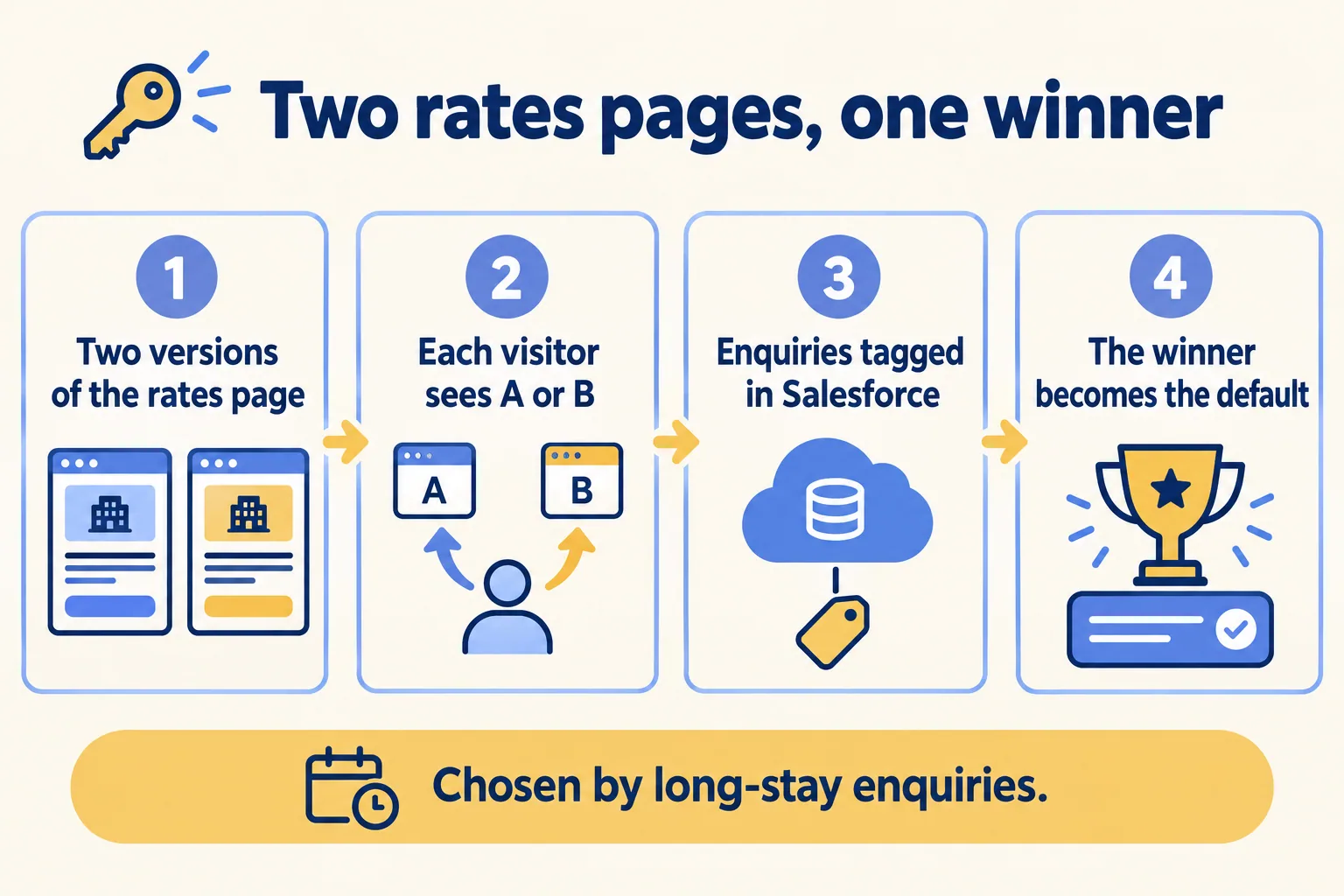
  3. Two versions of a rates page shown to different visitors, enquiries counted in Salesforce, and the winner kept.

    Example 3 · Hotel apartments, Abu Dhabi · Infographic

    Revenue manager at an Abu Dhabi hotel apartment building

    Today: I want to know if showing the monthly rate first brings more long-stay enquiries. Every test means a new page from the agency and a month of arguing.

    After: Routing Middleware sends each visitor to one of two versions of the rates page before the cache. Each enquiry reaches Salesforce with the version the guest saw.

    Worked example, step by step

    1. SunDeveloper. Builds a rates page with the monthly rate first, behind a flag.
    2. SunRevenue manager. Checks both versions on the preview link.
    3. MonVercel. Middleware sends each visitor to version A or B, still served from the cache.
    4. Mon to SunSalesforce. Each enquiry arrives tagged with the version the guest saw.
    5. Next MonRevenue manager. Compares long-stay enquiries per version and picks one.
    6. Next MonDeveloper. Makes the winner the default and removes the flag.

    The rates page that stays is the one that brought more long-stay enquiries.

    Hotel apartments
Examples of the work, not client stories. Times in each example show the order of events, not a measured result.

Is it for you

When Next.js fits, and when it doesn’t.

Good fit

Not for you yet

Your site or app is already in Next.js
The site is a few pages that change twice a year
Prices, listings or stock change often and must show fast
Your data must stay on servers in the UAE or Saudi Arabia
Traffic jumps with campaigns or seasons
Policy says you host it yourself: Next.js runs self-hosted too
You want previews and rollback without running servers
Editors want to change pages with no developer and no Git

What Mindcat does

We build it, then we run it.

The assessment is free: a short read of the org and a written note. If you go ahead, the first build week is a fixed AED/SAR 14,900 (about USD 4,050), credited in full when you sign the build within 60 days. After go-live, we keep it patched, watched and changing every month.

FAQ

What teams ask about Next.js.

Does Next.js only run on Vercel?
No. Next.js runs when you host it yourself. On Vercel it deploys with no configuration and ISR pages are kept in durable storage. Self-hosted ISR is limited to a single region and does not keep pages in durable storage by default.
What does it cost?
The framework is free and open source. Hosting follows your Vercel plan and Functions use. Hobby is for non-commercial, personal use only, so a business site needs Pro or Enterprise.
Our agency uses a different framework. Can it run on Vercel?
Most likely. Vercel supports many frameworks, often with no setup, and its Build Output API covers the rest. Features differ by framework: Runtime Cache is Next.js only, for example. The full list of supported frameworks is at https://vercel.com/docs/frameworks, with what each one supports.
Will a release break pages people already have open?
Skew Protection guards against old and new code mixing during a release. We switch it on and test it with a cart or form half filled before go-live.
Where does it run for visitors in the UAE and Saudi Arabia?
Vercel lists 19 compute regions and none of them is in the UAE or Saudi Arabia today. Mumbai (bom1) is the closest. If your data must stay in the country, tell us in the assessment: we confirm residency per project before you sign, and sometimes that rules Vercel out.


Sources

Where these facts come from.

Start here

Tell us what you want built, and where it runs today.

One or two lines is enough. You hear back within 24 hours from the person who signs the work.

Salesforce consulting partner since 2010 · MVP Hall of Fame · 200+ agents in production · UAE, India and US desks