

An engineering lead maps apps on a whiteboard in a Kochi office while one developer leans back as a build finishes.

Vercel · Frameworks

Every change rebuilds every app, and the team waits. Build only what changed.

When the website, the agent portal and the shared design live in one repository, a typo fix should not rebuild all three. Turborepo builds only the projects a change touches. Vercel Remote Cache shares build results, so a task a teammate or CI already ran is not run again. The Remote Cache is free on every Vercel plan within fair use, as of 16 October 2026.

Salesforce consulting partner since 2010 · MVP Hall of Fame · 200+ agents in production · UAE, India and US desks

The problem

Where one repository slows the whole team.

What Turborepo is

Turborepo, in plain words.

Facts from Vercel’s own pages, checked on 16 October 2026. The sources are at the end of this page.

What it is
A build system for JavaScript and TypeScript codebases, with incremental builds, content-aware hashing and Remote Caching.
Only what changed
On Vercel, Turborepo only builds affected projects. The ignore step is npx turbo-ignore --fallback=HEAD^1.
Remote Cache price
Free on all plans, subject to fair use, as of 16 October 2026.
Fair use
Uploads of 100GB a month on Hobby, 1TB on Pro and 4TB on Enterprise. Cached artifacts expire after 7 days.
Outside Vercel
The Remote Cache works without hosting on Vercel, from CI such as GitHub Actions and CircleCI.
Enterprise only
Signing and verifying cached artifacts with a symmetric key.

How it works

From one big repository to builds that skip what did not change.

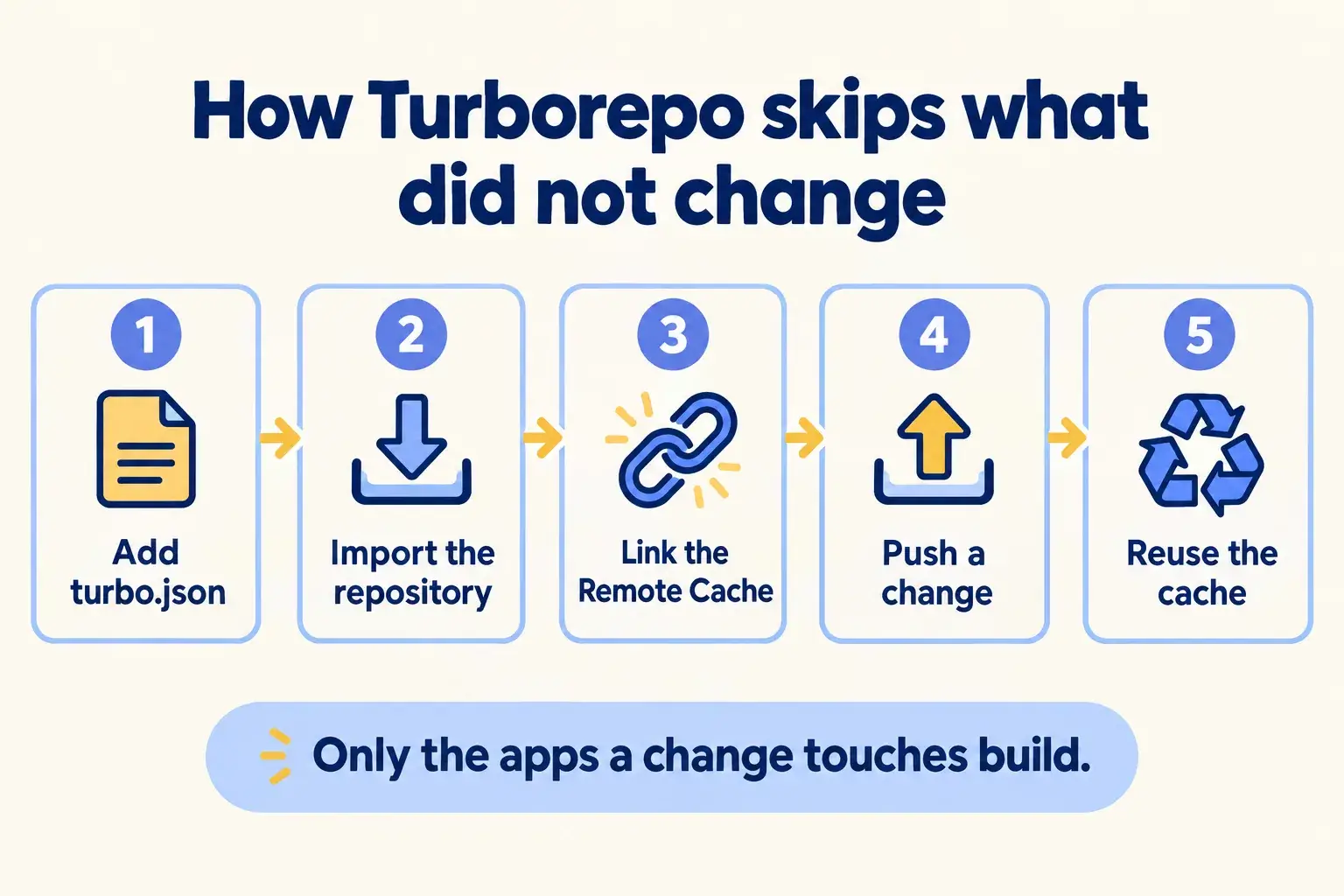
Five steps. Turborepo hashes each task’s inputs. If nothing changed, it skips the task or pulls the result from the cache.

Five steps: add turbo.json, import the repository, link the Remote Cache, push a change, reuse cached results.

Infographic

The same steps are written out below.

Step by step

What happens at each step.

  1. Set up

    Add turbo.json

    List the tasks and the environment variables each one reads.

  2. Import

    Import the repository

    Vercel sets the build command, root folder and ignore step per app.

  3. Link

    Link the Remote Cache

    turbo login and turbo link, on each laptop and in CI.

  4. Push

    Push a change

    Only the apps it touches build. The rest are skipped.

  5. Reuse

    Reuse the cache

    A task a teammate or CI already built is pulled, not run again.

How it fits together

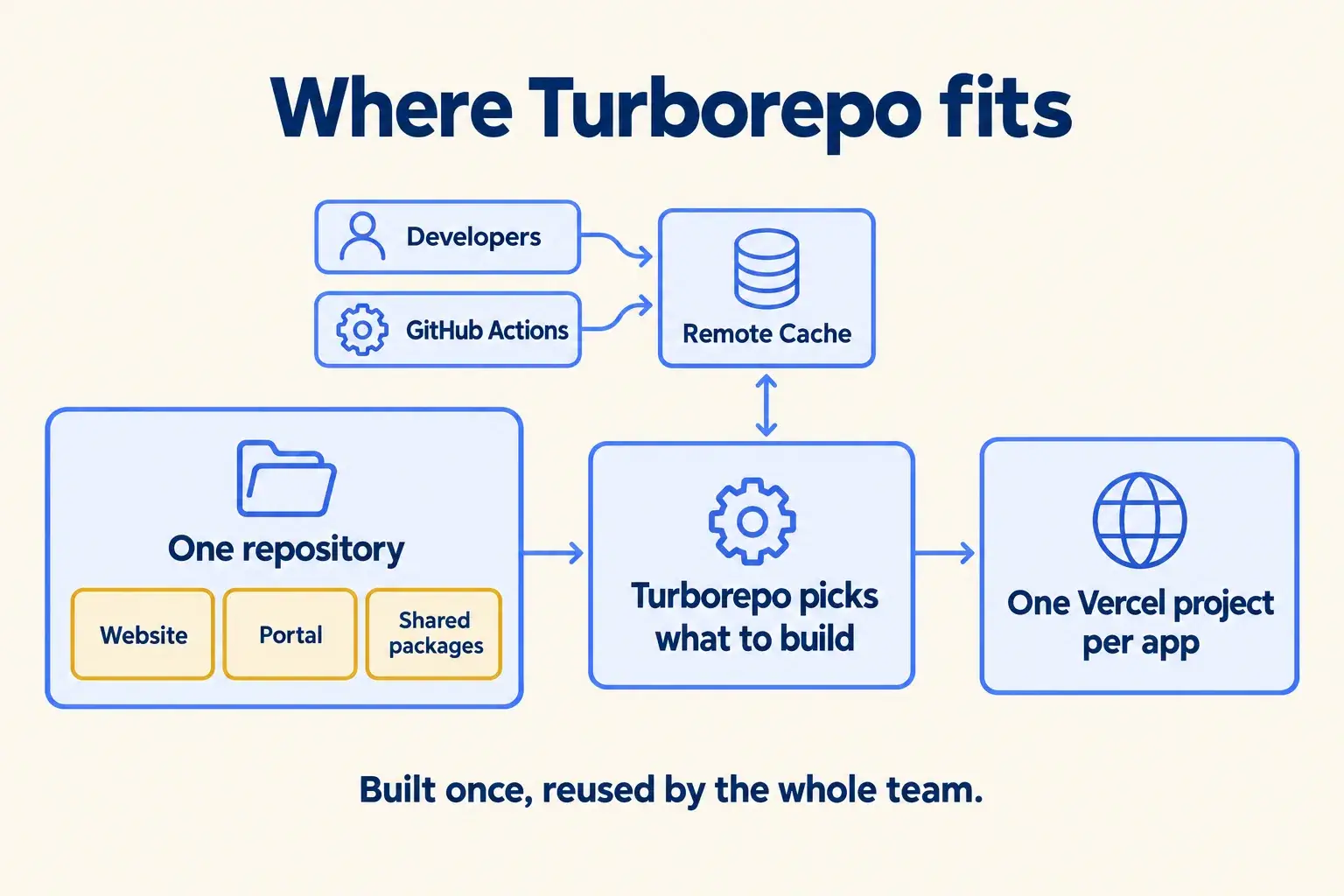
Where Turborepo sits between your developers, CI and Vercel.

One repository holds the website, the portal and the shared packages, such as the Salesforce client. Turborepo decides what to build. Developers and GitHub Actions share the Remote Cache, and each app deploys to its own Vercel project with previews.

One repository of apps and shared packages, one Remote Cache for developers and CI, one Vercel project per app.

Infographic

Where it sits next to the systems you run today.

Use cases · worked examples

One worked example in each industry.

How Turborepo fits into the work of the industries we serve, one step at a time.

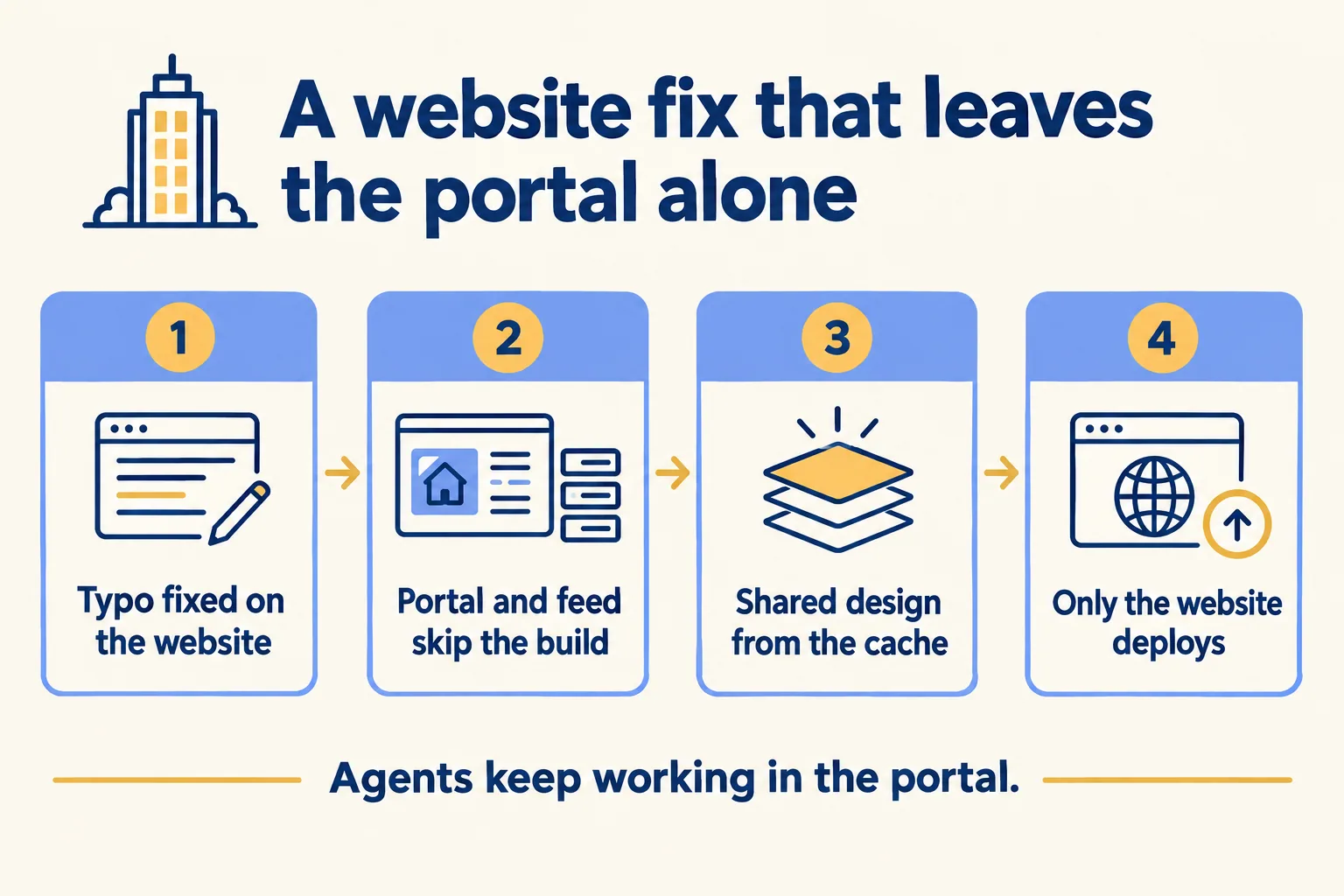
  1. A website fix builds only the website, the portal and feed are skipped, and shared packages come from the cache.

    Example 1 · Real estate, Dubai · Infographic

    Head of technology at a Dubai brokerage with a website, an agent portal and a listings feed

    Today: All three apps sit in one repository. A fix to the website waits while the portal and the feed rebuild too.

    After: Turborepo builds only the app a change touches. The Salesforce client and the design live in shared packages all three use.

    Worked example, step by step

    1. 10:00Developer. Fixes a typo on the website’s area guide.
    2. 10:01Vercel. Runs the ignore step. The portal and feed projects skip the build.
    3. 10:01Turborepo. Pulls the shared design package from the Remote Cache.
    4. 10:04Vercel. Posts the website preview link on the pull request.
    5. 10:20Marketing lead. Approves. Only the website deploys.

    A website fix ships without touching the portal the agents use all day.

    Real estate CRM
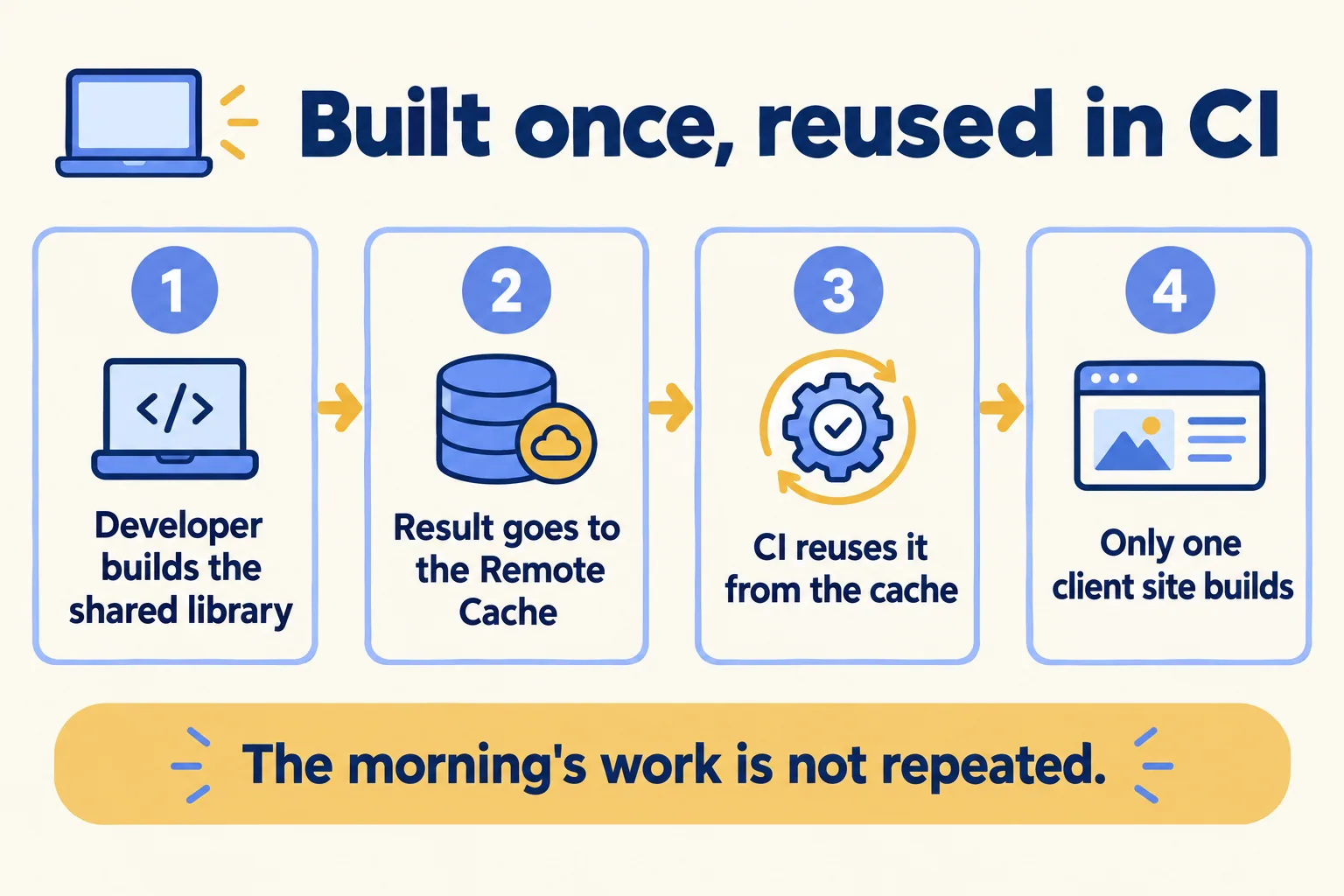
  2. A developer builds a shared library once, CI reuses it from the Remote Cache, and only one client site builds.

    Example 2 · Digital agency, Bengaluru · Infographic

    Engineering lead at a Bengaluru agency running client sites from one repository

    Today: Every pull request rebuilds every client site in CI, and the developers wait on it.

    After: Developer laptops and GitHub Actions share the Vercel Remote Cache. A task built once is reused for up to 7 days.

    Worked example, step by step

    1. 09:00Developer. Builds the shared component library on her laptop. The result goes to the Remote Cache.
    2. 09:30Developer. Opens a pull request for one client’s contact page.
    3. 09:31GitHub Actions. Runs turbo. The library comes from the cache, and only that client’s site builds.
    4. 09:35Vercel. Builds the preview for that one client project.
    5. 09:50Client. Approves the contact page on the preview link.

    CI builds what changed, and the morning’s work is not repeated.

    Digital agencies
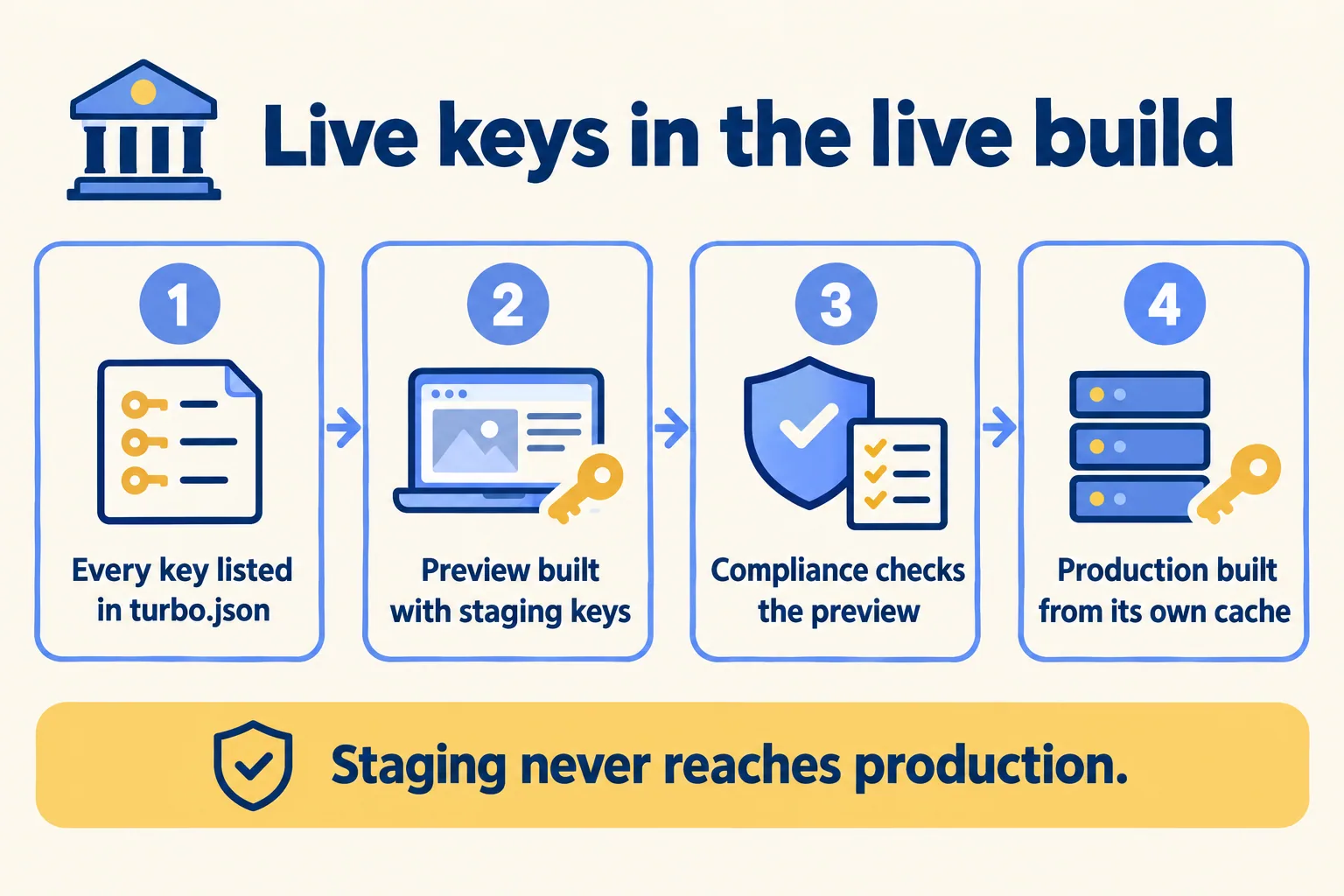
  3. Keys are declared in turbo.json, staging and production builds stay apart, and only the changed portal rebuilds.

    Example 3 · Financial services, Mumbai · Infographic

    Platform lead at a Mumbai lending company with a customer app and a partner portal

    Today: Last quarter a staging API key ended up in the live partner portal. Nobody could say which build put it there.

    After: Every environment variable each app reads is declared in turbo.json, so Turborepo keeps separate caches for staging and production.

    Worked example, step by step

    1. MonPlatform lead. Lists every environment variable each app reads in turbo.json.
    2. TueDeveloper. Changes the partner portal’s loan calculator.
    3. TueVercel. Builds a preview with staging keys. Only the portal builds.
    4. WedCompliance officer. Checks the calculator on the preview link.
    5. WedTurborepo. Builds production with production keys, from a separate cache.

    The live portal is built with live keys, and a portal change leaves the customer app alone.

    Financial services
Examples of the work, not client stories. Times in each example show the order of events, not a measured result.

Is it for you

When Turborepo fits, and when it doesn’t.

Good fit

Not for you yet

Several apps or sites share one repository
You have one small app in its own repository
Build waits and CI time slow the team
You need cached builds kept longer than 7 days
Shared code is copied between apps today
Your code is not JavaScript or TypeScript
You run CI outside Vercel and still want the cache
You expect unlimited caching: fair use limits apply

What Mindcat does

We build it, then we run it.

The assessment is free: a short read of the org and a written note. If you go ahead, the first build week is a fixed AED/SAR 14,900 (about USD 4,050), credited in full when you sign the build within 60 days. After go-live, we keep it patched, watched and changing every month.

FAQ

What teams ask about Turborepo.

Does the Remote Cache cost extra?
No. As of 16 October 2026 Vercel Remote Cache is free on all plans, subject to fair use: 100GB of uploads a month on Hobby, 1TB on Pro and 4TB on Enterprise. Hobby itself is for non-commercial use only.
Do we have to host on Vercel to use it?
No. The Remote Cache works from external CI such as GitHub Actions and CircleCI, without hosting the project on Vercel.
How long are cached builds kept?
Seven days. After that the task runs again and the new result is cached.
Can a staging key end up in production?
It can if an environment variable is not declared in turbo.json. The docs warn about this, so we declare every key each task reads and check the list in review.
Can we sign cached artifacts?
Signing and verifying artifacts with a symmetric key is listed as an Enterprise feature.

Sources

Where these facts come from.

Start here

Tell us what you want built, and where it runs today.

One or two lines is enough. You hear back within 24 hours from the person who signs the work.

Salesforce consulting partner since 2010 · MVP Hall of Fame · 200+ agents in production · UAE, India and US desks