

If your next proposal's fee is a number the partner remembers from the last one, this is for you. It is not for a firm that bills every hour on time and materials and never quotes a fixed fee, because there the client already pays for the hours.
Where does the number on the proposal come from?
The client wants a fixed fee by Thursday. The partner opens last year's proposal for a similar job, sees AED 60,000, and adds a little because the client is bigger. Nobody checks whether the last AED 60,000 covered the hours. The project lead suspects it did not: the readout went to three rounds and the weekly calls became two a week.
You are not unusual in quoting a fixed number. Consulting Success, a firm that coaches independent consultants, asked nearly 1,000 of them how they price (updated 19 October 2026): 30 percent charge by the project, 29 percent by the hour, 16 percent on a monthly retainer, 15 percent on value and 10 percent by the day. Their sample is mostly solo consultants, not Gulf firms, so read it as the shape, not your number. Most of them still quote a figure up front, and a figure only holds if someone checks it against the hours.

What did your last fixed fee really pay an hour?
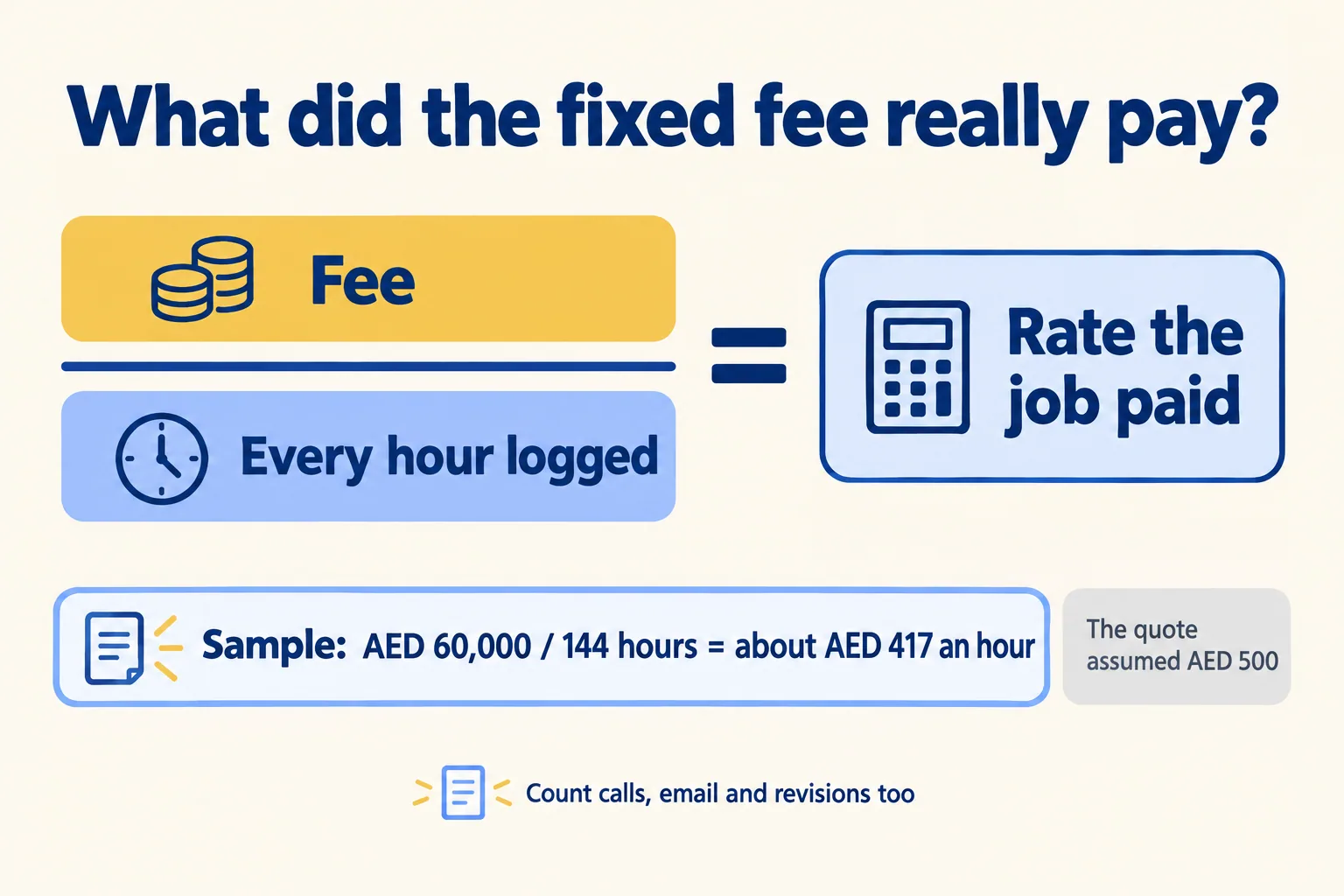
Every fixed fee hides an hourly rate. Divide the fee by the hours the team logged on the job, and you have the rate the job really paid. Timen, a time-tracking vendor, gives the example of a website quoted at USD 4,500 on 50 hours, which is USD 90 an hour. At 56 hours it paid USD 80.36. At 75 hours it paid USD 60. "The quote did not change; the job did."
Count every hour, billable or not. Time-Trak, another vendor, says to divide what you invoiced "by the total hours you actually worked, including unbilled hours." The hours that go missing first are the calls, the email and the evening spent on a fix the client found on their phone. If nobody logged them, the job looks better than it was.
Which tasks ran over?
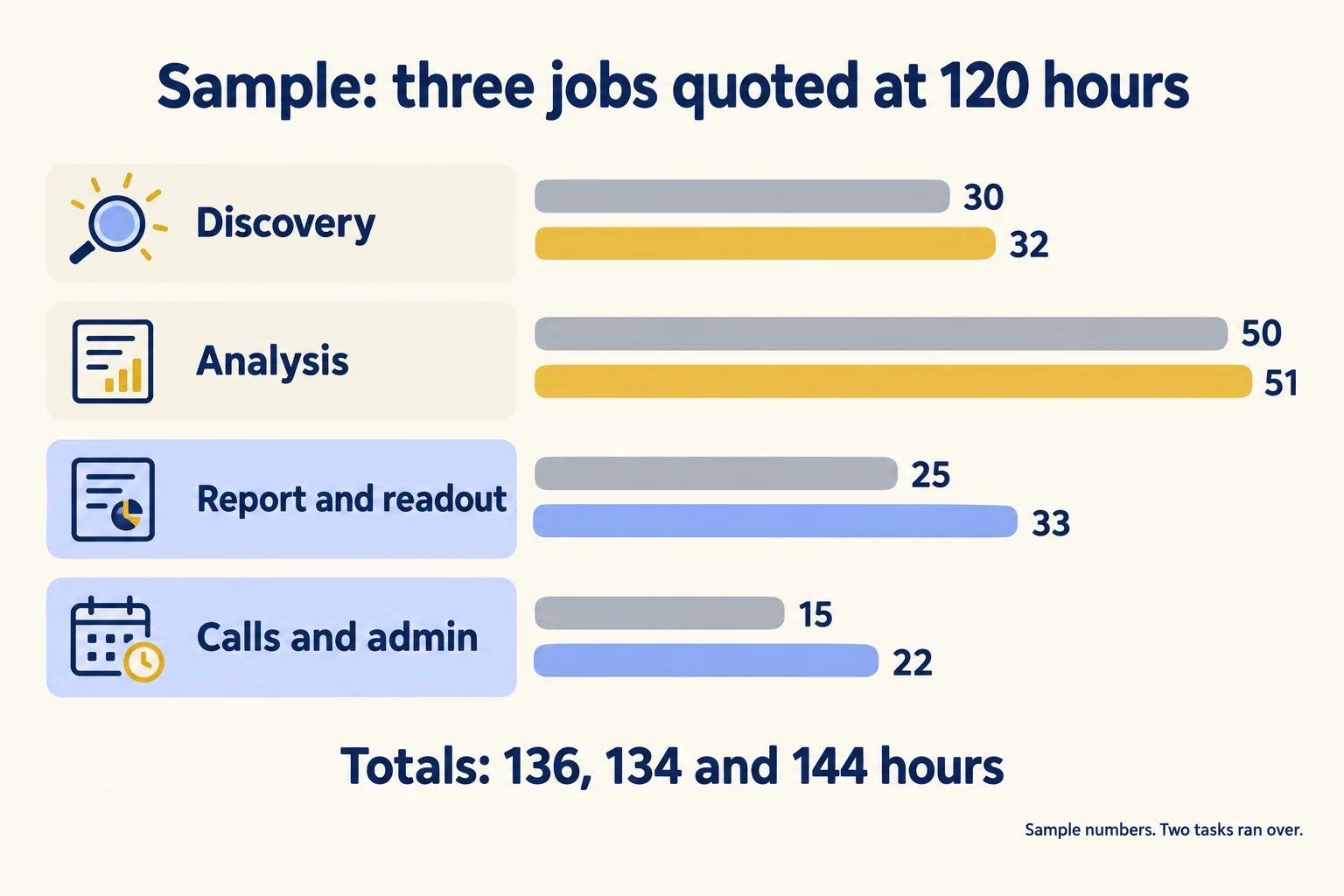
A total tells you a job ran over. Hours by task tell you where, and the next quote needs the where. Here are three past jobs of the same kind at a 20-person Dubai consultancy, each sold at AED 60,000 on a 120-hour plan, which is AED 500 an hour. The numbers are a sample to show the method.
Discovery and analysis stayed close to the plan. The report and readout averaged 33 hours against 25, and calls and admin 22 against 15. AdvisorKit, a vendor writing for consultants, says project management (weekly check-ins, email, scheduling) "typically add 10 to 20%" to an engagement and that "most first estimates leave it out." The sample shows the same thing: calls and admin is the line the first estimate left short.
If one job ran long because the client kept adding asks, that is a different problem with a different fix; we wrote it up in our post on scope creep or a bad estimate. This post is about the next proposal, priced from jobs that are already finished.
How do you build the next fee?
Timen's rule is the one we use: "average the hours per phase from three similar completed jobs, add a contingency, and multiply by your target hourly rate."
- 01Pick the last three finished jobs of the same kind, with hours logged by task.
- 02Divide each fee by its hours to see what each job paid an hour.
- 03Average the hours for each task across the three jobs.
- 04Add a contingency, read off how far apart the three jobs landed.
- 05Multiply by your rate card. That is the fee.
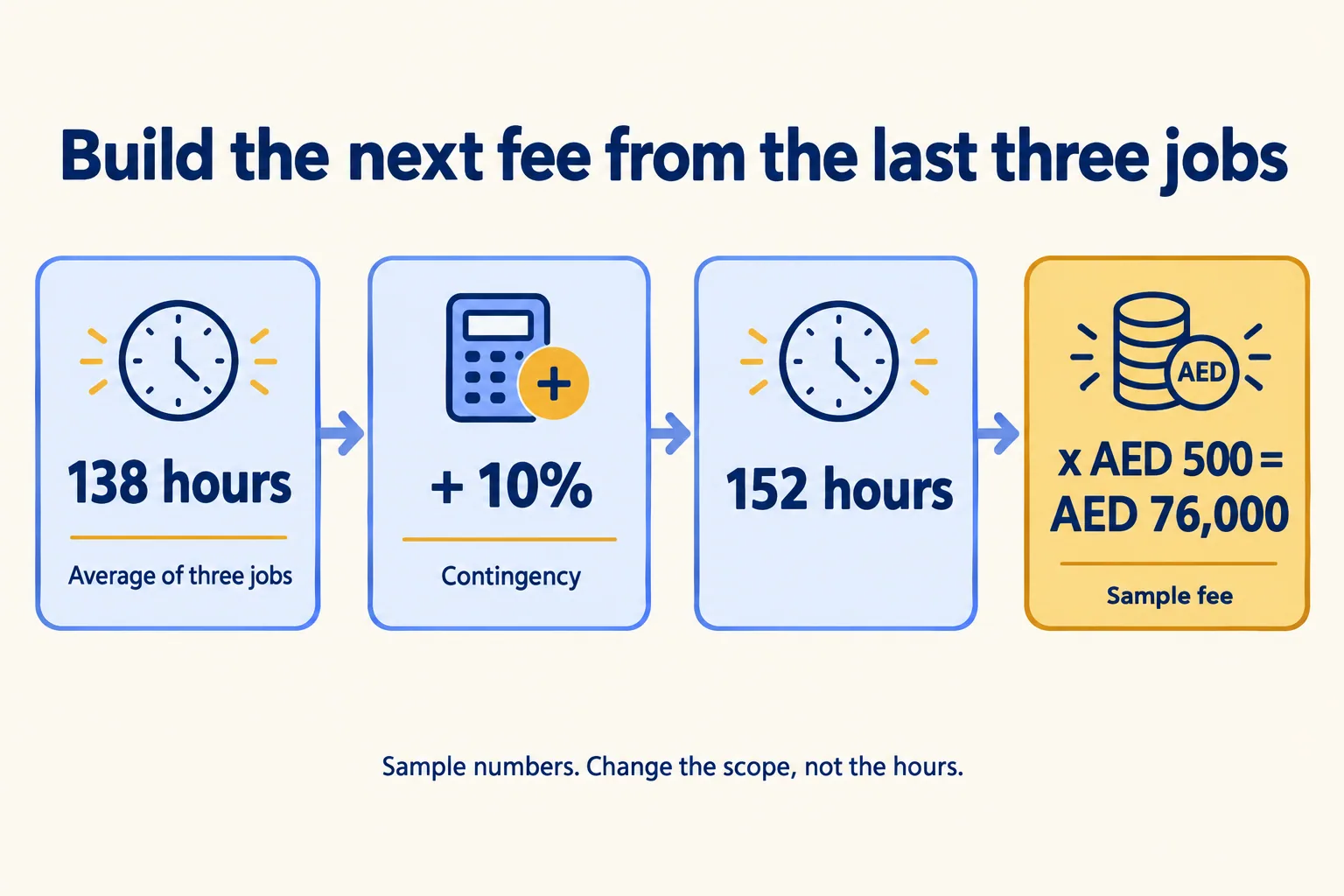
For the sample, the averages come to 138 hours. A 10 percent contingency takes it to about 152 hours. At AED 500 an hour that is AED 76,000, about a quarter more than the AED 60,000 the partner remembered. It feels like a big jump, but it is the price of the work as the team has been doing it.
On the contingency: the 138-hour average already carries the old overrun, so the buffer only has to cover how far one job can land from the average. In the sample, the worst job ran 6 hours over it, about 4 percent, so 10 percent leaves room. Timen uses about 10 percent for work you have done and tracked several times. Nicecoder, another vendor, says that when you price from your old estimates instead, use "at least the average amount your past projects ran over their estimates," and 20 to 30 percent with no history.
One flat rate keeps the sample simple. A 20-person firm has partner, manager and analyst rates, so price each task at the rate of the people who did it on the last three jobs. And compare the rate a job paid with what an hour costs you, salary plus overhead per person. The rate paid only tells you whether the job made money once you set it against that cost.
If the client will only pay AED 60,000, change the scope, not the hours. At AED 500, AED 60,000 buys 120 hours. In the sample, two readout rounds and one fixed weekly call bring the two tasks that ran over back close to their plan. Put both limits in the proposal, with the rate for anything past them. The wording of that clause belongs in your contract, so have a lawyer write it.
When should you not quote a fixed fee?
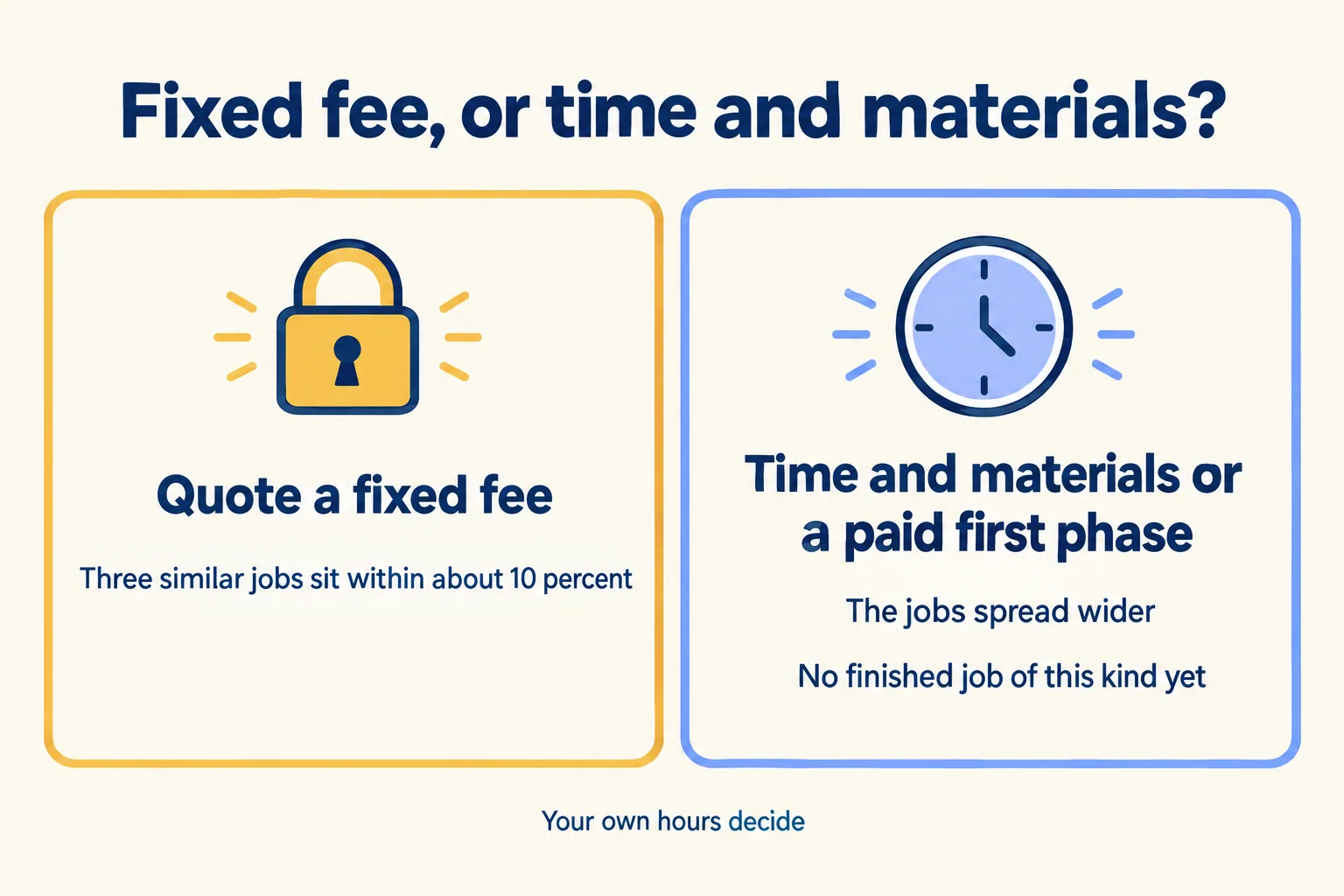
The three jobs also tell you whether a fixed fee is safe at all. Our rule: if the three totals sit within about 10 percent of their average, quote a fixed fee. In the sample they run from 134 to 144 against an average of 138, so a fixed fee holds.
When they spread wider than that, or when you have not finished a job of this kind yet, there is nothing steady to price from. Quote time and materials, or sell a paid first phase and quote the rest once you know the work. Nicecoder says the same for work with no comparable data: make the first milestone "a short, paid investigation" and price the rest after.
If your hours are patchy, start with one job. Rebuild its hours by task from calendar invites and sent email, and log by task on the job running now, so the proposal after next has real numbers.
If the work is ongoing rather than a project, the monthly version of this problem is in our post on retainer agreements and WhatsApp extras.
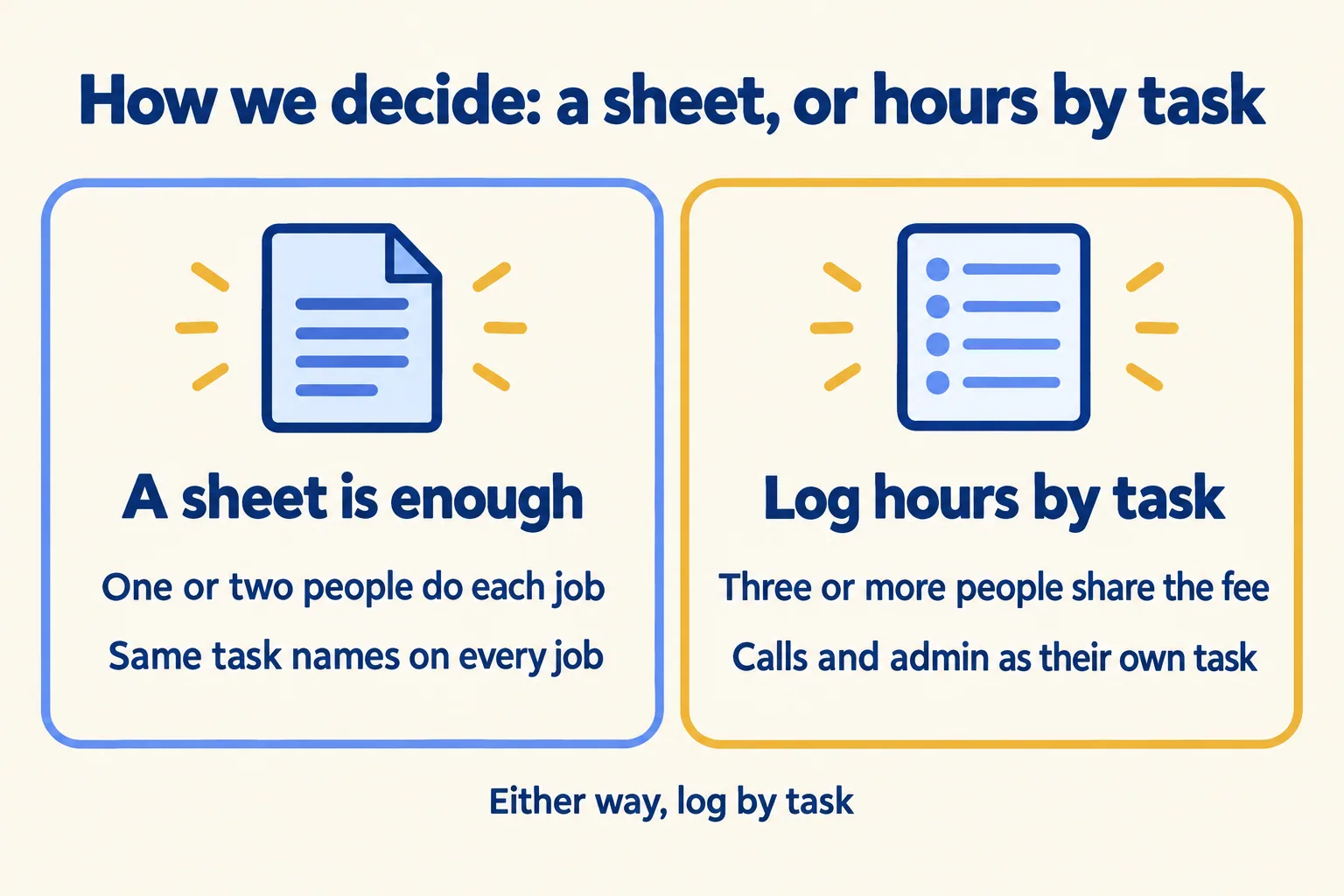
How we decide: a sheet, or hours by task
Our method is called Log it, price it, show it. Before setup we ask for the last three proposals of one kind and whatever hours you have for them. Then we apply one rule.
When three or more people share the fee, nobody can rebuild the hours from memory at the end, and the next quote goes back to a remembered number.
What Mindcat Hours does here, and what it does not
In Mindcat Hours, billable rates sit per firm, per person, per project and per person on a project, in AED or SAR. Each project and task can carry an hour estimate. The report groups hours by client, project, task, person or tag, with the billable amount, and exports to PDF or Excel. The screen below is from our page, with sample data.
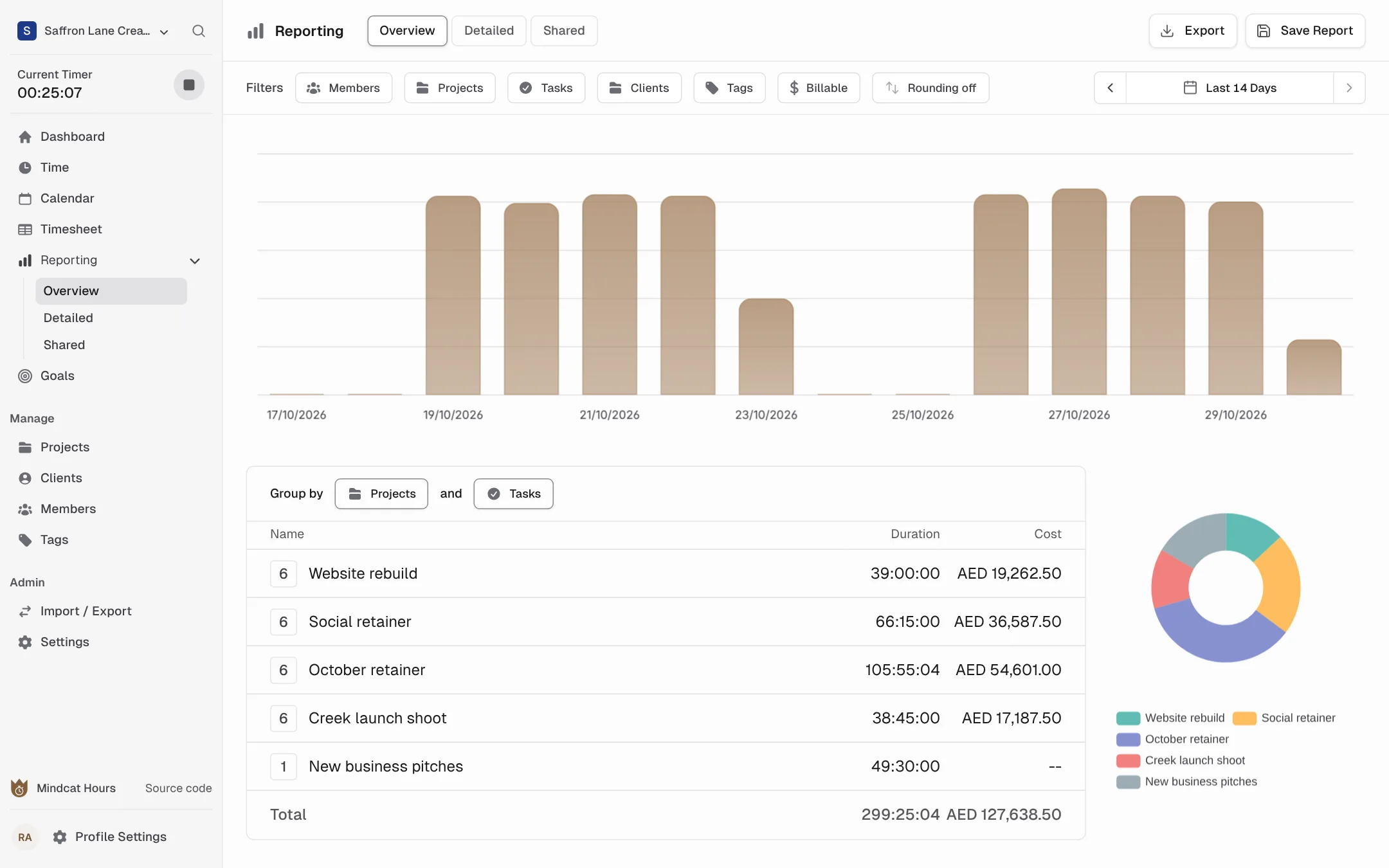
What it does not do:
- It has no cost rates and no profit or margin report. The rate a job paid is one division you do on the report: the fee over the hours.
- It does not raise invoices. Priced hours go to Mindcat Accounts for the VAT or ZATCA invoice, or out as an export.
- It sends no alert when a task passes its estimate. Someone reads the report.
- The screens are in English. Your team can type tasks and entries in Arabic.
- There is no phone app to install. On a phone, Hours runs in the browser.
- It takes no screenshots and scores nobody. It records the time people log.
Plans and dates belong in Mindcat Projects; Hours is the time you bill against them.
What does it cost?
From the Hours pricing, per user a month on the shared plan: AED/SAR 39 for users 1 to 20, then AED/SAR 29 for users 21 to 100. The shared minimum is AED/SAR 690 a month, which covers up to 17 users. On that band, a 20-person consultancy pays 20 × 39 = AED 780 a month. Clients who open a report link pay nothing.
Up to 50 users, the quick start is a fixed AED/SAR 2,500: we set up your organisation and import your clients, projects and rates from our template or a Clockify, Toggl or Harvest export. Above 50 users, setup is managed. Invoices are made in Mindcat Accounts or your own accounting system, priced separately. Prices exclude 5 percent UAE VAT and 15 percent Saudi VAT.
This is not for you if you bill every hour on time and materials, or if one or two people do each job; a sheet with task names will do. If several people share fixed fees and the next proposal is due, more on the firms we work with is on our technology and software page. Tell us how many people log time, how you bill clients and what you track time in today. We reply with the setup plan and the monthly price per user, in AED or SAR.
