
If a leaver's clearance waits on IT because nobody can find the form that says which laptop they hold, this is for you. This post is not for a team where no one owns the register once the laptop has been handed over. Fix that first, because a signature on a device nobody tracks records nothing.
Why does a leaver's clearance stall on one form?
It is the last week. HR wants IT's signature on the exit clearance. IT knows the person had a laptop, but the handover form is in a folder, or scanned onto a shared drive, and nobody can say whether it names a serial number or a charger.
The same stall shows up in other people's writing. Kevin Beaver, an independent security consultant, wrote in TechTarget on 10 February 2026: "Too many organizations have a return policy but no verification process." The policy exists. The proof that anything came back does not.

What does an asset handover form need to carry?
Sirius Star, a device-management consultancy in Navi Mumbai, published a nine-clause laptop form on 8 October 2026. It is an Indian firm's view and we do not borrow its legal remarks, but the list is a good one. SiteSurvey, a form-template site, adds checks before the device goes out and when it comes back. Put together, here is what a form should hold.
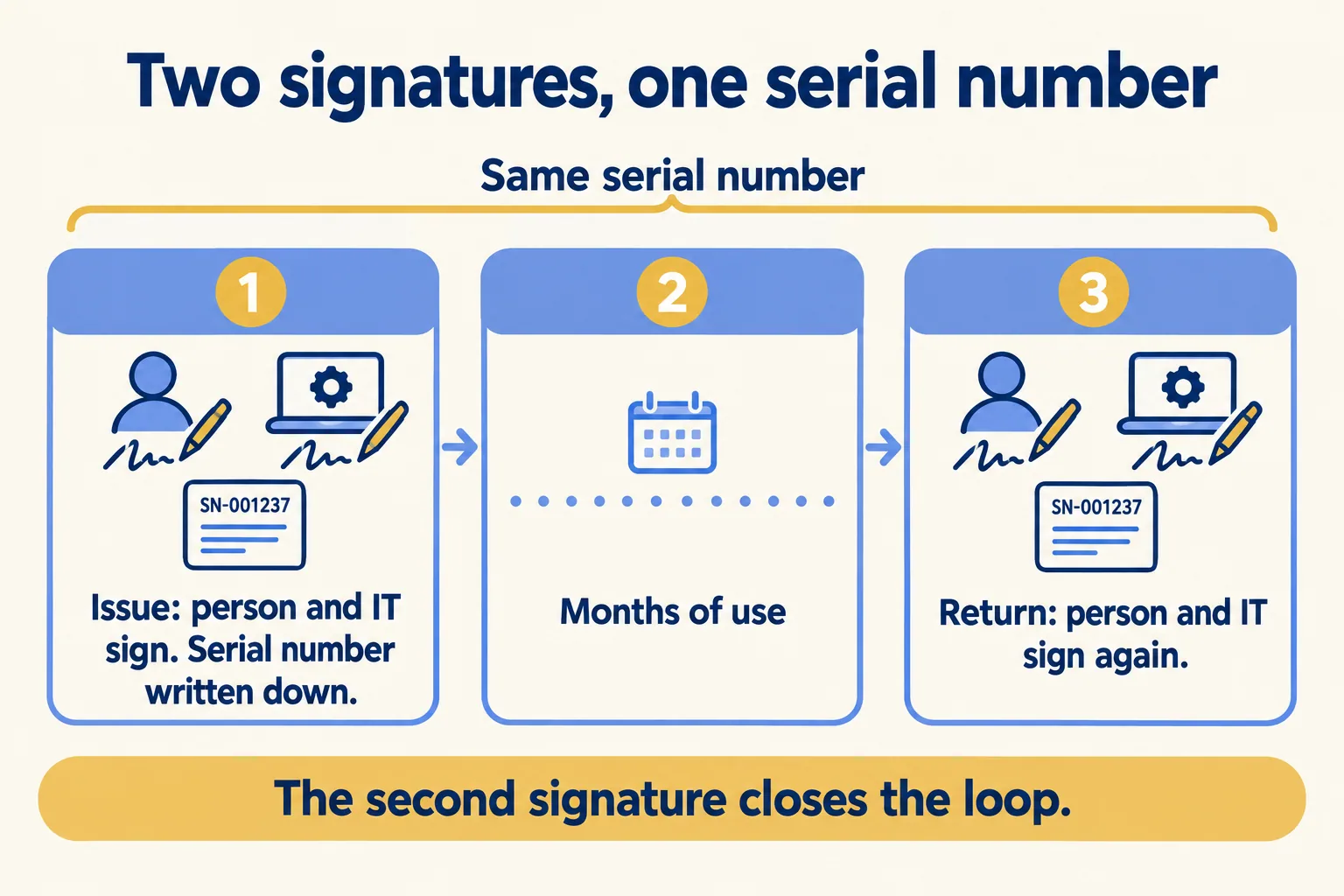
Sirius Star puts the point this way: "The form is signed twice, once at issue and once at return. The second signature is the one that makes the first one worth anything." Its nine clauses run from employee details to loss and damage, with a report within 24 hours and the return tied to the last working day.
A long form is not a better form. If people skip the fields, the form gets signed at issue and forgotten at return, which is the failure the second signature exists to prevent.
When is a paper form enough?
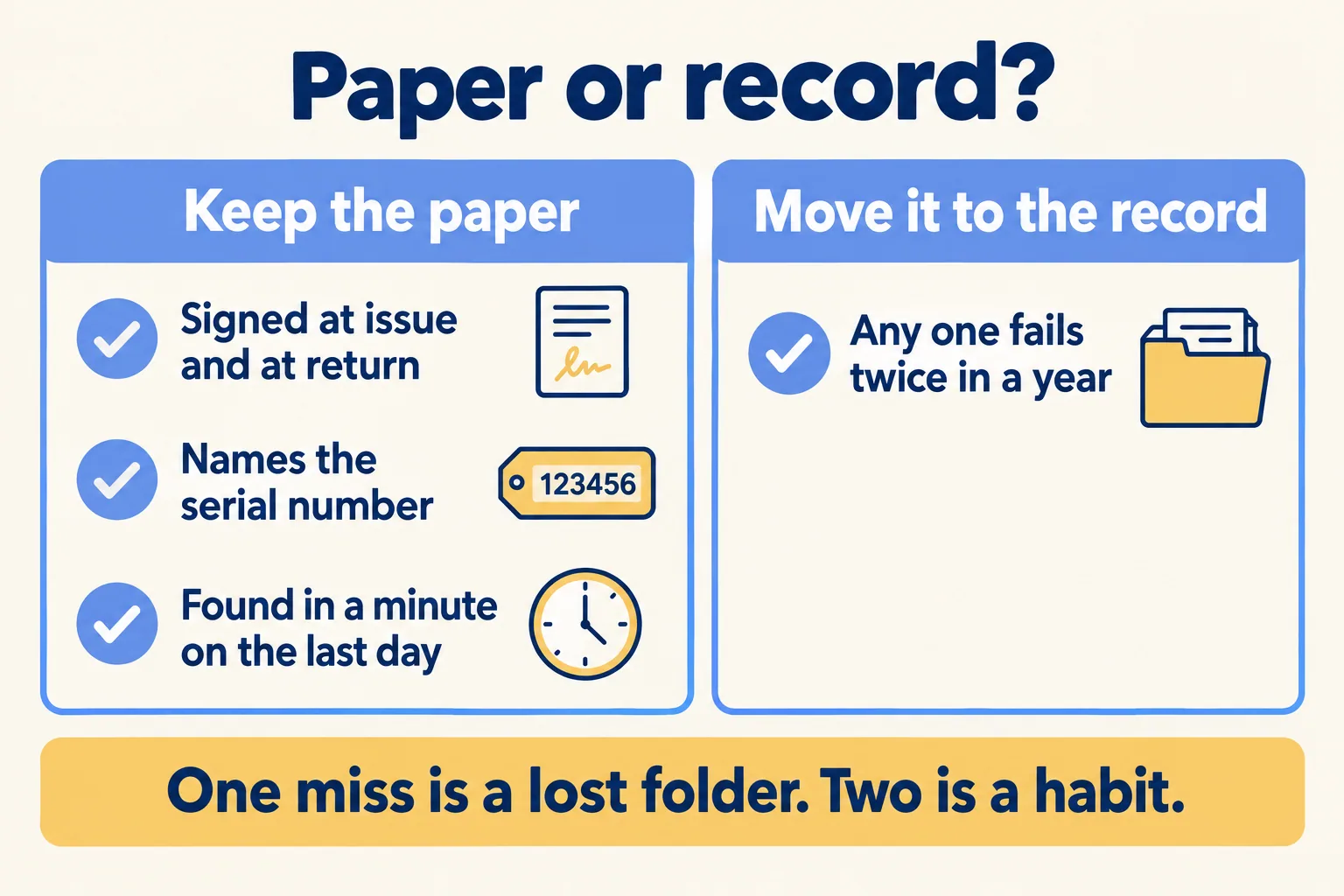
Our rule: a paper form is enough while it is signed at issue and again at return, names the serial number, and someone can find it within a minute on the leaver's last day. We say so before we sell a record, because a small team with one careful person often needs nothing else.
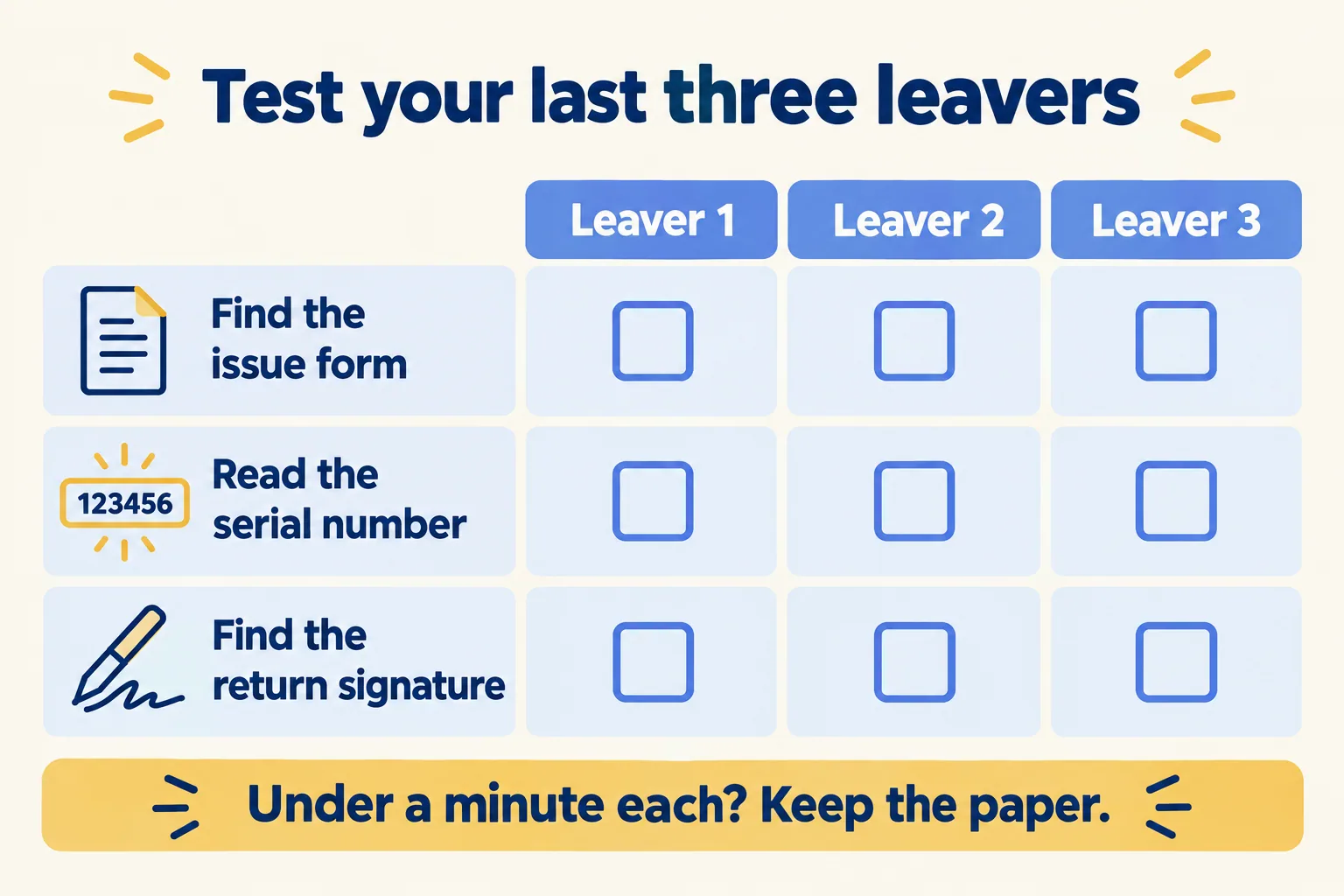
The receipt is a ten-minute test. Take your last three leavers. For each one, find the issue form, read the serial number on it and find the return signature. Three out of three, each in under a minute, means keep the paper. If you had to ask who filed it, the serial was missing or the return section was never signed, the paper is already failing.
When should the signature sit on the record?
Move it when any one of the three conditions fails twice in a year. One miss is an unlucky folder. Two is a habit.
Rayda, a device-management vendor, makes the case for signing early: "The time to establish that equipment must be returned is when equipment is issued." It adds that most people "will do the right thing when they've acknowledged the obligation in writing." That is a vendor's view, but it matches the rule. The acknowledgement is only useful if you can find it later.
What can a form never do?
It does not bring the laptop back. It records who agreed to what and when. Everything after that is a conversation with the person, HR and, if it comes to money, a lawyer.
Deductions are the sharp edge. SiteSurvey's form puts a line next to the "not returned" item: "Check with HR before promising or threatening a charge." It cites Acas, which is UK guidance, so read it as one vendor's caution and not as UAE law. In the UAE, our Assets page says HR has 14 days to settle a leaver's dues under Federal Decree-Law 33 of 2021, Article 53. Confirm with HR or a lawyer what your contracts need, and whether a form supports a deduction, before you rely on it. That is guidance, not legal advice.
How does a signed record work in Mindcat Assets?
Here is what our page describes. IT checks an item out to a named person. The person gets an email, opens it on their phone, reads your handover note, accepts it and signs with a finger. The signed copy is kept on the record and emailed to them. We write your handover note in Arabic and English during setup.
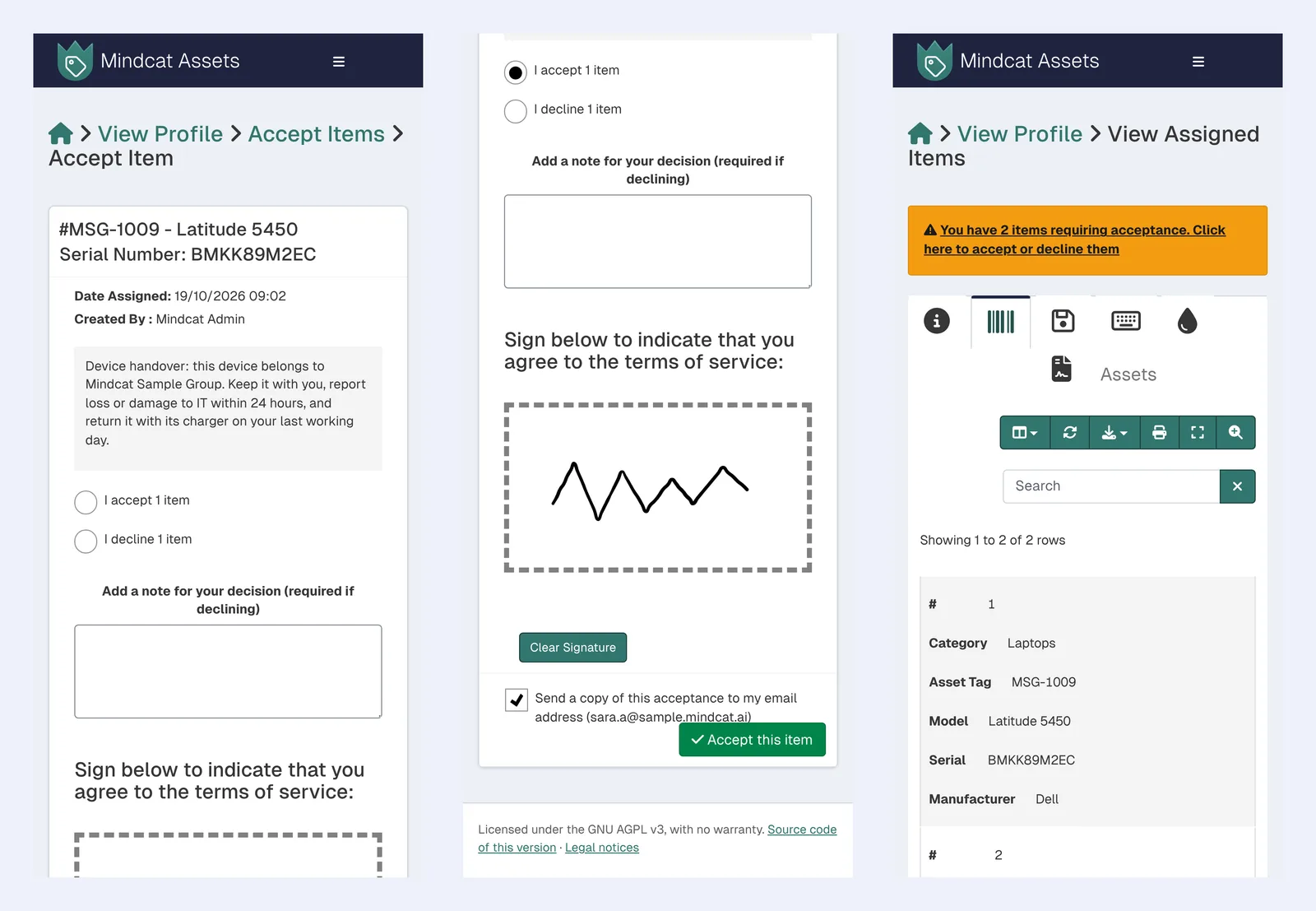
On the last week, IT opens the leaver's record, checks in what comes back and signs the clearance. Anything still missing is on the list with its serial number.
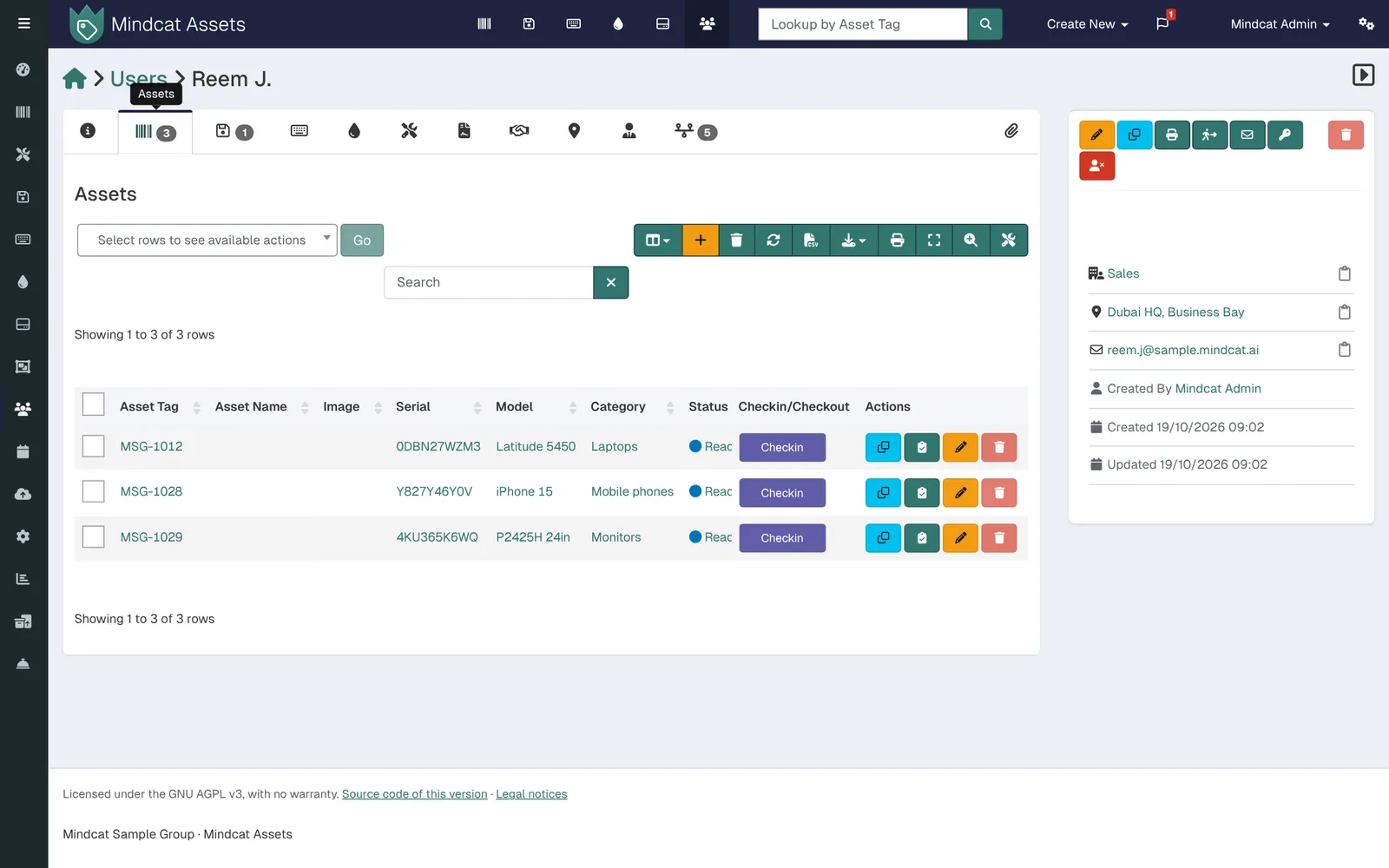
Some limits to plan around:
- Mindcat Assets does not find devices on your network and does not wipe them. That is the job of a device-management tool.
- Sign-in with Microsoft and device sync from Intune, Jamf or Google Workspace are set up during setup, not on day one.
- Arabic screens are partly translated today. The page counts about 54 percent of labels at its last count, and we finish the screens your team uses during setup.
What would it cost, and what happens first?
You pay per person holding kit a month: AED or SAR 5 for 1 to 100 people, 3 for 101 to 300, 2 for 301 to 1,000 and 1 above that. IT, HR and finance logins are free, and there are no per-asset fees. The per-person price comes with a monthly minimum, so no one buys a few seats at the per-person rate. On the shared plan it is AED or SAR 600 a month, which covers up to 133 people. For 100 people holding kit, 100 times 5 is 500, so you pay the 600 minimum. That is arithmetic on the page's list, not a quote. Prices exclude 5 percent UAE VAT and 15 percent Saudi VAT.
Up to 100 people, the quick start is a fixed package we set up for AED or SAR 2,500, one time. It includes your register imported from our CSV template, the handover note in Arabic and English that people sign, the label template and recorded training. Label printers and labels are yours to buy.
We call the method Signed-for custody: every item checked out to a named person, with the signature on the record. If your last three leavers all came up in under a minute, keep the paper and spend nothing. If they did not, tell us how many people hold kit and where the forms live today. We reply with the setup plan and the monthly price in AED.
If you are still choosing between a sheet and a system, the post on asset registers shows the columns that make a handover useful. The label question is in which devices get a tag. Plant and PPM are a different buyer: see Mindcat Maintain. IT teams that run this for other companies can start at IT service desks.
