

If a leaver's exit clearance waits while IT looks for the spreadsheet, this is for you. It is not for an office with ten laptops and one person who hands them out and signs for them: keep the spreadsheet, and use the columns below.
Why does a clearance wait on a spreadsheet?
Because the spreadsheet answers "what do we own" and the clearance asks "what does she still hold". Those are different questions.
The clock is not yours. Article 53 of UAE Federal Decree-Law 33 of 2021 says the employer pays the worker, "within fourteen (14) days as of the date of the end of the contract", his wages and all other entitlements. We read it on the UAE Legislation portal on 15 October 2026. We did not find a clause that requires a clearance form or allows a deduction for unreturned kit, so do not assume either. Ask your lawyer. What the clock does mean is that HR is waiting on someone to say what the leaver holds.
Practitioners describe the gap in plain words. A poster in a sysadmin thread, captured on 7 September 2026 by an aggregator site, wrote: "We currently have several devices still assigned to people who left months ago.. no one has a clear view of what was returned and what is still sitting with a former employee." A reply in the same thread: "HR owns the timeline. IT owns the process. Nobody owns the handoff." We could not open the original Reddit threads, so treat both as quoted. None are Gulf voices.
What goes in an asset register template?
The searcher's answer first, because it is a fair question. Most templates agree on the first seven columns. The last three are the ones a leaver needs.
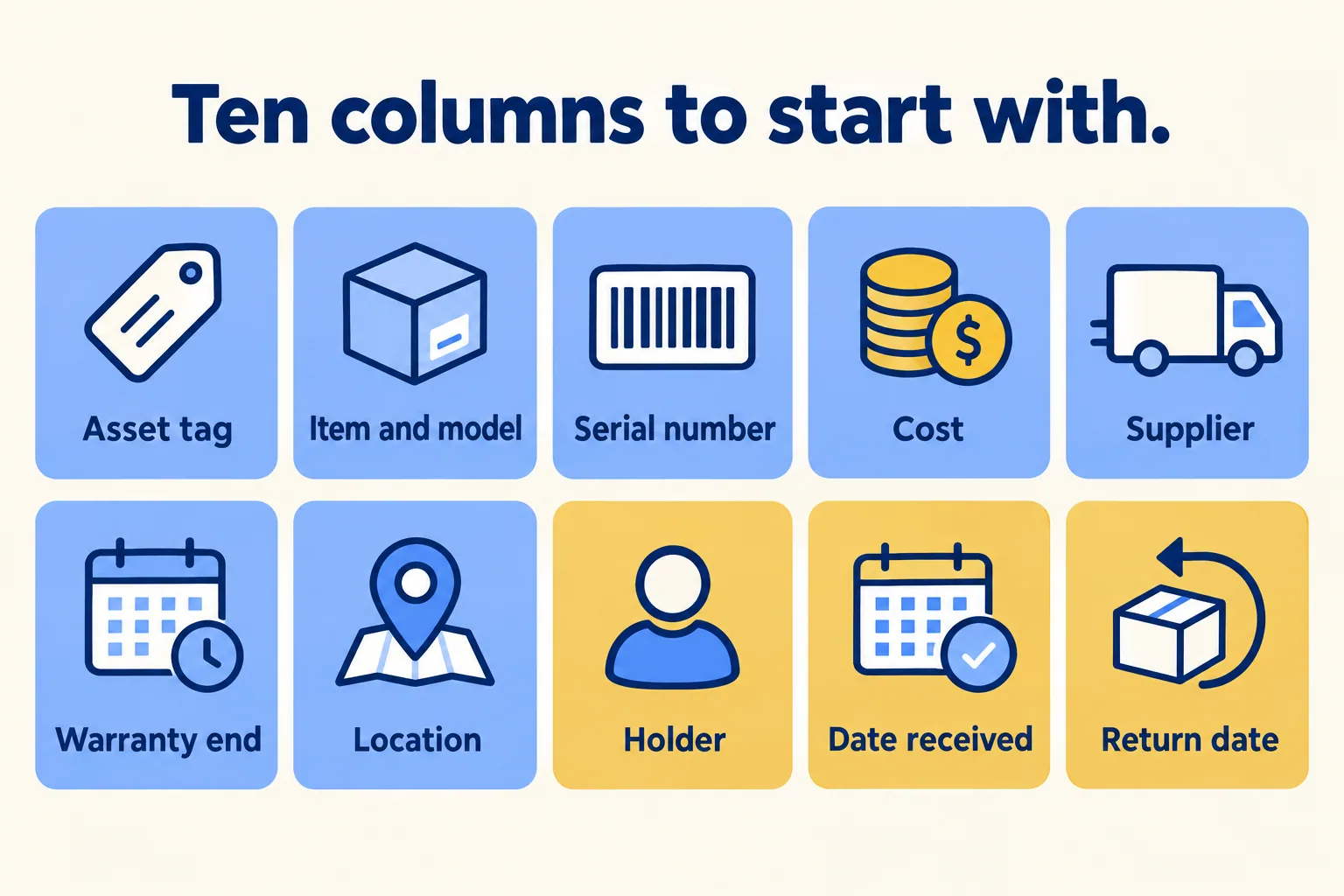
Asset tag, item and model, serial number, purchase date and cost, supplier, warranty end, location. Then the holder's name, the date they received it, and the date it should come back.
A vendor guide on hardware recovery, from Ampthilly, makes the same point about the holder: the item is not "issued to Alex", it is "issued to Alex on 2026-01-15", with a serial and a tag, and "if you can't pull this with one query, you're not ready to offboard." It is a vendor blog, so take the shape of the process and leave its recovery rates.
When does the spreadsheet stop being enough?
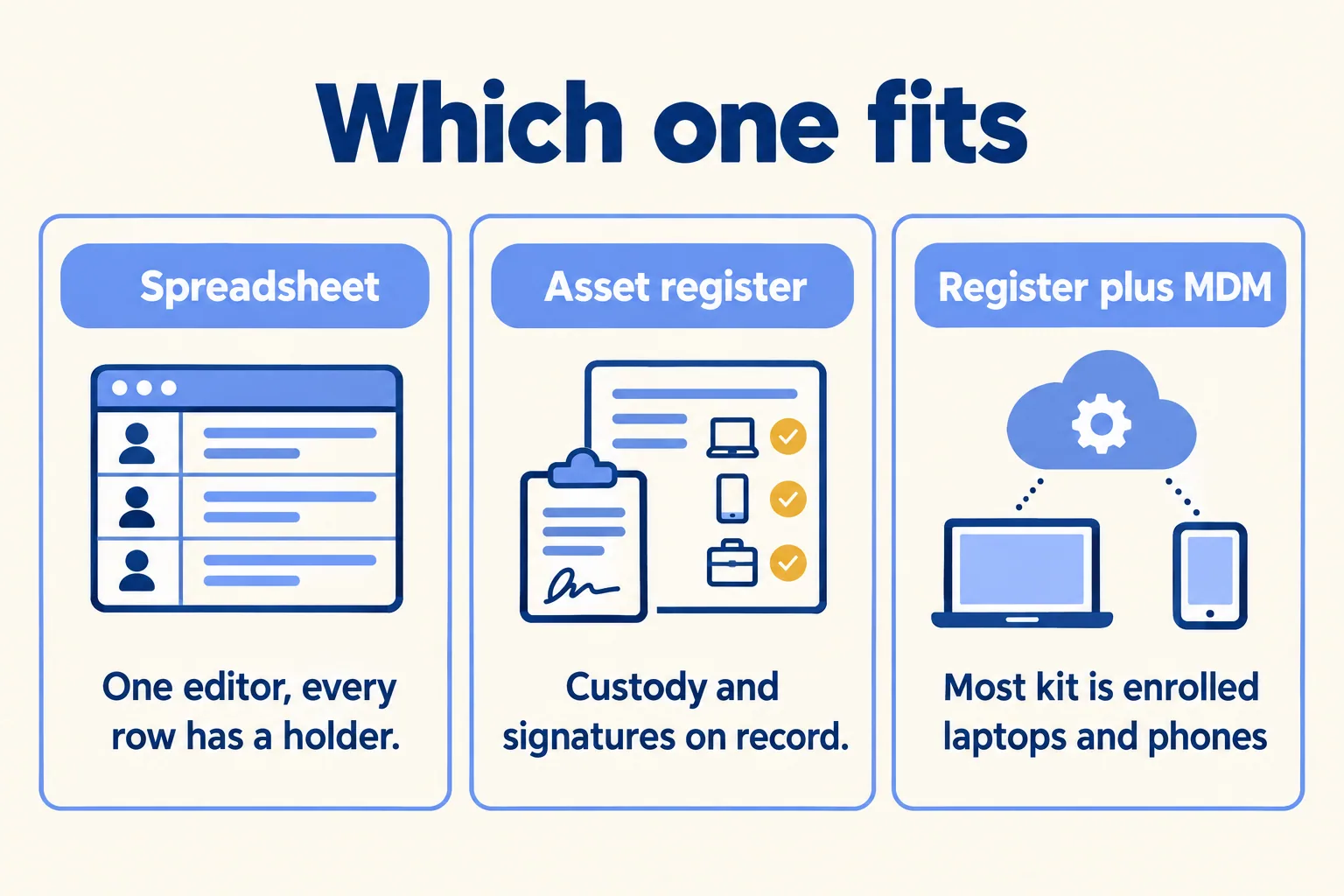
This is our rule of thumb, not a study. A spreadsheet is enough while all three of these are true: one person edits it, every item has a serial and a named holder with a date, and a clearance never waits on someone finding the file.
It stops being enough at the first of these:
- 01Two people edit it. IT adds a laptop and the office manager adds a monitor, and the rows no longer agree.
- 02A signature has to be on the record. A paper form in a folder does not say which serial the person signed for.
- 03A leaver's list has to reach HR inside the 14 days. If the answer takes a week of asking around, the clock is already running.
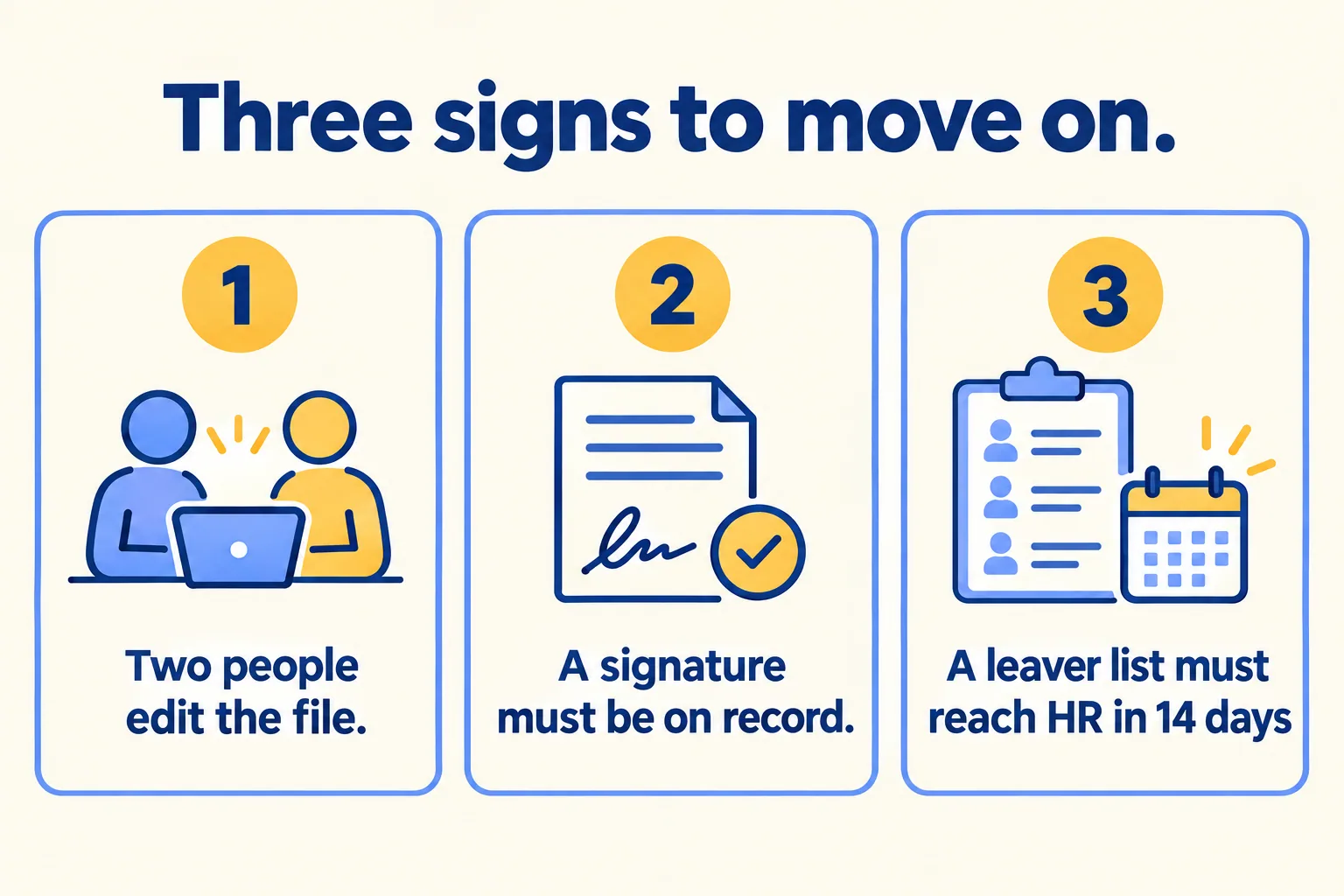
One sign is enough. If none applies, close this tab; the template is the right answer and it is free.
Does an MDM already do this?
For laptops and phones it manages, partly. That is the belief that keeps the spreadsheet alive: "Intune already lists our laptops." Intune lists managed devices. It does not list the monitor, the Hilti kit or the SIM, and it does not know who signed for them.
What does Assets add, and what is left out?
Mindcat Assets is an asset register we host and run, in the UAE or Saudi Arabia. Each laptop, phone, tool and licence seat is checked out to a named person. They get an email, read your handover note, sign with a finger on their phone, and the signed copy is kept on the record and emailed to them. A person's record lists everything they hold, so on a leaver's last week IT opens it, checks in what comes back, and anything missing is on the list with its serial number.
Here is the one step it changes. Before: HR asks on a leaver's last week what she still holds, and IT opens the spreadsheet, finds a laptop row, and has to ask around for the monitor and the phone. After: IT opens her record and sees every item checked out to her, with serial numbers, and checks in what she hands back. Anything missing is on the list for HR the same day.
It also shows an overdue-returns list, licence and warranty dates, and a QR label you scan with a phone for the yearly count. Each office has its own currency: SAR in Riyadh, AED in Dubai. Our page's screens use sample data.
What it leaves out:
- No network scanner. It does not find unknown devices on your network.
- It does not wipe a phone. The person's record lists every device to wipe, and the wiping stays in your MDM.
- Laptops can arrive from Intune, Jamf or Google Workspace once a day, with serial numbers, and sign-in with Microsoft can be set up. Both are done during setup, not on day one.
- Arabic screens are partly translated today: about 54 percent of labels, counted on 10 October 2026, and the rest show in English. The layout runs right to left. There are no Hijri dates.
- Label printers and labels are yours to buy. Tagging and counting on site is quoted separately.
Building equipment, preventive maintenance and CAFM are a different job: see Mindcat Maintain. This post is about who holds laptops, phones and tools. For the ticket a leaver's kit raises, see Mindcat Desk.
What would 40 people cost?
Our page prices each person holding kit, a month: AED 5 for the first 100, AED 3 for 101 to 300, AED 2 for 301 to 1,000, AED 1 above that. IT, HR and finance logins are free, and so is everyone with nothing checked out. Assets, licences and locations are unlimited, with no per-asset fees.
The per-person price comes with a monthly minimum, so no one can buy a few seats at the per-person rate. On the shared plan the minimum is AED 600 a month (USD 163.38), which covers up to 133 people. For 40 people, 40 × AED 5 is AED 200, under the minimum. So you pay AED 600, not AED 200, plus 5 percent UAE VAT. Past 133 people the per-person price takes over: 250 people holding kit is AED 950 a month.
Up to 100 people, the quick start is a fixed package we set up for AED 2,500 one time. It loads your register from our CSV template, with our categories and tag format, and includes the handover note in Arabic and English that people sign. We send the payment link within 24 hours, and the go-live date counts from the day your file arrives. Annual prepay takes 15 percent off. Managed setup up to 100 people is AED 3,900.
Set that against the spreadsheet: no software bill, and the cost is a clearance that waits on IT. Whether that is worth AED 600 a month depends on how often people leave. We will not put a number on it for you.
What happens in the first working session?
Week one on the quick start, as our page states it: you send your register in our CSV template. We send the payment link within 24 hours, and the go-live date counts from the day your file arrives. You get your own copy on our servers with your logo, the handover note people sign in Arabic and English, the label template, and recorded training. No call and no on-site visit. We cannot give you a day count before we see your file.
We call the method Signed-for custody: every item checked out to a named person, with the signature on the record. You send how many people hold kit and what the spreadsheet looks like today. We reply with the setup plan and the monthly price in AED. If you have ten laptops and one person who signs for them, we will say keep the sheet. If two people edit it, or a leaver's list has to reach HR inside 14 days, tell us how many people hold kit and we start from your file.
