

If your branches change the menu board by hand when Ramadan starts, this is for you. It is not for a single-branch restaurant with a printed Ramadan menu: that is a different question.
Who changes the menu board when the moon moves Ramadan?
Ramadan 2027 is expected to begin on Monday 8 February 2027, "subject to official moon-sighting confirmation", Gulf News reported on 10 October 2026. The month then runs 29 or 30 days, which puts Eid al Fitr on 9 or 10 March. The UAE moon-sighting committee observes the moon on the 29th of the month (The National, 6 October 2026), so the start is a forecast until the evening it does.
That is the problem for a menu board. The iftar menu has to be on every screen at sunset, and the sighting that sets the start comes the evening before the first fast. Between the sighting and sunset, someone has to change the boards in every branch, and nobody has planned who.
The easy answer is the branch manager. One supplier's case study of a Saudi quick-service group with more than 300 sites describes the starting point: "Managers had to physically visit stores and verify the right pricing was being displayed." That works for three branches. It does not work for thirty, on one evening, with the date moving by a day.
What does changing it by hand cost?
Printing is the visible cost. A Dubai advertising firm, Cameo Advertising, estimates that a restaurant with 3 branches and seasonal offers "might reprint menus 6 to 8 times a year", at "AED 500 to 1,500 per round of printing across locations", and adds that "Ramadan hours mean a different menu layout." On its numbers, that is AED 3,000 to AED 12,000 a year for three branches (6 × 500 to 8 × 1,500). It is a supplier's estimate, not a measured figure, so replace it with your own print invoices.
The other cost is the night itself. The same article names it: "a handwritten correction taped over the old price." A screen fixes the print bill and keeps the night problem, because a person in each branch still has to make the change at the same moment.
Who should own the Ramadan schedule?
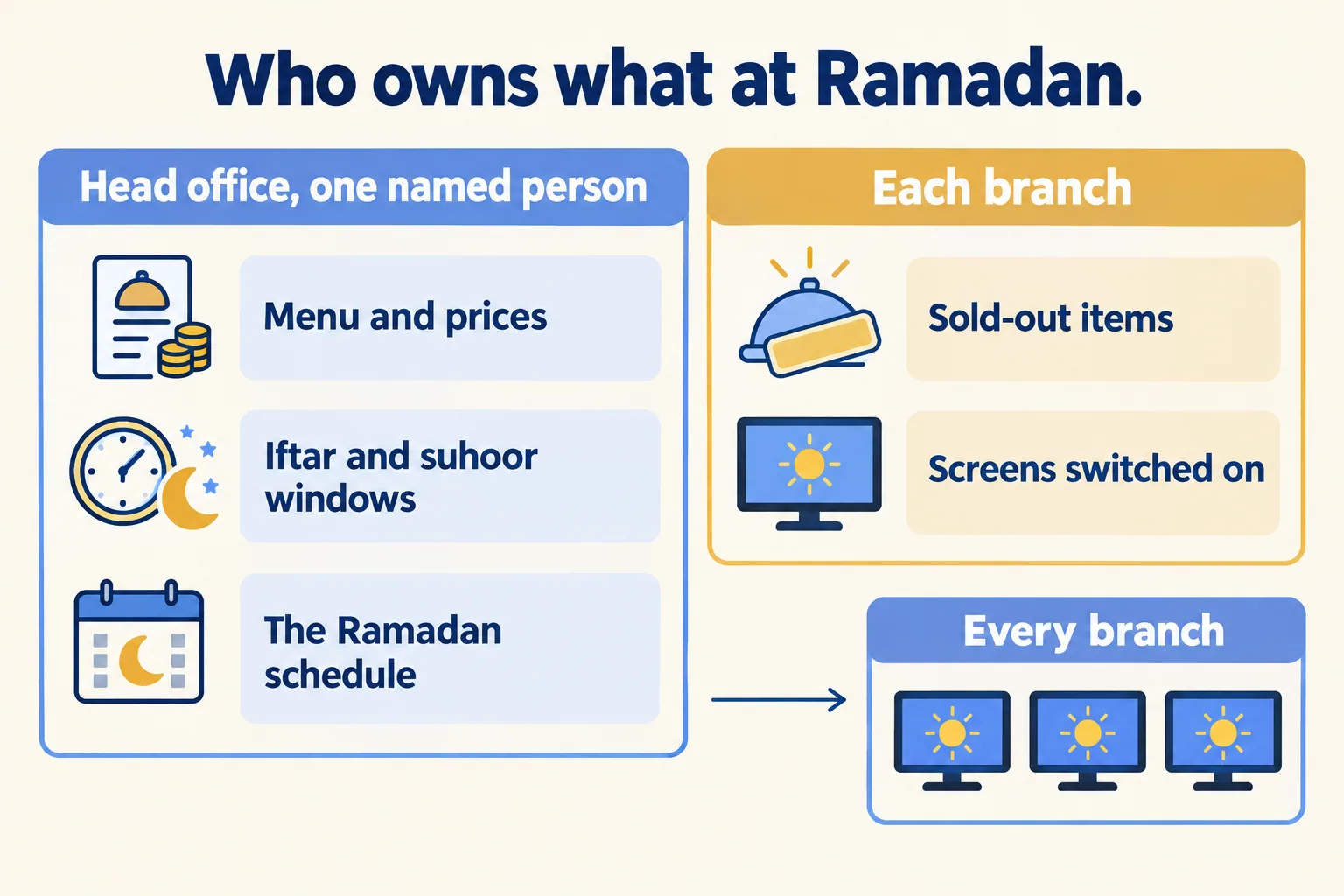
One named person at head office owns the menu schedule and the prices. Branches own only two things: an item being sold out, and the screens being on.
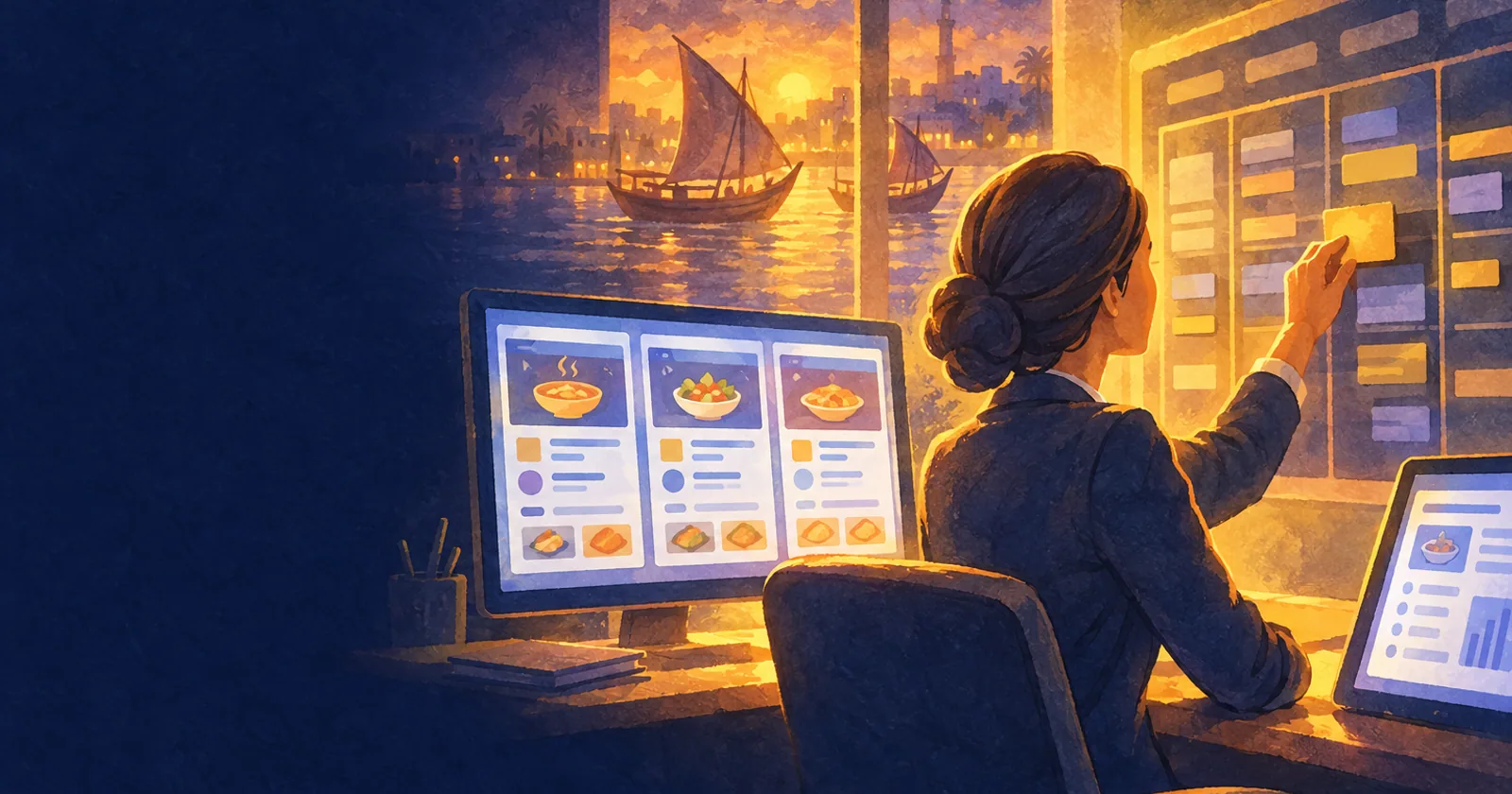
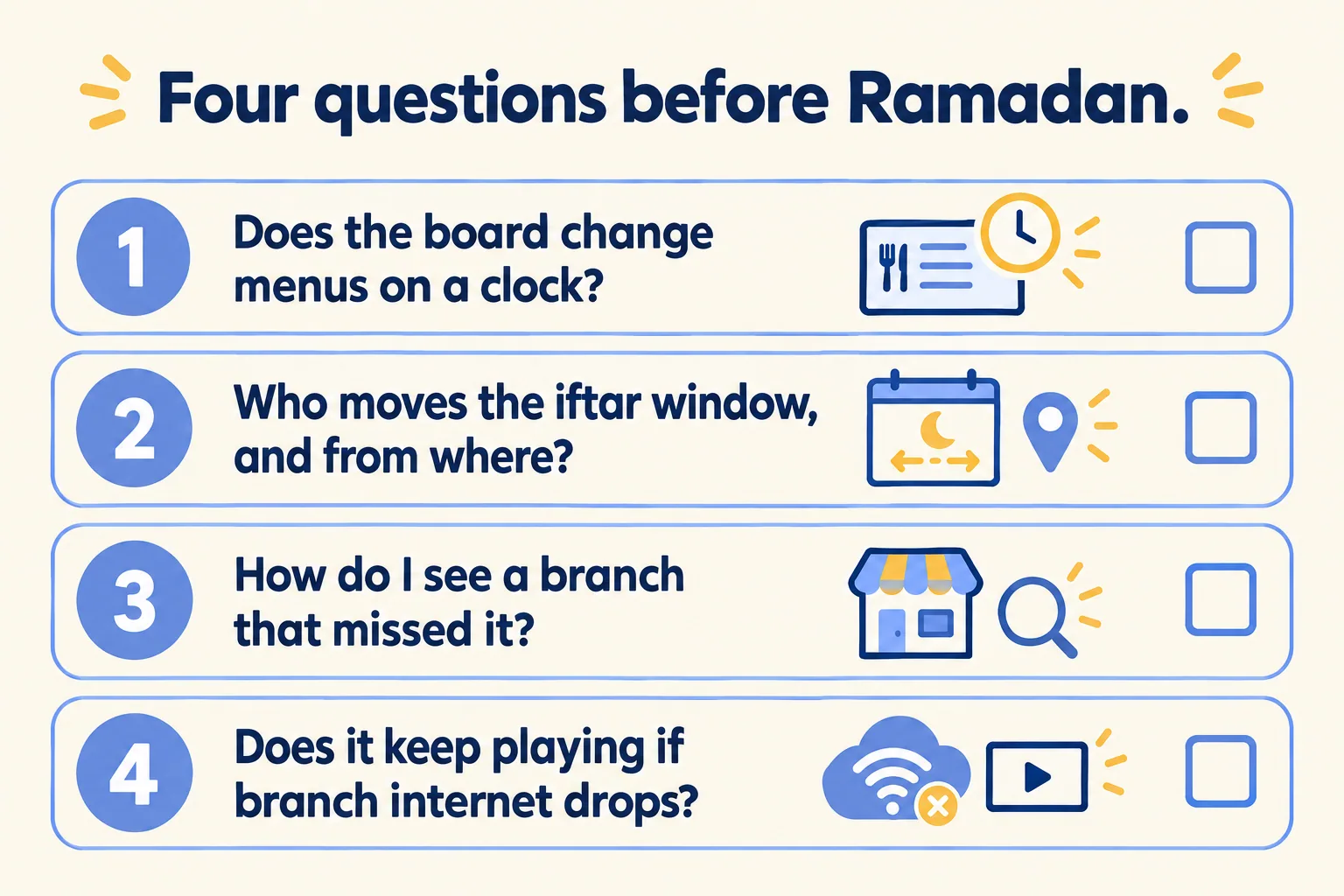
The test is one question. If the sighting moves Ramadan by a day, can you say who changes which screen, by when, and how you would know a branch missed it? If any of the three is "the branch manager, probably", the schedule has no owner yet.
Where you run one branch, the manager who knows the menu may be the owner, and a printed Ramadan menu may still be enough.
Can a menu board switch itself at sunset?
Not every board can. One POS-fed menu board maker's features page says its board "will not switch from a breakfast board to a lunch board on a clock", and that the board requests the menu "every 60 seconds", so a change appears within about a minute of someone making it (page read on 29 October 2026). The refresh is fast. The switch is still an edit a person makes.
So ask before you buy, and again before Ramadan: does the board change menus on a clock, or does someone have to be there at 17:30? A tool that polls every minute is fine. A tool that needs a person in each branch at sunset is the by-hand route with a screen on it.
What did a 300-site chain put in place?
The same case study lists four moves, none of which needs a store visit:
- 01One central server controls the content on every screen in every restaurant.
- 02An annual schedule built ahead for the festive season and promotions.
- 03Each region set up as its own workgroup, so only that region's menu is updated there.
- 04A locked template for specialty stores, so other stores cannot show it by mistake.
At ten branches the same four hold. Enter the calendar ahead, change it in one place, group branches only where prices differ, and lock the templates a branch should not touch. The case study is a supplier's own, so treat it as a pattern, not a result.
How does Mindcat Screens handle iftar and suhoor?
On our page, breakfast, lunch, dinner, iftar and suhoor menus run today as named time windows, and we set yours up in the first week. Ramadan dates are entered ahead and moved after the moon sighting. There is no Hijri calendar, so nothing moves by itself. Change the Iftar window once and every event that uses it moves with it.
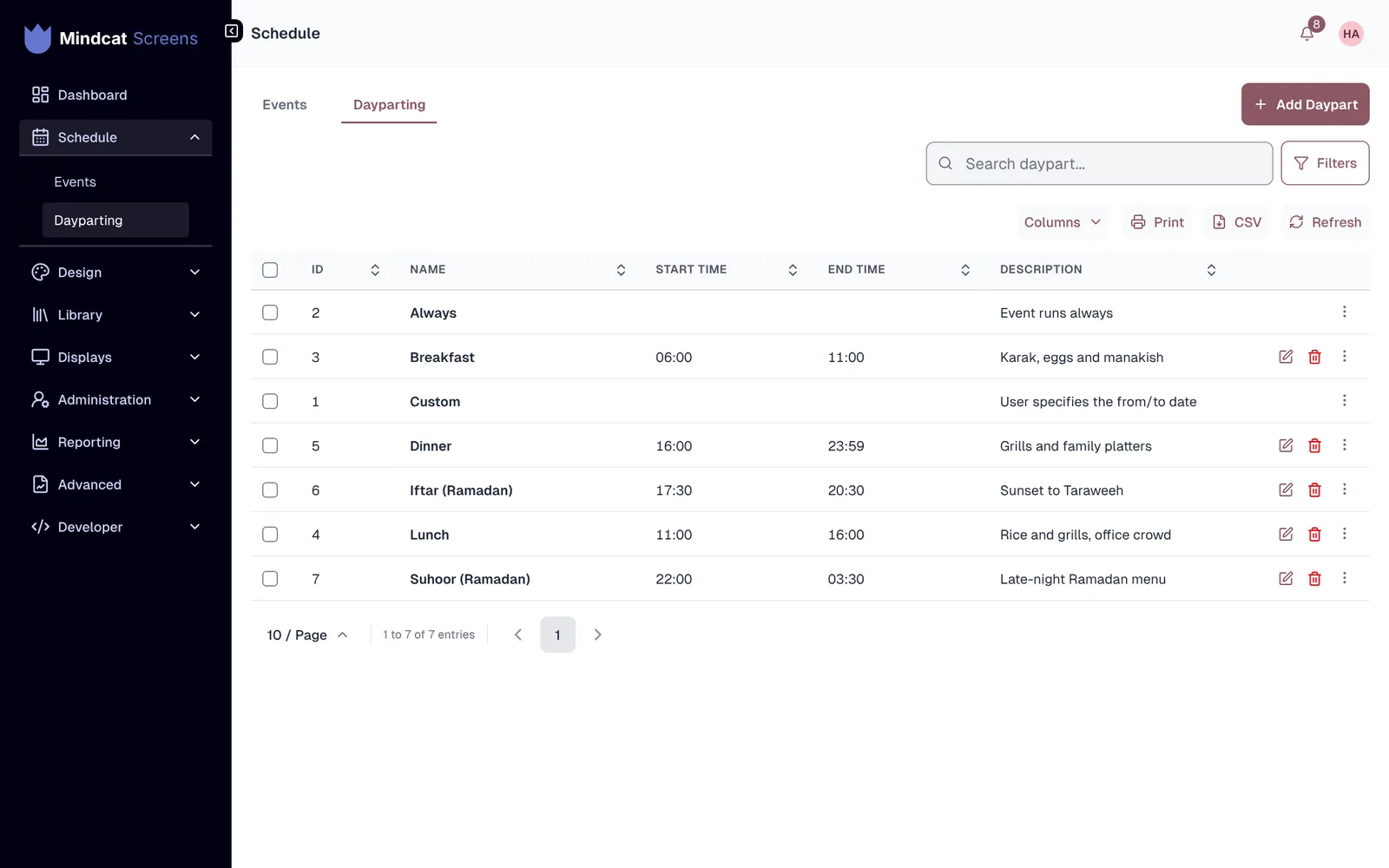
Back-after-prayer screens run on fixed times per city that we load month by month. A live prayer-time feed per city is added during setup. The displays list shows each screen as up to date or out of date, whether it is logged in, its player and the layout it is showing, so a branch that missed the change is one row you can see.
Our price is for the screen: AED 49 a screen a month for screens 1 to 10, AED 35 for 11 to 50, AED 25 for 51 to 200 and AED 19 from 201, the same numbers in SAR. Logins for marketing, operations, branch managers and IT are free. The shared plan has a monthly minimum of AED 590, so no one can buy one screen at the per-screen rate. Twenty-five screens pay 10 × 49 + 15 × 35 = AED 1,015 a month. UAE VAT is 5 percent and Saudi VAT is 15 percent on top.
Up to 10 screens, the quick start is a fixed package we set up for AED 2,500, one time, and it includes a daypart and a Ramadan and prayer schedule template. Player licences for Android, Samsung, LG and ChromeOS screens are paid to the maker, once per screen. Screens, media players, mounts and installation come from your AV installer, or we quote them separately.
What happens in the week of the sighting?
Four steps, in order. Do the first two this year, before the date is confirmed:
- 01Now: name the owner, and write the iftar and suhoor windows as named time windows.
- 02A week before: open the displays list and fix every screen that shows out of date.
- 03The evening of the sighting: the owner confirms the date and moves the window once.
- 04The next morning: the owner opens the displays list and calls any branch not showing the Ramadan layout.
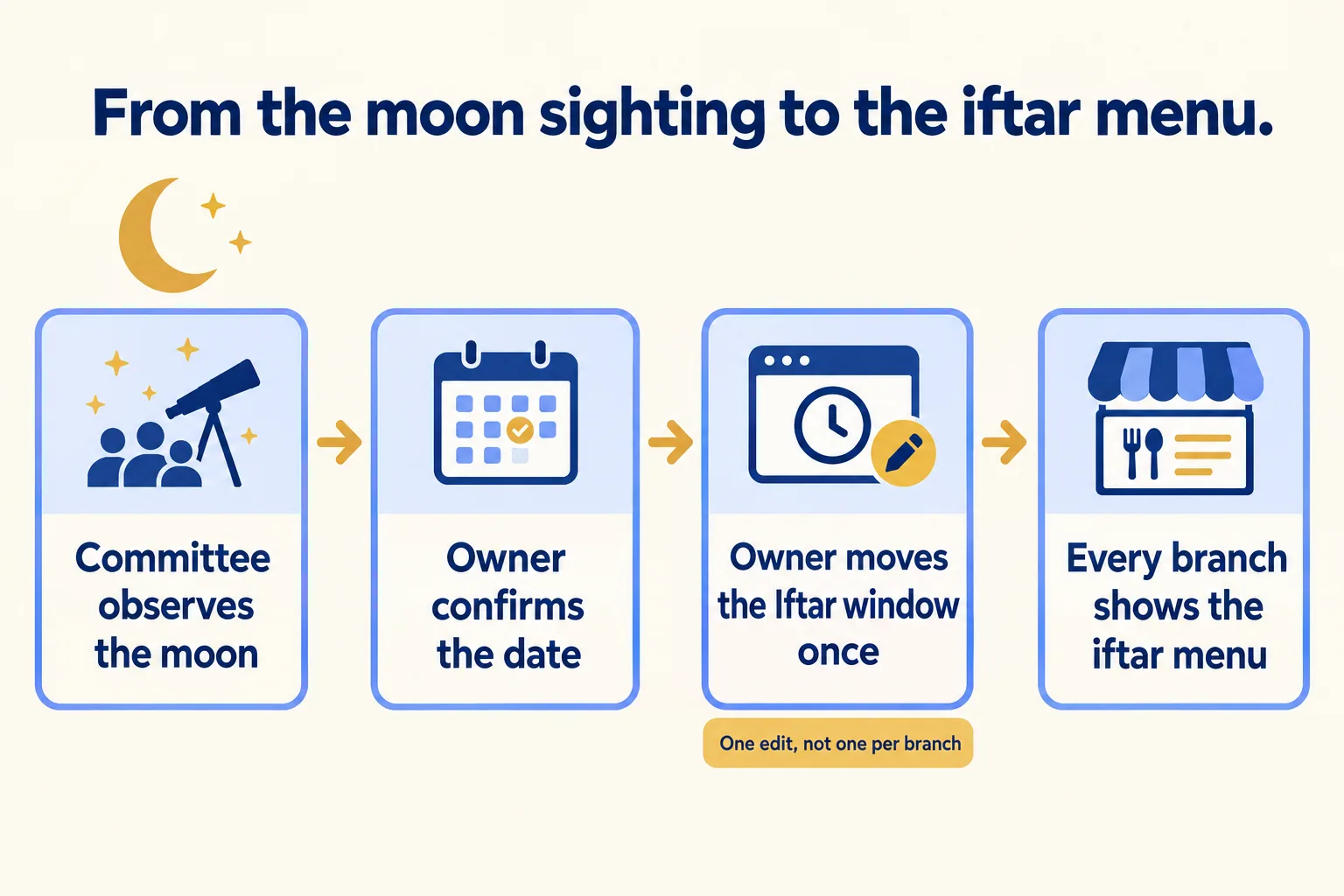
We call the method One edit, every branch. Tell us how many screens you run, in which branches, and what they are today. We reply with the setup plan and the monthly price per screen, in AED or SAR, and we check your screen models in the first call. If you run one branch and your menu changes a few times a year, we say so and point you back to the printed menu. If the player licence line on your installer's quote is the open question, our post on which player runs each screen covers it.
