

If a Thursday price change means branch managers swapping USB sticks over the weekend, this is for you. It is not for a single branch whose menu changes a few times a year: keep the printed menu or one TV.
Which question splits the three options?
Who changes the price on Thursday, and how do you know every branch shows it?
Screens and mounts are a purchase you make once. That question is about the work every week. Say the answer out loud for your chain. If it is "the marketing lead, once, and the screens show it", you are done. If it is "each branch manager, from a stick, and we hear on Sunday", you have a price-change problem that a better screen will not fix.
This is our rule of thumb, not a study. Match your week to the row.
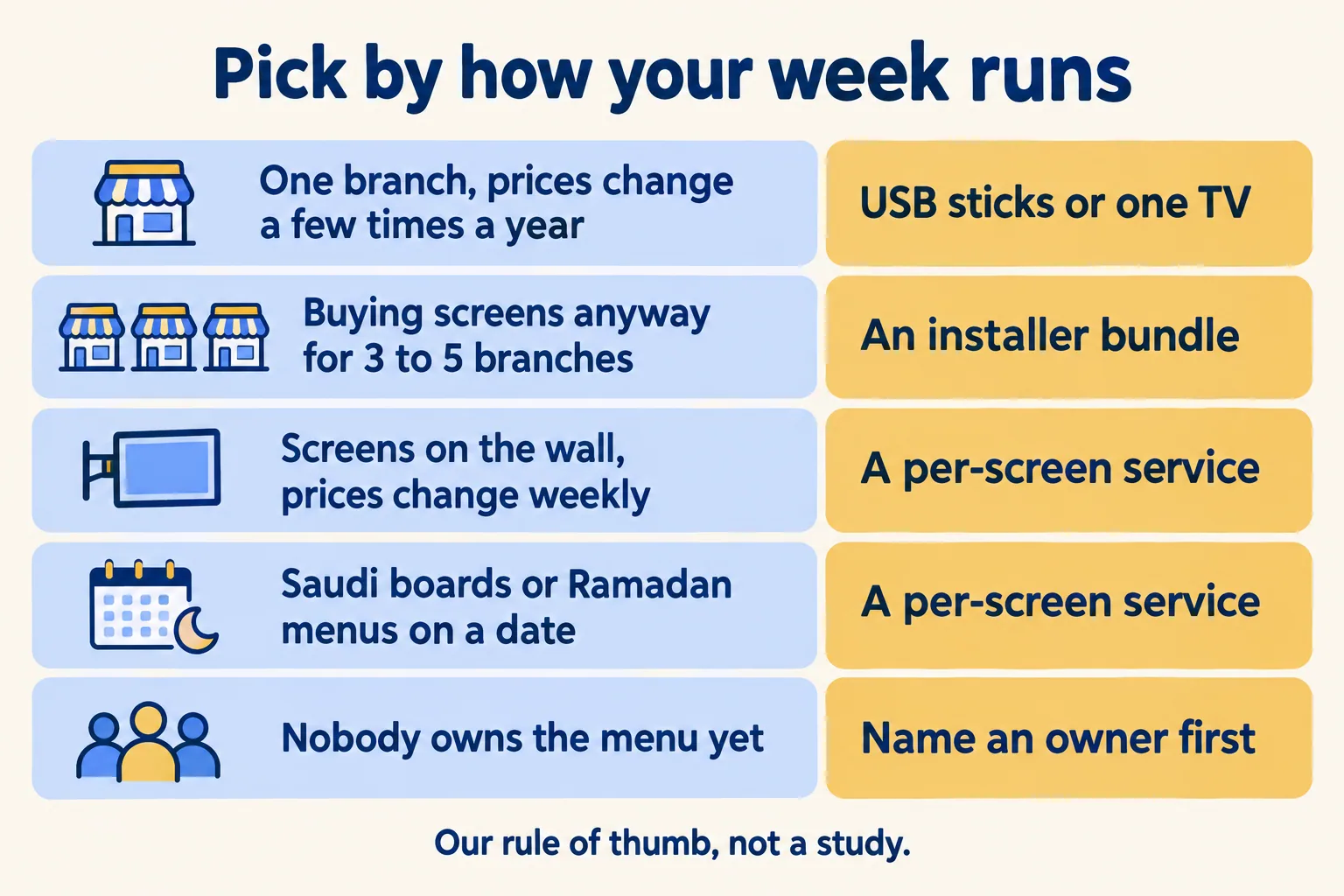
What does an installer's bundle include?
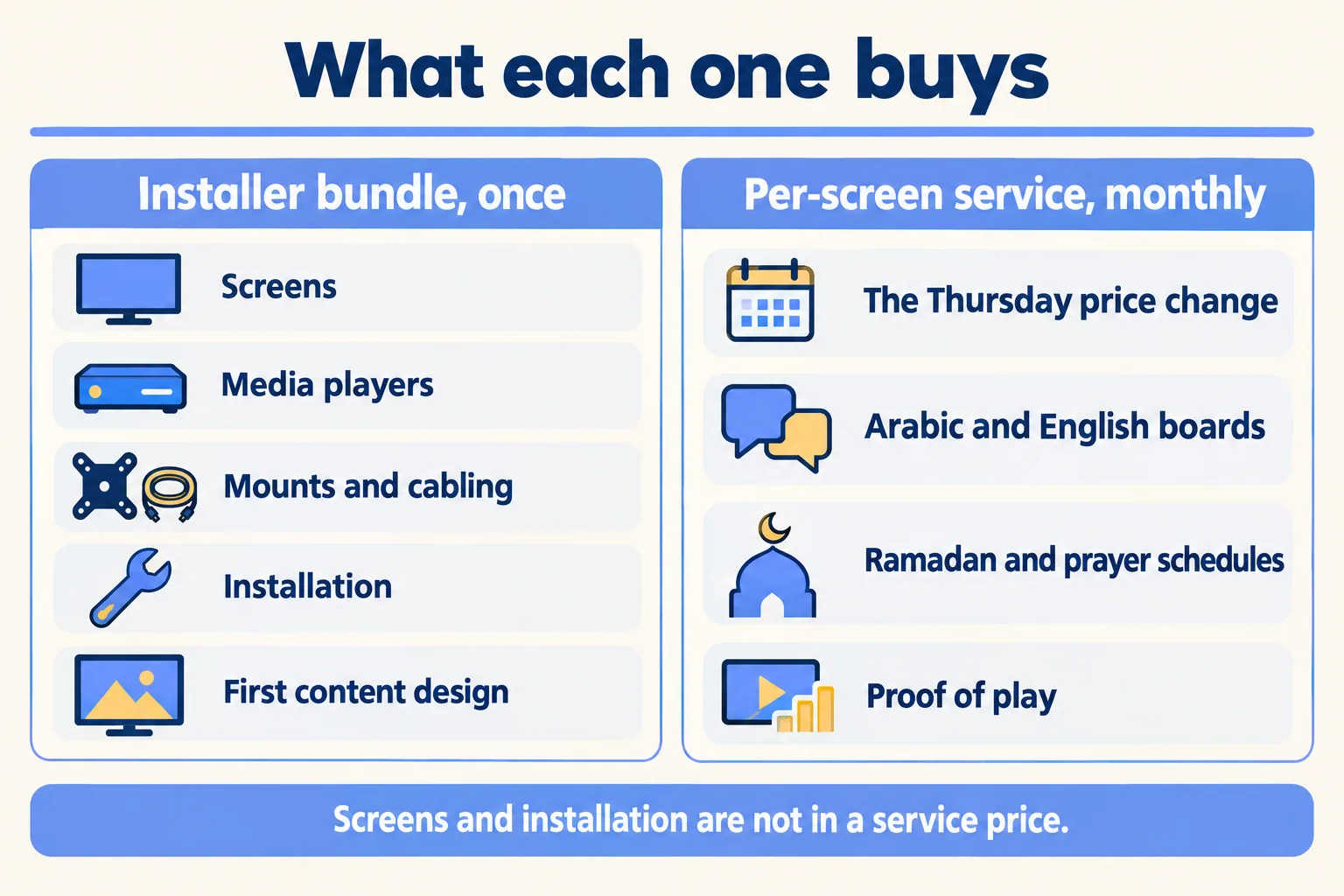
Hardware, and a first design. Cameo Advertising, a Dubai installer, published its ranges in December 2025. For a multi-branch setup of 3 to 5 locations with centralised content management it says AED 30,000 to 60,000. Those ranges include "the screen, media player, mounting hardware, cabling, installation, and initial content design". Content management software, it adds, "varies by provider but typically runs AED 500 to 1,500 per year per screen".
That is one installer's published range, not a market average. Read it as a shape. The bundle buys the things you need once. The software line is a yearly bill per screen, and the page does not say who edits the price on Thursday or what the software does with Arabic or Ramadan.
So when you compare installer quotes, ask in writing: which content software, who builds the Arabic boards, where the content and logs are stored, and who answers when a branch screen goes black on a Thursday night.
When does a per-screen service win?
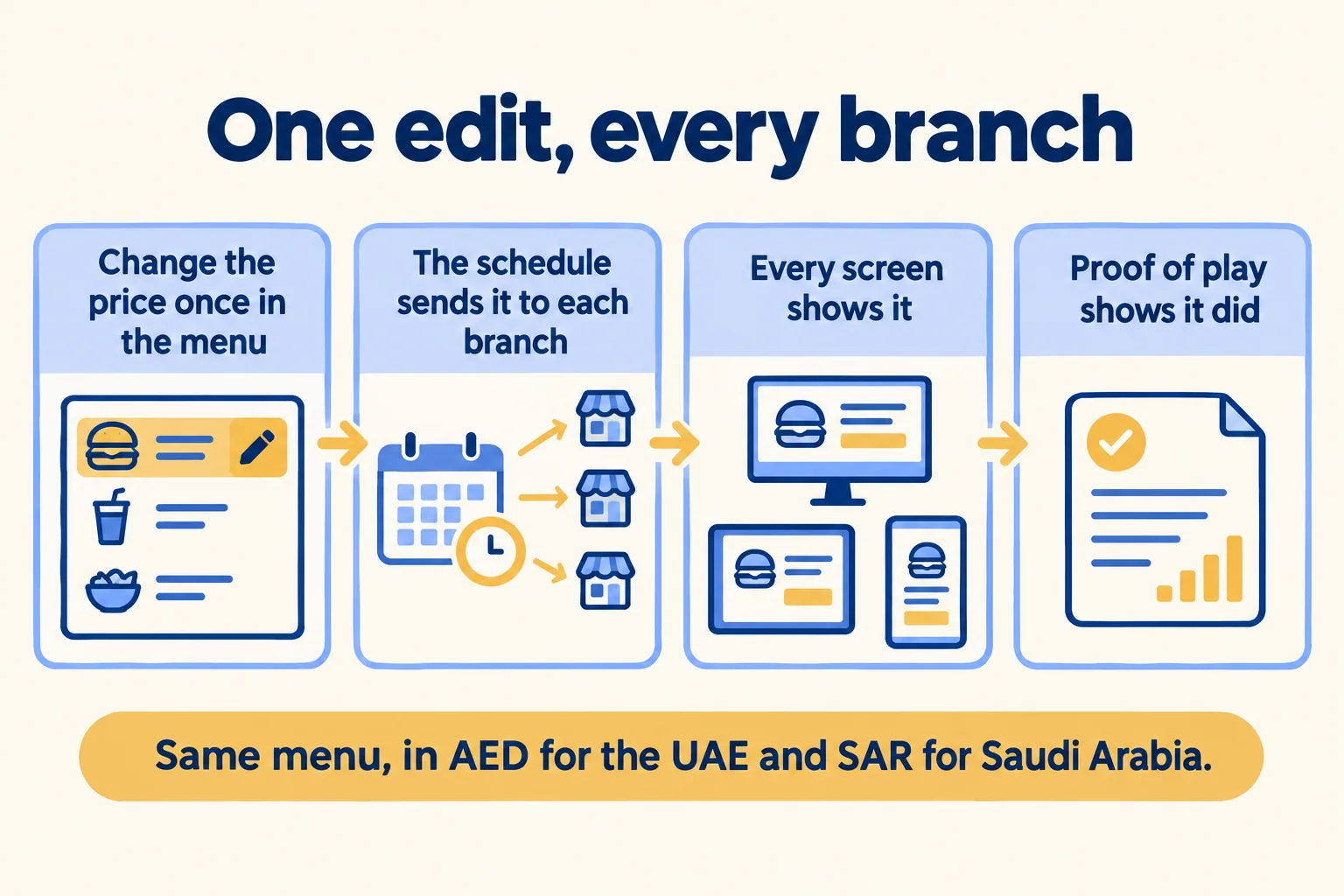
When the screens already exist and the price keeps moving. Mindcat Screens runs on shared servers in the UAE, or as your own copy in Jeddah or Riyadh if your data must stay in Saudi Arabia. It shows Arabic and English. You change Chicken Mandi from AED 42 to 45 once in the UAE menu, and from SAR 42 to 45 in the Saudi one. The screens in each branch follow their schedule.
Before, on our page's sample chain: a grill chain emails a price list on Thursday, branch managers swap sticks over the weekend, and the Olaya branch still shows last week's combo on Sunday. After: one edit in the menu, a schedule that sends it to each branch, and a proof-of-play report that shows what each screen actually played. The page shows these on sample data for a nine-screen grill chain, not a client.
Here is what it leaves out, because it matters as much:
- Screens, media players, mounts and installation come from your AV installer. We give your installer a guide to connect the screens.
- Player licences for Android, Samsung, LG and ChromeOS screens are paid once per screen to the player's maker. We bill them at cost if we order them in your name. The Windows player costs nothing.
- Existing screens: most Android boxes and commercial Samsung and LG screens can run a player, each with its licence. Consumer smart TVs often cannot, and a small player box behind them fixes that. We check your models first.
- A price feed from Foodics or another till is setup work, from 51 screens or as extra work. Until then someone enters prices once in the menu.
- The console your team uses is partly in Arabic today. On the screens in your branches, Arabic runs right to left beside the English.
What does a Saudi branch change?
The menu itself. Since 1 July 2025, the Saudi Food and Drug Authority has required restaurants and cafes to show caffeine content in beverages on paper and electronic menus, in milligrams per 100 ml or per cup. It also requires a Salt icon on items with over 5 grams of salt (2,000 mg sodium). A chain with a Riyadh branch needs a Saudi menu apart from its UAE one, so someone has to redraw the Saudi boards. Ask your installer whether that is in the quote.
On Mindcat Screens, the caffeine line and the Salt icon are added to your Saudi templates during setup. They are not built in on day one. We put the icon on the items you tell us are over 5 grams of salt. Check the rule with the SFDA or your adviser before you set the items.
Ramadan is the same kind of problem. Iftar and suhoor menus run as named time windows, which we set up in your first week. Ramadan dates are entered ahead and moved after the moon sighting. There is no Hijri calendar, so someone on your team still confirms the date.
When do USB sticks still win?
When nothing changes often. For one branch, a TV and a stick cost nothing, and a swap a few times a year is not worth a monthly bill.
The cost shows up when you have five branches and a Thursday price list. Then the work is five people on a weekend and a check on Sunday that nobody does. If your weekend swap is already breaking, move to a service; if it is not, keep the stick.
What would 25 screens cost each way?
These are different things, so do not subtract one from the other. Both prices exclude VAT.
The software line is the fair comparison. On that installer's range, 25 screens would be AED 12,500 to 37,500 a year. On our price list the same 25 screens are AED 12,180 a year. The bundle also gave you the screens. We did not, and we say so above.
The per-screen price comes with a monthly minimum, so no one can buy a few screens at the per-screen rate. On the shared plan the minimum is AED 590 a month, which covers up to 12 screens. A chain with 9 screens pays AED 590 a month, AED 7,080 a year, plus the quick start: a fixed package we set up for AED 2,500 one time, for up to 10 screens. UAE VAT is 5 percent and Saudi VAT is 15 percent on top.
Weigh that against what a Thursday costs you now: the drives, the weekend hours, the branch that opens on Sunday with the wrong price. We will not put a number on that for you. Only your branches can.
What happens in the first working session?
We call the method One edit, every branch. You send how many screens you run, in which branches, and how content reaches them today. We reply with the setup plan and the monthly price per screen, in AED or SAR. Up to 10 screens, we send the payment link within 24 hours, then a spreadsheet template for your branches and screens, guides and recorded training in Arabic and English. Your installer connects the screens with our guide, and the go-live date counts from the day your spreadsheet arrives. From 11 screens, we start with one call with your operations or marketing lead. If you have one branch and your menu changes a few times a year, we will say so and point you back to the stick. If the Thursday change is what breaks, tell us your screen count and we start from it. Restaurants and cafe chains can see how that looks on our restaurants and cafes page.
