

If your clinic sends insurance claims every week and a new record system would have to send them too, this is for you. It is not for a clinic that treats self-pay patients only, and it is not for a clinic whose current system already sends its claims and works. If you need the insurer connection live on day one, the checks below are yours, and Mindcat Clinic is not the right choice yet.
Why can NPHIES decide a clinic's switch?
Because it is where insured visits are paid. NPHIES is the National Platform for Health Information Exchange Services. Its implementation guide calls it a single point of contact for providers, insurers and third-party administrators (TPAs), and it says what that covers today:
"Currently all of the private insurers and/or their TPAs and most of the 6,600 regulated provider organizations exchange all of their eClaims transactions via the nphies system."
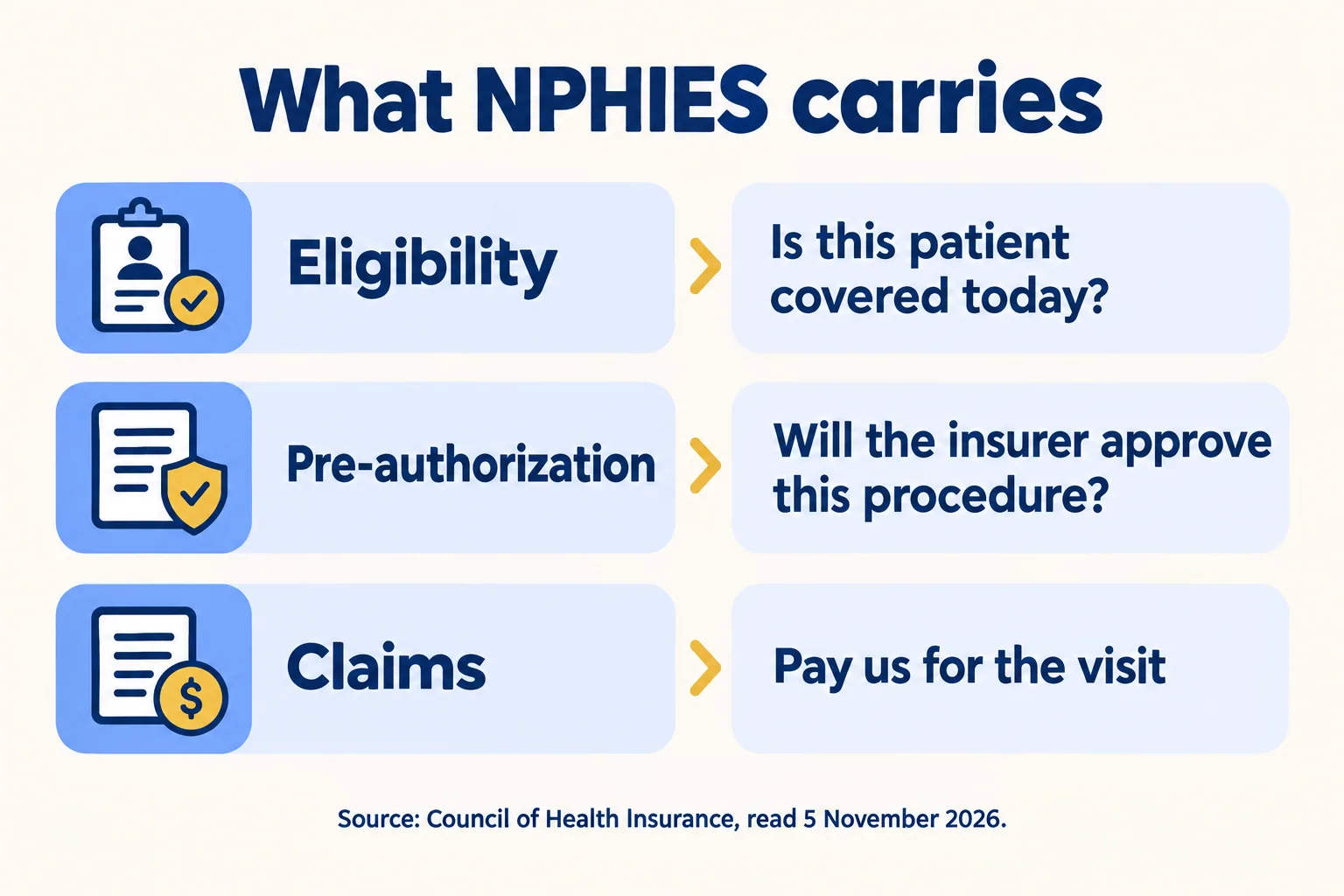
The Council of Health Insurance names the three services: eligibility, pre-authorization and financial claims. A clinic checks that the patient is covered, asks the insurer to approve a procedure, then submits the claim. If your next system cannot send those three messages, your billing desk goes back to portals and phone calls.
The Council's onboarding page also says why this reaches providers. It states that its implementing regulations require payers and providers to meet the electronic transaction controls it adopts, as a condition of their approval or accreditation. Whether that binds your clinic depends on your accreditation and your insurer contracts, so ask the Council or your insurers in writing.
What does a connected system still leave to you?
More than the vendor's badge suggests. The guide is clear that NPHIES does not provide a practice management system for providers. It offers a simple claims entry screen "until they acquire a proper healthcare information management system". The system you pick is that system.
Bonami, a software vendor, publishes a readiness checklist (12 October 2026). Its registration list is four items: the NPHIES Academy certificate, your facility's NPHIES ID, a stamped authorized person form and a copy of that person's ID. It also says you can connect through a system whose vendor has already integrated, or build a direct integration, and it lists the common mistake of assuming the vendor has covered everything:
"An integrated system handles messages. It does not clean your data, map your codes or train your staff."
So a switch also moves three jobs: who maps your service and diagnosis codes, who trains the billing desk, and who watches the answers that come back. For a clinic of 3 to 15 practitioners, that is usually one person at the front desk. Decide who before you sign.
What do you ask a vendor in writing?
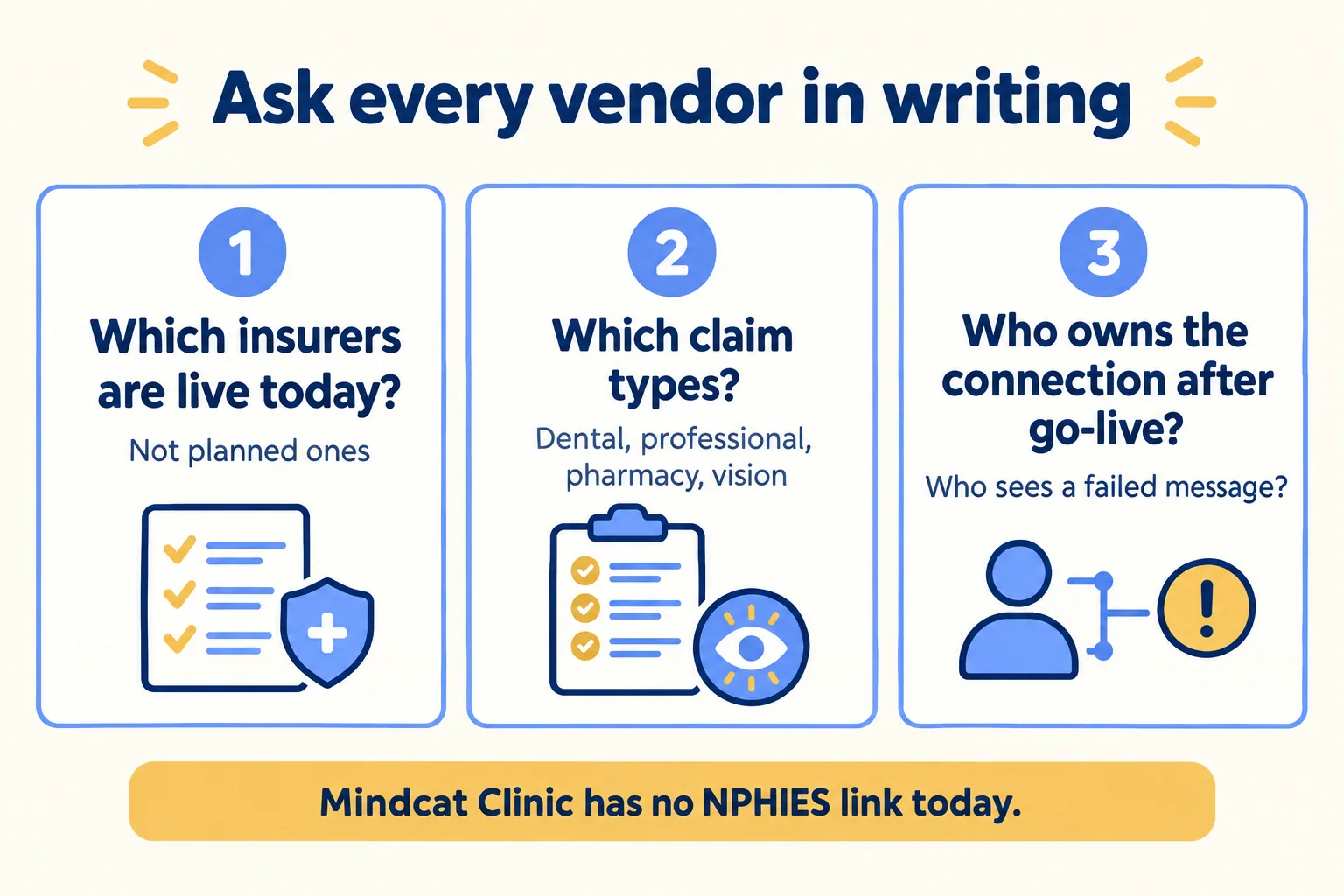
Three questions, answered in writing before you scope any move:
- Which insurers are live? Ask for the list of insurers and TPAs the vendor sends to in production today, not the ones it plans to add.
- Which claim types? The guide lists five: institutional, professional, pharmacy, dental and vision. A dental group needs dental claims. A skin clinic needs professional ones.
- Who owns the connection after go-live? When a message fails, who sees it, who fixes it and how fast. Ask for the name of a clinic with your licence type that connects through the vendor, and for permission to call it.
What does a rejection mean for your billing desk?
A second job. The guide says nphies validates each claim and forwards it to the insurer. The answer is an approval, a denial or a request for more information, and the insurer may take time to give it. A delayed answer is stored on nphies for the provider, who retrieves it by polling. Claims also cannot be edited once sent: to change one, you cancel it and submit a new claim.
A system that only prints a claim form for the desk to send does not do that work. Ask each vendor to show you a rejected claim and a delayed answer on screen, and to show who on your team is told about each.
When do we say wait?
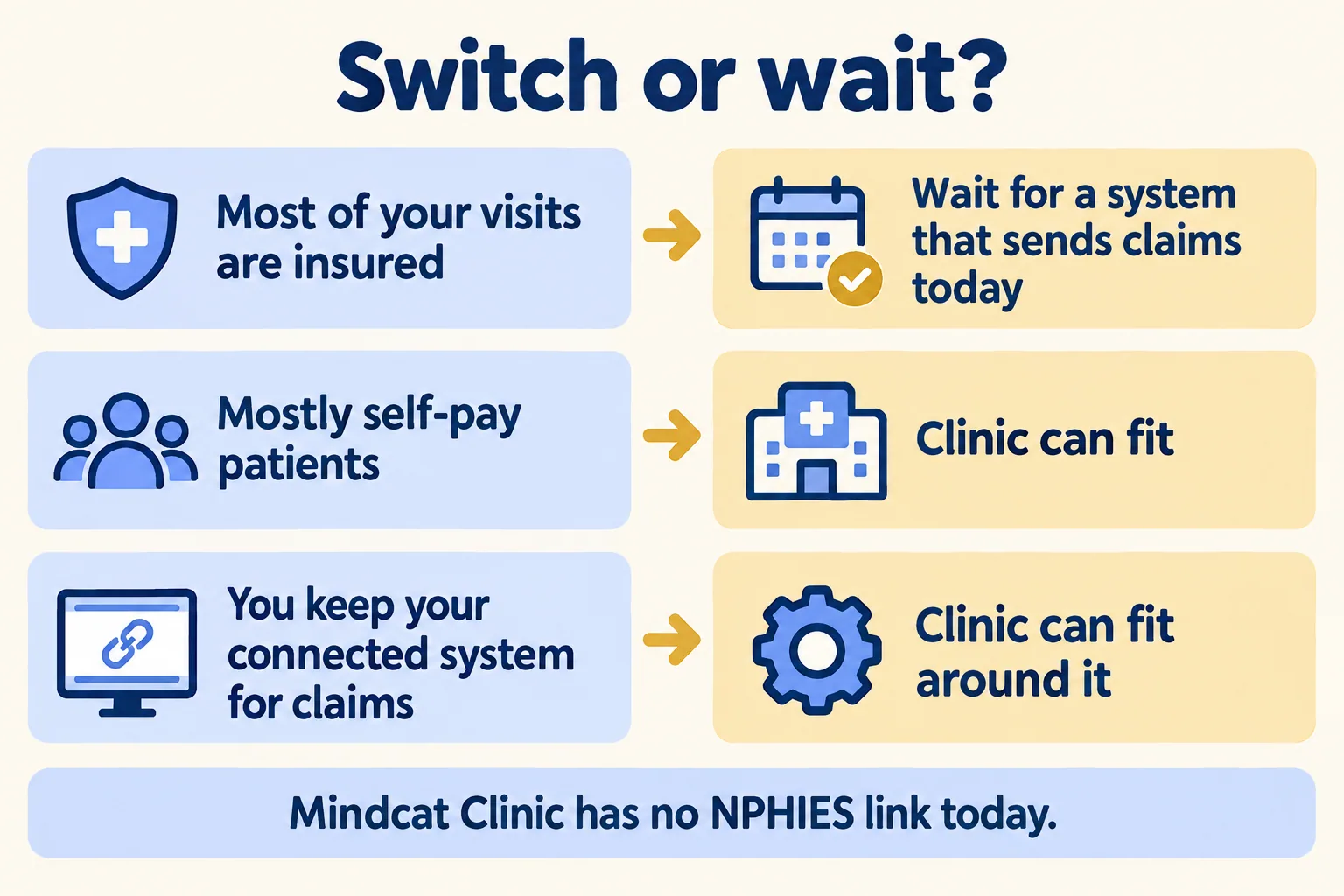
When most of your visits are insured and you need the connection live from the first day. Mindcat Clinic has no NPHIES link today. Our page says it in its table of what Gulf clinics need and in the FAQ: eligibility checks and claims are not in any plan today, a connection would be a separate project quoted once the scope is confirmed, and if your licence needs one before you switch, we are not the right choice yet. No date exists for it, so a clinic that needs the connection should pick a vendor that sends claims today.
If you are in that group, use the wait:
- Ask your insurers which of them you send to through NPHIES today, and which claim types.
- Find out which of your current vendor's services you rely on, before you scope any move.
- Ask each vendor the three questions above, and write down the answers.
- Ask the Council of Health Insurance what applies to your accreditation. We cannot answer it for you.
Clinics in the UAE answer to different exchanges. We cover them in our posts on switching clinic records and NABIDH, Malaffi and Riayati.
Who does Mindcat Clinic fit, and what does it cost?
It fits a clinic that treats mostly self-pay patients and wants one record across branches. Our Clinic is aimed first at Saudi Arabia. What it gives you today: one patient record across branches, a log of who opened each record, a standard health-records API (FHIR), a full export of your data, and your copy set up on servers in the Kingdom. Patient details and allergies come across from your CSV files; old visit notes do not. Not today: NPHIES eligibility and claims, a ZATCA e-invoicing system, a card terminal connection, and finished Arabic screens (about half are translated).
For one dentist with no insurance work, our page says a local app at SAR 199 costs less than we do. We fit the group that wants one record across branches, with its data kept in its own country.
The bands are graduated: the first 5 practitioners cost SAR 249 each and the next ones SAR 179. A group of 6 pays 5 × 249 + 179 = SAR 1,424 a month, and a group of 10 pays 5 × 249 + 5 × 179 = SAR 2,140. Our page prices each practitioner a month, in bands: SAR 249 for 1 to 5 practitioners, SAR 179 for 6 to 15, SAR 119 for 16 to 40 and SAR 89 from 41. Reception, clinic manager, billing and owner logins are free.
The price comes with a monthly minimum, so no one can buy one practitioner at the per-practitioner rate: the shared plan minimum is SAR 890 a month, which covers up to 3 practitioners. Up to 5 practitioners, the quick start is a fixed package we set up for SAR 2,500 one time; from 6 practitioners we set it up to a written plan with a go-live date. SMS and email reminder fees and your e-invoicing provider are billed at cost. Prices exclude 15 percent Saudi VAT.
A clinic that only needs patients to pick their own slots wants Mindcat Bookings; this post is about the record.
You tell us your accreditation, how many practitioners and branches you run, how many visits are insured and what you use today. We reply with the setup plan and the price per practitioner. If most of your visits are insured and you need NPHIES first, we say wait. If not, tell us about your clinic and we start there.
