A maintenance coordinator in a Dubai property office reads a tenant repair request on her phone as a technician waits.

Vercel · Agent stack

Every model change means a rewrite. Write the feature once and swap the model in one line.

Your team wired one chatbot to one provider. Then the price changes, a better model ships, or the provider has a bad week, and the code has to come apart. The AI SDK is one TypeScript library for text, structured answers, tool calls and agents. The model is a single string. Change it and the rest of your code stays as it is.

Salesforce consulting partner since 2010 · MVP Hall of Fame · 200+ agents in production · UAE, India and US desks

The problem

Where an AI feature gets stuck today.

What AI SDK is

AI SDK, in plain words.

Facts from Vercel’s own pages, checked on 16 October 2026. The sources are at the end of this page.

What it is
An open-source TypeScript library for AI apps and agents, under the Apache-2.0 licence. Version 7 shipped on 25 June 2026.
Where it runs
React, Next.js, Vue, Svelte, Node.js and more. Version 7 needs Node.js 22 or later and ESM imports; CommonJS require() is not supported.
Three parts
Core for text, structured objects, tool calls and agents. UI for chat hooks. Harnesses for running coding agents such as Claude Code and Codex.
Changing models
Vercel’s page says you switch providers with one line of code, with streaming and built-in fallbacks. It works with AI Gateway.
New in version 7
Tool approvals, durable WorkflowAgent runs, sandbox support and OpenTelemetry. Realtime voice and video generation are marked experimental.
What it costs
The library is free and open source. You pay for the models you call, through the provider or AI Gateway.


How it works

From a customer’s question to a checked answer.

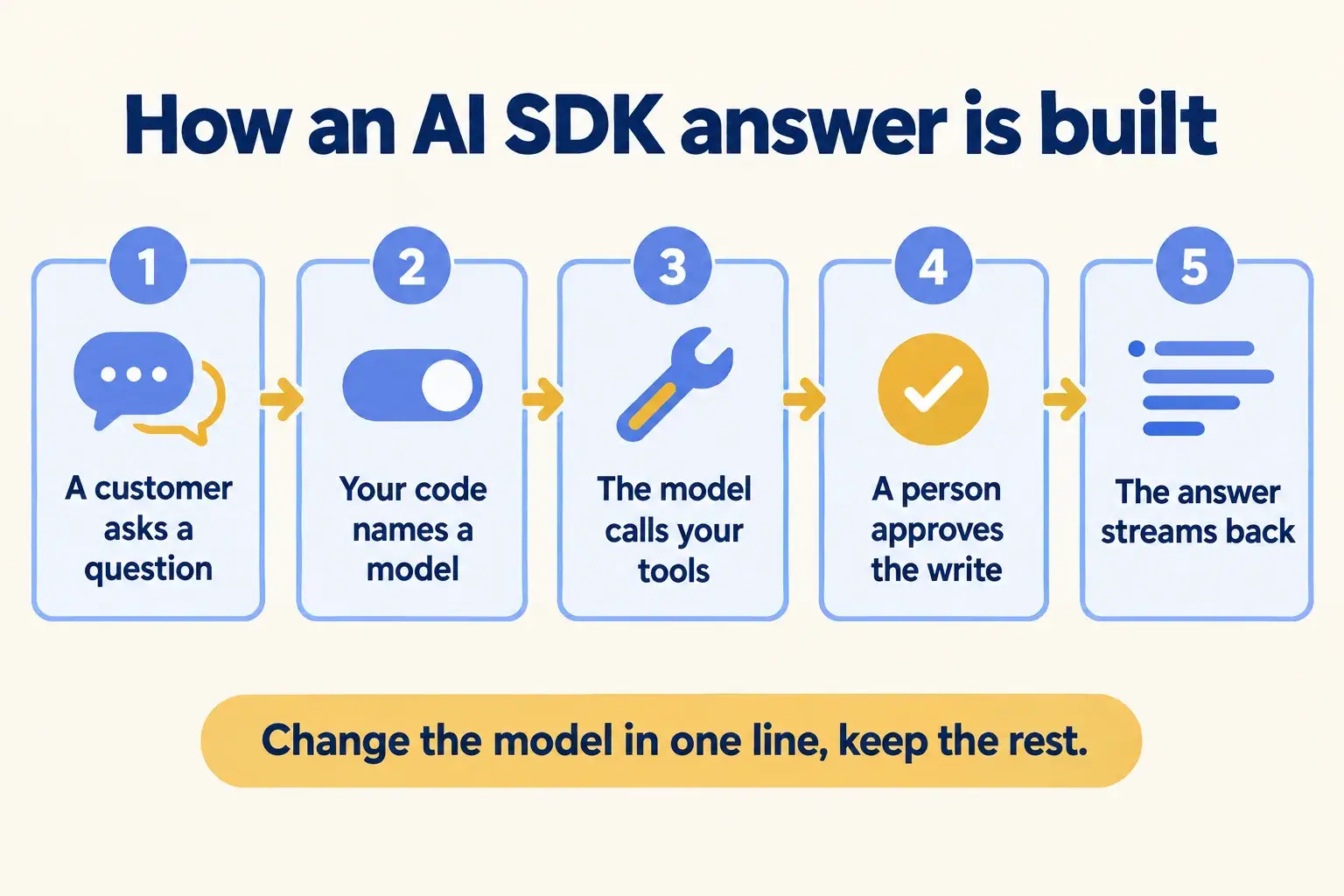
Five steps. You can swap the model at step two without touching the rest, and no record changes until a person says yes.

Five steps: a customer asks, your code names a model, the model calls your tools, a person approves, the answer streams back.

Infographic

The same steps are written out below.

Step by step

What happens at each step.

  1. Ask

    A customer asks a question

    On the website chat, or in a WhatsApp message your app receives.

  2. Model

    Your code names a model

    One string with the provider and model name. It resolves through the provider or through AI Gateway.

  3. Tools

    The model calls your tools

    It looks up the unit, the order or the ticket, and returns a structured object your code checks field by field.

  4. Approve

    A person approves the write

    Tool approvals hold an action, such as creating a Salesforce case, until someone confirms it.

  5. Stream

    The answer streams back

    UI hooks show the reply as it is written, in React, Vue or Svelte.

How it fits together

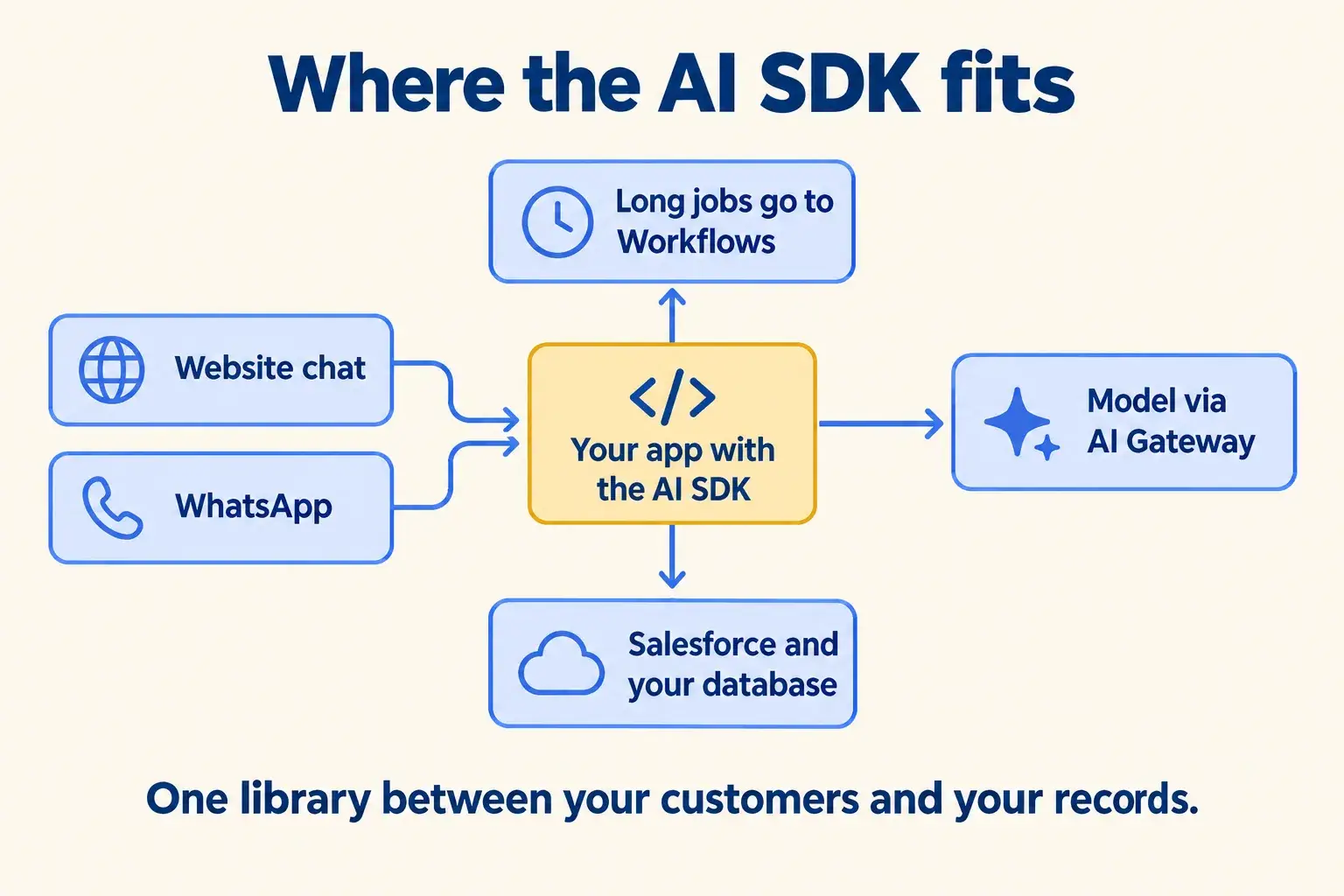
Where the AI SDK sits between your customers and your records.

Customers write on your website or on WhatsApp. Your app uses the AI SDK to call a model, through AI Gateway or the provider. Tools read and write Salesforce or your database, and long jobs hand off to Workflows.

Website and WhatsApp messages reach your app, which calls a model, uses tools on Salesforce and hands long jobs to Workflows.

Infographic

Where it sits next to the systems you run today.

Use cases · worked examples

One worked example in each industry.

How AI SDK fits into the work of the industries we serve, one step at a time.

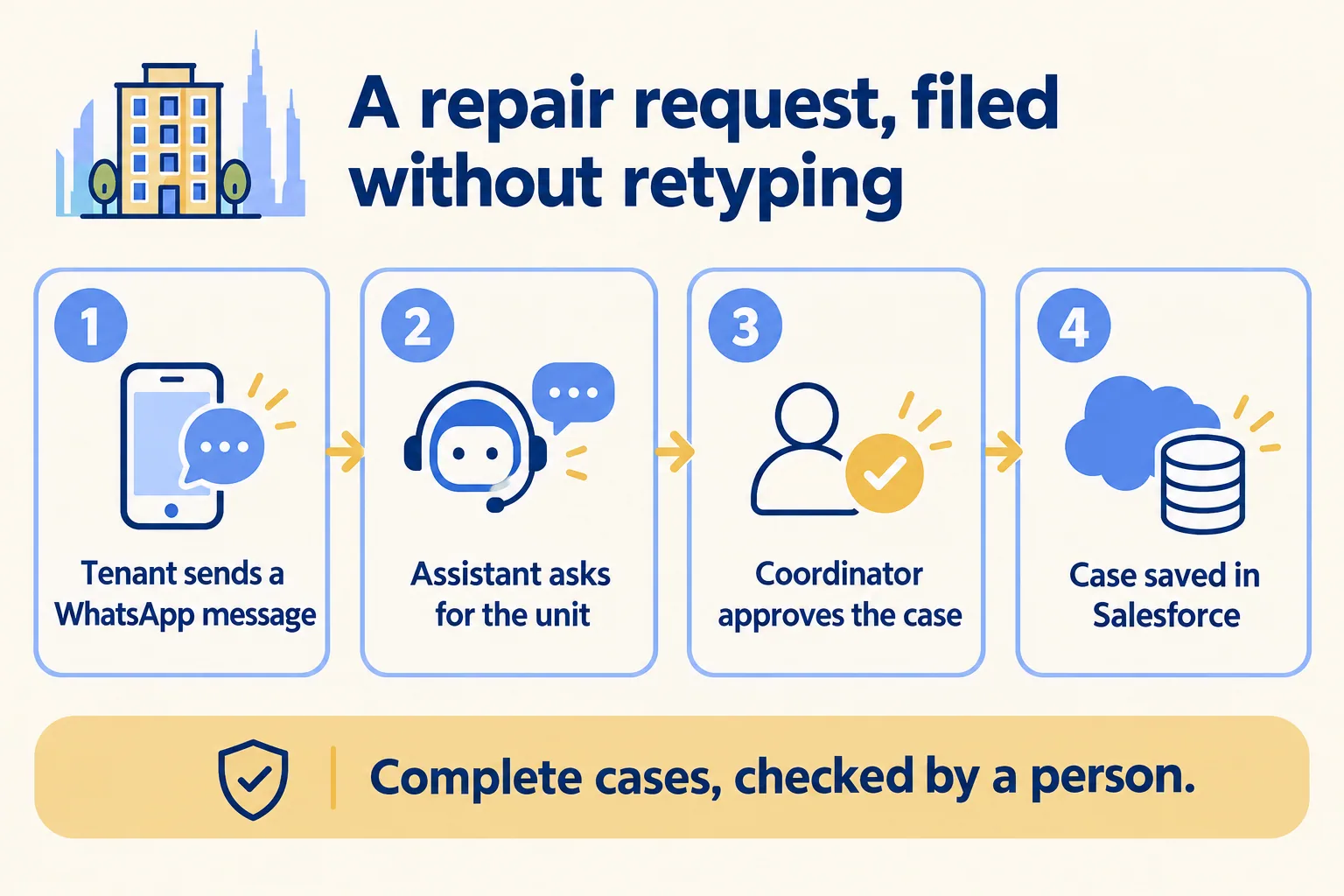
  1. A tenant’s WhatsApp repair request is completed by the assistant, approved by the coordinator and saved in Salesforce.

    Example 1 · Property management, Dubai · Infographic

    Maintenance coordinator at a Dubai property management company

    Today: Tenants send repair requests on WhatsApp with a photo and two words. I retype each one into Salesforce, and half of them have no unit number.

    After: An assistant built on the AI SDK reads each message, asks for whatever is missing and fills a structured case. The coordinator approves it before the case is created in Salesforce.

    Worked example, step by step

    1. 08:12Tenant. Sends a WhatsApp message: AC leaking in the bedroom, with a photo.
    2. 08:12Assistant. Asks for the building and unit number, because the message has neither.
    3. 08:15Tenant. Replies: Tower B, 1204.
    4. 08:15Assistant. Fills a case object with unit, issue type, urgency and photo. The code checks every field against the schema.
    5. 08:30Coordinator. Reviews the draft and approves it. The case is created in Salesforce on the unit’s record.
    6. 08:31Tenant. Gets a WhatsApp reply with the case number.

    Every repair request reaches Salesforce complete, and the coordinator checks and approves instead of retyping.

    Property management
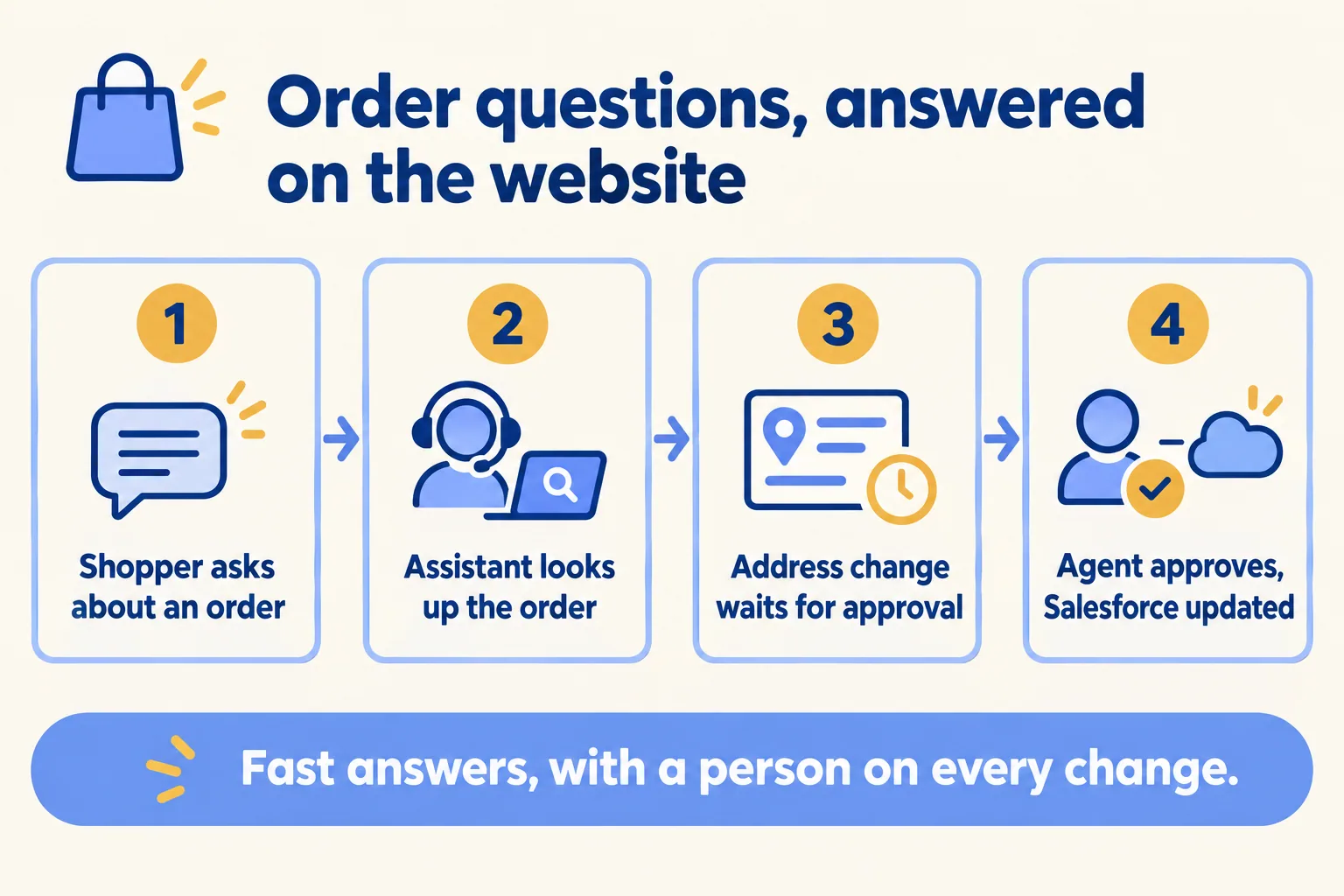
  2. A shopper’s order question is answered on the website chat; an address change waits for an agent to approve it.

    Example 2 · Retail and e-commerce, Bengaluru · Infographic

    Customer care lead at a Bengaluru online fashion store

    Today: “Where is my order” is most of our chat. My agents copy the order number into three screens to answer one question.

    After: The website chat uses AI SDK tools to look up the order in the store database and streams the answer as it is written. Address changes and refunds wait for an agent to approve.

    Worked example, step by step

    1. 19:02Shopper. Asks on the website chat where order 48213 is.
    2. 19:02Assistant. Calls the order lookup tool against the store database.
    3. 19:02Assistant. Streams the answer: shipped yesterday, with the courier’s tracking link.
    4. 19:04Shopper. Asks to change the delivery address.
    5. 19:04Assistant. Prepares the change and holds it, because it writes to the order.
    6. 19:10Care agent. Approves. The order updates, and the chat is logged on the contact in Salesforce.

    Shoppers get order answers on the spot, and an agent still signs off every change to an order.

    Retail and e-commerce
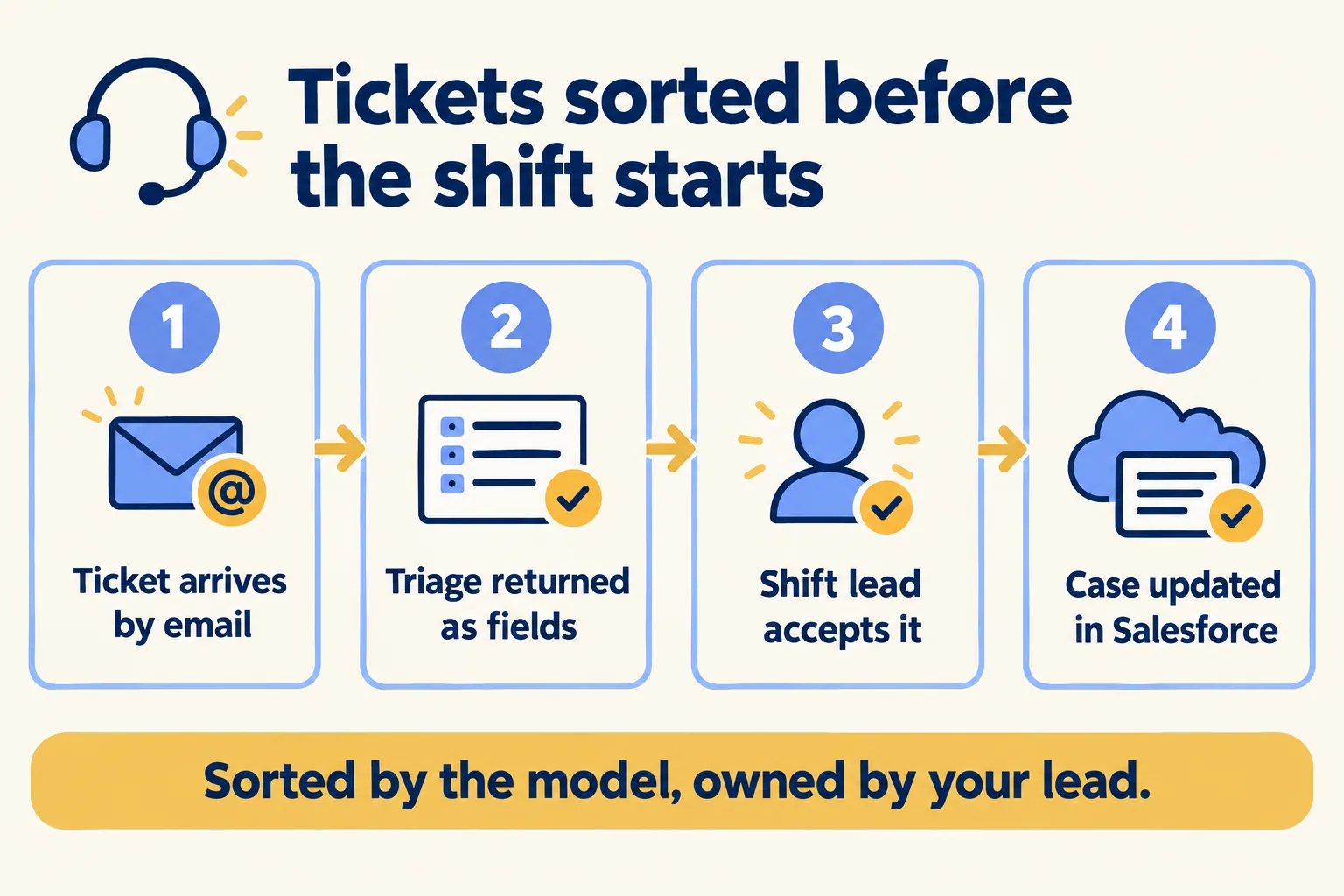
  3. An emailed ticket is triaged into fields, accepted by the shift lead and updated on the Salesforce case.

    Example 3 · IT service desk, Austin · Infographic

    Service desk manager at an Austin managed IT provider

    Today: Tickets arrive by email with subjects like “urgent!!”. My team spends the first hour of every shift sorting them.

    After: Each new ticket goes through the AI SDK, which returns a structured triage: category, priority, site and a likely fix. The shift lead accepts or changes it before the Salesforce case updates.

    Worked example, step by step

    1. 07:00Customer. Emails: “urgent!! nobody can print in the Dallas office”.
    2. 07:01App. Sends the ticket to the model with a schema: category, priority, site, suggested fix.
    3. 07:01Model. Returns Printing, P2, Dallas office, restart the print queue.
    4. 07:20Shift lead. Accepts the triage. The Salesforce case updates with category and priority.
    5. 07:40Engineer. Works the case with the suggested fix already on screen.
    6. Week 2Team. Tries a second model on the same tickets by changing one string, and compares the results.

    The shift starts with sorted tickets, and the lead still owns every priority.

    IT service desks
Examples of the work, not client stories. Times in each example show the order of events, not a measured result.

Is it for you

When AI SDK fits, and when it doesn’t.

Good fit

Not for you yet

Your team writes TypeScript or JavaScript
Your app is Python only
You want to try more than one model without a rewrite
You run Node.js 18 or 20 and cannot upgrade
The agent needs tools that read and write your systems
You want a hosted product with an SLA: this is a library
Some actions must wait for a person to approve them
Realtime voice is the first thing you need: it is still experimental

What Mindcat does

We build it, then we run it.

The assessment is free: a short read of the org and a written note. If you go ahead, the first build week is a fixed AED/SAR 14,900 (about USD 4,050), credited in full when you sign the build within 60 days. After go-live, we keep it patched, watched and changing every month.

FAQ

What teams ask about AI SDK.

Is the AI SDK a hosted service?
No. It is an open-source library under Apache-2.0 that runs inside your own app. It has no price and no SLA of its own. You pay for the models you call and for wherever the app is hosted.
Does our app have to run on Vercel?
No. It is a library for React, Next.js, Vue, Svelte and Node.js, so it runs where your app runs, on Node.js 22 or later. On Vercel it pairs with AI Gateway, Sandbox and Workflows.
Can it keep our data in the UAE?
The library has no region of its own. Where data goes depends on where you host the app and which model endpoint you call. Vercel has no compute region in the UAE or Saudi Arabia; Mumbai is the closest. We confirm the data path per project before you sign.
Can a person approve what the agent does?
Yes. Version 7 added tool approvals, so a call such as creating a case or sending a message can wait for someone to confirm it. We agree with you which calls need that before we build.
Is voice ready?
Text, structured answers and tool calls are the stable core. In version 7, realtime voice and video generation are marked experimental, so we do not put a customer line on them yet.

Sources

Where these facts come from.

Start here

Tell us what you want built, and where it runs today.

One or two lines is enough. You hear back within 24 hours from the person who signs the work.

Where are you?

Salesforce consulting partner since 2010 · MVP Hall of Fame · 200+ agents in production · UAE, India and US desks