A courier service supervisor in Saudi Arabia answers customer messages on a phone as drivers load vans behind her.

Vercel · Agent stack

A provider has a bad hour and your agent goes quiet. Send every model call through one gateway that fails over.

Each team signed up with its own model provider. The keys live in five places, the bills arrive on five cards, and when one provider slows down the customer chat stops. AI Gateway puts hundreds of models behind one API key. When a provider degrades, it sends the request to the same model on another provider, and it turns away new requests once a budget is spent.

Salesforce consulting partner since 2010 · MVP Hall of Fame · 200+ agents in production · UAE, India and US desks

The problem

Where model calls go wrong today.

What AI Gateway is

AI Gateway, in plain words.

Facts from Vercel’s own pages, checked on 16 October 2026. The sources are at the end of this page.

What it is
One API for hundreds of models from many providers: text, image, video and audio. Generally available since August 2025, on all plans.
Token prices
Vercel says it adds no markup to provider token prices, including when you bring your own keys. Some add-ons and card processing fees are charged.
Works from anywhere
Your app does not need to run on Vercel. It accepts OpenAI and Anthropic request formats, and Vercel says moving is usually a base URL swap.
Failover
If a provider degrades, the request goes to the same model on another provider. You can also set your own order of fallback models.
Budgets
Per team, project, API key or team member. They are soft caps, and spend on your own provider keys does not count toward them.
Privacy and region
Prompts and responses are deleted after each request by default. Inference can be pinned to the US or the EU; there is no UAE, Saudi or India zone.

How it works

From one model call to an answer, even when a provider is down.

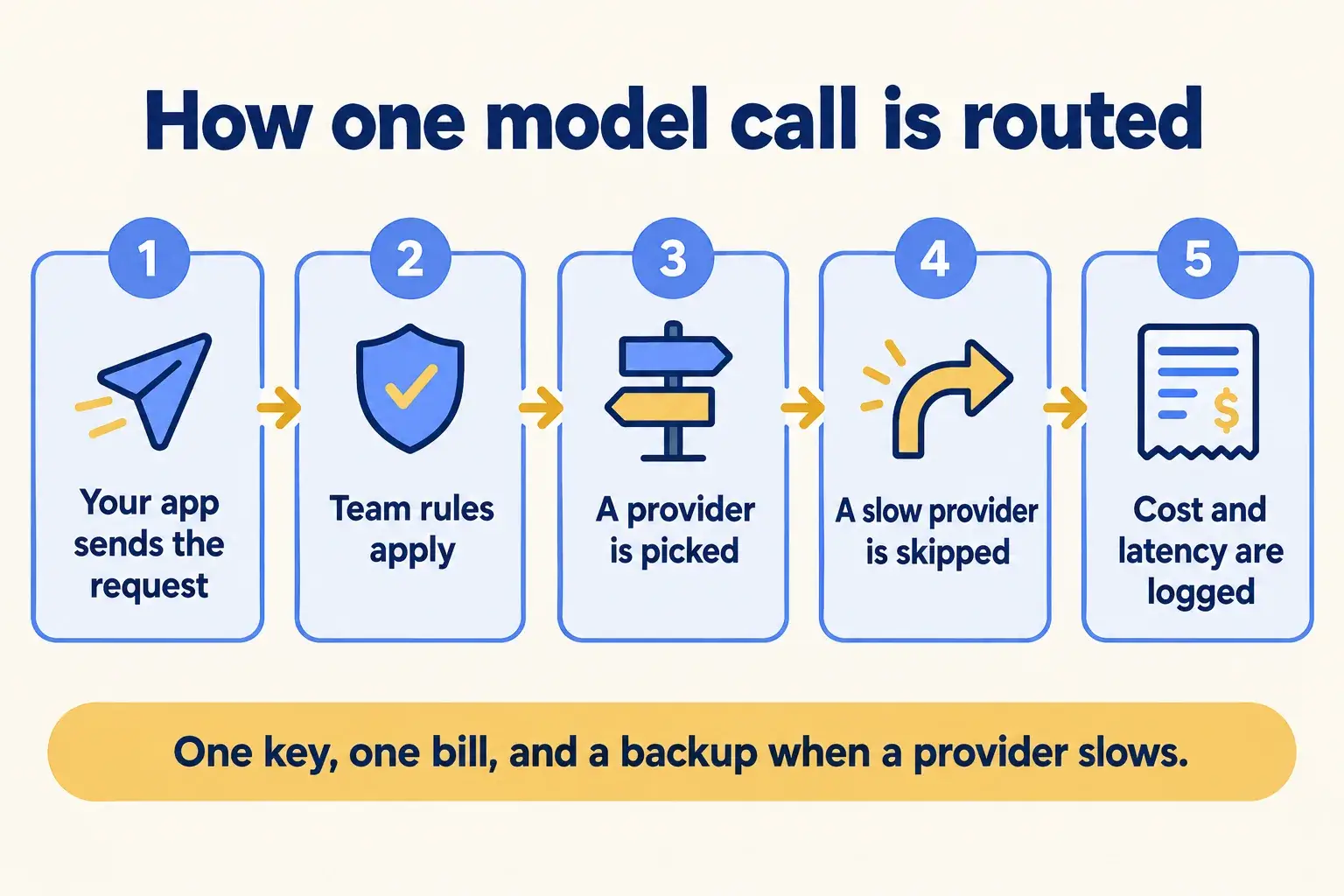
Five steps. Your code calls one endpoint. The gateway checks your rules, picks a provider and records what the call cost.

Five steps: your app sends a request, team rules apply, a provider is picked, a slow provider is skipped, cost is logged.

Infographic

The same steps are written out below.

Step by step

What happens at each step.

  1. Call

    Your app sends the request

    With one AI Gateway key, in AI SDK, OpenAI or Anthropic format.

  2. Check

    Team rules apply

    Allowed providers and models, data retention, and the budget for that project or key.

  3. Route

    A provider is picked

    Your own provider keys first if you added them, then Vercel’s credits.

  4. Fail over

    A slow provider is skipped

    The same model on another provider, or the fallback model you set.

  5. Log

    Cost and latency are recorded

    Provider, tokens, cost and every routing attempt, in the dashboard and the reporting API.

How it fits together

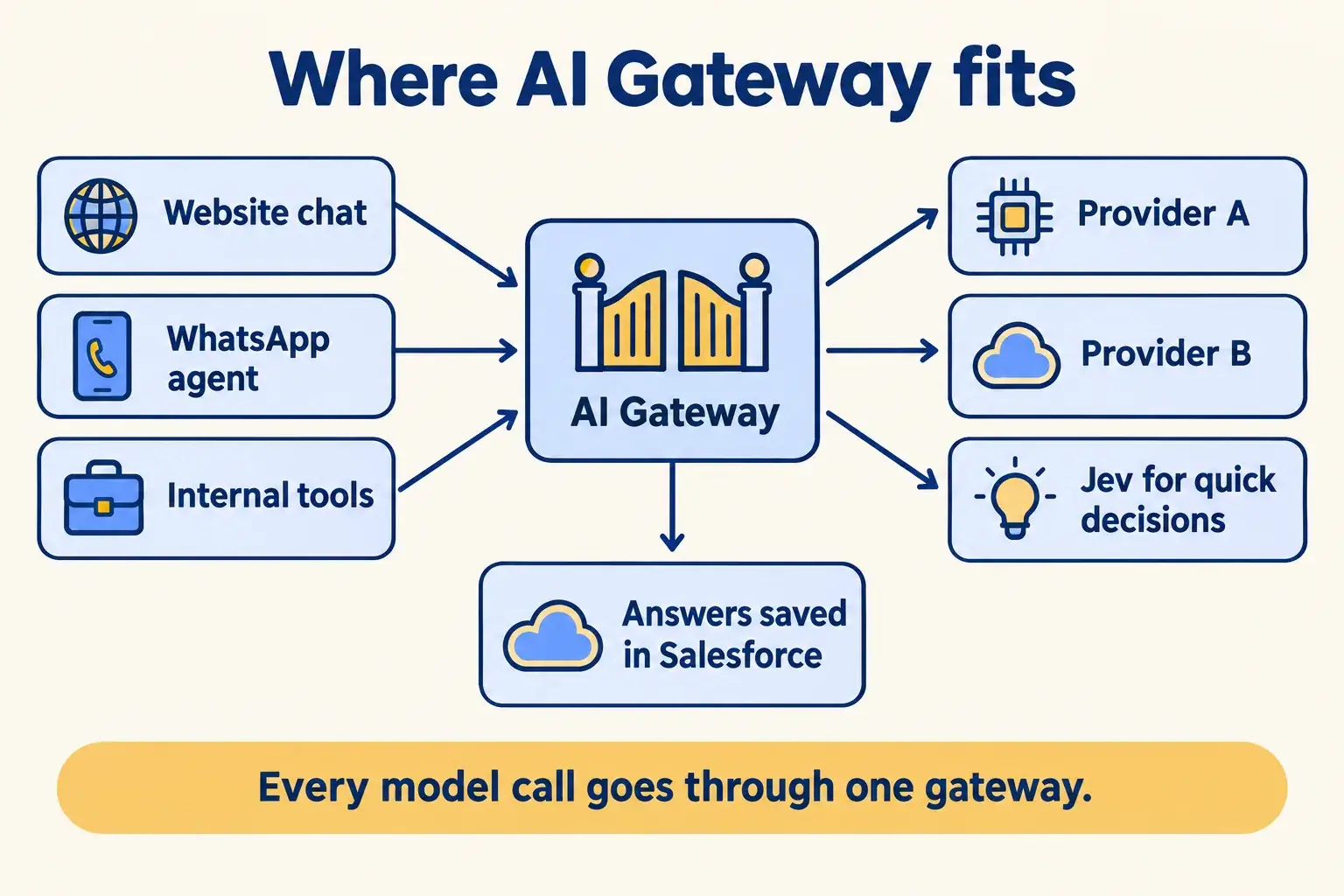
Where AI Gateway sits between your agents and the model providers.

Your website chat, your WhatsApp agent and your internal tools all call one gateway. It routes to the providers, including Jev for quick routing and yes-or-no decisions. Answers go back to your app, which writes to Salesforce.

Website chat, a WhatsApp agent and internal tools call one gateway, which routes to model providers and Jev; results go to Salesforce.

Infographic

Where it sits next to the systems you run today.

Use cases · worked examples

One worked example in each industry.

How AI Gateway fits into the work of the industries we serve, one step at a time.

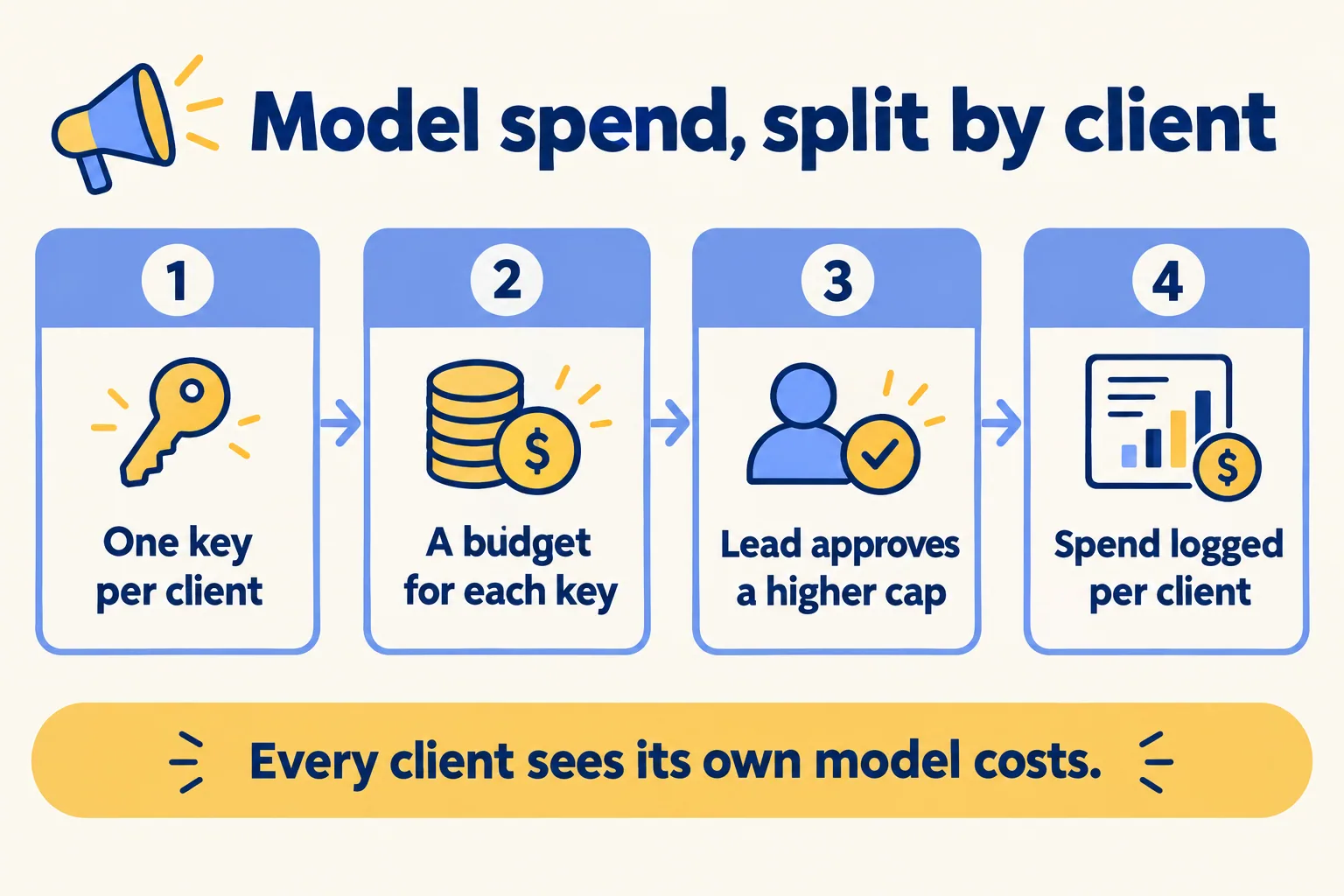
  1. One gateway key per client, each with a budget; the account lead approves a higher cap and spend is billed per client.

    Example 1 · Marketing agency, Dubai · Infographic

    Head of delivery at a Dubai marketing agency with a dozen retainer clients

    Today: We run AI copy and image tools for every client. The model bill is one card charge a month, and I cannot tell which client used what.

    After: Each client gets its own API key on AI Gateway, with a budget. Spend shows per client, and the account lead approves a higher budget when a campaign needs it.

    Worked example, step by step

    1. Day 1Mindcat. Creates one API key per client, each with a monthly budget.
    2. Day 1Developer. Points the agency’s copy tool at the gateway by changing one base URL.
    3. Day 12Gateway. One client’s budget is spent, so new requests on that key are turned away.
    4. Day 12Account lead. Gets a Slack note from our check on the logs, reviews the campaign and approves a higher budget.
    5. Day 30Finance. Exports cost per key and logs each client’s model spend on its Salesforce account.

    Each client’s model spend is visible and capped, and raising a cap is a decision a person makes.

    Marketing agencies
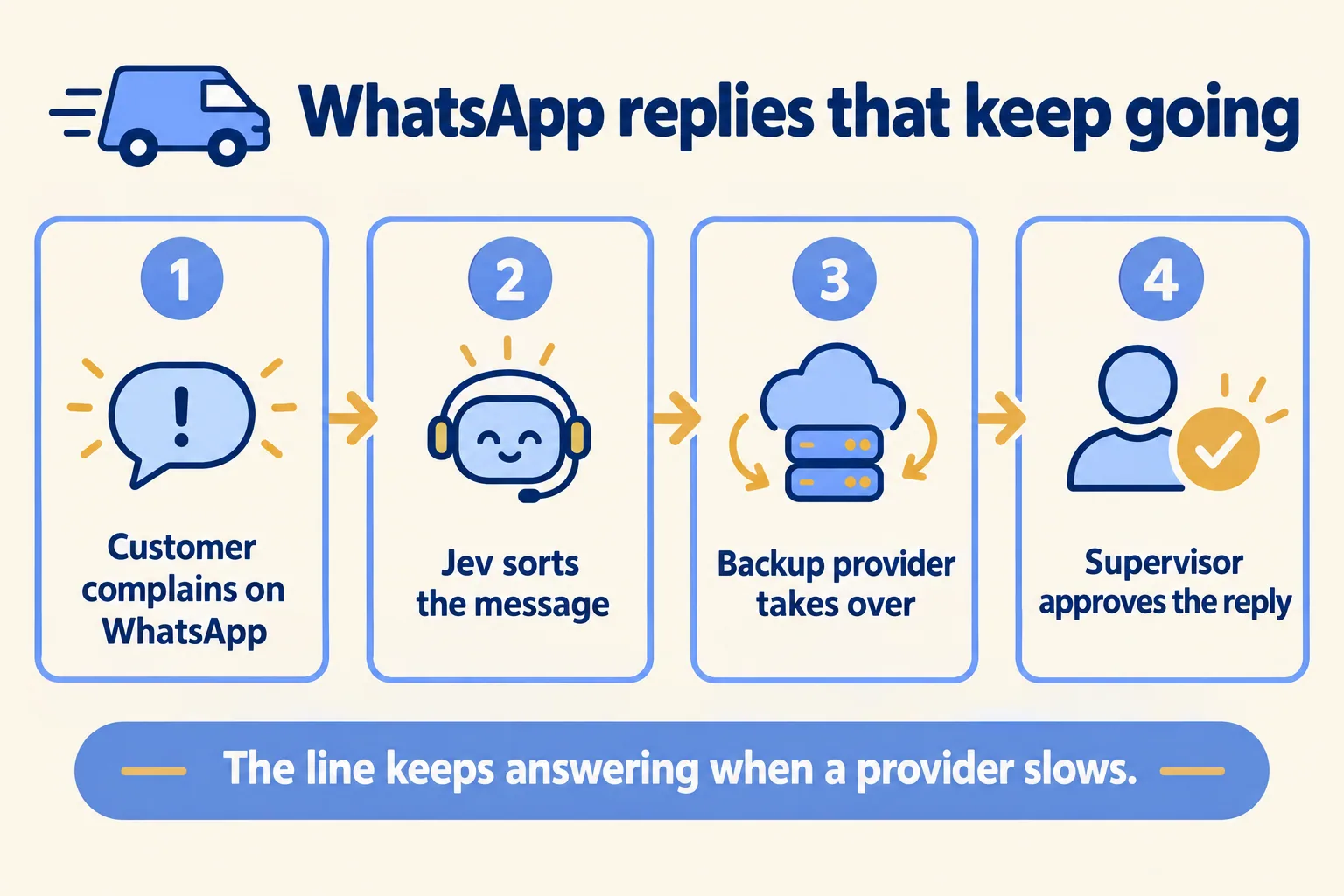
  2. A WhatsApp complaint is sorted by Jev, a backup provider takes over, and a supervisor approves the reply.

    Example 2 · Couriers, Jeddah · Infographic

    Customer service manager at a Jeddah courier company

    Today: Customers message us on WhatsApp all day. When our AI provider slowed down last month, the bot stopped replying and the call centre filled up.

    After: The WhatsApp agent calls its models through AI Gateway. Jev sorts each message first: parcel status, a new slot or a complaint. A larger model drafts the reply, and complaints go to a supervisor.

    Worked example, step by step

    1. 10:05Customer. Writes on WhatsApp: the parcel was due yesterday and nobody came.
    2. 10:05Jev. Called through the gateway, it sorts the message as a missed-delivery complaint.
    3. 10:05Agent. Pulls the shipment from Salesforce and drafts a reply with a new slot.
    4. 10:06Gateway. The main provider is slow, so the same model runs on another provider.
    5. 10:12Supervisor. Approves the reply and the new slot. The case in Salesforce updates.
    6. 10:12Customer. Gets the WhatsApp reply with the new delivery window.

    A slow provider no longer silences the WhatsApp line, and complaints still reach a person.

    Jev for message routing
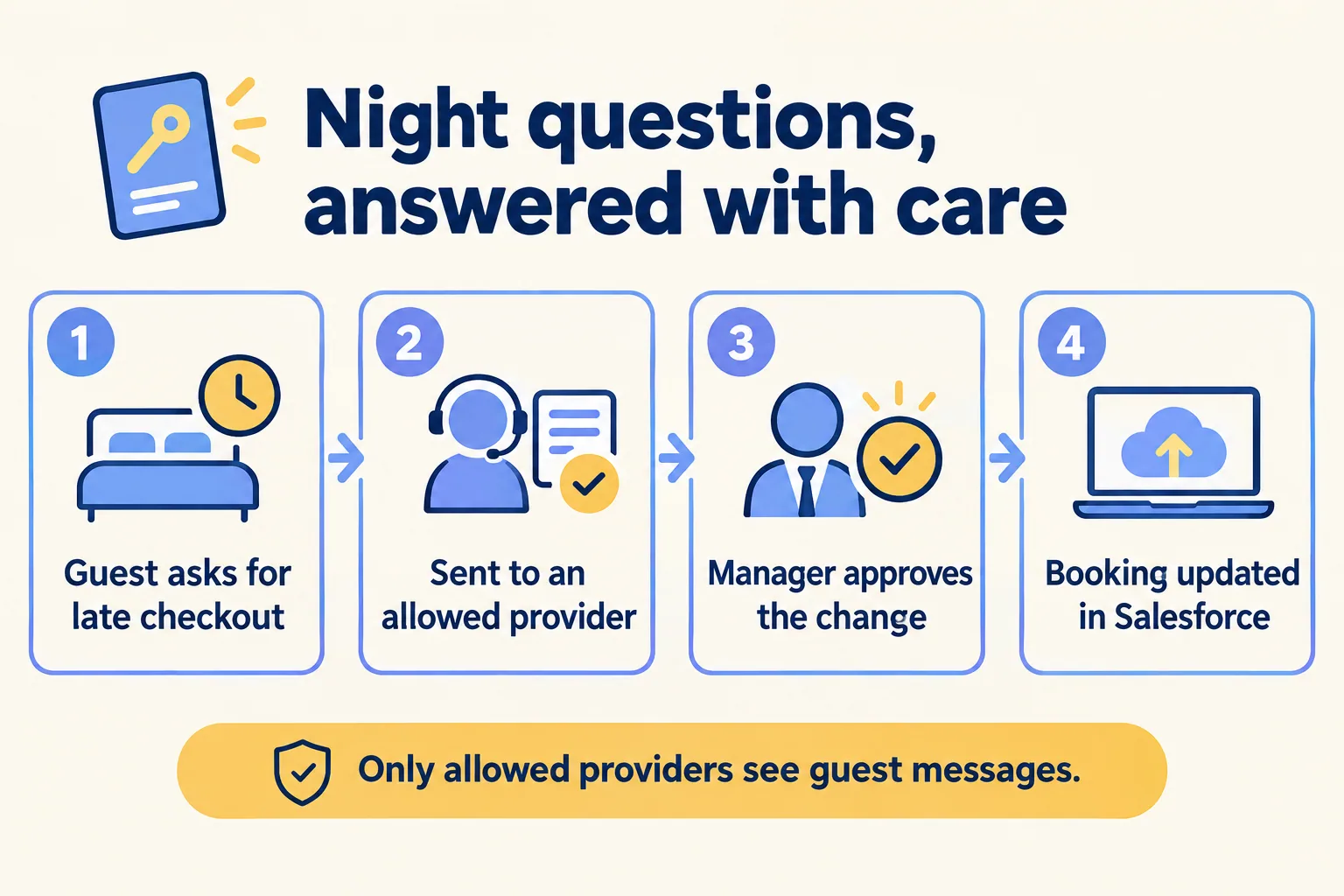
  3. A guest asks for late checkout at night, the gateway uses only allowed providers, and the manager approves the change.

    Example 3 · Hotel apartments, Abu Dhabi · Infographic

    Guest relations manager at an Abu Dhabi hotel apartment building

    Today: Our website chat answers guests at night. I do not know which AI provider sees what guests type, or whether it keeps it.

    After: Guest chat calls models only through AI Gateway, limited to the providers the hotel allows and to providers that keep no data. A duty manager confirms any booking change before it is saved in Salesforce.

    Worked example, step by step

    1. 23:40Guest. Asks on the website chat for a late checkout on Friday.
    2. 23:40Gateway. Sends the request only to an allowed provider with zero data retention.
    3. 23:40Assistant. Checks the booking in Salesforce and drafts a late checkout offer.
    4. 07:30Duty manager. Approves the late checkout. The booking in Salesforce updates.
    5. 07:31Guest. Gets the confirmation on WhatsApp.

    Guests get answers at night, and the team can show which providers saw each message.

    Hotel apartments
Examples of the work, not client stories. Times in each example show the order of events, not a measured result.

Is it for you

When AI Gateway fits, and when it doesn’t.

Good fit

Not for you yet

You call more than one model provider
Inference must run in the UAE, Saudi Arabia or India: zones are US and EU
An outage at one provider would stop your customers
You need a hard spending stop: budgets are soft caps
You need model spend split by client, team or project
You call one model a few times a day
You want one place to set which providers may see your data
You are on Hobby and the work is commercial

What Mindcat does

We build it, then we run it.

The assessment is free: a short read of the org and a written note. If you go ahead, the first build week is a fixed AED/SAR 14,900 (about USD 4,050), credited in full when you sign the build within 60 days. After go-live, we keep it patched, watched and changing every month.

FAQ

What teams ask about AI Gateway.

Does AI Gateway cost more than going to the provider?
Vercel says it adds no markup to provider token prices, including with your own keys. You buy AI Gateway credits ahead. As of 16 October 2026, card processing fees, custom reporting, and team-wide provider allowlists or zero data retention are charged on top.
Can it keep our prompts in the UAE?
No. You can pin inference to the US or the EU, and the default is global. There is no UAE, Saudi or India zone, and the request itself may be handled in any Vercel region. If your data must stay in the country, we design around that before you sign.
Will a budget stop all spending?
No. Budgets are soft caps on spend through Vercel’s credits. The gateway turns away new requests on those credits once a budget is spent, and spend on your own provider keys does not count toward it.
Does our app have to run on Vercel?
No. Vercel’s docs say your application does not need to run on Vercel. An app hosted elsewhere uses an API key; an app on Vercel can sign in with Vercel’s OIDC token.
What is Jev doing on the gateway?
Jev is TypeSafe AI’s decision model, listed on AI Gateway as typesafe-ai/jev. It answers typed questions with choices, scores and yes-or-no probabilities, so it can sort a message or check a rule before a larger model writes the reply. As of 16 October 2026, the gateway lists it at $0.042 per million input tokens. We set up Jev for clients, so weigh our view with that tie in mind; our Jev page explains how we use it.


Sources

Where these facts come from.

Start here

Tell us what you want built, and where it runs today.

One or two lines is enough. You hear back within 24 hours from the person who signs the work.

Where are you?

Salesforce consulting partner since 2010 · MVP Hall of Fame · 200+ agents in production · UAE, India and US desks