

If you can't say what each step of your agent costs, or who gets the call when the model bill jumps, this is for you. A gateway can give the bill one owner, and the Vercel AI Gateway is cheap on tokens. The fees, the caps and the data path are where you have to read closely. It is not for a team whose prompts must stay in the UAE, Saudi Arabia or India: no inference zone there exists today.
What do you pay for, token by token?
You pay the model provider's list price, and nothing on top for the tokens themselves. Vercel's pricing docs say AI Gateway charges "no markup and no platform fee on tokens", including when you bring your own provider key (BYOK). You pre-buy AI Gateway Credits and each request is deducted from the balance.
Three details change the sum:
- Free tier versus paid. The free tier gives a monthly credit on a subset of models, with lower rate limits. Buying credits moves your team to the paid tier and the monthly free credit stops.
- BYOK still needs credits. When a request on your own key fails, the gateway retries it on Vercel's system credentials, and that retry is charged to your credits.
- Payment fees are yours. "You're responsible for any payment processing fees that may apply." Enterprise teams can pay by invoice, with no processing fees.
What you get for that is one API key for many providers, request formats for the OpenAI, Anthropic and AI SDK clients, and failover to the same model on another provider when one degrades. The docs also say your app does not need to run on Vercel.
Which fees sit on top of the tokens?
Several controls a security review will ask for are paid add-ons, and most are on Pro and Enterprise only. These are the rates in Vercel's docs on 16 October 2026.
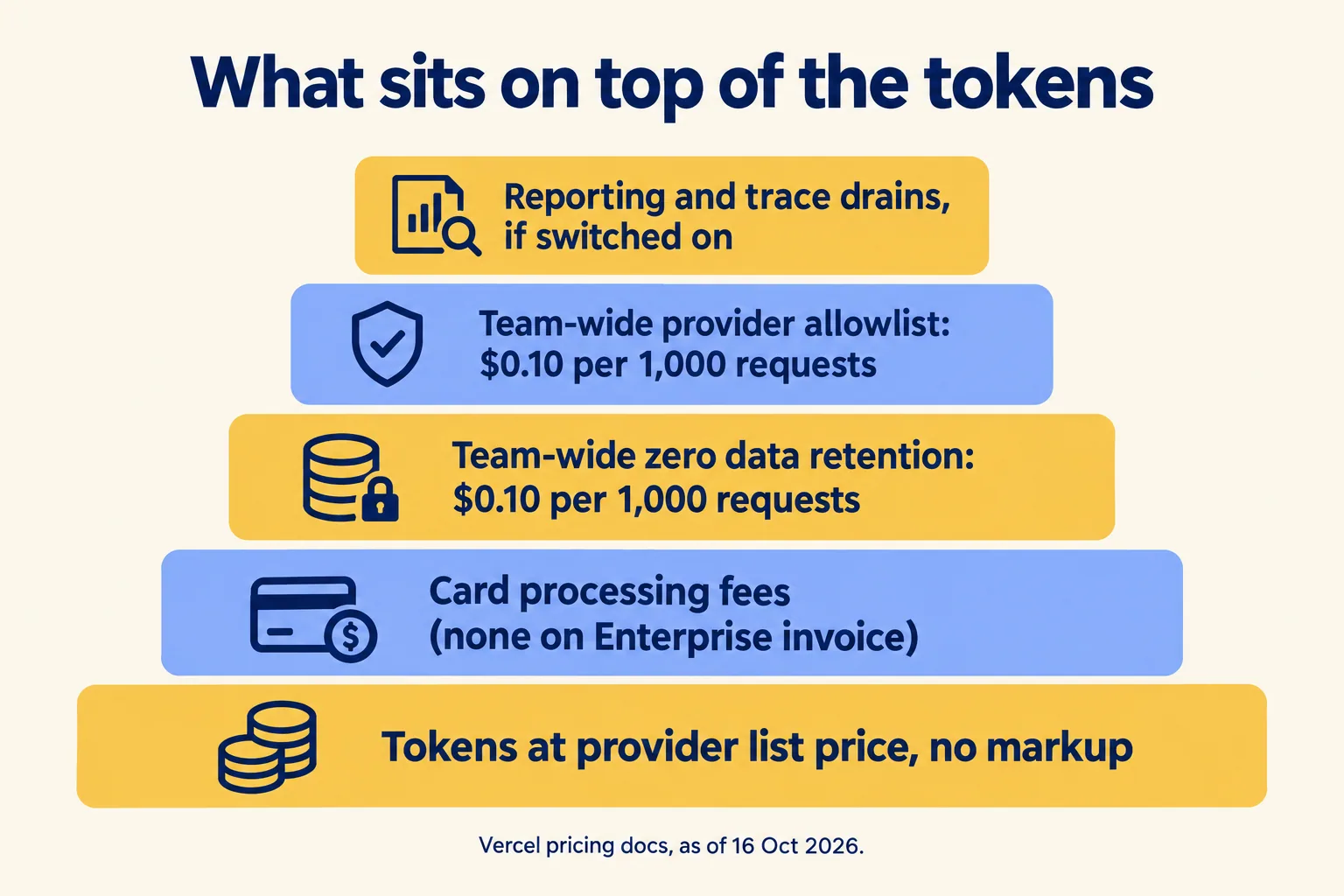
The trade in that table is policy you set once against policy you set on every call. A team-wide setting cannot be forgotten by one developer, and it costs per request. The per-request version is free, and it depends on every caller getting it right. Our default: team-wide zero data retention on any agent that reads customer data, per-request filters for everything else. Two details from the zero data retention docs settle the failover worry. ZDR enforcement "also applies to any fallback providers", so a failover cannot land on a provider that keeps your prompts. And if no compliant provider is available for the model, the request fails with an error instead of running elsewhere. Team-wide ZDR is charged only on successful responses. Pro has no free allowance on the trace meters, so a high sampling rate is billed from the first trace.
Do budgets stop the spend?
Partly. You can set budgets for a team, a project, an API key or a team member, and the gateway "rejects further requests once a limit is exceeded" with an HTTP 402. The same docs say "a budget is a soft cap, not a hard limit", and BYOK provider keys carry no budget at all.
So a budget is an alarm with a brake on one path. If most of your traffic runs on BYOK, the budget does not see it. Keep a hard limit on the provider account too, and give each agent its own API key, so the report names the agent that spent the money.
The gateway gives the bill a shape, not an owner. We write one name against each agent's key in the spec: the person who gets the 402 alert, raises the budget or turns the agent off. Usually that is the owner of the process the agent runs, not the platform team.
Where do your prompts go?
Pinned or not, inference runs in the US, the EU or wherever the gateway picks. The inferenceRegion setting accepts a US zone, an EU zone, or global, which is the default and "may be outside your users' jurisdiction". If the gateway cannot honour a pinned region, the request fails instead of running elsewhere.
There is one more line in the regional inference docs worth reading twice. The setting pins where the provider runs inference, not where your request first lands: it "can terminate and be processed in any Vercel region" before the gateway forwards it. Vercel says region-pinned gateway hosts are coming.
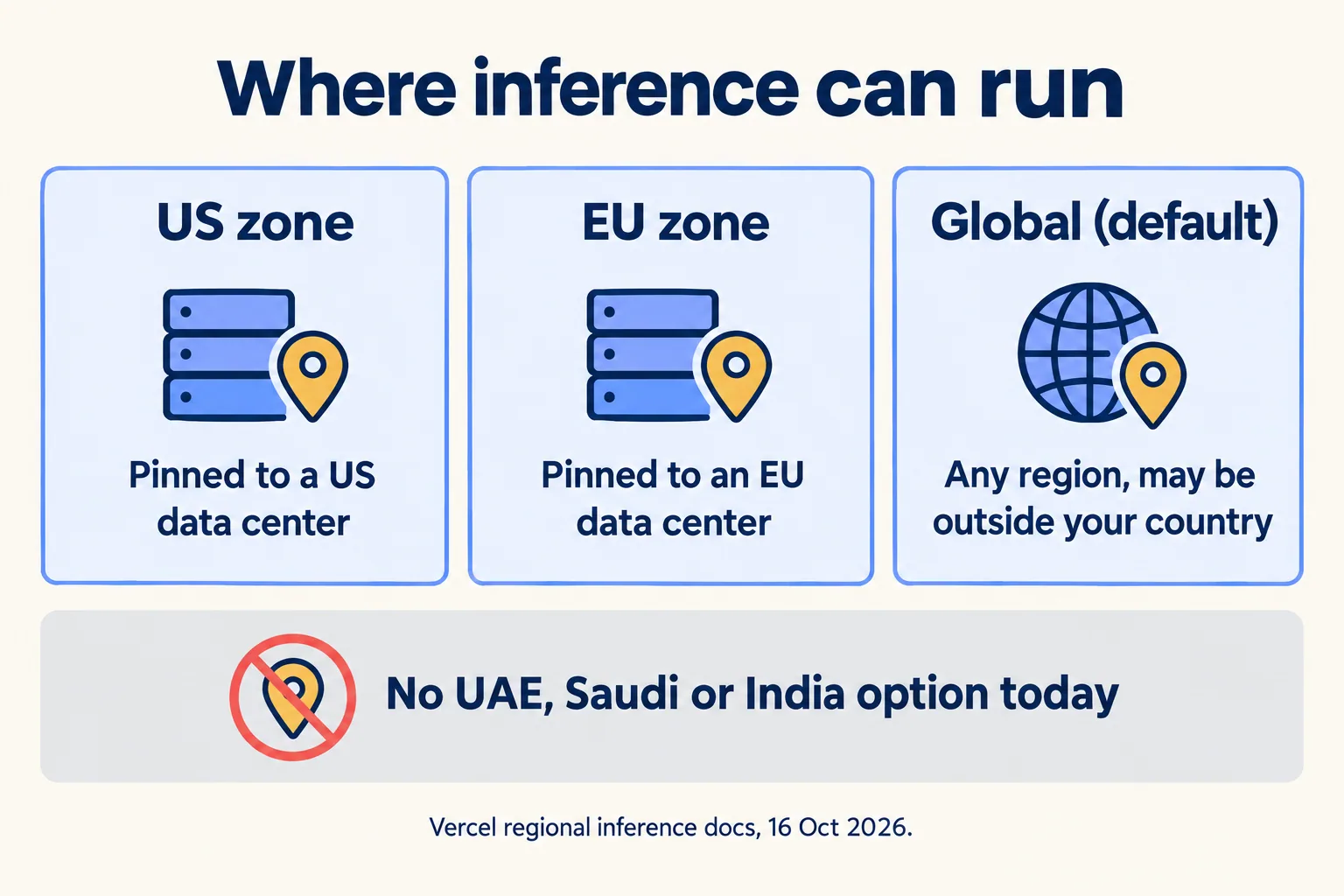
For a Dubai, Riyadh or Mumbai team, that settles which steps can use it. A step that reads a patient record, a payroll file or a passport scan stays on a model endpoint you have placed and checked. A step that sorts a public enquiry or drafts marketing copy can go through the gateway with zero data retention on. We write that split per step, and confirm it per project in writing before you sign.
What does a ticket-routing gate cost on it?
About $14 a month for 100,000 tickets, a fraction of a cent each, if the gate is a decision model and not a writing model. Here is our arithmetic on Vercel's listed price, for a sample IT service desk that routes 100,000 tickets a month. It is a sample volume, not a client's bill.
Jev, TypeSafe's decision model, is on AI Gateway as typesafe-ai/jev. Its model page lists $0.042 per million input tokens, and Vercel's model list prices its output tokens at zero. Since 7 October 2026 the gateway also serves an OpenAI-compatible /v1/decisions endpoint, so a routing question goes out as a typed choice and comes back as an answer, not prose.
- 01Each ticket, with its subject, body and requester, is about 1,000 input tokens (our assumption).
- 02100,000 tickets × 1,000 tokens is 100 million input tokens.
- 03100 million tokens at $0.042 per million is $4.20 a month in model tokens.
- 04Team-wide zero data retention on those 100,000 requests adds $10.00 at $0.10 per 1,000.
- 05Card processing fees, trace drains and the writing model that drafts replies are separate lines.
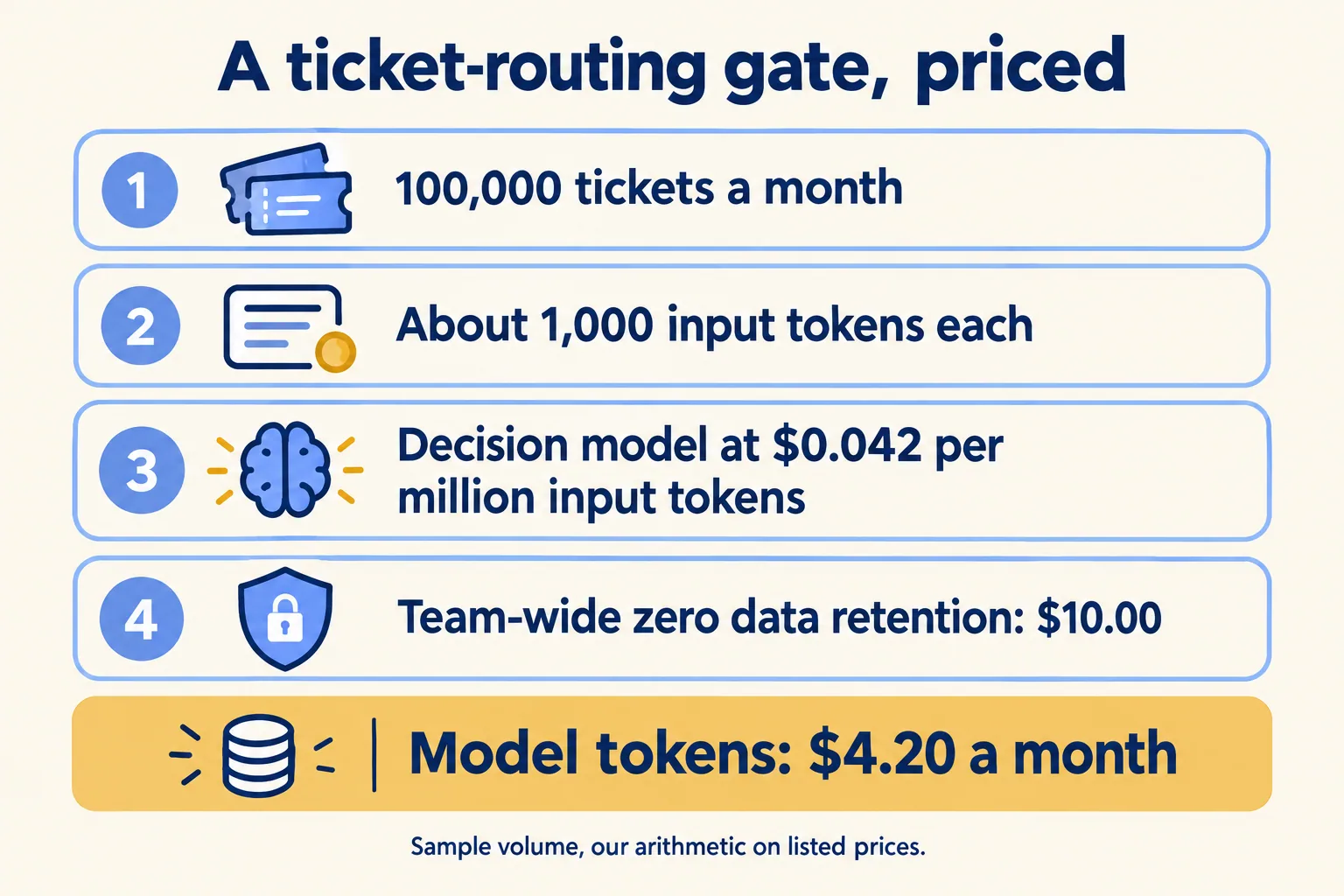
Three things follow. First, in this sample the privacy control costs more than the model: $14.20 in all, of which $10.00 is retention. That is fine, and worth knowing before someone turns it off to save money.
A decision model answers with a short typed choice, so input tokens are the whole token bill here. Put a writing model on the same tickets and output tokens take over the bill.
Our model-mix rule, from putting 200+ agents into production: a step whose answer is one of a fixed set (a queue, yes or no, a score) goes to a decision model. A step that fills a short, well-specified draft goes to a small writing model. A step that plans, reads long context or writes to a customer in their own words goes to a frontier model, with a person on the write. Own the routing rules, the eval set and the record of what was decided; rent the inference and the plumbing.
Second, cost per call is half the number. A cheap gate that sends one ticket in ten to the wrong queue costs you the re-routing, not the tokens. So we measure the gate before it goes live: in shadow mode it answers on real tickets while your team still routes them, and we count where it disagrees with the person, by queue. You get cost per correct route from your own tickets, and the threshold below which the gate hands the ticket to a person. The gateway hop adds latency we have not measured for your traffic, and Vercel's pages give no figure, so p50 and p95 per step are part of the same shadow run.
Third, the model list marks Jev's zero data retention as available on "some" of its providers. With team-wide retention on, the gateway routes only to those and fails the request if none is available, so test that path before go-live. The pinned versions (typesafe-ai/jev-1.14.0, for one) are marked zero data retention on all providers in the same list. We set up Jev for clients (Jev page), so read this example with that in mind; the ticket routing use case and Mindcat for IT service desks show the work around it.
When should you not put a gateway in front?
Compare it with the two things you would really do instead. This is our reading, not a benchmark.
Skip a managed gateway when it adds a hop and buys you nothing:
- One model, one provider, one bill you already read. A gateway is one more processor of your data and one more contract.
- Prompts that must stay in the UAE, Saudi Arabia or India. No inference zone there today.
- You need a hard spending stop. Budgets are soft and skip BYOK traffic.
- Hobby plan for company work. Vercel's Hobby plan is for non-commercial, personal use only.
How do we start?
We call the method Spec, shadow, gate. We write down each step of your agent with its model, its cost per call and where its data goes, run it beside your team with nothing written, then put a person on the write. The written assessment is free. The first build week is a fixed AED/SAR 14,900, credited in full if you sign the build within 60 days, and our Run plans are on one page. See how we build on Vercel for the rest.
We are not a Vercel partner; we use the product's own names, and mindcat.ai itself runs on Netlify. If you run one model from one provider and every step's data must stay in the Gulf, this is not for you yet: put the limit on the provider account and keep the call direct.
