
If you own a website or web app on Vercel and a fault reported two days later has already left your logs, this is for you. It is not for a site with no logins, orders or forms that can fail, or for a team whose platform team already ships logs to its own store. If your site still runs on an old server, keep this for the week after the move: it is the setting to decide on first. The gap is the plan's retention window, and the fix is a setting with a price you can work out before you turn it on.
Why do one-day logs hurt more than they sound?
Because complaints arrive late. A customer tries again, gives up, and writes on Sunday about Friday. By then a Pro team without Plus has nothing left to read.
On base Pro, Vercel keeps Observability data and runtime logs for one day. That covers a team that watches a dashboard in real time. It does not cover the weekend message, the monthly reconciliation that finds a missing payment, or the client who forwards a screenshot a week later. The cost is not the log. It is the hour your team spends guessing, and the refund you give because you cannot show what happened.
How long does each plan keep your data?
Twelve hours on Hobby, one day on Pro, three days on Enterprise, and 30 days with Observability Plus. Runtime logs are shorter on Hobby.
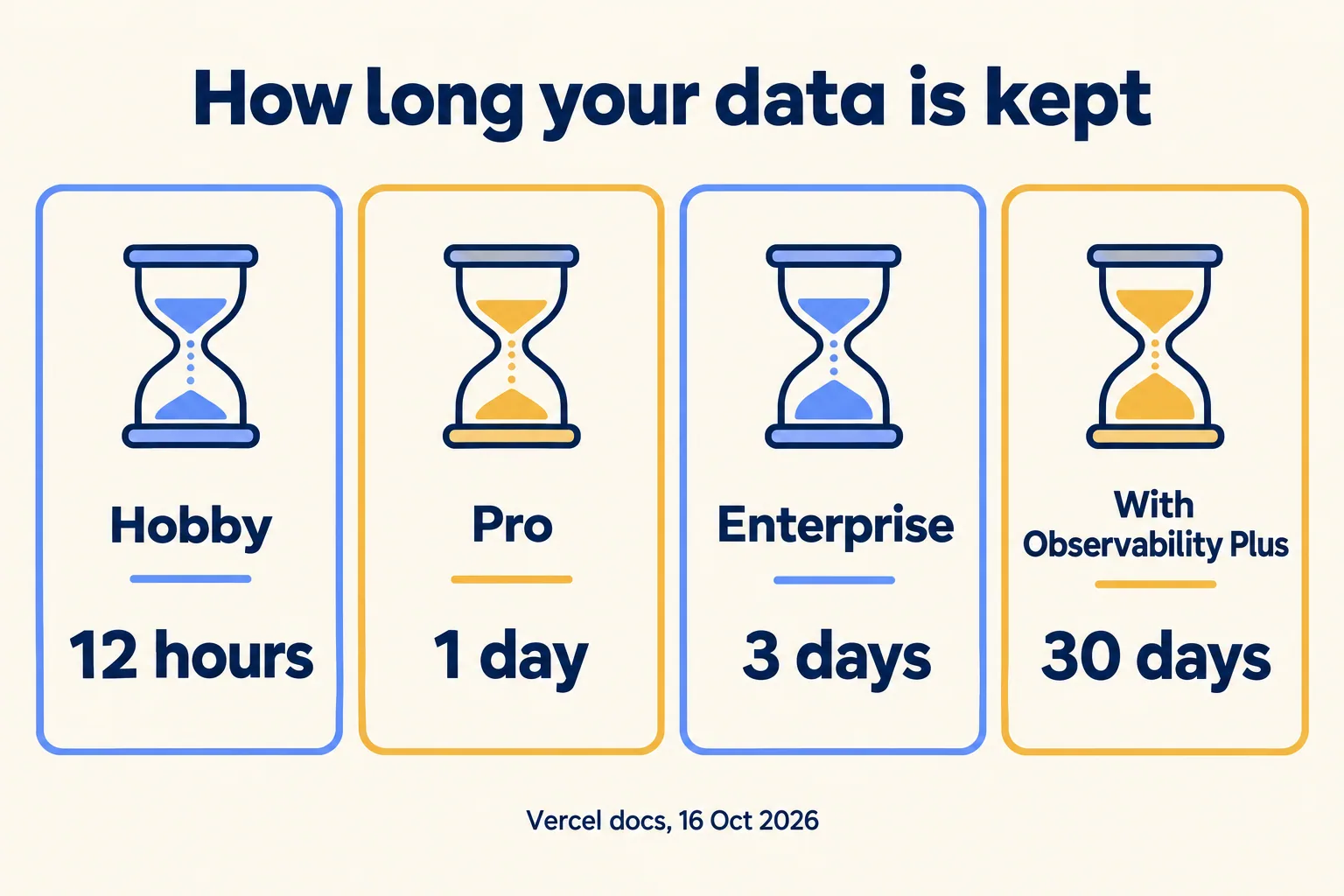
Hobby is for non-commercial, personal use only, so a business site is on Pro or Enterprise anyway. Observability itself is on every plan at no extra cost. Plus is the paid layer, on Paid Pro and Enterprise.
Two facts to check on your own team today. Teams created or upgraded to Paid Pro on or after 3 April 2026 have Plus on by default, so you may already be paying for it. And Pro Trial does not include it, so a trial shows you the one-day view only.
What does Observability Plus cost a real site?
For many business sites, a few dollars a month; for yours, work it out from your own request mix. Plus is $1.20 per million events, and an event is one step of a request, not one visitor.
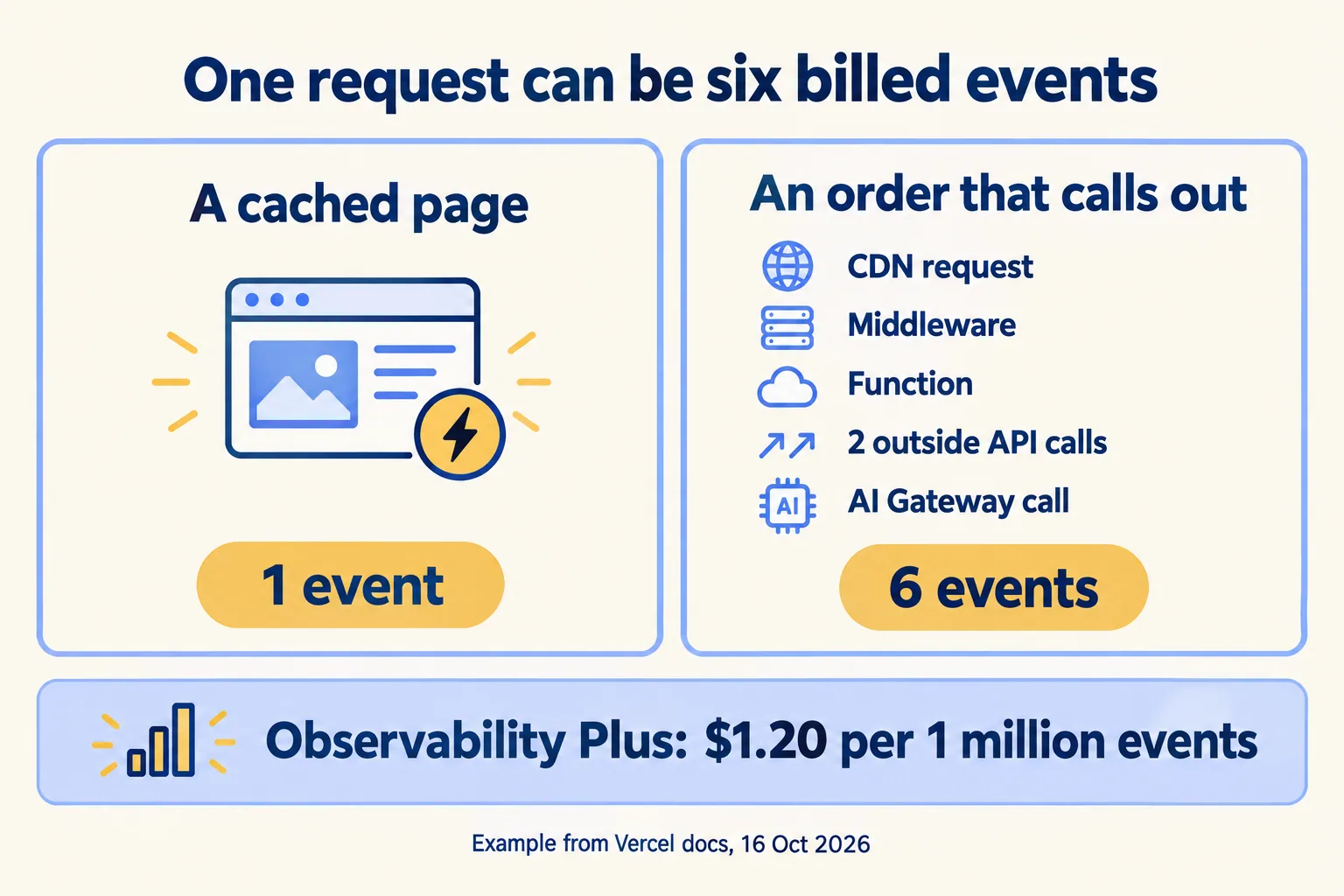
Vercel counts CDN requests, function invocations, external API requests, routing middleware runs and AI Gateway requests. A cached page is one event. Vercel's own example of a request with middleware, a function, two outside API calls and an AI Gateway call comes to six. Events are counted across every project in the team.
A sample month for a Dubai restaurant group's ordering site, with our assumptions stated (not a client):
In dirhams, the sample comes to about AED 14 a month. It sits on top of the plan itself: Pro is USD 20 a month (about AED 73) with one deploying seat and USD 20 of usage credit, each extra deploying seat is USD 20, and viewer seats are free. So the lines to show finance are the plan, the seats, and this one.
That sample is our illustration, not a measured site. The method is what carries over: count each request type, multiply by its events, then by the rate. Volume changes the answer, and so does an AI Gateway call on every request, which adds an event each time. Our restaurants and cafes page shows the ordering and branch work this sits beside.
What do you get beyond longer logs?
The tools you reach for when a customer says "the checkout was slow". Without Plus, the Functions view has no p75 latency (the wait that the slowest one in four visitors gets) and no breakdown by path, and you cannot write queries.
With Plus you can see which page is slow for that one visitor in four, break traffic down by path, find which outside service (a payment provider, your CRM) is the slow step, and save the question as a query your developer reruns next time. The product page lists anomaly alerts on Pro and Enterprise. From the command line, vercel logs --environment production --status-code 500 --json pulls failing requests for a script or a coding agent to read.
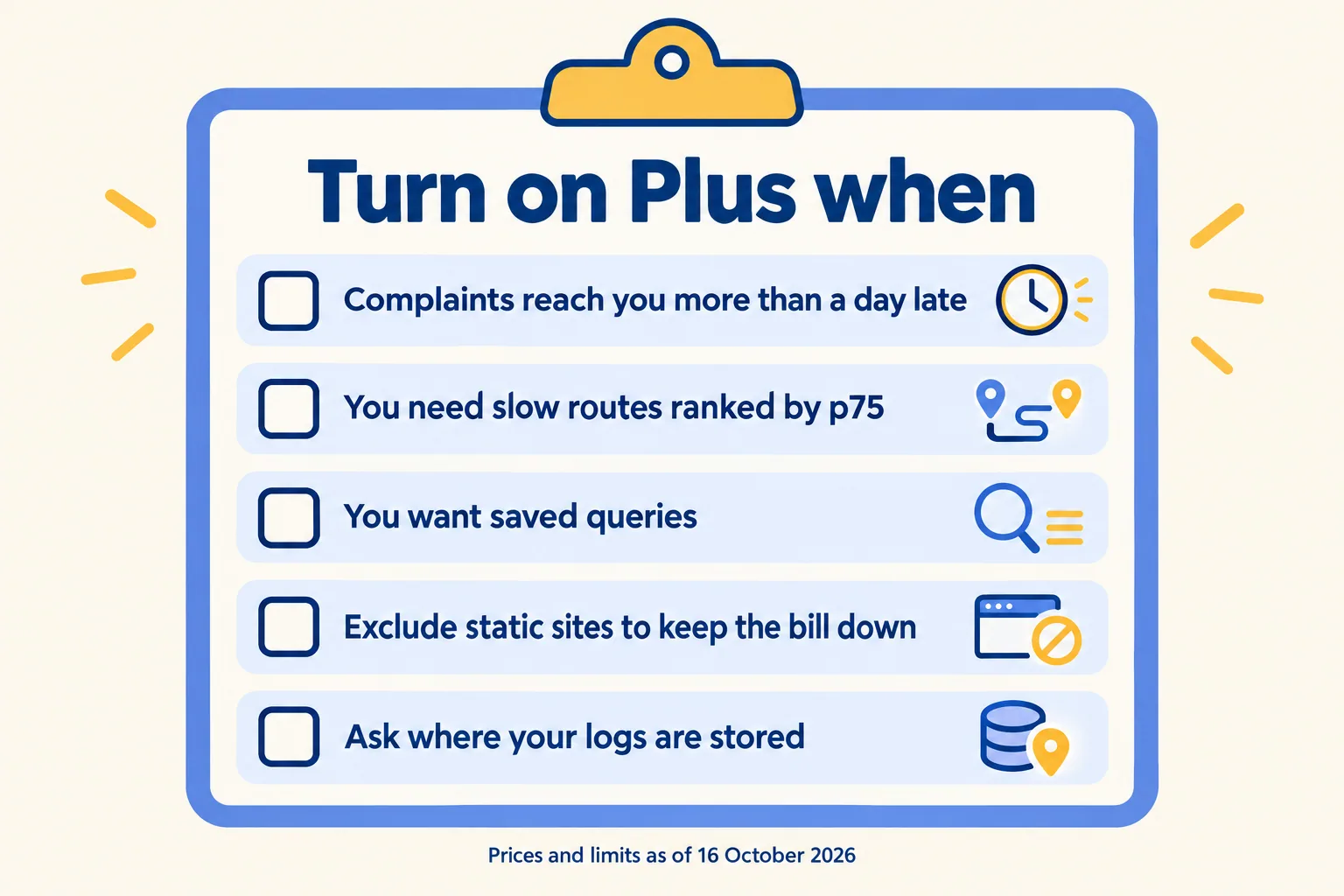
The same checklist, as text you can paste to your developer:
- 01Turn on Plus if complaints can reach you more than a day after the fault, or you need slow pages by route or saved queries.
- 02Exclude static marketing projects, so their page views stop counting as events.
- 03Count each request type, multiply by its events and by USD 1.20 per million, and put the result next to the plan and seats.
- 04Ask where the logs are stored, and drain them to a store you choose if location or anything past 30 days matters.
What about agents and model calls?
They show up in the same place, with their own retention. Observability has insights for AI Gateway and AI Traffic, and AI Gateway logs the provider, latency, tokens and cost of each request, so the cost of each model step is something you read, not estimate.
Traces are priced and kept on their own terms. Tracing spans, labelled Beta on the pricing page, are $0.50 per million span units on Pro (Hobby includes 1 million a month), and session traces are kept 1 hour on Hobby, 1 day on Pro and 3 days on Enterprise as of 16 October 2026. For an agent built with eve (in Beta), Agent Runs shows tokens, timing and tool calls per session. If you need last month's agent trace in an incident review, drain it: the default windows are as short as the logs.
Where do the logs live, and how do you keep them longer?
Vercel does not state where log and telemetry data is stored. For a UAE or Saudi business with customer data in its logs, that is a question for your legal team, not a footnote.
Vercel's 19 compute regions include none in the UAE or Saudi Arabia; Mumbai (bom1) is the nearest. Its compliance page says data "may" be transferred to the United States and anywhere Vercel or its providers process data. If you need logs in a place you choose, or for longer than 30 days, send them out: Log Drains to your logging provider ($0.50 per GB on Pro), or OpenTelemetry traces to an application monitoring tool such as Datadog or New Relic.
If a bank or hospital client's questionnaire asks for logs kept longer than 30 days, Plus cannot reach it, so the drain is the answer you write down, with the store and its location named. Which answers Vercel's own reports give and which stay yours is in our post on security questionnaires for a web app on Vercel.
Keep personal data out of log lines in the first place. A drain copies whatever you wrote. For website visitor counts that should stay in the region, our hosted Mindcat Analytics is the other route.
When should you leave Plus off?
On static marketing sites where every page is cached and nobody files a ticket about a page view. Exclude those projects from Plus; their events then stop counting.
If your site has no logins, orders or forms that can fail, wait: you have nothing yet that a longer log would explain.
We are not a Vercel partner: your Vercel account and its bill stay in your company's name. The written assessment is free. It says whether Plus is already on in your team, which projects to exclude, and whether you need a drain, with the monthly cost of each line. We call the method Preview every change: each change opens first on a preview link, a copy of the site only your team can see, and goes live only after someone has checked it there. If you want us to build it, the first build week is a fixed AED/SAR 14,900, credited in full if you sign the build within 60 days, and Run plans cover watching the site after go-live. The Vercel hub shows the rest.
