

Building and running websites and apps on Vercel

UAE

Pages slow for visitors in Dubai and Riyadh: what the Vercel CDN fixes, and what it cannot

By Shivanath DevinarayananPublished 6 min read
Written forCTO, CXO, or VP or director of engineering who owns the agent stack and the model bill“Which model should run which step, and what does each step cost?”

The short answer

How does the Vercel CDN serve visitors in the UAE and Saudi Arabia, and how should a business site be set up so Gulf visitors get fast pages?

A cached page is answered from the nearest point of presence. Anything not cached runs in a compute region, and none is in the Gulf. So cache every page that can be cached, put the function region near your data, and measure with real visitors. At Mindcat, we write which pages cache and which run before we build.

A lit desk globe turned to India and the Gulf with one bright point over Mumbai, and the words Nearest region: Mumbai

Takeaways

  1. 01Cached pages come from the nearest point of presence. Uncached requests go to a compute region, and none is in the Gulf.
  2. 02Cache marketing, offer and listing pages with ISR, and let tag-based purges refresh them when a price changes.
  3. 03Put functions near the database or CRM they call. The default is Washington, D.C.
  4. 04Pro includes 1 million CDN requests and 1 TB a month. Paid Flat Rate tiers start at $20.

If your site loads fast in your office but your agents in Dubai or Riyadh say it drags on their phones, this is for you. It is not for a team without real visitor numbers yet: measure first, then change the setup.

What does the CDN do for a visitor in Dubai?

It answers from the nearest point of presence when the page is cached, and sends the request on to a compute region when it is not. The second half is where Gulf visitors lose time.
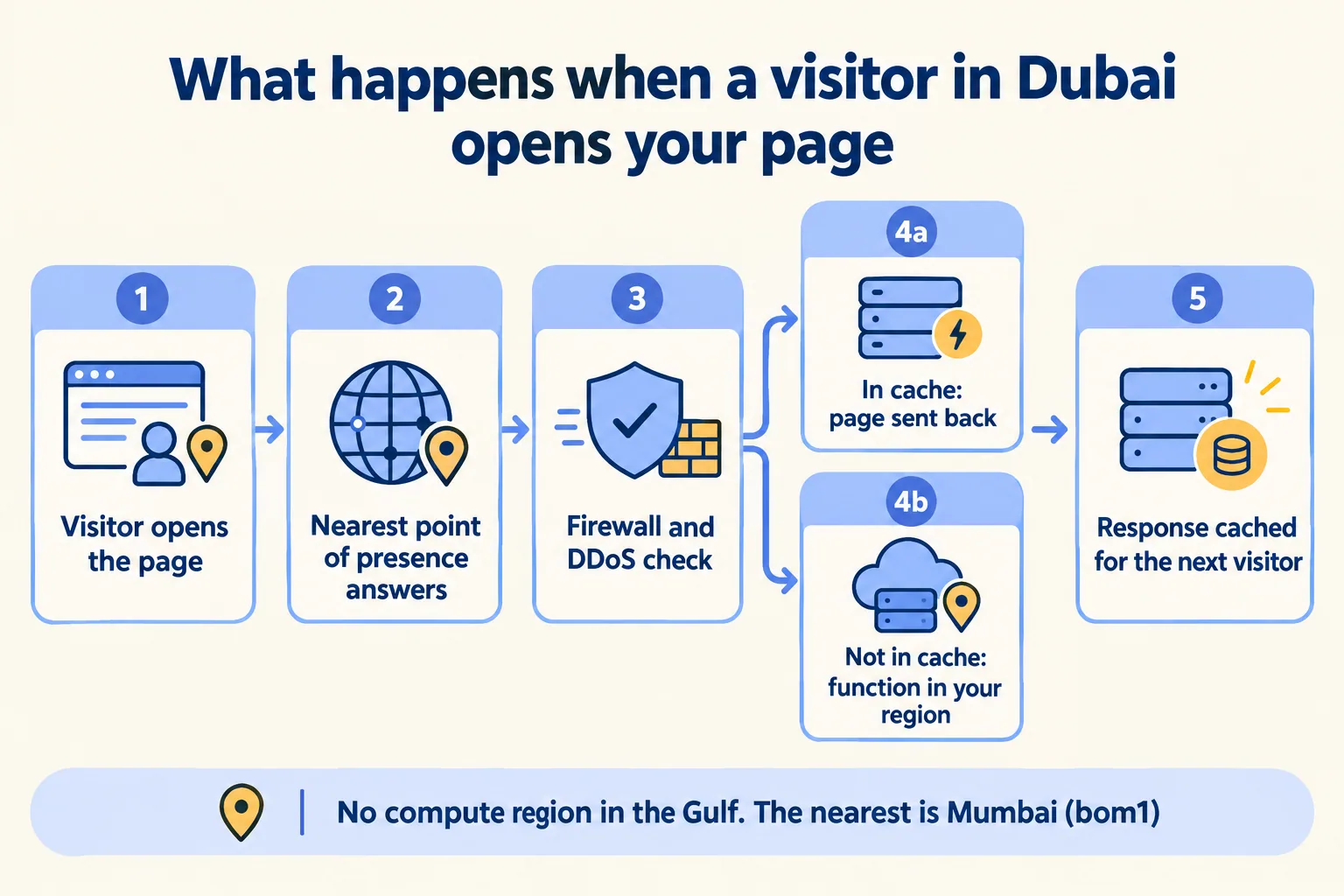
A Dubai visitor's request: nearest point of presence, firewall, cache hit or a function in your region, then cached
The path of one request. There is no compute region in the Gulf; the nearest is Mumbai.
  1. 01The visitor's request reaches the nearest of Vercel's points of presence: over 126 in 51 countries, its regions page says.
  2. 02The firewall and DDoS checks run. Vercel says this mitigation is unmetered and on every deployment at no extra cost.
  3. 03Routing rules run: redirects, rewrites and headers.
  4. 04If the page is in the cache, it goes straight back. If not, the request travels over Vercel's private network to a function in your compute region.
  5. 05The response can be cached so the next visitor gets it from the cache.

Vercel does not publish the city list for its points of presence, so we cannot tell you whether one sits in Dubai or Riyadh. What it does publish is the compute region list: 19 regions, none in the UAE, Saudi Arabia or the Middle East. Mumbai (bom1) is the nearest.

So a cached page skips the trip to a compute region. An uncached one goes to India, Europe or, by default, Washington, D.C. The search results for "vercel cdn" on 16 October were almost all Vercel's own pages, and none of them said where an uncached Gulf request goes.

How we set up caching, regions and the firewall for a site is on the Vercel CDN page.

Which pages can the CDN answer on its own?

More than most teams cache today. Vercel's CDN is framework-aware: with a supported framework, the caching rules come out of the build, so nobody writes cache headers by hand.
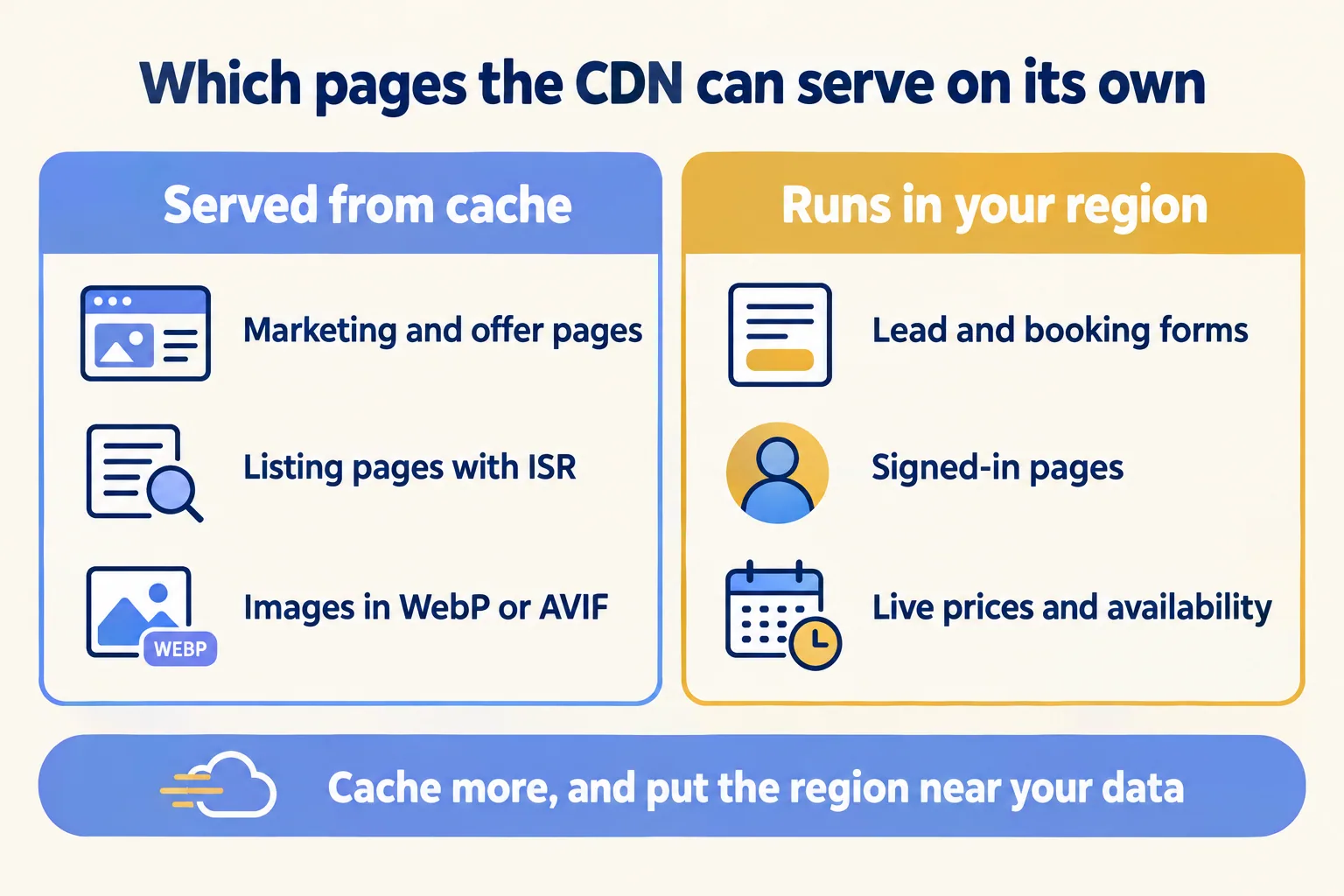
Served from cache: offer pages, ISR listing pages, images. Runs in your region: forms, signed-in pages, live prices
Which pages the CDN can answer on its own, and which run in your region.
PageWhere it should come fromWhy
Home, offer and launch pagesCache, built aheadThe same for every visitor
Listing or room pagesCache with ISR, purge by tagChanges when a price changes, not on every visit
Photos and floor plansImage Optimization, cachedResized and served as WebP or AVIF
Lead and booking formsFunction in your regionWrites to your CRM
Signed-in pages, live availabilityFunction in your regionDifferent for every visitor

Incremental Static Regeneration (ISR) is the middle row's tool. It serves the cached page and regenerates it in the background, and Vercel handles the purging for Next.js, SvelteKit, Nuxt and Astro. Tag-based invalidation lets you clear only the pages for one project or one building when its price changes.

The regions page explains why this works: by keeping "fewer, dense regions", Vercel says it raises the chance that a popular page is already in a region's cache.

Where should the uncached part run?

Next to the data it reads, not next to the visitor. A form that runs in Mumbai and then calls a database in Frankfurt crosses two seas. Vercel's regions page says the same: run functions in the same region as your database.

  1. 01List what each function calls: your CRM, a database, a payment provider, an AI model.
  2. 02Find where the one it calls most lives.
  3. 03Set the function region to the nearest of Vercel's 19. Never leave it on the iad1 default by accident.
  4. 04If the data has no fixed home and your visitors are in the Gulf, bom1 Mumbai is the nearest region.

This also answers the data question. The CDN does not make Vercel a place to keep records that must stay in the UAE. Vercel's compliance page says data may be transferred to the United States. The form collects; the record lives in a system that keeps it in the country.

What does a listings site look like on it?

Here is a sample plan, not a client. A Dubai brokerage runs a site with 400 listing pages, each with photos and a payment plan, and a lead form that creates a Salesforce lead.

PartSetupWhat the visitor in Dubai gets
Listing pagesISR, one cache tag per projectA cached page; a price change purges only that project's pages
PhotosImage OptimizationWebP or AVIF sized for the phone, from the cache
Launch page for a roadshowBuilt ahead, previewed firstA cached page, checked before it went live
Lead formFunction in the region nearest the CRMOne trip out of the Gulf, only when they submit
Bots hitting the formFirewall rules on the projectFewer fake leads in Salesforce

The only part that has to leave the Gulf is the submit. Browsing, photos and the payment plan come from the cache. For the shape of this work, see Mindcat for real estate brokers.

What does the CDN cost on Pro?

A fixed amount, as long as traffic stays inside a tier. Pro includes the lowest Flat Rate CDN tier at no extra cost.
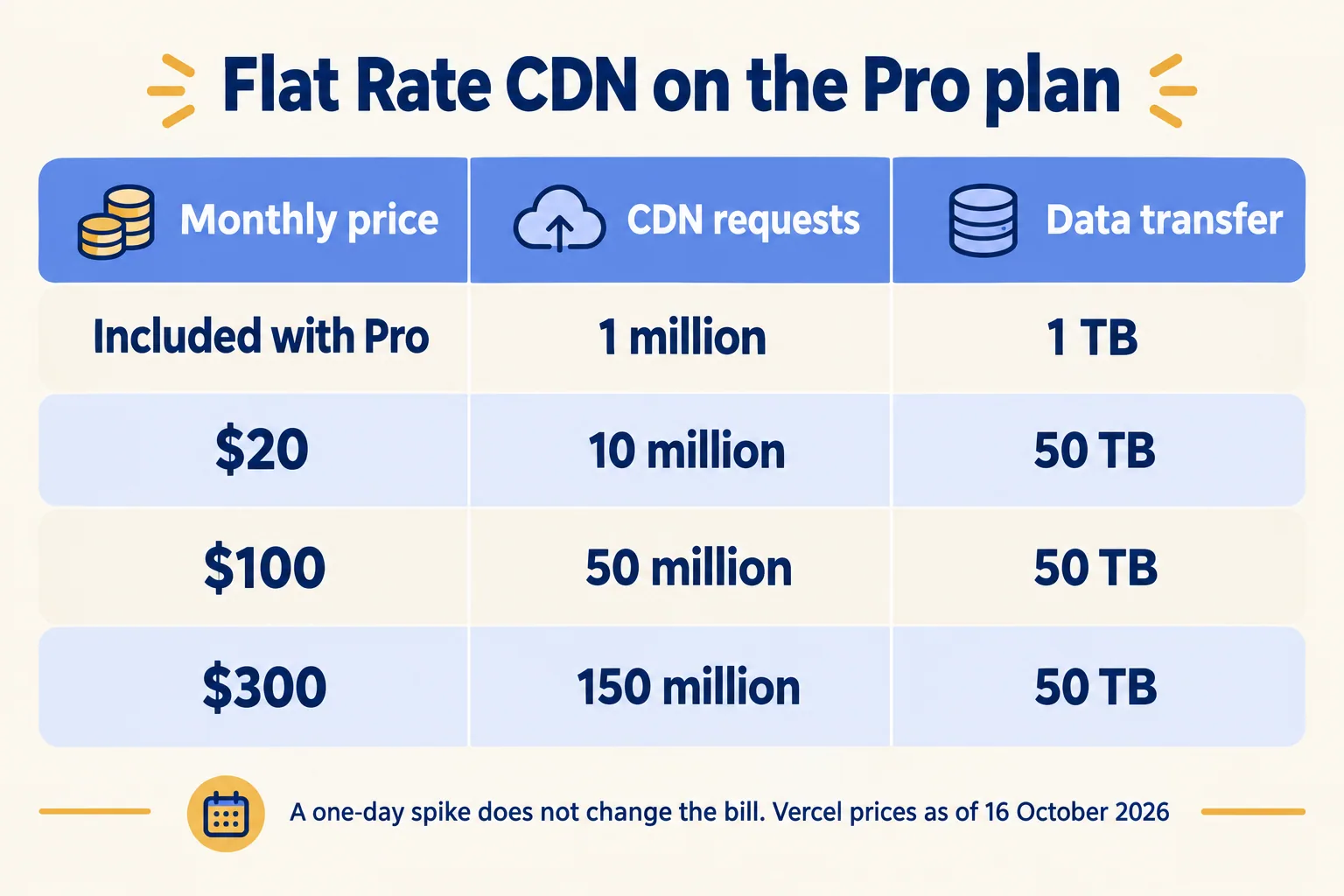
Flat Rate CDN tiers: included 1M requests and 1 TB; $20 for 10M; $100 for 50M; $300 for 150M, each 50 TB
Flat Rate CDN tiers on Pro, as of 16 October 2026.
Monthly priceCDN requestsData transfer
Included with Pro1 million1 TB
$2010 million50 TB
$10050 million50 TB
$300150 million50 TB

Vercel says 1 million requests a month is about 33,000 a day, and a single busy day does not change the bill. If a whole month goes over, it moves you up a tier at the next cycle. On demand, outside Flat Rate, Fast Data Transfer costs $0.15 to $0.35 a GB and is priced by the region the requests come from.

Hobby includes 1 million CDN requests and 100 GB of Fast Data Transfer a month, but Hobby is for non-commercial use only. A business site is on Pro.

How do you know it is fast for your visitors?

Measure the people who use it, not a test from your office. Vercel's Speed Insights reports real-user Core Web Vitals, and the usage dashboard can filter data transfer by region. Look at your Gulf visitors on phones, on the pages that matter: the listing, the offer and the form.

If you have no traffic numbers yet, do not tune the CDN. Launch with the cache-or-run rule above, then change it with a month of real data.

What happens on the first call?

We call the method Preview every change, and cache rules are part of the change: Vercel scopes every CDN change to a branch and a preview link, so you test caching before production. On the call you tell us which pages matter, where your data lives and where your visitors are. The written assessment is free and lists what caches, what runs where, and the expected tier.

The first build week is a fixed AED/SAR 14,900, and Run plans watch the cache and the bill after go-live. See everything we build at Vercel, then send us the site.

Filed under

Building and running websites and apps on Vercelvercel flat rate cdnvercel isr cachingvercel cdn middle eastvercel edge network regions
Useful to someone on your team?

FAQ

Questions teams ask next

Does Vercel have a CDN server in Dubai or Riyadh?
Vercel does not publish its point-of-presence cities on the docs we read. The regions page says it runs over 126 points of presence in 51 countries and 19 compute regions. None of the 19 is in the UAE, Saudi Arabia or the Middle East; the nearest is bom1 in Mumbai. So we cannot say whether a Gulf point of presence exists, and we do not promise one.
What is Flat Rate CDN on Vercel?
A Pro feature that charges a fixed monthly price for CDN capacity instead of per unit. Pro includes the lowest tier, 1 million CDN requests and 1 TB of data transfer a month. Paid tiers are $20 for 10 million requests, $100 for 50 million and $300 for 150 million, each with 50 TB, as of 16 October 2026. A one-day spike does not change the bill.
Does the Vercel CDN protect against DDoS attacks?
Vercel's CDN docs say every deployment gets unmetered, always-on DDoS mitigation and network-level security at no extra cost, and HTTPS with automatically provisioned certificates. A Web Application Firewall with custom rules can be set per project. That is network protection, not a guarantee against bots filling your forms; those need their own controls.
Is Flex CDN a cheaper way to serve a business site?
Only for projects that can tolerate reduced reliability. Vercel says Flex CDN traffic has no latency or availability guarantees, and it is available only to teams using Flat Rate CDN. Keep the site that takes leads or bookings off it. A test site or an internal page is the kind of project it is for.

Sources

  1. 01Vercel docs: CDN overviewAccessed 16 Oct 2026
  2. 02Vercel docs: Global network and regionsAccessed 16 Oct 2026
  3. 03Vercel docs: Flat Rate CDNAccessed 16 Oct 2026
  4. 04Vercel docs: CDN pricing and usageAccessed 16 Oct 2026
  5. 05Vercel docs: Regional pricingAccessed 16 Oct 2026
  6. 06Vercel: Observability product page (Speed Insights)Accessed 16 Oct 2026
Shivanath Devinarayanan, founder of Mindcat

Written by

Shivanath Devinarayanan

Founder, Mindcat Consulting · Salesforce MVP Hall of Fame

Runs 200+ agents in production. Reads every brief that comes in and signs the work that goes out.

About Shivanath

Build It, Preview It, Run It · the written assessment

We work in real estate and right now, leads go cold before anyone replies.

Industry
Problem

Brief: Real estate. Leads from portals and WhatsApp. Follow-up has no owner. An agent on a named process. A reviewer on the exceptions. From: /blog/vercel-cdn-gulf-visitors.