An operations lead and a dispatcher in a Dubai courier depot follow the evening delivery rush on a laptop.

Vercel · SDKs · Beta

The evening rush hits and half the updates never send. Queue them, and retry until they land.

A driver marks a delivery done. A client asks for a statement. A campaign brings in a burst of sign-ups. Today the slow part runs while the customer waits, and when Salesforce or WhatsApp is slow, the update is lost. With Vercel Queues, the app hands the job to a queue and answers at once. A worker picks it up and retries until it is done.

Salesforce consulting partner since 2010 · MVP Hall of Fame · 200+ agents in production · UAE, India and US desks

The problem

Where background work goes wrong today.

What Queues SDK is

Queues SDK, in plain words.

Facts from Vercel’s own pages, checked on 16 October 2026. The sources are at the end of this page.

Status
Beta, available on all plans. The SDK is @vercel/queue for JavaScript and TypeScript, and vercel-queue for Python (also beta).
What it does
Your code sends messages to topics. Consumers pick them up with automatic retries and at-least-once delivery.
Durability
Each message is written to three separate availability zones before the send call returns.
Order and repeats
Order is approximate, not strict, and a message can arrive more than once. Your workers must be safe to run twice.
Limits
Messages kept from 60 seconds to 7 days (24 hours by default), delays up to 7 days, up to 100 MB per message.
Regions
Available in all 19 Vercel regions, including Mumbai. Strict data residency is not supported yet: in an outage, messages may sit in a nearby region.

How it works

From a request to a job that is done.

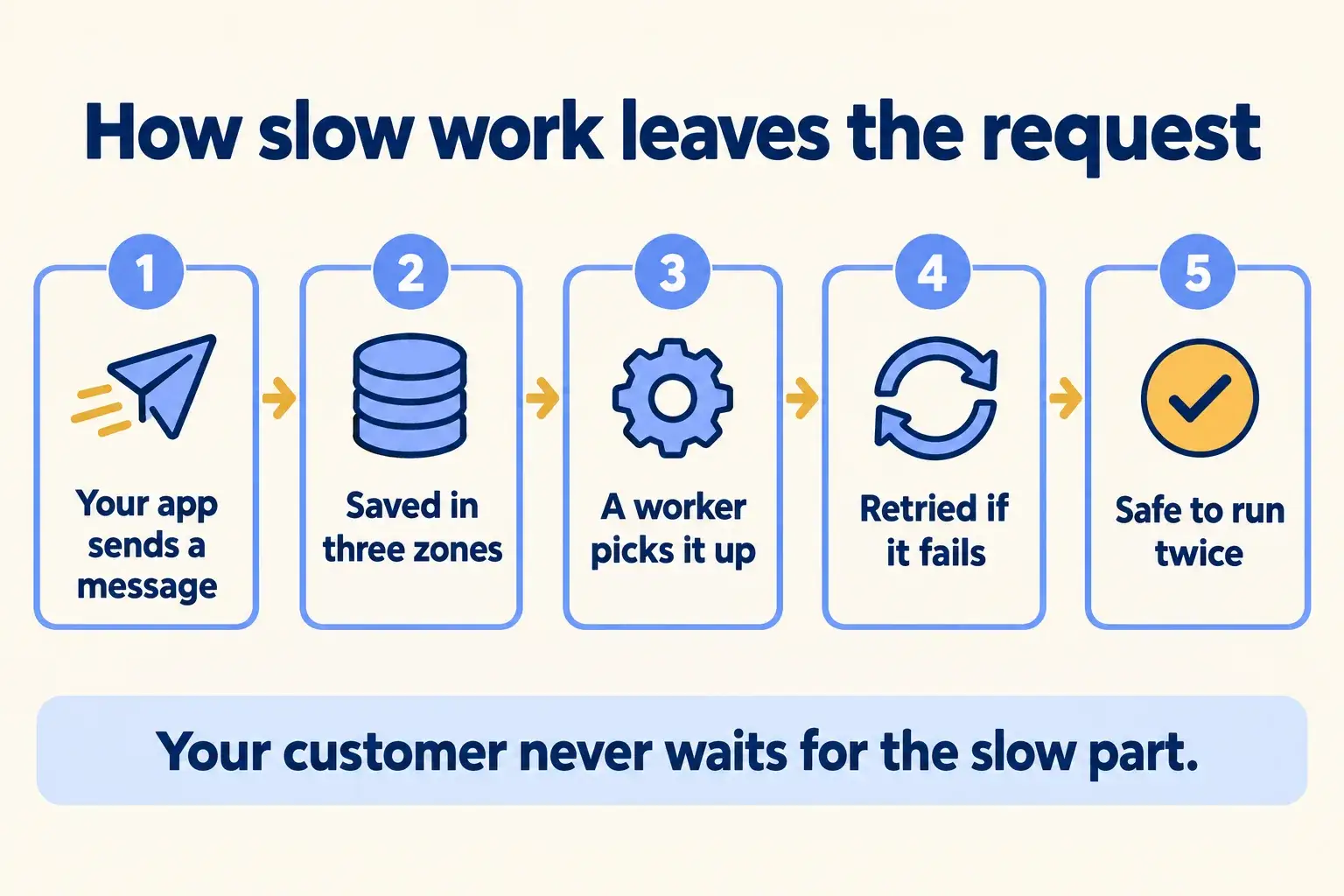
Five steps. The customer gets an answer at step one, and the slow work carries on without them.

Five steps: your app sends a message, it is saved in three zones, a worker picks it up, it retries on failure, safe to run twice.

Infographic

The same steps are written out below.

Step by step

What happens at each step.

  1. Send

    Your app sends a message

    To a topic, with an optional delay, and answers the customer at once.

  2. Store

    Saved in three zones

    The send call returns only after three availability zones have the message.

  3. Pick up

    A worker picks it up

    Pushed to a Vercel Function, or pulled by a worker running anywhere.

  4. Retry

    Retried if it fails

    If Salesforce or WhatsApp is slow, the message comes back and runs again.

  5. Check

    Safe to run twice

    The worker checks an ID first, so a repeat delivery does no harm.

How it fits together

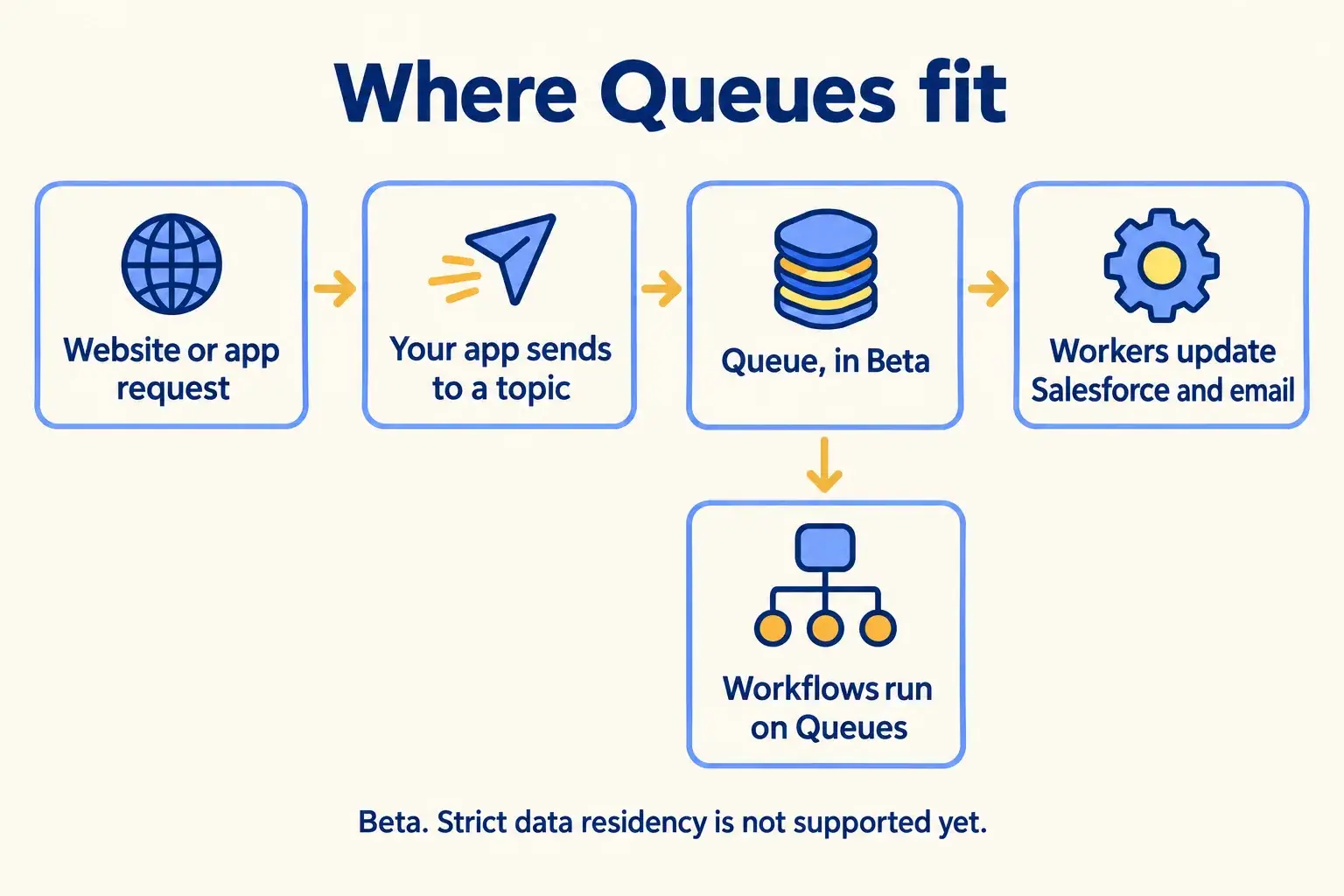
Where the queue sits between your app and your slow systems.

A request comes in from your website or app. The app sends the job to a topic and answers. Workers update Salesforce, send emails and WhatsApp messages, and build PDFs. Vercel Workflows run on the same queues underneath.

A website request goes to a topic, into a Beta queue, and workers update Salesforce and email; Workflows run on Queues.

Infographic

Where it sits next to the systems you run today.

Use cases · worked examples

One worked example in each industry.

How Queues SDK fits into the work of the industries we serve, one step at a time.

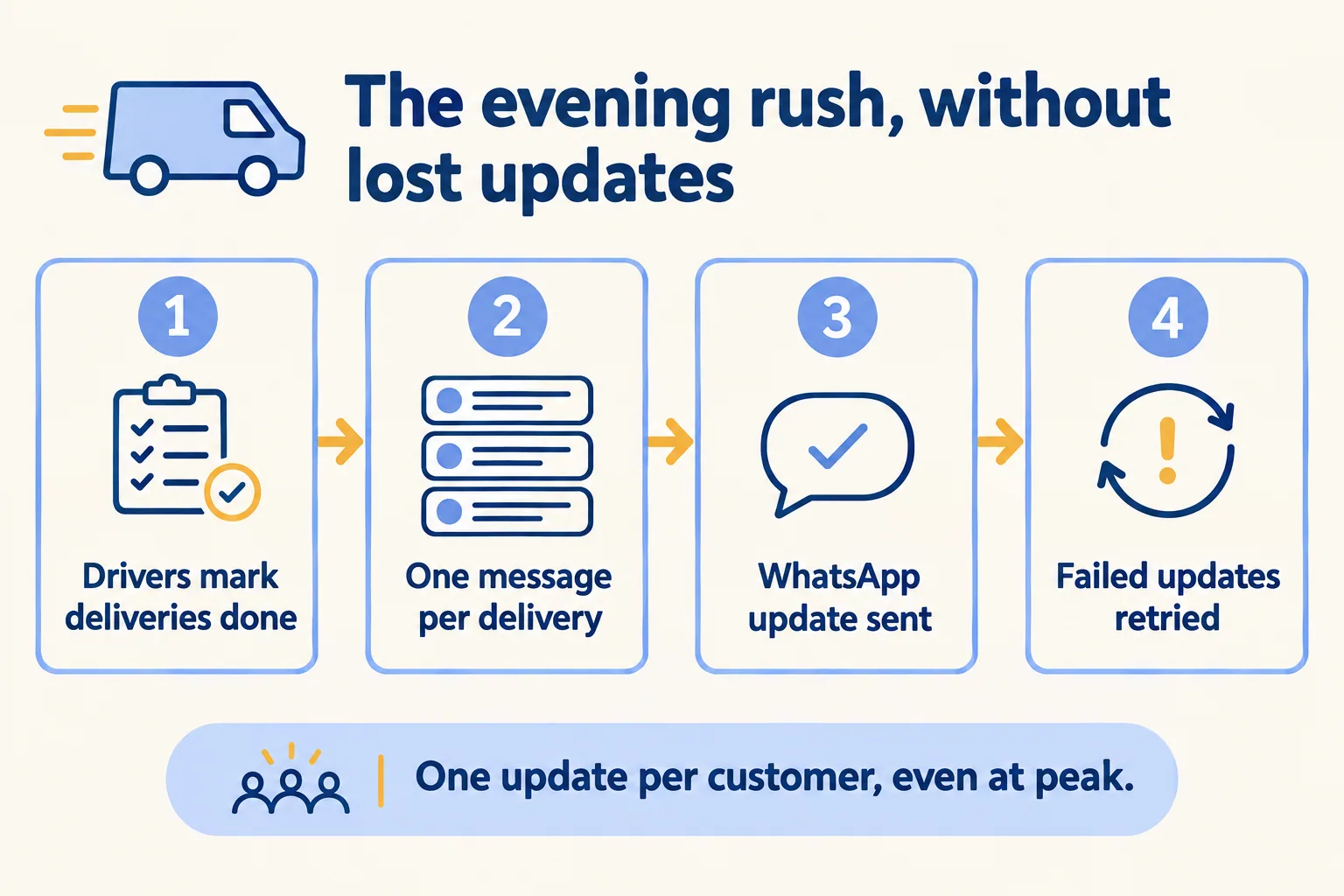
  1. Drivers mark deliveries done, one queue message per delivery, WhatsApp updates are sent and failed ones are retried.

    Example 1 · Couriers, Dubai · Infographic

    Operations lead at a Dubai courier company

    Today: At the end of the evening rush, drivers close hundreds of deliveries in minutes. Some customers never get the “delivered” message, and the hotline rings.

    After: Each closed delivery becomes one queue message. Workers send the WhatsApp update and write to Salesforce, and anything that fails is retried.

    Worked example, step by step

    1. 18:00Drivers. Mark deliveries done in the app as the rush ends.
    2. 18:00App. Sends one queue message per delivery and answers each driver at once.
    3. 18:01Worker. Sends the WhatsApp “delivered” message to each customer.
    4. 18:02Worker. Some Salesforce updates time out. Those messages go back on the queue.
    5. 18:06Worker. Retries succeed. The worker checks each delivery ID, so no customer gets two messages.

    Every customer gets one “delivered” message, even on the busiest evening.

    Couriers and delivery
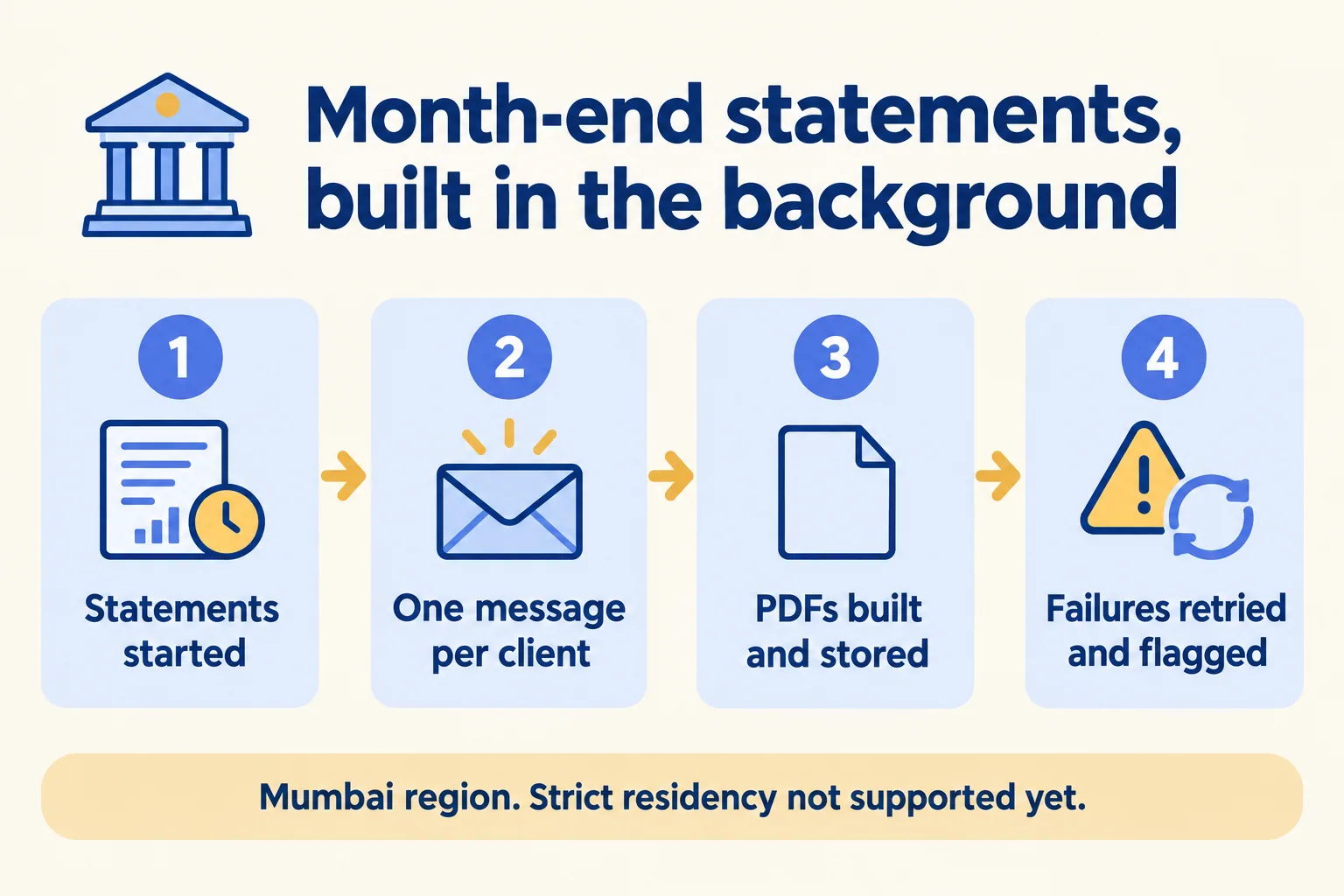
  2. Month-end statements start, one queue message per client, PDFs are built and stored, failures are retried and flagged.

    Example 2 · Financial services, Mumbai · Infographic

    Operations head at a Mumbai wealth advisory firm

    Today: Month-end statements are built one by one while the screen waits. The page times out halfway and nobody knows which clients got theirs.

    After: Starting the run sends one message per client, in the Mumbai region. Workers build each PDF in the background and flag any that keep failing.

    Worked example, step by step

    1. 1st, 07:00Operations head. Starts the month-end statement run.
    2. 07:00App. Sends one message per client to the statements topic in the Mumbai region.
    3. 07:01Workers. Build each PDF and store it.
    4. 07:15Worker. One statement fails on a missing field. It retries, then alerts the team.
    5. 07:40Analyst. Fixes the field. The statement builds on the next try.
    6. 09:00Advisors. Send statements to clients from Salesforce.

    Every statement is built, and the one that failed is known by name, not found by a client.

    Financial services
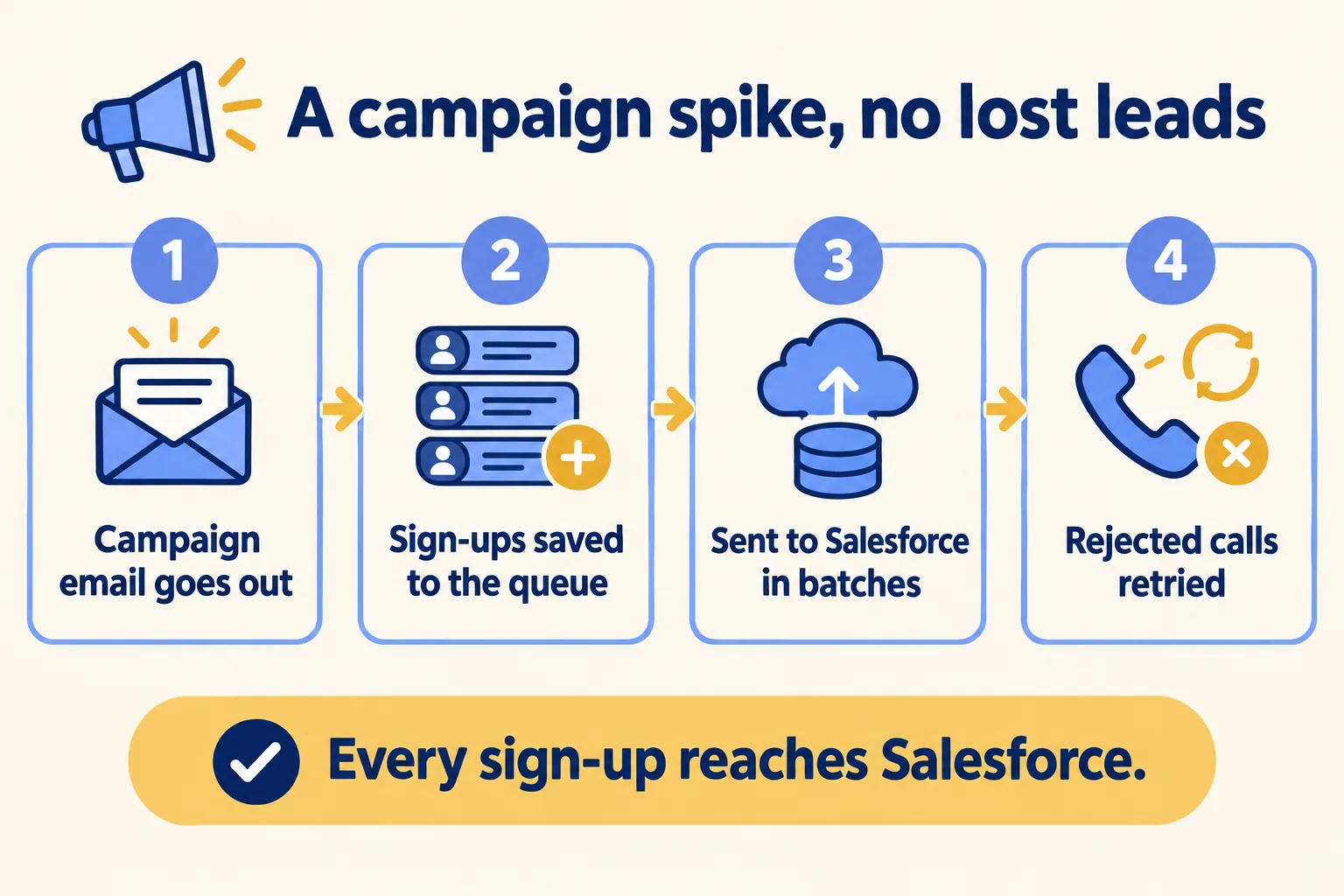
  3. A campaign email brings sign-ups, each is saved to the queue, sent to Salesforce in batches, and rejected calls are retried.

    Example 3 · Marketing agency, Chicago · Infographic

    Account director at a Chicago marketing agency

    Today: A client’s campaign email brings a burst of sign-ups. The client’s Salesforce rejects calls once it hits its API limit, and leads are lost.

    After: Each sign-up is saved as a queue message and the visitor is thanked at once. Workers send leads to Salesforce in small batches and retry the ones it rejects.

    Worked example, step by step

    1. 12:00Client. Sends the campaign email to its list.
    2. 12:01Website. Saves each sign-up as a queue message and thanks the visitor.
    3. 12:02Worker. Takes up to 10 messages at a time and sends them to Salesforce.
    4. 12:05Salesforce. Rejects a batch at its API limit. The worker retries it later.
    5. 12:40Account director. Sees every sign-up as a lead in the client’s Salesforce.

    The campaign spike reaches Salesforce in full, a little later instead of never.

    Marketing agencies
Examples of the work, not client stories. Times in each example show the order of events, not a measured result.

Is it for you

When Queues SDK fits, and when it doesn’t.

Good fit

Not for you yet

Customers wait while emails, PDFs or API calls run
You need strict in-region data residency: not supported yet
Busy hours bring bursts of work
You need exactly-once delivery or strict order
A failed update must be retried, not lost
You cannot use a Beta product in production
You accept a Beta product with a written fallback
The work is quick and never fails

What Mindcat does

We build it, then we run it.

The assessment is free: a short read of the org and a written note. If you go ahead, the first build week is a fixed AED/SAR 14,900 (about USD 4,050), credited in full when you sign the build within 60 days. After go-live, we keep it patched, watched and changing every month.

FAQ

What teams ask about Queues SDK.

Is Vercel Queues ready for production?
Vercel labels it Beta, available on all plans. We use it where a short delay or a retry is acceptable, and we write down a fallback before go-live.
Will a customer ever get a message twice?
The queue can deliver a message more than once. We write each worker to check an ID first, so a second delivery does nothing.
Can the data stay in India or the UAE?
Vercel has no region in the UAE or Saudi Arabia. Mumbai is one of the 19 regions and you can choose it, but strict data residency is not supported yet: in an outage, messages may sit in a nearby region for a while. We confirm this with your compliance team before you sign.
How is it priced?
Per operation: send, receive, delete and a few others, counted in 4 KiB chunks, with regional prices. As of 16 October 2026, Hobby includes the first 1,000,000 operations, but Hobby is for non-commercial use only.
How is this different from Workflows?
Queues is the lower-level piece that Vercel Workflows run on. A queue suits one job at a time; a workflow suits a process with several steps and waits.


Sources

Where these facts come from.

Start here

Tell us what you want built, and where it runs today.

One or two lines is enough. You hear back within 24 hours from the person who signs the work.

Salesforce consulting partner since 2010 · MVP Hall of Fame · 200+ agents in production · UAE, India and US desks