

A developer and a project manager in a Kochi office tick off new client sites set up from a script.

Vercel · SDKs

Every new site takes a day of clicking, and one key is always wrong. Set it up from a script instead.

A new launch site, a new client, a new branch page. Today someone clicks through the same screens, copies keys from a note and hopes nothing is missed. With the Vercel SDK, a script creates the project, adds the keys and attaches the domain. It runs the same way for the tenth site as for the first.

Salesforce consulting partner since 2010 · MVP Hall of Fame · 200+ agents in production · UAE, India and US desks

The problem

Where setting up sites goes wrong today.

What Vercel SDK is

Vercel SDK, in plain words.

Facts from Vercel’s own pages, checked on 16 October 2026. The sources are at the end of this page.

What it is
A type-safe TypeScript SDK for the Vercel REST API, installed as @vercel/sdk.
How it signs in
With a Vercel access token for the right team.
What it reaches
About 40 groups of endpoints, including projects, deployments, domains, environment variables, feature flags and AI Gateway budgets.
Shared keys
Team-wide shared environment variables can be listed, created and updated from code.
Plan limits
Some endpoints need a paid plan. A 403 error means an expired token, the wrong team or a feature your plan does not include.
Language
Vercel documents the SDK for TypeScript only.

How it works

From a request to a site that is set up right.

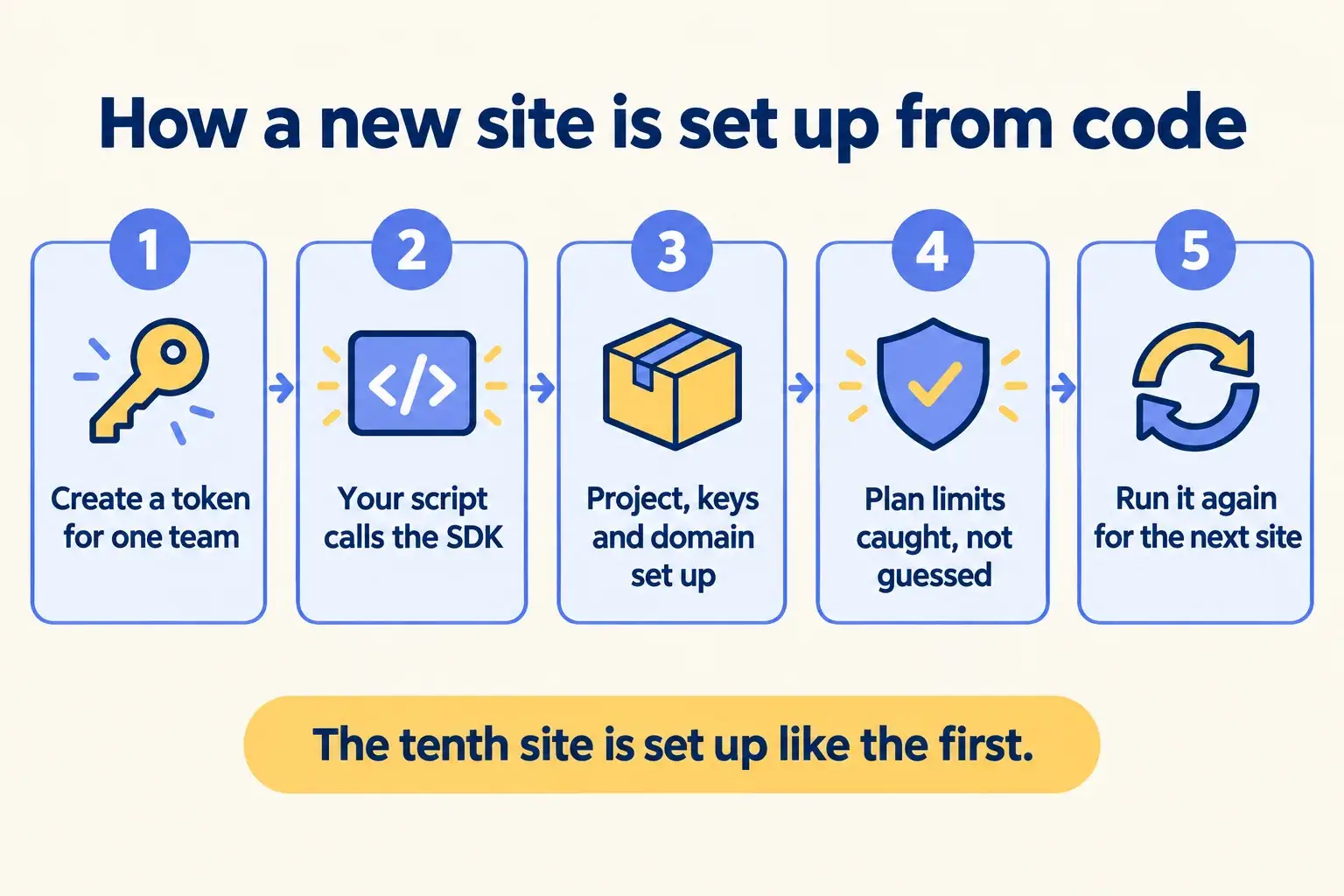
Five steps. The setup lives in a script your team can read, so the next site is set up the same way.

Five steps: create a team token, the script calls the SDK, project and keys are set up, plan limits are caught, run it again.

Infographic

The same steps are written out below.

Step by step

What happens at each step.

  1. Token

    Create a token for one team

    Scoped to the team that owns the sites, kept as a secret, never in the code.

  2. Script

    Your script calls the SDK

    The script is in Git, so anyone can read what it does.

  3. Set up

    Project, keys and domain set up

    It creates the project, adds the environment variables and attaches the domain.

  4. Check

    Plan limits caught, not guessed

    A 403 from a feature your plan lacks stops the script with a clear message.

  5. Repeat

    Run it again for the next site

    Same steps, same keys, same checks, every time.

How it fits together

Where the SDK sits between your team and your sites.

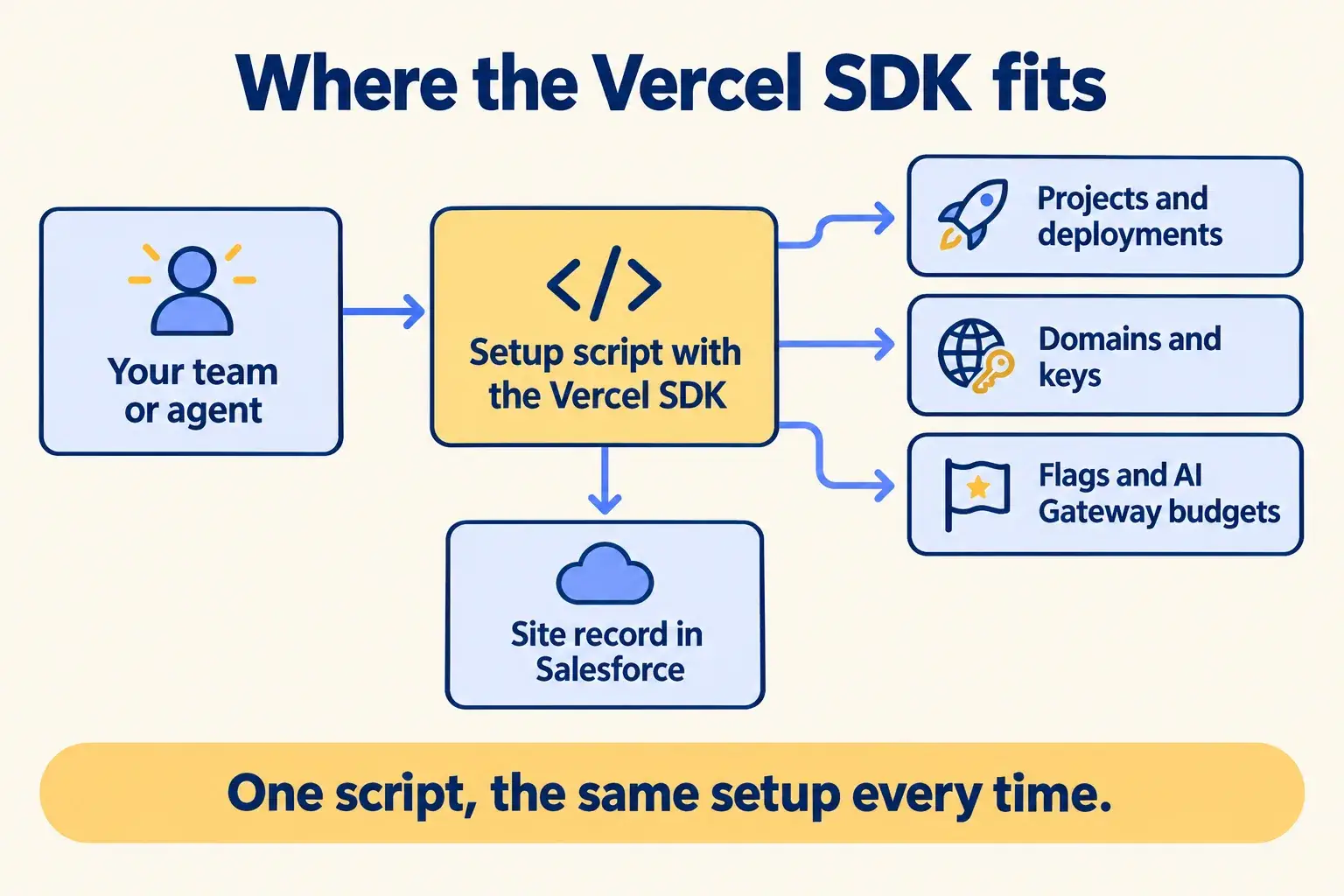
Your team or an agent runs the script. The SDK talks to Vercel projects, domains, keys and flags. A record of each site can sit in Salesforce, so account managers know what was set up for whom.

Your team runs a setup script using the Vercel SDK, which sets up projects, domains, keys and flags, with a site record in Salesforce.

Infographic

Where it sits next to the systems you run today.

Use cases · worked examples

One worked example in each industry.

How Vercel SDK fits into the work of the industries we serve, one step at a time.

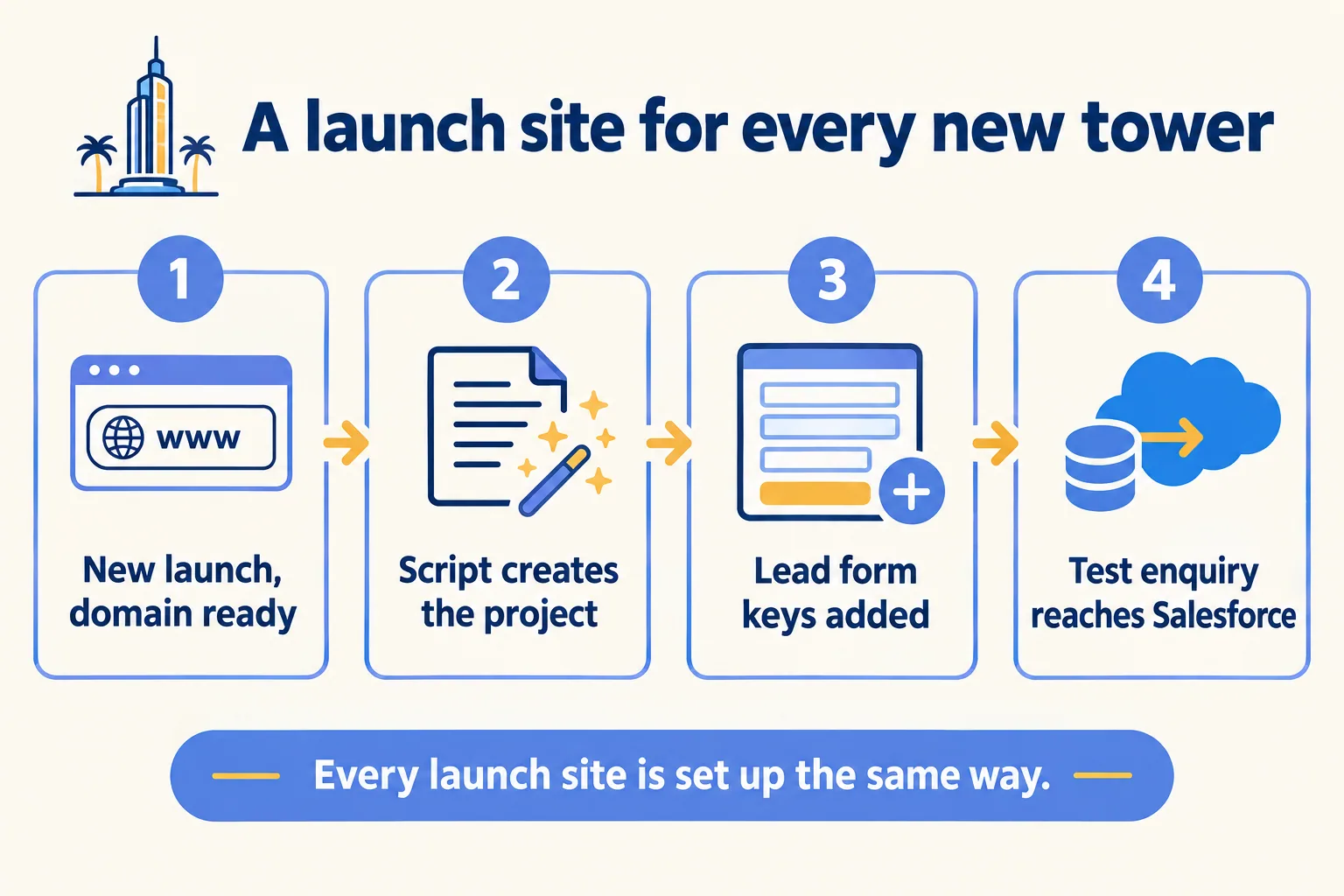
  1. A new tower launch site is created by a script, gets its lead form keys, and a test enquiry reaches Salesforce.

    Example 1 · Real estate, Dubai · Infographic

    Marketing manager at a Dubai off-plan brokerage

    Today: Each new tower launch gets its own site. Setting one up takes the developer most of a day, and last time the lead form pointed at the wrong Salesforce key.

    After: One script creates the project from the launch template, adds the Salesforce form keys and attaches the domain the brokerage bought elsewhere.

    Worked example, step by step

    1. 09:00Marketing manager. Asks for a site for the new tower. The domain is already bought.
    2. 09:10Developer. Runs the setup script with the project name and the domain.
    3. 09:11Vercel SDK. Creates the project and links it to the launch template repository.
    4. 09:12Vercel SDK. Adds the environment variables for the Salesforce lead form.
    5. 09:13Vercel SDK. Adds the domain to the project and lists the DNS records the registrar needs.
    6. 09:40Marketing manager. Opens the preview and sends a test enquiry. It arrives in Salesforce as a test lead.

    The launch site starts with the right keys and form, set up the same way as the last one.

    Real estate brokers
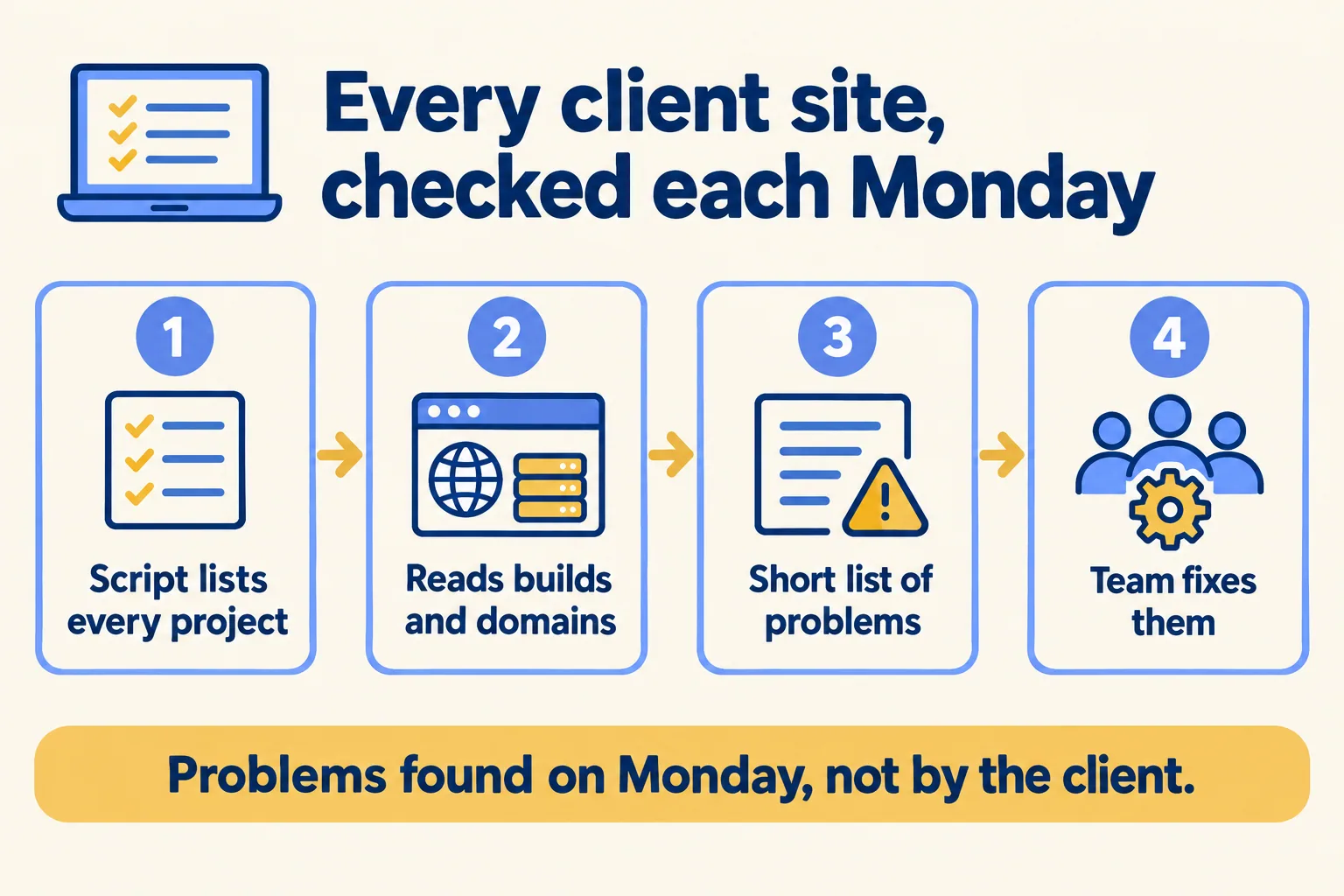
  2. A Monday script lists every client project, reads builds and domains, and gives the team a short list to fix.

    Example 2 · Digital agency, Bengaluru · Infographic

    Delivery lead at a Bengaluru digital agency

    Today: The agency runs dozens of client sites. A client is usually the first to say a build failed or a new domain never went live.

    After: A script runs every Monday. It lists each project, reads its latest deployment and domains, and sends the delivery lead a short list of what needs fixing.

    Worked example, step by step

    1. Mon 08:00Script. Lists every project in the agency’s Vercel team.
    2. Mon 08:01Script. Reads each project’s latest deployment and its domains.
    3. Mon 08:02Script. Sends the delivery lead two failed builds and one domain that was never connected.
    4. Mon 09:00Delivery lead. Assigns each fix in the team’s tracker.
    5. Mon 11:30Developer. Fixes the builds and connects the domain. The next Monday list is clean.

    The agency finds broken client sites on Monday morning, before any client does.

    Digital agencies
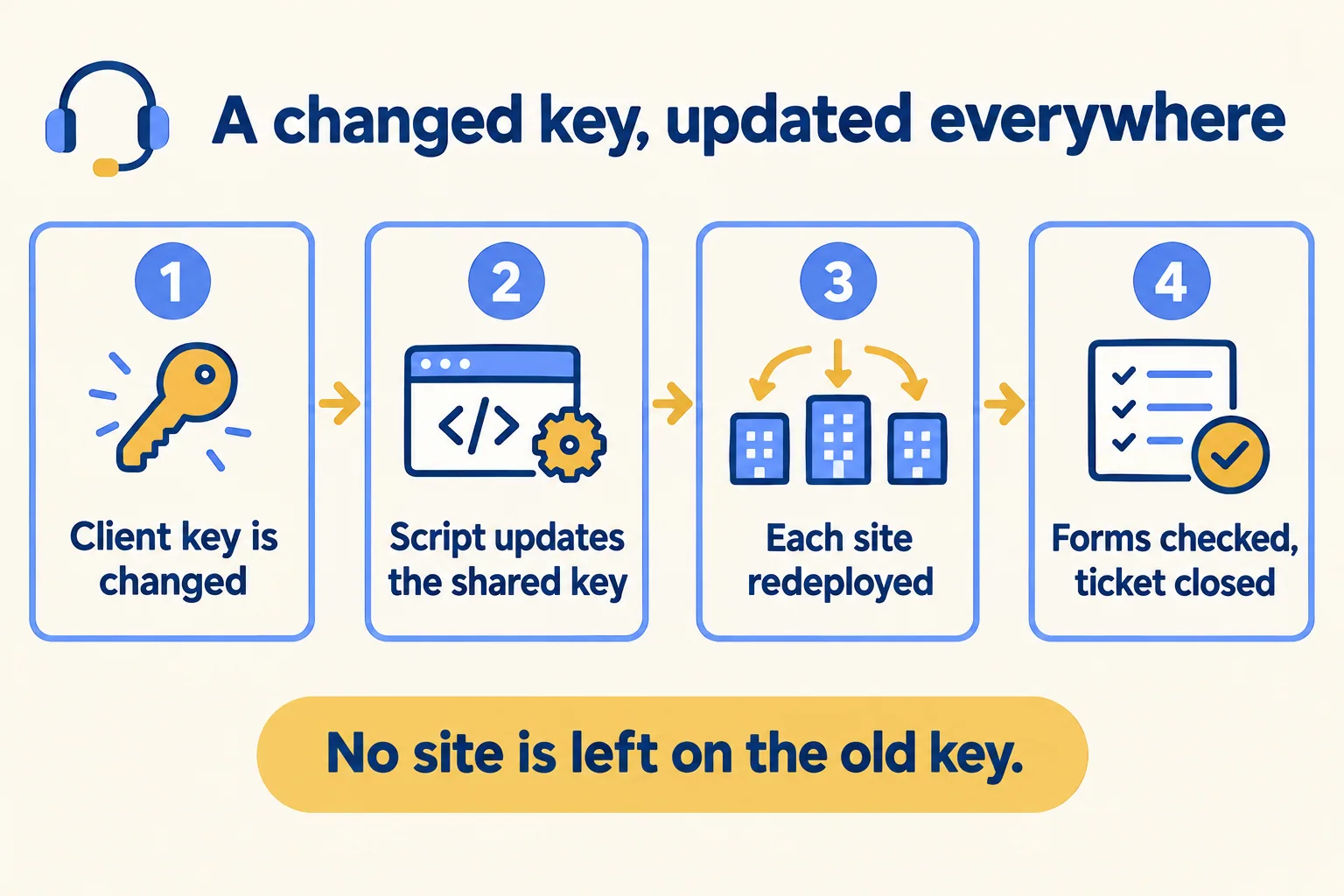
  3. A changed client key is updated once as a shared key, each site is redeployed, and the forms are checked.

    Example 3 · IT service desk, Austin · Infographic

    Service desk manager at an Austin IT support company

    Today: A client changes its CRM key after a staff change. Three of the client’s sites use that key, and last time one kept the old key for a week.

    After: The key lives as one shared environment variable for the team. A script updates it once and redeploys every site that uses it.

    Worked example, step by step

    1. 10:00Client. Raises a ticket: the CRM key has changed.
    2. 10:05Engineer. Runs the key update script with the new key.
    3. 10:06Vercel SDK. Updates the shared environment variable linked to the client’s three projects.
    4. 10:07Vercel SDK. Starts a new production deployment of each project so the new key is used.
    5. 10:25Service desk manager. Sends a test form from each site, sees it reach the CRM, and closes the ticket.

    Every site moves to the new key in one pass, and the ticket closes the same morning.

    IT service desks
Examples of the work, not client stories. Times in each example show the order of events, not a measured result.

Is it for you

When Vercel SDK fits, and when it doesn’t.

Good fit

Not for you yet

You set up new sites or client projects often
You run one site and change it twice a year
Several sites share keys that change
You expect every endpoint on every plan: some need Pro or Enterprise
You want one list of what is live and what is broken
You need the SDK in another language: Vercel documents TypeScript only
Your team reads TypeScript, or we write it for you
Nobody will own the script once it is written

What Mindcat does

We build it, then we run it.

The assessment is free: a short read of the org and a written note. If you go ahead, the first build week is a fixed AED/SAR 14,900 (about USD 4,050), credited in full when you sign the build within 60 days. After go-live, we keep it patched, watched and changing every month.

FAQ

What teams ask about Vercel SDK.

Does the Vercel SDK cost anything?
Vercel lists no price for the SDK itself. What it creates is billed under your plan as usual, and some features it can reach need Pro or Enterprise.
Can it register a .ae or .in domain?
Not through Vercel today. Vercel’s list of supported domain endings does not include .ae or .in. You can buy the domain elsewhere and the script adds it to the project.
Why did a call fail with a 403?
Vercel names three causes: an expired token, a token for the wrong team, or a feature your plan does not include, such as Access Groups on Enterprise. We build the script to say which one.
Is this the same as the Vercel MCP server?
No. The SDK is a library your code calls, and Vercel lists the Vercel MCP server as a separate tool. We use the SDK for setup that must run the same way every time.
Who keeps the token?
You do. It lives as a secret in your own systems, scoped to one team. We set a date to replace it and write down who can create a new one.

Sources

Where these facts come from.

Start here

Tell us what you want built, and where it runs today.

One or two lines is enough. You hear back within 24 hours from the person who signs the work.

Salesforce consulting partner since 2010 · MVP Hall of Fame · 200+ agents in production · UAE, India and US desks