

If your partner leaves the week you go live and change requests pile up, this is for you. The question is who runs the org from here: an admin you hire, a partner on retainer, or nobody. This is not for you if an admin already owns your releases. If you have no admin at all, read on: you still need one named owner, and the sections below say how small that role can be.
What does an unowned org cost after go-live?
Dated work that lands on nobody. Most plans stop at go-live. Atypical Tech, an ERP consultancy, describes the pattern: "The implementation partner's contract ends, the project team disbands, and support quietly becomes the responsibility of whichever internal person happened to be most involved during the project." That is an ERP firm describing ERP projects, but the handover gap is the same one.
Salesforce gives you a concrete example this autumn. Its Winter '27 architect highlights list authentication changes with dates. From 4 November 2026, production refresh tokens expire after 30 days of inactivity, which "may break low-frequency integrations." The OAuth 2.0 device flow is restricted from 30 November 2026. The username-password, user-agent and hybrid user-agent flows are retired on 20 February 2027. Salesforce's advice is to inventory the authentication pattern each integration uses and migrate in order of enforcement date.
Dated Salesforce authentication changes
4 Nov 2026
Production refresh tokens expire after 30 days idle
30 Nov 2026
OAuth 2.0 device flow restricted
20 Feb 2027
Username-password, user-agent and hybrid flows retired
Someone has to be given that list. If no one is, the first notice is an integration that stops. That is the test of who owns your org.
Does your Salesforce plan do the change work?
No, and it assumes you have someone who does. Under Salesforce's Premier and Signature Success terms, you must "identify and maintain at least one (1) Designated Contact." That person must have completed, at a minimum, the Admin Beginner trail on Trailhead, and oversees your support cases.
The legacy Premier+ option adds Admin Assist, where Salesforce administrators work from your design specifications. The same terms exclude from Admin Assist "flows, AppExchange installs/uninstalls/customization, VLOOKUPs and custom code," along with data cleansing, merging and de-duping. Your own plan may differ, so read your order form.
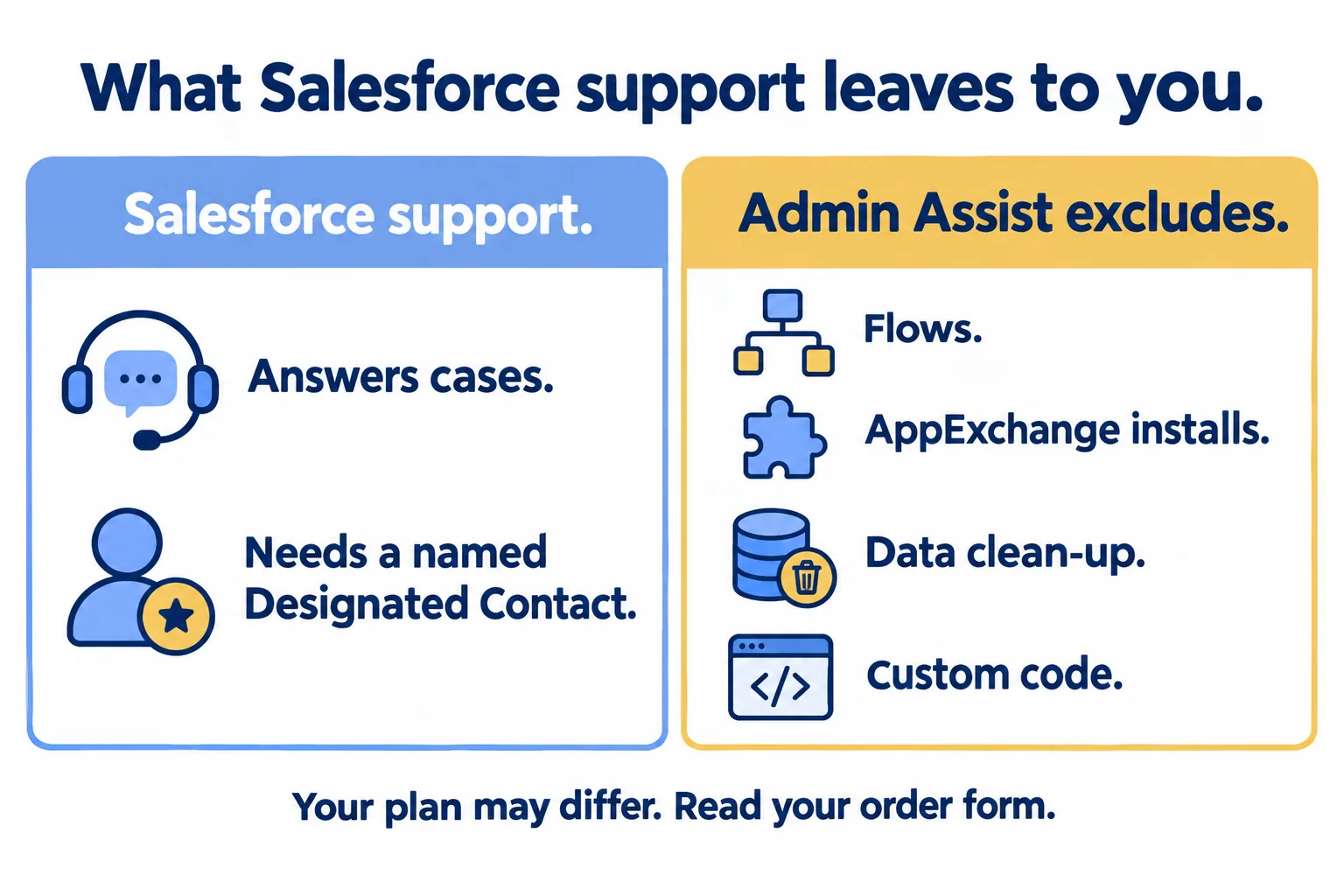
So "nobody" cannot mean that no one on your side touches the org. Salesforce's support starts with a named person on your side, and it leaves out the work that usually fills the queue.
How do you count the work before you choose?
Pull every change request from the last 90 days: tickets, emails, chat messages and hallway asks. If you went live last week, there is no history yet, so use the open defect list, the pre-launch backlog and the phase 2 wishlist, count four weeks, and multiply by three as a rough start. Write one line each, with an hour estimate from whoever would do the work. Add the recurring jobs nobody logs, such as user setup, release checks and the monthly report that breaks. Then compare the monthly average to one admin's month. We assume a 160-hour working month, so half is about 80 hours.
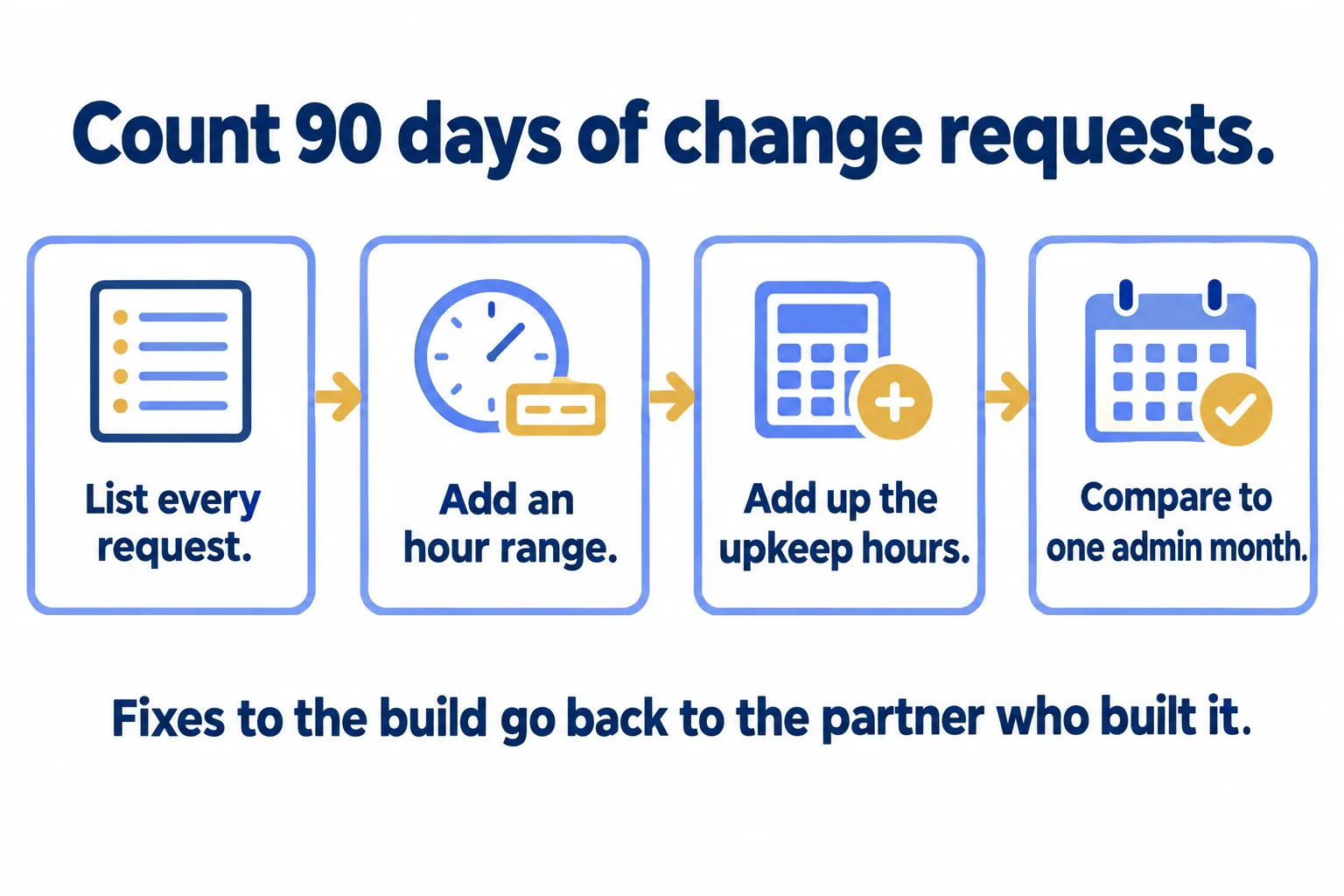
Two cautions. Estimates are rough, so keep a range and not a single number. And mark which requests are fixes to the build. Those belong to the partner who built it, and a retainer is the wrong place to absorb them.
If that partner has already gone, send one written request this week. Ask for the admin logins and sandboxes they hold, the design and configuration documents, the list of open defects, and a date for handing everything over. Then read your contract for any defect or warranty period. We do not know what yours says, and we do not give legal advice. Anything they will not fix is a cost to count in your own list.
Which option fits your count?
TechParrot, a managed services vendor, puts it this way: "Below roughly half an administrator's workload, a retainer wins on both cost and skill coverage. Above about one full administrator's workload, hiring wins and keeps winning." Its middle band is "a genuine judgement call." That is a vendor's rule of thumb, not a study, but it matches how we would sort it. Add the owner rule on top.
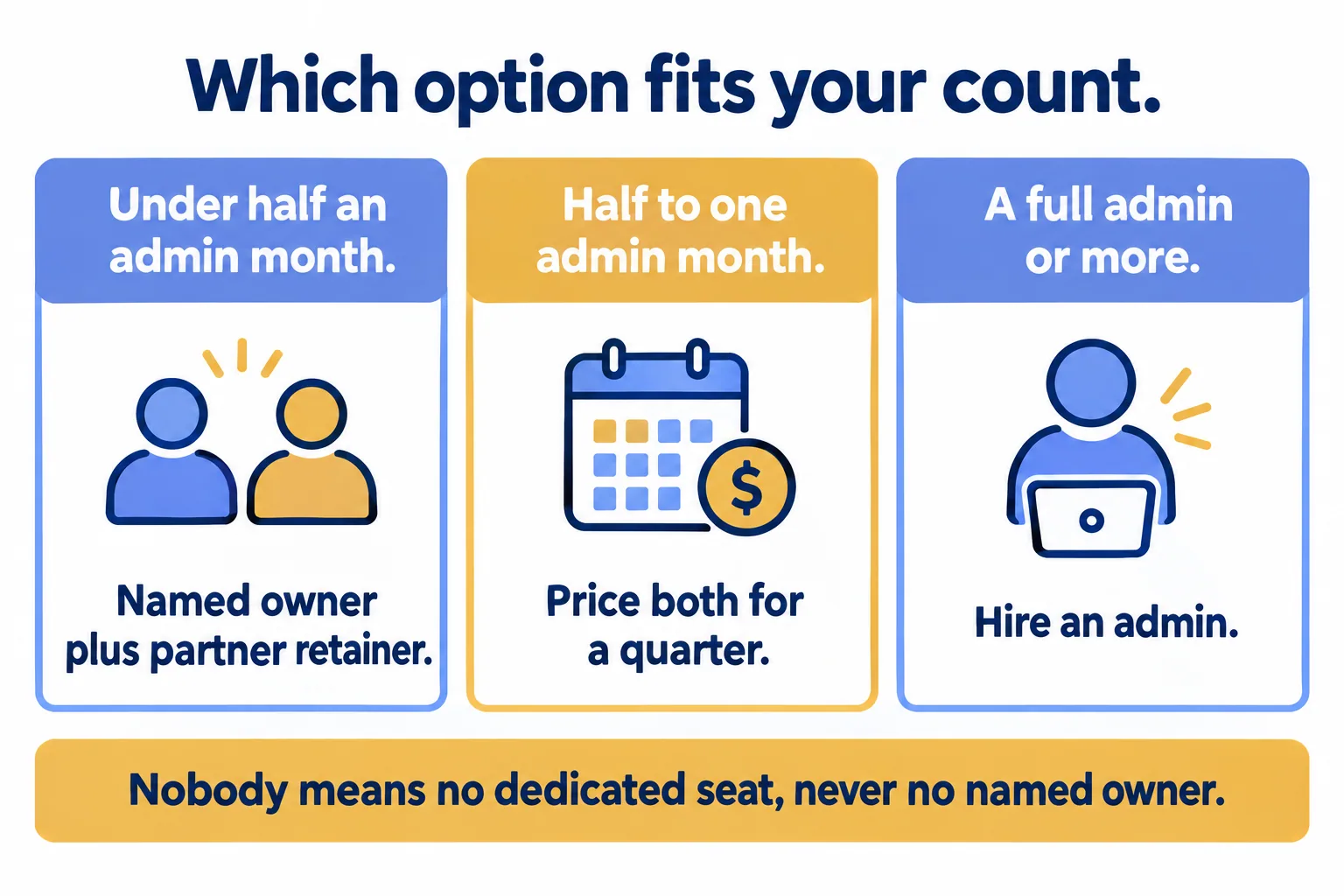
The last row is the only version of "nobody" we would accept. A small org can go without a dedicated admin. It cannot go without someone who answers for it.
A worked sum, on the vendors' own figures (sourced in the next section) and not ours: 30 hours a month at $175 to $275 an hour is $5,250 to $8,250 a month. A hire at $80,000 to $120,000 a year is $6,667 to $10,000 a month in salary alone, before benefits and management time. At 30 hours the two ranges overlap, so price is not the deciding factor, and cover when one admin is away is. Run's own rate, from the page's prices, works out to about USD 235, 216 and 210 an hour for Run 8, Run 20 and Run 40 (our arithmetic). That sits inside the $175 to $275 range and not below it. At 100 hours a month the sum flips, because the retainer side grows and the salary does not.
What do the published prices tell you?
Less than they seem to, because the people who publish them sell one of the options. TrueSolv, a firm that sells this work, puts a senior in-house admin at $80,000 to $120,000 a year in salary plus benefits, and a senior consultant at a partner firm at $175 to $275 an hour. Neither figure is ours, and your market may differ.
What the figures leave out is the cost of the queue. A request that waits has a cost, and so does an integration that stops on 4 November because no one read the list. Compare options on your own 90-day count, then add what the waiting cost you, in lost deals or hours redone. If you cannot put a number on that, say so in the decision note instead of guessing one.
When are we the wrong answer?
When you want a full-time person inside your team, or when your request count already fills an admin's month. Hire in that case. We will say so.
Our Run plan is for teams already live on Salesforce, with a named admin on your side. If your owner is a business lead who does not administer Salesforce, we cannot promise it fits, so ask us before you buy. It comes in three sizes: Run 8, Run 20 and Run 40, which are 8, 20 and 40 hours a month, at AED/SAR 6,900, 15,900 and 30,900 a month (about USD 1,880, 4,330 and 8,415), excluding VAT. Each starts with three months, then runs monthly, with 30 days' notice and no exit fee, and unused hours roll over for one month (the plan and its terms). Match your upkeep hours to the size. If your count runs above 40 hours a month, the plan is too small, and a hire or a larger retainer is the better fit. It does not replace an owner, and it does not cover 24/7 on-call.
For managed services on Gulf or US desk hours (no 24/7 on-call), see our support page. If you are still choosing a partner, the consulting versus in-house comparison sets out the trade-offs, and this list of questions works as a hiring checklist for either route.
What would we do first?
We would count before we compared prices, and we would write the owner's name on the page. Five steps, none of which need us.
- 01List every change request from the last 90 days, one line each, with an hour range from whoever would do it.
- 02Mark which are fixes to the build, which belong to the partner who built it, and which are steady upkeep.
- 03Turn the upkeep into hours a month and compare it to one admin's month.
- 04Name the owner, even if the answer is a part-time seat. Give them the dated authentication list above.
- 05Write the decision and its reasons, then check it again after one quarter.
If the org itself is stuck, with duplicates or integrations that fail without a sound, read finish, cut or rebuild first. Who runs the org is the second decision.
If you would rather have the first read done for you, send us the org. The assessment is free: a short look and a written note on what is worth fixing. Before you send anything to any firm, us included, ask what access its read needs and whether it is read-only.
