
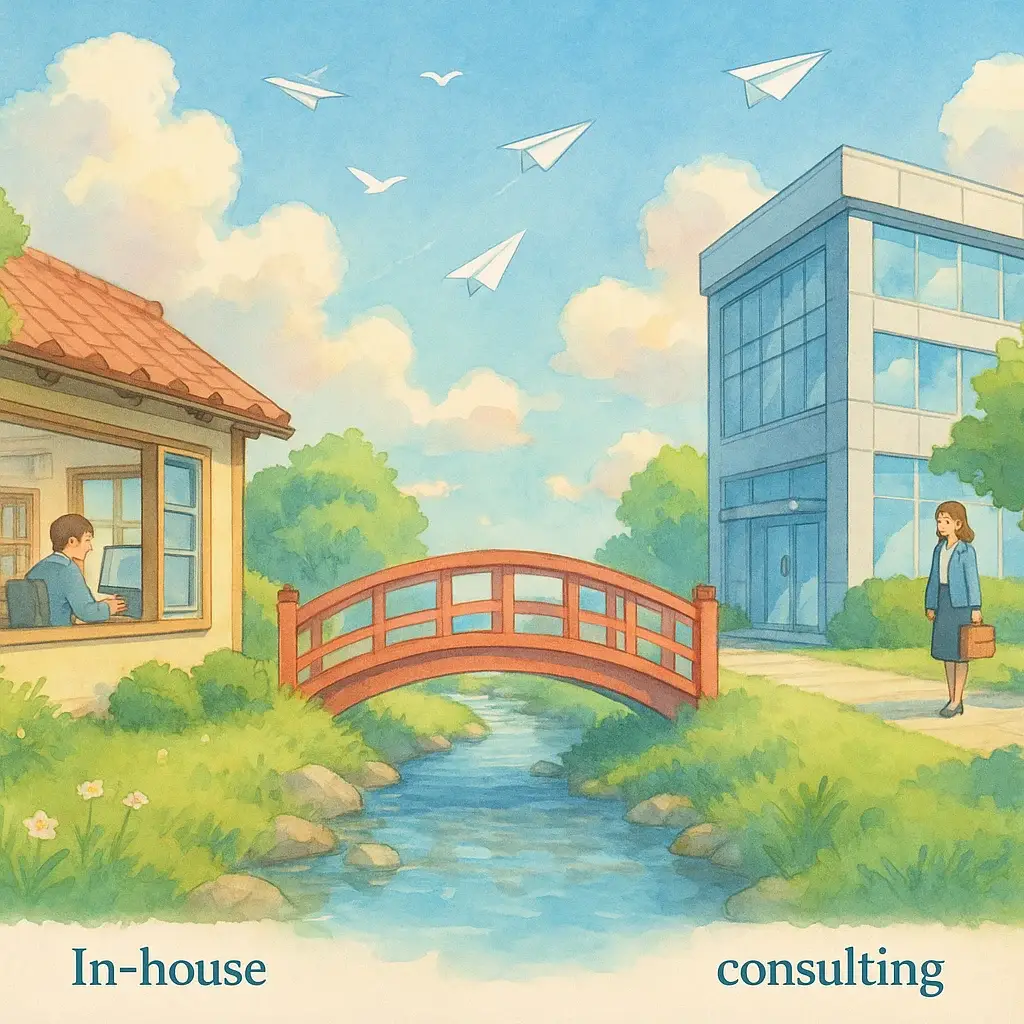
The Decision Nobody Gets to Defer
Every company adopting AI hits the same fork: hire people who build it, or hire people who already know how. For Salesforce, this question came up once in a company's life, maybe twice. For AI, it comes up with every new use case, because the skills behind a customer-service chatbot differ from the skills behind a fraud-detection model or a document-extraction pipeline.
Get the call wrong and the cost shows up later, not immediately. An in-house team with the wrong skill mix can spend a year before anyone admits the model does not work. A partner engagement with no transition plan leaves a department permanently dependent on outside help for routine maintenance. Neither failure announces itself early. Both are expensive.
Neither model wins in general. Below are the real costs of each path, the specific situations where one wins outright, and why most companies end up running a hybrid of the two.
Why AI Is a Harder Call Than CRM
Salesforce administrators and developers exist in large numbers, certifications are standardized, and the platform changes on three predictable release windows a year. None of that holds for AI.
Machine learning engineers and applied AI specialists remain scarce relative to demand. Job postings for senior AI/ML roles sit open longer than equivalent software engineering roles, and compensation for senior ML talent in major US markets sits well above standard senior-engineer bands. That gap shows up in UAE and India hiring markets too, at different absolute numbers but the same relative premium.
The field also moves on a different clock. A model architecture or deployment pattern that looked standard in 2024 can be a legacy choice by 2026. An in-house team that commits to one foundation model, one orchestration framework, one deployment pattern, and one evaluation approach locks in assumptions that may not survive two product cycles. A partner working across model providers and frameworks for several clients absorbs that churn between engagements rather than mid-deployment.
AI implementation also demands two skill sets at once: software engineering and statistical judgment. Knowing a model is wrong takes a different instinct than knowing code threw an error. The tooling layer is younger too. Orchestration frameworks, evaluation harnesses, guardrail libraries, and fine-tuning toolkits reshape themselves every few months, in a way Salesforce's release cycle never did.
The scarcity also changes who holds the advantage in a hiring negotiation. A Salesforce administrator candidate competes against dozens of similar candidates for one role. A candidate with two years of production LLM experience fields competing offers from several companies at once, and can walk from a slow hiring process without much cost. That dynamic stretches timelines and pushes compensation further than most internal hiring budgets anticipate going in.
The Real Cost of an In-House AI Team
Hiring a senior ML engineer or applied AI specialist takes longer than hiring a senior software engineer. Time-to-hire for specialized AI roles stretches past 90 days once sourcing, technical screening, and competing offers from better-funded companies enter the picture. A small core team, an architect, a senior engineer, an MLOps specialist, and a product owner to define requirements, can take two full quarters to assemble.
Compensation reflects the scarcity. Senior ML and AI engineering talent in major US markets commands total compensation packages well above equivalent backend or full-stack roles. Add recruiting fees and the months of productivity ramp before a new hire ships anything in production, and the first year of an in-house team costs more than its salary line suggests.
The bet that compounds: the most expensive in-house mistake is not a bad hire. It is a correct hire who makes one early architectural call, a model provider, a vector database, a fine-tuning approach, that looks reasonable at the time and becomes the wrong foundation eighteen months later. Replacing that foundation means rebuilding integrations and retraining the team on a new stack, all while explaining to leadership why the AI initiative needs a second budget cycle.
Retention carries its own risk once the team is assembled. A competitor or a better-funded startup can hire away the one engineer who understands the production system, mid-build, in a market where that engineer fields recruiter messages weekly. Losing a Salesforce admin sets a project back a few weeks. Losing the one person who understands an in-house model pipeline can set it back a quarter.
None of this argues against building in-house. It means the true cost of that path includes the hiring timeline, the compensation premium, the onboarding ramp, and the risk premium of a team making first-time architectural decisions in a field with few settled best practices.
The Real Cost of an AI Partner
A partner removes the hiring problem. The team that builds your deployment already has the experience your company would otherwise spend a year acquiring, and that team starts on day one instead of after a hiring cycle. For a single project with a defined scope, this path reaches a working system faster and at a lower upfront cost.
The cost shows up differently. Every partner engagement carries dependency risk: the people who understand why the system was built a certain way leave when the contract ends, unless the engagement is structured to prevent that. Documentation helps, but a handoff document written to close out a contract is a different artifact than the documentation an in-house team needs to run the system unsupervised.
Knowledge transfer has to be a deliverable, not an afterthought. That means architecture reviews with internal staff during the build, not after it, and a transition plan that names who owns the system once the partner leaves. Skip that step and the partner relationship becomes a permanent retainer, because nobody internal understands the system well enough to take it over.
Retainer costs follow the logic of any consulting relationship: ongoing support after launch costs less than the original build, but it never reaches zero unless ownership transfers in practice. Companies that treat a partner as a permanent extension of the team, rather than a bridge to internal capability, end up paying consulting rates for work a salaried hire could otherwise do.
Stack lock-in shows up too, in a different shape than vendor lock-in with a CRM. A partner builds toward the model providers, orchestration frameworks, deployment patterns, and evaluation methods they know best, which makes sense on its own. A system built deep inside one partner's preferred stack can be harder for a future in-house team, or a second partner, to take over without a rebuild. Ask any prospective partner how portable the system is before signing, not after.
Scenario by Scenario: Which Way to Go
Most build-vs-buy debates skip the step where you name the actual scenario. The right choice changes depending on what you are building and why.
| Situation | Better choice | Why |
|---|---|---|
| AI is the core product, not a support function | In-house | The differentiator has to live inside the company. Outside knowledge of how it works becomes a competitive liability sitting with a vendor. |
| One regulated-industry compliance project (a document-classification system for a healthcare or financial client, for example) | Partner | The project has a start and an end date. Specialists who have solved this exact compliance problem before exist, and a year-long hiring cycle for a single project does not pay back. |
| Ongoing automation across many small, low-risk use cases | Hybrid, partner-led at first | Volume favors a team with reusable patterns at the start, but a growing long tail of small requests justifies an internal owner over time. |
| Need production AI live in under 90 days | Partner | No in-house hiring cycle fits inside that window. A partner starts building on day one. |
| Data sensitivity rules out any third-party access to the underlying systems | In-house | Some regulatory or contractual constraints make external access a non-starter, regardless of cost or speed. |
| Sustained, multi-year AI roadmap with growing scope | In-house, with partner support for spikes | The economics of salaried staff beat consulting rates once the work turns continuous rather than project-shaped. |
The Hybrid Model
The scenario table above points at a pattern most companies land on without planning for it: a partner for the parts that benefit from outside experience, an internal team for the parts that benefit from proximity to the business.
In practice, the partner handles architecture decisions, model selection, governance frameworks, and the first production deployment. These are the areas where mistakes are expensive and experience across multiple clients and model providers helps. The in-house team takes over monitoring, prompt and model updates, cost optimization, and the steady stream of small feature requests that follow any AI system once people start using it. These are the areas where proximity to the business outweighs breadth of experience.
The handoff works only when it is built into the contract from the start, not negotiated after the partner has already delivered. Name which internal staff shadow the build, what documentation format they need, what a successful transition looks like, and who signs off on go-live readiness before the engagement begins. Companies that treat this as a late-stage afterthought tend to discover, six months after launch, that the partner relationship never ended.
A common version of this in practice: a partner builds an agentic support workflow and ships it to production in ten weeks. Two internal engineers shadow the build from week one, not just at the end, and inherit the monitoring dashboards, the prompt-update process, the model-routing logic, and the cost-tracking reports on day one of go-live. The partner stays on a reduced retainer for the first quarter to handle edge cases the internal team has not seen yet, then steps back. The company ends up with a system it owns and a team that built nothing from scratch, which is the point.
Where Mindcat Fits This Decision
Mindcat's Enterprise AI Deployment service is built around the path described above: architecture and governance work upfront, a working system in production, an internal team trained during the build, and a transition plan that hands operation to that team once the company is ready. That fits the partner side of the scenario table. It is not a substitute for building internal capability when the scenario calls for one.
For companies still weighing the decision, the choice does not have to be permanent. Starting with a partner does not rule out building an internal team later, and starting in-house does not rule out bringing in outside architecture review when a project hits unfamiliar regulatory or technical territory. The two models work in sequence more often than they work as a single permanent choice.
Whichever path fits today, the questions in the scenario table above are worth answering before signing a contract or posting a job listing. A wrong answer found early is recoverable. A wrong answer found eighteen months in is expensive.